-
卷积神经网络模型之——VGG-16网络结构与代码实现
VGGNet简介
VGG原文:Very deep convolutional networks for large-scale image recognition:https://arxiv.org/pdf/1409.1556.pdf

VGG在2014年由牛津大学Visual GeometryGroup提出,获得该年lmageNet竞赛中Localization Task(定位任务)第一名和 Classification Task (分类任务)第二名。VGG与AlexNet相比,它采用几个连续的3x3的卷积核代替AlexNet中的较大卷积核。
在VGG中,使用了3个3x3卷积核来代替7x7卷积核,使用了2个3x3卷积核来代替5*5卷积核,从而在保证具有相同感知野的条件下,提升了网络的深度,在一定程度上提升了神经网络的效果。

在论文中,作者尝试了使用5种不同的网络结构,深度分别为11,11,13,16,19,5种结构图如下所示:

其中最常用的是VGG16和VGG19,下面我们就以VGG16为例来分析它的网络结构。VGG16网络结构
VGG16中的16指的是它由16层组成(13个卷积层 + 3个全连接层,不包括池化层)。
VGG的输入图像大小为224X224X3的三通道彩色图像,共有1000个类别。
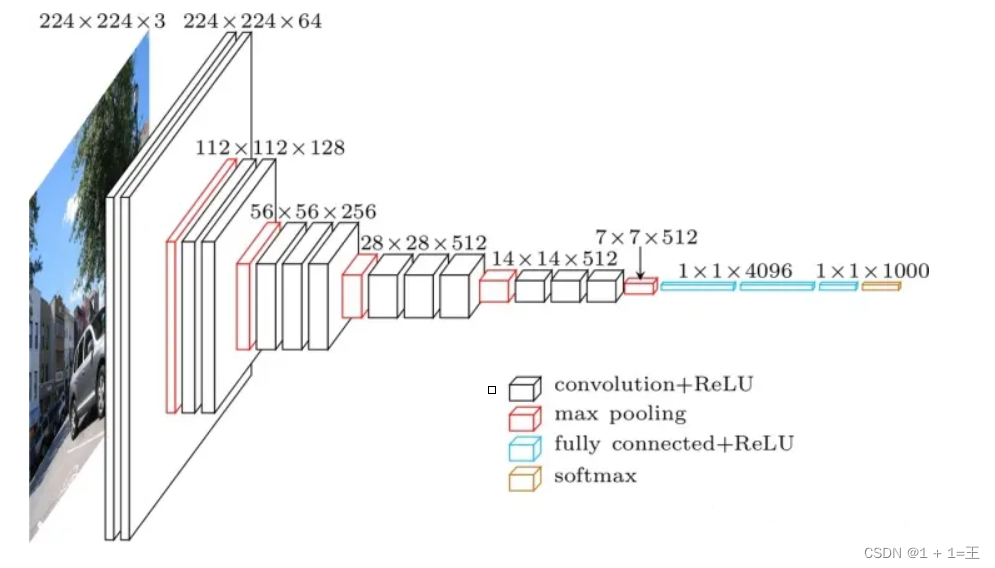
其中卷积层的卷积核大小都为3,padding为1;池化层的kernel_size为2,stride为2。因此
- 卷积层只改变特征图的通道数,不改变大小。(W - 3 + 2*1)/ 1 + 1 = W
- 池化层不改变特征图的通道数,大小变为原来的一半。
VGG具有明显的块结构,VGG可以分为如下六块:
- 两个卷积 + 一个池化:conv3-64+conv3-64 + maxpool
- 两个卷积 + 一个池化:conv3-128+conv3-128+ maxpool
- 三个卷积 + 一个池化:conv3-256+conv3-256+conv3-256+ maxpool
- 三个卷积 + 一个池化:conv3-512+conv3-512+conv3-512+ maxpool
- 三个卷积 + 一个池化:conv3-512+conv3-512+conv3-512+ maxpool
- 三个全连接:fc-4096 + fc-4096 + fc-1000(对应1000个类别)
使用pytorch搭建VGG16
为了便于理解,我们把正向传播过程分为两块,
- 一块为特征提取层(features),包括13个卷积层;
- 另一块为分类层(classify),包括3个全连接层。
features
def make_features(self): cfgs = [64, 64, 'MaxPool', 128, 128, 'MaxPool', 256, 256, 256, 'MaxPool', 512, 512, 512, 'MaxPool', 512, 512, 512, 'MaxPool'] layers = [] in_channel = 3 for cfg in cfgs: if cfg == "MaxPool": # 池化层 layers += [nn.MaxPool2d(kernel_size=2,stride=2)] else: layers += [nn.Conv2d(in_channels=in_channel,out_channels=cfg,kernel_size=3,padding=1)] layers += [nn.ReLU(True)] in_channel = cfg return nn.Sequential(*layers)- 1
- 2
- 3
- 4
- 5
- 6
- 7
- 8
- 9
- 10
- 11
- 12
- 13
- 14
classifier
【注意】:在进行全连接之前,需要现将卷积层输出的三维特征图展平为1维。
x = torch.flatten(x,start_dim=1)self.classifier = nn.Sequential( nn.Linear(512 * 7 * 7, 4096), nn.ReLU(True), nn.Dropout(p=0.5), nn.Linear(4096, 4096), nn.ReLU(True), nn.Dropout(p=0.5), nn.Linear(4096, 1000) )- 1
- 2
- 3
- 4
- 5
- 6
- 7
- 8
- 9
完整代码
""" #-*-coding:utf-8-*- # @author: wangyu a beginner programmer, striving to be the strongest. # @date: 2022/7/1 15:01 """ import torch import torch.nn as nn class VGG(nn.Module): def __init__(self): super(VGG, self).__init__() self.features = self.make_features() self.classifier = nn.Sequential( nn.Linear(512 * 7 * 7, 4096), nn.ReLU(True), nn.Dropout(p=0.5), nn.Linear(4096, 4096), nn.ReLU(True), nn.Dropout(p=0.5), nn.Linear(4096, 1000) ) def forward(self,x): x = self.features(x) x = torch.flatten(x,start_dim=1) x = self.classifier(x) return x def make_features(self): cfgs = [64, 64, 'MaxPool', 128, 128, 'MaxPool', 256, 256, 256, 'MaxPool', 512, 512, 512, 'MaxPool', 512, 512, 512, 'MaxPool'] layers = [] in_channel = 3 for cfg in cfgs: if cfg == "MaxPool": # 池化层 layers += [nn.MaxPool2d(kernel_size=2,stride=2)] else: layers += [nn.Conv2d(in_channels=in_channel,out_channels=cfg,kernel_size=3,padding=1)] layers += [nn.ReLU(True)] in_channel = cfg return nn.Sequential(*layers) net = VGG() print(net)- 1
- 2
- 3
- 4
- 5
- 6
- 7
- 8
- 9
- 10
- 11
- 12
- 13
- 14
- 15
- 16
- 17
- 18
- 19
- 20
- 21
- 22
- 23
- 24
- 25
- 26
- 27
- 28
- 29
- 30
- 31
- 32
- 33
- 34
- 35
- 36
- 37
- 38
- 39
- 40
- 41
- 42
- 43
- 44
- 45
- 46
- 47
- 48
- 49

-
相关阅读:
React 与 TS 结合使用时的技巧总结
国内离线安装 Chrome 扩展程序的方法总结
VMware——WindowServer2012R2安装jdk1.8及环境变量配置
含文档+PPT+源码等]精品基于springboot+mybatis的在线基金管理平台vue[包运行成功]
牛客多校赛2(找规律/根号分块 三维括号dp)
公司电脑如何限制安装软件
R语言ggplot2可视化:使用get_dim函数获取第一个图像的维度信息、使用set_dim函数设置第二个图像的维度、使得两个图像对齐
C++面试八股文:std::string是如何实现的?
环境安装篇 之 golang环境安装
docker
- 原文地址:https://blog.csdn.net/weixin_43598687/article/details/125566442
