-
gPRC入门笔记
This blog is about learning gRPC You are welcomed to chat about it and if you like this blog, do not forget to give me a like.- 1
- 2
Welcome to see my homepage and contact me: NicholasYe’s Homepage.
0. Before study
- All the information comes from gRPC website, and I strongly recommend you to read it by yourself.
1. Introduction
- An overview
- gRPC is a kind of tool which you can create a server and many client, while the server handle every call of the client and respond them.
- You can easily create your server in Java with client in Go, Python and so on, which is a huge advantage.
- gRPC use protocol buffers to transmit the message.
2. What is protocol buffers?
-
Introduction
- Protocol buffers provide a language-neutral, platform-neutral, extensible mechanism for serializing structured data in a forward-compatible and backward-compatible way.
- It’s like JSON, except it’s smaller and faster, and it generates native language bindings.
-
Workflow:
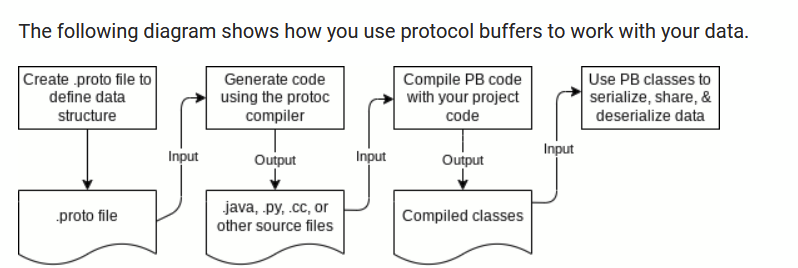
-
A very simple example
- In
.protodefinition, use Java to write down:message Person { optional string name = 1; optional int32 id = 2; optional string email = 3; }- 1
- 2
- 3
- 4
- 5
- After compiling this, you will get a
Builderclass:Person john = Person.newBuilder() .setId(1234) .setName("John Doe") .setEmail("jdoe@example.com") .build(); output = new FileOutputStream(args[0]); john.writeTo(output);- 1
- 2
- 3
- 4
- 5
- 6
- 7
- Then you can deserialize the data and use the methods protocol buffers creates in other languages, like C++:
Person john; fstream input(argv[1], ios::in | ios::binary); john.ParseFromIstream(&input); int id = john.id(); std::string name = john.name(); std::string email = john.email();- 1
- 2
- 3
- 4
- 5
- 6
- In
3. Core concept
-
In this section I will show you an simple but complete gPRC service, and explain what they mean:
service HelloService { rpc SayHello (HelloRequest) returns (HelloResponse); } message HelloRequest { string greeting = 1; } message HelloResponse { string reply = 1; }- 1
- 2
- 3
- 4
- 5
- 6
- 7
- 8
- 9
- 10
- 11
service: Define what your server want to receive and what to reply according to the message.message: Define every message detail information.
-
gPRC let you define four kinds of service method(you can also see the website for more detailed information):
rpc SayHello(HelloRequest) returns (HelloResponse);rpc LotsOfReplies(HelloRequest) returns (stream HelloResponse);rpc LotsOfGreetings(stream HelloRequest) returns (HelloResponse);rpc BidiHello(stream HelloRequest) returns (stream HelloResponse);
4. A guidance of gPRC in python
- See the website by yourself~
Please clearly mark the source of the article in the process of reproducing it! Respect for originality and intellectual property rights, thanks! -
相关阅读:
大数据专业学起来会不会很累?
4种API性能恶化根因分析
自从新来了个字节20K出来的,就见识到了什么是天花板
Conda常用命令及Pycharm使用虚拟环境
探索JDK8新特性,Stream 流:构建流的多种方式
牛客小白月赛52 E 分组求对数和(容斥定理+二分)
上周热点回顾(9.19-9.25)
高创伺服驱动器CDHD2和sick伺服编码器hiperface通讯时的故障解决
亚马逊对IP的要求是什么?
c++ condition_variable使用场景
- 原文地址:https://blog.csdn.net/NicholasYTZ/article/details/125888366