-
八、kotlin的高阶函数
theme: Chinese-red
高阶函数
是什么?
一种以另一个函数为参数、返回值或两者兼顾的函数叫高阶函数


函数类型
整数类型, 可以存放整数, 字符串类型可以存放字符串, 而函数类型则可以存放函数引用
首先, 函数是虚拟的存在, 所以没有类型, 也没有对象
但是我们可以将函数的参数列表和返回值类型归纳为一种实化类型
只要有了实化类型, 就会有对应的对象val sum: (Int, Int) -> Int = { x, y -> x + y } val action: () -> Unit = { println(42) } var canResultNull: (Int, Int) -> Int? = { null } var funOrNull: ((Int, Int) -> Int)? = null- 1
- 2
- 3
- 4
上面
(Int, Int) -> Int和() -> Unit就是函数类型
记住
函数类型是 以小括号包裹参数用->隔离参数和返回值, 搞懂这个非常重要,比如:
(Int) -> (Int) -> Char表示 参数是Int返回值是(Int) -> Char函数类型。还可以这样:
((Int) -> Int) -> Char, 参数是((Int) -> Int)函数类型, 返回值是Char函数类型的参数名称
fun performRequest(url: String, callback: (Int, String) -> Unit) { // ... } fun performRequest(url: String, callback: (code: Int, content: String) -> Unit) { // ... }- 1
- 2
- 3
- 4
- 5
- 6
- 7
看两个区别:
(1)callback: (Int, String) -> Unit
(2)callback: (code: Int, content: String) -> Unit除了参数带上名字外, 其实本质上没有区别
参数的名字只不过是为了代码的可读性
调用作为参数的函数
fun twoAndThree(operator: (Int, Int) -> Int) { val result = operator(2, 3) println("The result is ${result}") }- 1
- 2
- 3
- 4
实现一个简化版的 filter
private fun String.myFilter02(predicate: Char.() -> Boolean): String { val sb = StringBuilder() this.forEach { if (predicate(it)) { sb.append(it) } } return sb.toString() } private fun String.myFilter01(predicate: (Char) -> Boolean): String { val sb = StringBuilder() this.forEach { if (predicate(it)) { sb.append(it) } } return sb.toString() } fun main() { val str: String = "abc123" println(str.myFilter01 { it in 'a'..'z' }) println(str.myFilter02 { this in 'a'..'z' }) }- 1
- 2
- 3
- 4
- 5
- 6
- 7
- 8
- 9
- 10
- 11
- 12
- 13
- 14
- 15
- 16
- 17
- 18
- 19
- 20
- 21
- 22
- 23
- 24
- 25
函数类型默认参数
private fun String.filter(predicate: (Char) -> Boolean = { it in 'a'..'z' }) { // ... }- 1
- 2
- 3
返回函数的函数
根据某些条件判断返回不同的逻辑(函数引用 + 函数参数栈)
enum class Delivery { STANDARD, EXPEDITED } class Order(val itemCount: Int) fun getShippingCostCalculator(delivery: Delivery): (Order) -> Double { if (delivery == Delivery.EXPEDITED) { return {order -> 6 + 2.1 * order.itemCount } } return { order -> 1.2 * order.itemCount } } fun main() { val calculator = getShippingCostCalculator(Delivery.EXPEDITED) println(calculator(Order(3))) }- 1
- 2
- 3
- 4
- 5
- 6
- 7
- 8
- 9
- 10
- 11
- 12
- 13
- 14
- 15
- 16
- 17
返回函数保存了
函数引用 + 函数栈帧, 看下面的代码:fun sum(a: Int, b: Int): Int { return a + b } fun myFun(a: Int, b: Int): () -> Int { return { sum(a, b) } } fun main() { // mFun 保存了函数引用和函数参数栈帧 val mFun = myFun(20, 39) // 所以在这里会输出为 59, 因为它有栈帧, 保存了 a = 20, b = 39 val i = mFun() println(i) // 59 }- 1
- 2
- 3
- 4
- 5
- 6
- 7
- 8
- 9
- 10
- 11
- 12
- 13
- 14
- 15
lambda 的使用场景之一: 去除重复代码
Shaw因为旅游喜欢上了地理,然后他建了一个所有国家的数据库。作为一名程序员,他设计了一个
CountryApp类对国家数据进行操作。Shaw偏好欧洲的国家,于是他设计了一个程序来获取欧洲的所有国家。data class Country( val name:String, val continent: String, val population: Int ) class CountryApp { fun filterCountries(countries: List<Country>): List<Country> { val list = mutableListOf<Country>() for (country in countries) { if (country.continent == "EU") { list.add(country) } } return list } }- 1
- 2
- 3
- 4
- 5
- 6
- 7
- 8
- 9
- 10
- 11
- 12
- 13
- 14
- 15
- 16
- 17
调用它:
val countrues = listOf(x, y, z) val countryApp = CountryApp() countryApp.filterCountries(countries)- 1
- 2
- 3
但是这么写存在很大的问题,该功能只针对欧洲。太过于具体了,需要抽象
第一次改造的代码:
fun filterCountries(countries: List<Country>, continent: String): List<Country> { val list = mutableListOf<Country>() for (country in countries) { if (country.continent == continent) { list.add(country) } } return list }- 1
- 2
- 3
- 4
- 5
- 6
- 7
- 8
- 9
调用它:
val countrues = listOf(x, y, z) val countryApp = CountryApp() countryApp.filterCountries(countries, "EU")- 1
- 2
- 3
之后多了个需求,需要取到大于某人数的国家
fun filterCountries(countries: List<Country>, continent: String, population: Int): List<Country> { val list = mutableListOf<Country>() for (country in countries) { if (country.continent == continent && country.population > population) { list.add(country) } } return list }- 1
- 2
- 3
- 4
- 5
- 6
- 7
- 8
- 9
调用它:
val countrues = listOf(x, y, z) val countryApp = CountryApp() countryApp.filterCountries(countries, "EU", 10_000_000)- 1
- 2
- 3
总结下需要改的地方在:
-
函数
filterCountries需要添加参数,并且在函数体内需要添加响应的落实 -
调用方需要添加多少人数
好恶心
那我们把这些变化封装了吧
class CountryTest { companion object { fun isEuropeanBigCountry(country: Country): Boolean { return country.continent == "EU" && country.population > 10_000_000 } } }- 1
- 2
- 3
- 4
- 5
- 6
- 7
调用它:
val countryApp = CountryApp() val countryList = countryApp.filterCountries(listOf( Country("zhazha", "EU", 10_000_101), Country("heihei", "EU", 10_000_102), Country("hoho", "EU", 10_000_103)), "EU", 10000000) for (country in countryList) { println(country) }- 1
- 2
- 3
- 4
- 5
- 6
- 7
- 8
但带来个新的问题
fun isEuropeanBigCountry(country: Country): Boolean { return country.continent == "EU" && country.population > 10_000_000 }- 1
- 2
- 3
country要set哪些字段?
再改
fun filterCountries(countries: List<Country>, countryTest: CountryTest): List<Country> { val list = mutableListOf<Country>() for (country in countries) { if (countryTest.isEuropeanBigCountry()) { list.add(country) } } return list } data class CountryTest( val continent: String, val population: Int ) { fun isEuropeanBigCountry(): Boolean { return continent == "EU" && population > 10_000_000 } }- 1
- 2
- 3
- 4
- 5
- 6
- 7
- 8
- 9
- 10
- 11
- 12
- 13
- 14
- 15
- 16
- 17
- 18
调用它:
val countryApp = CountryApp() val countryList = countryApp.filterCountries(listOf( Country("zhazha", "EU", 10_000_101), Country("heihei", "EU", 10_000_102), Country("hoho", "EU", 10_000_103)), CountryApp.CountryTest("EU", 10000000)) for (country in countryList) { println(country) }- 1
- 2
- 3
- 4
- 5
- 6
- 7
- 8
等下, 还能再优化:
算了, 已经成java式"过度优化"(瞎吉儿"优化")了
CountryTest类可以使用Builder模式封装但…
这算优化么? 还是那么多文件需要修改…
不过也算优化吧, 把需要修改的文件和主逻辑的文件区分开来, 到时候修改不会影响到主逻辑
越优化越复杂…
此时, 我们可以考虑使用 lambda
fun filterCountries(countries: List<Country>, filter: Country.() -> Boolean): List<Country> { val list = mutableListOf<Country>() for (country in countries) { if (country.filter()) { list.add(country) } } return list }- 1
- 2
- 3
- 4
- 5
- 6
- 7
- 8
- 9
val countryApp = CountryApp() val countryList = countryApp.filterCountries(listOf( Country("zhazha", "EU", 10_000_101), Country("heihei", "EU", 10_000_102), Country("hoho", "EU", 10_000_103)) ) { this.continent == "EU" && this.population > 10_000_000 } for (country in countryList) { println(country) }- 1
- 2
- 3
- 4
- 5
- 6
- 7
- 8
- 9
- 10
- 11
非常的 nice
Function类型
kotlin设计了Function0、Function1。。。到Function22来兼容java的lambda表达式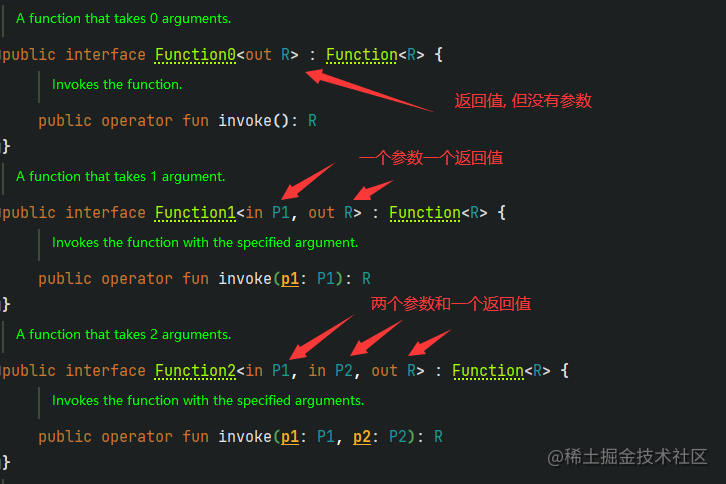
Function0表示0个参数,一个返回值Function1表示1个参数,一个返回值Function22表示22个参数,一个返回值出现这种情况的原因是,
kotlin支持使用函数做参数或者返回值,java中只能用函数式接口实现传递函数类型参数,所以java的函数式接口需要转化成Function0 ~ 22,同时kotlin中的函数也需要借助Function 系列接口代替翻译成java的函数式接口fun foo(int: Int): () -> Unit = { println(int) } fun main() { listOf(1, 2, 3).forEach { foo(it).invoke() } }- 1
- 2
- 3
- 4
- 5
- 6
- 7
- 8
- 9
这里的
foo 函数的返回值如果翻译成java就是Function0public static final Function0<Unit> foo(int n) { return new Function0<Unit>(n){ final int $int; { this.$int = $int; super(0); } public final void invoke() { System.out.println(this.$int); } }; }- 1
- 2
- 3
- 4
- 5
- 6
- 7
- 8
- 9
- 10
- 11
- 12
- 13
柯里化 风格
fun sum(x: Int)= { y: Int -> {z: Int -> x + y + z} } sum(1)(2)(3)- 1
- 2
- 3
- 4
- 5
fun curryingLike(content: String, block: (String) -> Unit) { block(content) } fun main() { curryingLike("look like currying stycle") {content -> println(content) } }- 1
- 2
- 3
- 4
- 5
- 6
- 7
- 8
- 9
fun <A, B> Array<A>.corresponds(that: Array<B>, p: (A, B) -> Boolean): Boolean { val i = this.iterator() val j = that.iterator() while (i.hasNext() && j.hasNext()) { if (!p(i.next(), j.next())) { return false } } return !i.hasNext() && !j.hasNext() } val a = arrayOf(1, 2, 3) val b = arrayOf(2, 3, 4) a.corresponds(b) { x, y -> x + 1 == y } a.corresponds(b) { x, y -> x + 2 == y }- 1
- 2
- 3
- 4
- 5
- 6
- 7
- 8
- 9
- 10
- 11
- 12
- 13
- 14
- 15
- 16
- 17
- 18
- 19
内联函数, 消除 lambda 带来的代价
是什么?
内联函数, 主要的功能是一处内联, 到处(
调用处)粘贴(函数体)功能和 c语言的宏定义很像, 主要就是在调用到内联函数的位置, 直接把内联函数体拷贝过去, 然后去掉该函数的名称和作用域(也就是
{}括号)同时, 内联函数还可以把
传入的已经调用的lambda 参数也给内联了记住是已经 传入的并且已经调用了的lambda表达式才能内联
记住是已经 传入的并且已经调用了的lambda表达式才能内联
记住是已经 传入的并且已经调用了的lambda表达式才能内联inline fun f(param: () -> Unit) { println("inline function") param() return } fun main() { f { println("lambda") } }- 1
- 2
- 3
- 4
- 5
- 6
- 7
- 8
- 9
反编译后:
String var1 = "inline function"; System.out.println(var1); String var4 = "lambda"; System.out.println(var4);- 1
- 2
- 3
- 4
传入的对象无法内联
注意只有 传入的已经被调用的 lambda 参数才可以内联, 如果传入的是一个对象则不可以内联对象, 看下面这段代码:
fun main() { val v: () -> Unit = { println("lambda") } f(v) }- 1
- 2
- 3
- 4
反编译后的
java源码是这样:Function0 v = (Function0)null.INSTANCE; String var2 = "inline function"; System.out.println(var2); v.invoke();- 1
- 2
- 3
- 4
发现了没有?
Function0 v = (Function0)null.INSTANCE;这个v就是前面的变量, 该 lambda 表达式已经变成了对象编译器遇到内联函数的大体处理步骤
原始代码:
inline fun f(param: () -> Unit): Int { println("inline function") param() return Random(100).nextInt() } fun main() { println("进入 f 函数之前: ") val v = f { println("lambda") } println("v = $v") println("进入 f 函数之后") }- 1
- 2
- 3
- 4
- 5
- 6
- 7
- 8
- 9
- 10
- 11
- 12
- 把函数体的lambda表达式内联掉
inline fun f(param: () -> Unit): Int { println("inline function") println("lambda") // 内联 lambda 表达式 return Random(100).nextInt() }- 1
- 2
- 3
- 4
- 5
- 把函数体拷贝到调用该内联函数的位置, 把 内联函数的
return处理下
记住是 内联函数的
return, 不是lambda的return
记住是 内联函数的return, 不是lambda的return
记住是 内联函数的return, 不是lambda的returnfun main() { println("进入 f 函数之前: ") println("inline function") println("lambda") // 内联 lambda 表达式 val v = Random(100).nextInt() println("v = $v") println("进入 f 函数之后") }- 1
- 2
- 3
- 4
- 5
- 6
- 7
- 8
至此, 完成内联函数的内联大致过程, 其中还有在内联过程中如果遇到实参传递形参时怎么处理没搞, 会在后续讲
注意到
return了么? 如果inline真的是直接拷贝内联函数体代码到调用处, 代码肯定会直接返回, 而不是 执行println("进入 f 函数之后"), 但实际上, 它执行了.[外链图片转存失败,源站可能有防盗链机制,建议将图片保存下来直接上传(img-MRSxweal-1656299795610)(https://p6-juejin.byteimg.com/tos-cn-i-k3u1fbpfcp/3539442d4dbe4dd586d70ec859e7380b~tplv-k3u1fbpfcp-watermark.image?)]
我们把代码改成
f{ println("lambda") }:
调用函数的返回值不会被内联函数直接内联到调用出, 而是去除 return 关键字, 再把 return 后面的代码拷贝过来, 如果有变量接受返回值, 就直接赋值给返回值
记住是调用函数哦, 不是被 内联函数函数类型表达式参数 的 return 表达式
需要注意
内联函数类型参数的returninline fun f(param: () -> Unit): String { println("inline function") param() return "有返回值" } fun main() { val f = f { println("lambda") return } println(f) }- 1
- 2
- 3
- 4
- 5
- 6
- 7
- 8
- 9
- 10
- 11
- 12
- 13
inline function lambda- 1
- 2

如果这段代码没有
return的话val f = f { println("lambda") } println(f)- 1
- 2
- 3
- 4
输出的将会是:
inline function lambda 有返回值- 1
- 2
- 3
有
return的话:val f = f { println("lambda") return // 这段代码没有 return } println(f)- 1
- 2
- 3
- 4
- 5
代码将会是下面这样:
fun main() { val f = f { println("inline function") println("lambda") return // 这里直接返回了, 后面的 有返回值 不会再赋值给变量f "有返回值" } println(f) // "有返回值" }- 1
- 2
- 3
- 4
- 5
- 6
- 7
- 8
- 9
所以返回的
"有返回值"没有传递给变量f, 在后面的println(f)不会打印出"有返回值"这几个字记住这和前面内联函数返回值不同, 这是内联函数参数的返回值
内联函数的返回将会被去掉
return赋值给变量或者凭空执行内联函数参数的返回值将会不经过处理, 直接原封不动的拷贝过去
为什么要引入内联函数?
答: 让内联函数中的
lambda参数不再创建对象看代码:
fun f(param: () -> Unit) { println("inline function") param() } fun main() { println("进入 f 函数之前: ") f { println("lambda") } println("进入 f 函数之后") }- 1
- 2
- 3
- 4
- 5
- 6
- 7
- 8
- 9
- 10
反编译后会发现
f { println("lambda") }这段代码变成f((Function0)null.INSTANCE);看到没???lambda表达式创建了个对象, 这是一次损耗在
kotlin中 类似f函数这种参数有函数类型的高阶函数有很多很多, 每次传递lambda到这些高阶函数中都需要创建一个对象, 太损耗性能了, 所以不得不引用内联函数这项功能前面说过, 有了内联函数,
调用内联函数的位置将被替换成内联函数的函数体, 这样就少创建了个{ println("lambda") }对象有什么缺点?
答: 缺点很明显, 内联函数只针对有函数类型参数的函数内联, 主要的目的为了防止
lambda多创建的 对象, 但如果内联函数的函数体比较大, 且函数调用的位置比较多, 则会造成字节码大量膨胀, 影响apk包的大小所以通常内联函数都比较短小, 特别是项目对
app大小有严格要求的情况下, 更需要注意高阶函数控制流
kotlin中的非内联lambda不允许显示的使用return(它不需要, 只要返回值放在表达式末尾就是返回值), 而内联的lambda表达式可以显示的使用return, 但返回的是外部调用它的函数, 内联lambda的return会穿透一层作用域lambda 返回最后一行的值
fun running(a: Int, b: Int, funcType: (Int, Int) -> Int) = funcType(a, b) fun main() { running(10, 20) {x: Int, y: Int -> x + y } }- 1
- 2
- 3
- 4
- 5
- 6
- 7
上面这种返回方式和下面这种一样
fun main () { running(10, 20, fun(x: Int, y: Int) { return x + y }) }- 1
- 2
- 3
- 4
- 5
内联函数的非局部返回
看似是局部(
lambda)的return, 其实是调用lambda函数的returnlambda内的
return会穿透一层作用域inline fun running(a: Int, b: Int, funcType: (Int) -> Int) { funcType(a + b) } fun main() { println("调用之前: ") // 下面这种方式是错误的, return it 返回的是 main 函数 running(10, 20) { println(it) return it // 这就是 非局部返回 } println("调用之后") }- 1
- 2
- 3
- 4
- 5
- 6
- 7
- 8
- 9
- 10
- 11
- 12
- 13
上面的
return it就是非局部返回, 返回的main函数
所以上面的提示就是让你修改 main 函数的返回值

我们可以给
return表达式一个标签return @running it, 返回的是running函数noinline用于未调用的lambda函数类型参数防止照抄内联函数参数的参数名称到 main 函数中, 导致无法识别的问题
比如:
fun main() { println("zhazha") return funcType02; // 这能不报错? }- 1
- 2
- 3
- 4
它在下面是
running函数的 参数名funcType02: (Int) -> Unit
此时我们可以添加
noinline关键字inline fun running(funcType01: (String) -> Unit, noinline funcType02: (Int) -> Unit) { funcType01("zhazha") return funcType02 } fun main() { running({ println(it) }, { println(it * 10) }) }- 1
- 2
- 3
- 4
- 5
- 6
- 7
- 8

注意, 如果内联函数的 lambda 参数没有被调用, 最好使用使用
noinline的话, 否则将会变成这样:
crossinline的使用场景主要用于
函数参数lambda参数的lambda作为函数体内另一个函数调用时使用, 说白了就是间接调用fun interface MyRunnable { fun myF() } inline fun running(a: Int, b: Int, crossinline funcType: (Int, Int) -> Int) { MyRunnable { // 在作用域的作用域内使用 println(funcType(a, b)) }.myF() } fun main() { running(10, 20) { x, y -> x + y } }- 1
- 2
- 3
- 4
- 5
- 6
- 7
- 8
- 9
- 10
- 11
- 12
- 13
- 14
- 15
- 16
crossinline需要配合inline的使用, 主要用于函数类型参数, 防止函数类型参数传递的是lambda函数体时,间接调用使用, 如果该间接调用lambda内有return, 该修饰符能够防止非局部返回出现, 导致函数穿透一层作用域返回running函数上面的
noinline和crossinline都不用我们去学, 等到报错,ide会提醒, 并修复的lambda中的局部返回
带标签的
return是什么?类似于
for循环中的breakval list = arrayListOf(Person("a", 1), Person("b", 2), Person("c", 3)) for (person in list) { if (person.name == "b") { break } println(person) } list.forEach { if (it.name == "b") { return@forEach } println(it) } list.forEach label@ { if (it.name == "b") { return@label } println(it) }- 1
- 2
- 3
- 4
- 5
- 6
- 7
- 8
- 9
- 10
- 11
- 12
- 13
- 14
- 15
- 16
- 17
- 18
- 19
上面这三种方式功能都差不多
标签是
标签 + @标注在lambda表达式之前标签@{ /* lambda */ }使用的时候是
return + @ + 标签中间没有空格, 这是返回带标签的 this
和前面一样, 对
lambda做标签标签@, 然后在使用的时候可以this@标签.xxxxprintln(StringBuilder().apply sb@ { listOf(1, 2, 3).apply { this@sb.append(this.toString()) } })- 1
- 2
- 3
- 4
- 5
this@sb.append的appendIDEA无法智能提示, 需要我们主动手写匿名函数使用的是 局部返回
inline fun running(funcType01: (String) -> Int, noinline funcType02: (Int) -> Unit): (Int) -> Unit { println(funcType01("zhazha")) return funcType02 } fun main() { println("调用之前: ") running(fun(str: String): Int { println(str) return str.length }) { println(it * 100) } println("调用之后") }- 1
- 2
- 3
- 4
- 5
- 6
- 7
- 8
- 9
- 10
- 11
- 12
- 13
- 14
- 15

if (it.name == “b”) {
return@forEach
}
println(it)
}
list.forEach label@ {
if (it.name == “b”) {
return@label
}
println(it)
}上面这三种方式功能都差不多 标签是 `标签 + @` 标注在 `lambda` 表达式之前 `标签@{ /* lambda */ }` 使用的时候是 `return + @ + 标签` 中间没有空格, 这是返回 #### 带标签的 this 和前面一样, 对 `lambda` 做标签 `标签@` , 然后在使用的时候可以 `this@标签.xxxx` ```kotlin println(StringBuilder().apply sb@ { listOf(1, 2, 3).apply { this@sb.append(this.toString()) } })- 1
- 2
- 3
- 4
- 5
- 6
- 7
- 8
- 9
- 10
- 11
- 12
- 13
- 14
- 15
- 16
- 17
this@sb.append的appendIDEA无法智能提示, 需要我们主动手写匿名函数使用的是 局部返回
inline fun running(funcType01: (String) -> Int, noinline funcType02: (Int) -> Unit): (Int) -> Unit { println(funcType01("zhazha")) return funcType02 } fun main() { println("调用之前: ") running(fun(str: String): Int { println(str) return str.length }) { println(it * 100) } println("调用之后") }- 1
- 2
- 3
- 4
- 5
- 6
- 7
- 8
- 9
- 10
- 11
- 12
- 13
- 14
- 15
[外链图片转存中…(img-8Q7MAHop-1656299795624)]
匿名函数在之前的章节中学习过, 这里就不做详解了
-
相关阅读:
IB DP 语言怎么选?
经典卷积神经网络 - VGG
鸿鹄工程项目管理系统em Spring Cloud+Spring Boot+前后端分离构建工程项目管理系统
数学建模笔记-第十讲-聚类
SpringBoot整合MQTT(MqttClient)
Vue3笔记
【Qt开发流程】之富文本处理
vue相关面试题:diff算法
《动手学深度学习》(一)-- 线性神经网络
鱼眼图像去畸变python / c++
- 原文地址:https://blog.csdn.net/qq_30690165/article/details/125480540
