-
[英雄星球六月集训LeetCode解题日报] 第26日 并查集
日报
- 今天的题都比较朴素,并查集的基础应用。
题目
一、 1559. 二维网格图中探测环
链接: 1559. 二维网格图中探测环
1. 题目描述

2. 思路分析
- 对于网格里每对相邻的格子,如果他们值相同,就可以连接起来。
- 那么我们朝单方向连接即可:
- 对于每个格子我们连接它的上方和左方。
- 不能连右和下的原因是:移到下一个格子的时候会产生重复处理。
3. 代码实现
class UnionFind: def __init__(self,size): self.fathers = list(range(size)) def find_father(self,x): return self._zip_find_father(x) def _zip_find_father(self,x): fathers = self.fathers if fathers[x] != x: fathers[x] = self._zip_find_father(fathers[x]) return fathers[x] def union(self,x,y): x = self.find_father(x) y = self.find_father(y) if x == y: return False self.fathers[x] = y return True class Solution: def containsCycle(self, grid: List[List[str]]) -> bool: m,n = len(grid),len(grid[0]) uf = UnionFind(m*n) for i in range(m): for j in range(n): if i > 0: if grid[i][j] == grid[i-1][j] and not uf.union(i*n+j,(i-1)*n+j): return True if j > 0: if grid[i][j] == grid[i][j-1] and not uf.union(i*n+j,i*n+j-1): return True return False- 1
- 2
- 3
- 4
- 5
- 6
- 7
- 8
- 9
- 10
- 11
- 12
- 13
- 14
- 15
- 16
- 17
- 18
- 19
- 20
- 21
- 22
- 23
- 24
- 25
- 26
- 27
- 28
- 29
- 30

二、 1391. 检查网格中是否存在有效路径
1. 题目描述
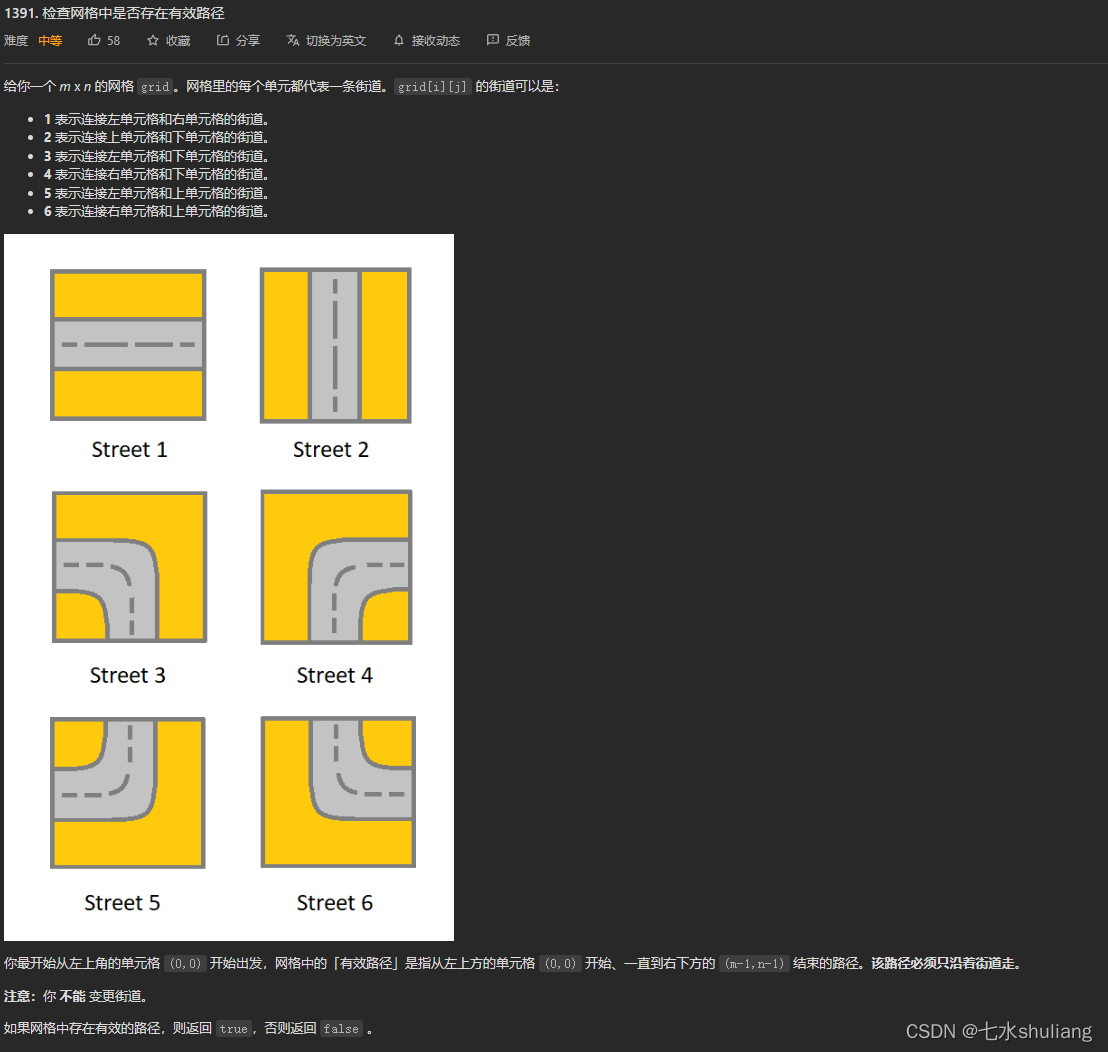
2. 思路分析
用并查集处理所有网格,最后检查起始点和结束点是否连通即可(祖宗相同)。
- 这题特殊之处就是要全部特判相邻网格是否连通,v=grid[i][j]:
- v==1时:它只能左右移动,且向左移动时,左边只能连接1、4、6;向右移动时,右边只能连接1、3、5。
- v==其它时,均需特判。
- 为了代码简洁,我们给1-6编号为0-5,用列表储存这6中情况分别对应的方向和方向上能连接的网格值。
- 然后就是遍历所有网格并且让他们移动,判断移动后的网格符合条件就合并家族即可。
3. 代码实现
class UnionFind: def __init__(self,size): self.fathers = list(range(size)) def find_father(self,x): return self._zip_find_father(x) def _zip_find_father(self,x): fathers = self.fathers if fathers[x] != x: fathers[x] = self._zip_find_father(fathers[x]) return fathers[x] def union(self,x,y): x = self.find_father(x) y = self.find_father(y) if x == y: return False self.fathers[x] = y return True def is_same_father(self,x,y): return self.find_father(x)==self.find_father(y) class Solution: def hasValidPath(self, grid: List[List[int]]) -> bool: m,n = len(grid),len(grid[0]) uf = UnionFind(m*n) def in_bound(x,y): return 0<=x<m and 0<=y<n def hashed(x,y): return x*n+y left = {1,4,6} right = {1,3,5} top = {2,3,4} bottom = {2,5,6} dirs = [ # 6个方块分别能走的方向 [(0,1),(0,-1)], # 右左 [(1,0),(-1,0)], # 下上 [(0,-1),(1,0)], # 左下 [(0,1),(1,0)], # 右下 [(-1,0),(0,-1)], # 上左 [(0,1),(-1,0)], # 右上 ] accepts = [ # 6个方块按方向走后,能连通的合法块 [right,left], [bottom,top], [left,bottom], [right,bottom], [top,left], [right,top], ] for i in range(m): for j in range(n): k = grid[i][j] - 1 # 用来索引这个块的属性 for z in range(2): # 走他能走的两个方向 x,y = i+dirs[k][z][0],j+dirs[k][z][1] accept = accepts[k][z] if in_bound(x,y) and grid[x][y] in accept: uf.union(hashed(i,j),hashed(x,y)) return uf.is_same_father(hashed(0,0),hashed(m-1,n-1))- 1
- 2
- 3
- 4
- 5
- 6
- 7
- 8
- 9
- 10
- 11
- 12
- 13
- 14
- 15
- 16
- 17
- 18
- 19
- 20
- 21
- 22
- 23
- 24
- 25
- 26
- 27
- 28
- 29
- 30
- 31
- 32
- 33
- 34
- 35
- 36
- 37
- 38
- 39
- 40
- 41
- 42
- 43
- 44
- 45
- 46
- 47
- 48
- 49
- 50
- 51
- 52
- 53
- 54
- 55
- 56
- 57

三、 1202. 交换字符串中的元素
链接: 1202. 交换字符串中的元素
1. 题目描述

2. 思路分析
- 我们用并查集把可以互相交换的字符合并为家族。
- 显然同一家族中的字符可以任意摆放。
- 那么我们对每个家族内部排序,然后按顺序填回他们家族的位置即可。
- 为了Python方便比较大小和转换,我先把所有字母变成ASCII码,最后拼接时再转回来。
3. 代码实现
class UnionFind: def __init__(self,size): self.fathers = list(range(size)) def find_father(self,x): return self._zip_find_father(x) def _zip_find_father(self,x): fathers = self.fathers if fathers[x] != x: fathers[x] = self._zip_find_father(fathers[x]) return fathers[x] def union(self,x,y): x = self.find_father(x) y = self.find_father(y) if x == y: return False self.fathers[x] = y return True def is_same_father(self,x,y): return self.find_father(x)==self.find_father(y) class Solution: def smallestStringWithSwaps(self, s: str, pairs: List[List[int]]) -> str: ss = [ord(c) for c in s] n = len(ss) uf = UnionFind(n) for a,b in pairs: uf.union(a,b) familys = defaultdict(list) for i in range(n): familys[uf.find_father(i)].append(i) ans = [0]*n for ps in familys.values(): ps2 = sorted(ps,key=lambda x:ss[x]) # print (ps,ps2) for i in range(len(ps)): ans[ps[i]] = ss[ps2[i]] return ''.join(chr(c) for c in ans)- 1
- 2
- 3
- 4
- 5
- 6
- 7
- 8
- 9
- 10
- 11
- 12
- 13
- 14
- 15
- 16
- 17
- 18
- 19
- 20
- 21
- 22
- 23
- 24
- 25
- 26
- 27
- 28
- 29
- 30
- 31
- 32
- 33
- 34
- 35
- 36
- 37
- 38
-
相关阅读:
记一次语音播报功能
【校招VIP】高校陌生人活动|产品的竞品和需求分析
基于 Docker CICD 的 Master Slave 架构应用
《职场求生攻略》
如何将您的网站添加到百度站长工具
CTF竞赛题解之stm32逆向入门
【概率论】斗地主中出现炸弹的几率
深度学习网络模型——DenseNet模型详解与代码复现
java计算机毕业设计ssm建设路小学芙童币和芙童印章管理系统(源码+系统+mysql数据库+Lw文档)
MySQL 的 limit 分页查询及性能问题
- 原文地址:https://blog.csdn.net/liuliangcan/article/details/125473801
