-
list的模拟实现
模拟实现list
示意图:
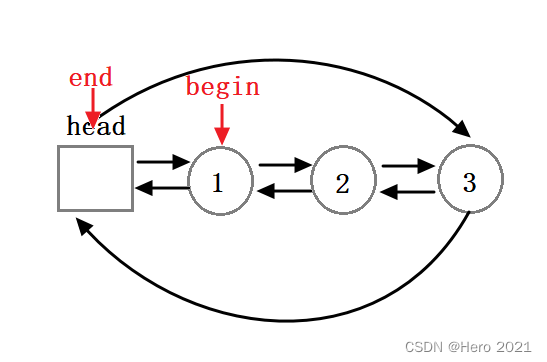
迭代器
正向迭代器类
我们之前所理解的是:迭代器理解为像指针一样的东西,但是在list中有些不同
// 迭代器逻辑 while(it!=l.end()) { *it; // 解引用取数据 ++it;// 自加到达下一个位置 }- 1
- 2
- 3
- 4
- 5
- 6
我们可以来观察一下STL源码中大佬是怎么封装的:

我们可以看到,只有一个成员,那就是一个结点的指针node,link_type又是一个自定义类型的指针,我们原生类型的指针在vector或者string中是可以直接typedef成为迭代器的,但是list底层是双链表,数据结构并非连续的,所以直接*it或者++it是不能够完成迭代器的任务的,但是C++中支持对于自定义类型的运算符重载,我们可以对解引用和自加两个运算符重载。++it:就是当前指针存放下一个结点的地址
*it:解引用当前节点,取出值来迭代器中,拷贝构造、运算符赋值重载、析构都不需要自己实现,使用默认生成的即可(即浅拷贝),因为迭代器是用自定义类型的指针封装的,访问修改链表,节点属于链表,不属于迭代器,所以不用管它。
我们在传入const版本的list时,list是const对象,需要的是const_iterator,这里会出现错误,不能将const的list的迭代器传给普通迭代器。如下所示例子:
void print_list(const list<int>& lt) { // lt.begin()是const迭代器(只可读) // it是普通迭代器(可读可写) list<int>::iterator it = lt.begin(); while (it != lt.end()) { cout << *it << " "; ++it; } }- 1
- 2
- 3
- 4
- 5
- 6
- 7
- 8
- 9
- 10
- 11
现在我们如何实现一个const的迭代器呢?
意思就是只可以读不能够写。可以++,- -,*解引用,但是解引用时不能修改数据。
可以想到这种写法:const T& operator*()const { return _node->_data; } T& operator*() { return _node->_data; }- 1
- 2
- 3
- 4
- 5
- 6
- 7
- 8
- 9
但是并不是迭代器是const的,而是我们传入的list容器是const版本的。
我们可以将写一个const_iterator 的类版本,这样普通迭代器和const迭代器就不是一个类型了,是两个不同的类型了,这样会造成代码冗余。
template<class T> struct __const_list_iterator { //... // __list_iterator全部替换为__const_list_iterator };- 1
- 2
- 3
- 4
- 5
- 6
优化:
增加一个模板参数class Ref

这样第一个模板参数都是T,我们可以根据传入的第二个参数来推出时T&还是const T&,本来我们是要实现两个类的,现在只需要增加一个模板参数即可,这里体现出了C++泛型的优势!
迭代器我们说,它是像指针一样的东西,如果它是指向的一个结构体,需要用它的成员变量,我们还需要重载->箭头struct Date { int _year; int _month; int _day; Date(int year = 0, int month = 0, int day = 0) //这里要给默认参数,因为需要构建一个哨兵位头结点 :_year(year) , _month(month) , _day(day) {} }; void test_list2() { list<Date> lt; lt.push_back(Date(2022, 1, 1)); lt.push_back(Date(2022, 1, 2)); lt.push_back(Date(2022, 1, 3)); lt.push_back(Date(2022, 1, 4)); // 现在来遍历日期类 list<Date>::iterator it = lt.begin(); while (it != lt.end()) { cout << (*it)._year << "/" << (*it)._month << "/" << (*it)._day << endl; ++it; } cout << endl; }- 1
- 2
- 3
- 4
- 5
- 6
- 7
- 8
- 9
- 10
- 11
- 12
- 13
- 14
- 15
- 16
- 17
- 18
- 19
- 20
- 21
- 22
- 23
- 24
- 25
- 26
- 27
- 28
这里的
*解引用然后再去.,我们可以重载->,让他可以去调用结构体的成员,这样更加快捷高效方便。T* operator->() { return &(_node->_data); }- 1
- 2
- 3
- 4
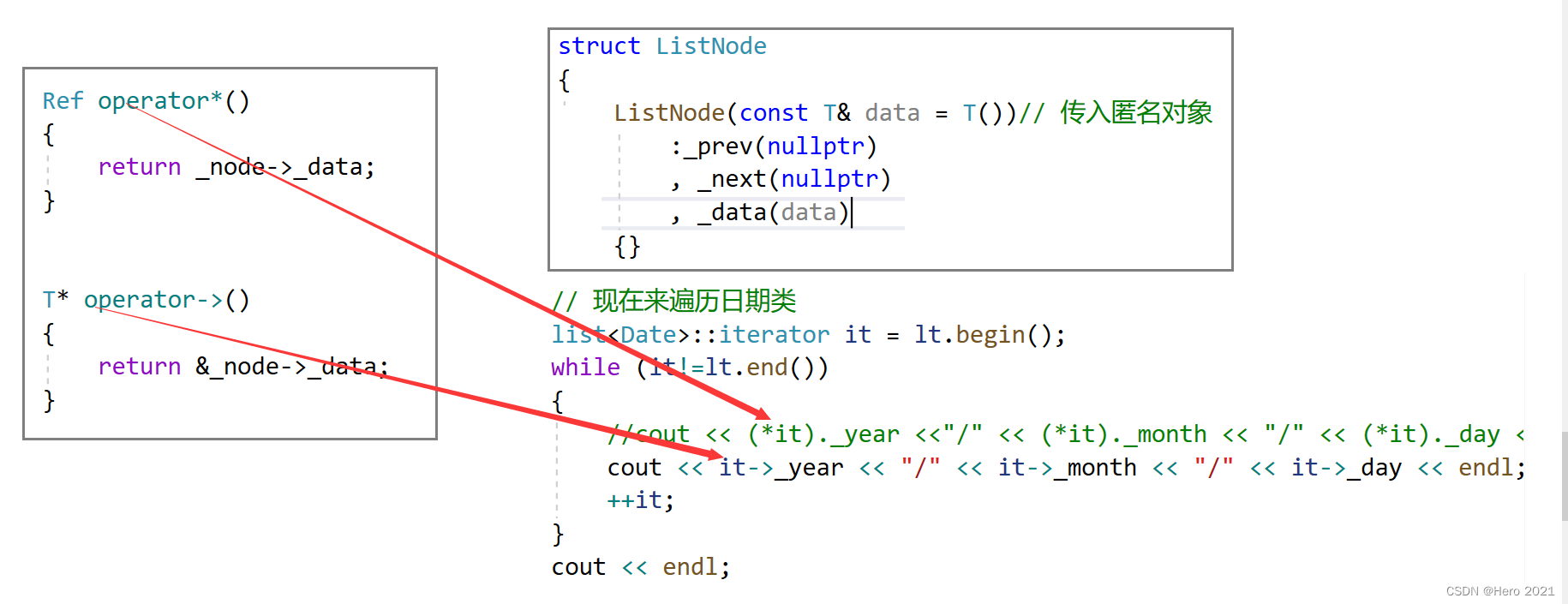
进一步解释:
*it调用operator*,返回一个结点对象,对象再.操作,拿到数据
it->调用operator->,返回对象的指针,(这里返回的是原生指针)再通过->调用用结构体成员,这里实际上应该是it->->_year,但是这样写,可读性很差,所以编译器做了一个优化,省略了一个->,所以所有的类型只要想要重载->,都会这样优化省略一个->这里又会衍生出一个问题,那就是如果使用const_iterator,使用->也会修改数据,所以再增加一个模板参数
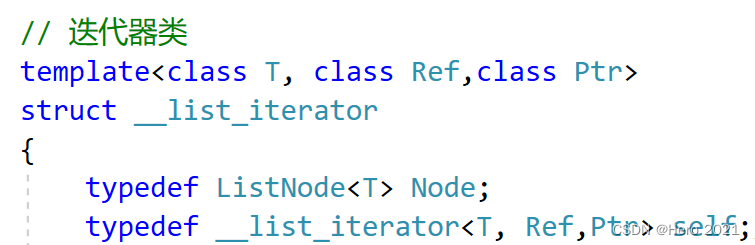
// 正向迭代器类 template<class T, class Ref, class Ptr> struct __list_iterator { typedef ListNode<T> Node; typedef __list_iterator<T, Ref, Ptr> self;// 再次typedef,方便后续的修改 Node* _node; __list_iterator(Node* x)// 迭代器的实质,就是自定义类型的指针 :_node(x) {} // ++it 返回++之后的引用对象 self& operator++() { _node = _node->_next; return *this; } // it++ 返回++之前的对象 self operator++(int) { self tmp(this); _node = _node->_next; return tmp; } // --it self& operator--() { _node = _node->_prev; return *this; } // it-- self operator--(int) { self tmp(this); _node = _node->_prev; return tmp; } // 返回引用,可读可写 Ref operator*() { return _node->_data; } // 返回对象的指针 Ptr operator->() { return &(_node->_data); } bool operator!=(const self& it)const { return _node != it._node; } bool operator==(const self& it)const { return _node == it._node; } };- 1
- 2
- 3
- 4
- 5
- 6
- 7
- 8
- 9
- 10
- 11
- 12
- 13
- 14
- 15
- 16
- 17
- 18
- 19
- 20
- 21
- 22
- 23
- 24
- 25
- 26
- 27
- 28
- 29
- 30
- 31
- 32
- 33
- 34
- 35
- 36
- 37
- 38
- 39
- 40
- 41
- 42
- 43
- 44
- 45
- 46
- 47
- 48
- 49
- 50
- 51
- 52
- 53
- 54
- 55
- 56
- 57
- 58
- 59
- 60
- 61
- 62
- 63
反向迭代器类
实质:对于正向迭代器的一种封装
反向迭代器跟正想迭代器区别就是++,- -的方向是相反的
所以反向迭代器封装正向迭代器即可,重载控制++,- -的方向
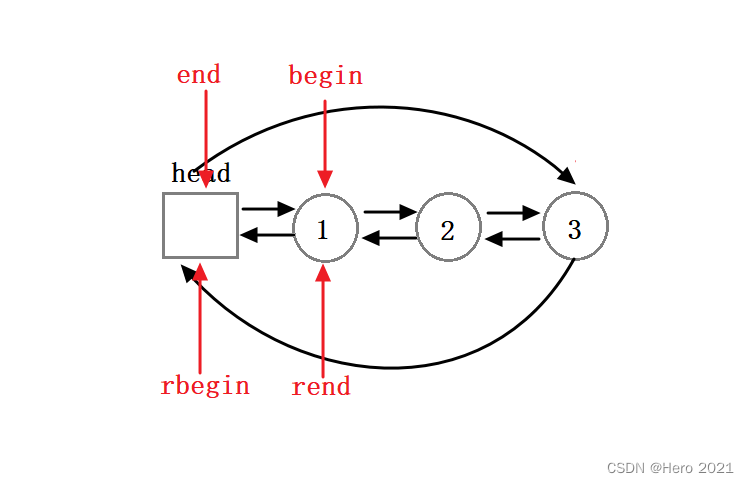
#pragma once // reverse_iterator.h namespace sjj { template <class Iterator, class Ref, class Ptr> class reverse_iterator { typedef reverse_iterator<Iterator,Ref,Ptr> self; public: reverse_iterator(Iterator it) :_it(it) {} // 比较巧妙,解引用取的是当前位置的前一个位置的数据 // operator*取前一个位置, 主要就是为了让反向迭代器开始和结束跟正向迭代器对称 Ref operator *() { Iterator tmp = _it; return *--tmp; } Ptr operator->() { return &(operator*()); } self& operator++() { --_it; return *this; } self operator++(int) { self tmp = *this; --_it; return tmp; } self& operator--() { ++_it; return *this; } self operator--(int) { self tmp = *this; ++_it; return tmp; } bool operator!=(const self& rit) { return _it != rit._it; } bool operator==(const self& rit) { return _it == rit._it; } private: Iterator _it; }; }- 1
- 2
- 3
- 4
- 5
- 6
- 7
- 8
- 9
- 10
- 11
- 12
- 13
- 14
- 15
- 16
- 17
- 18
- 19
- 20
- 21
- 22
- 23
- 24
- 25
- 26
- 27
- 28
- 29
- 30
- 31
- 32
- 33
- 34
- 35
- 36
- 37
- 38
- 39
- 40
- 41
- 42
- 43
- 44
- 45
- 46
- 47
- 48
- 49
- 50
- 51
- 52
- 53
- 54
- 55
- 56
- 57
- 58
- 59
- 60
- 61
- 62
- 63
- 64
push_back尾插函数

void push_back(const T& x) { // 先找尾记录 /*Node* tail = _head->_prev; Node* newnode = new Node(x); tail->_next = newnode; newnode->_prev = tail; _head->_prev = newnode; newnode->_next = _head; tail = tail->_next;*/ // 复用insert函数 insert(end(), x); }- 1
- 2
- 3
- 4
- 5
- 6
- 7
- 8
- 9
- 10
- 11
- 12
- 13
- 14
- 15
- 16
push_front头插函数
// 头插 void push_front(const T& x) { // 复用insert函数 insert(begin(), x); }- 1
- 2
- 3
- 4
- 5
- 6
insert插入函数

// 在pos位置前插入 iterator insert(iterator pos, const T& x) { Node* cur = pos._node; Node* prev = cur->_prev; Node* newnode = new Node(x); prev->_next = newnode; newnode->_prev = prev; newnode->_next = cur; cur->_prev = newnode; return iterator(newnode);// 返回新插入结点位置的迭代器 }- 1
- 2
- 3
- 4
- 5
- 6
- 7
- 8
- 9
- 10
- 11
- 12
- 13
- 14
- 15
- 16
注意:这里list的insert函数,pos位置的迭代器不会失效,因为pos指向的位置不会改变,vector中迭代器失效的原因是因为挪动数据,导致指向的位置的数据发生变化。
erase删除函数
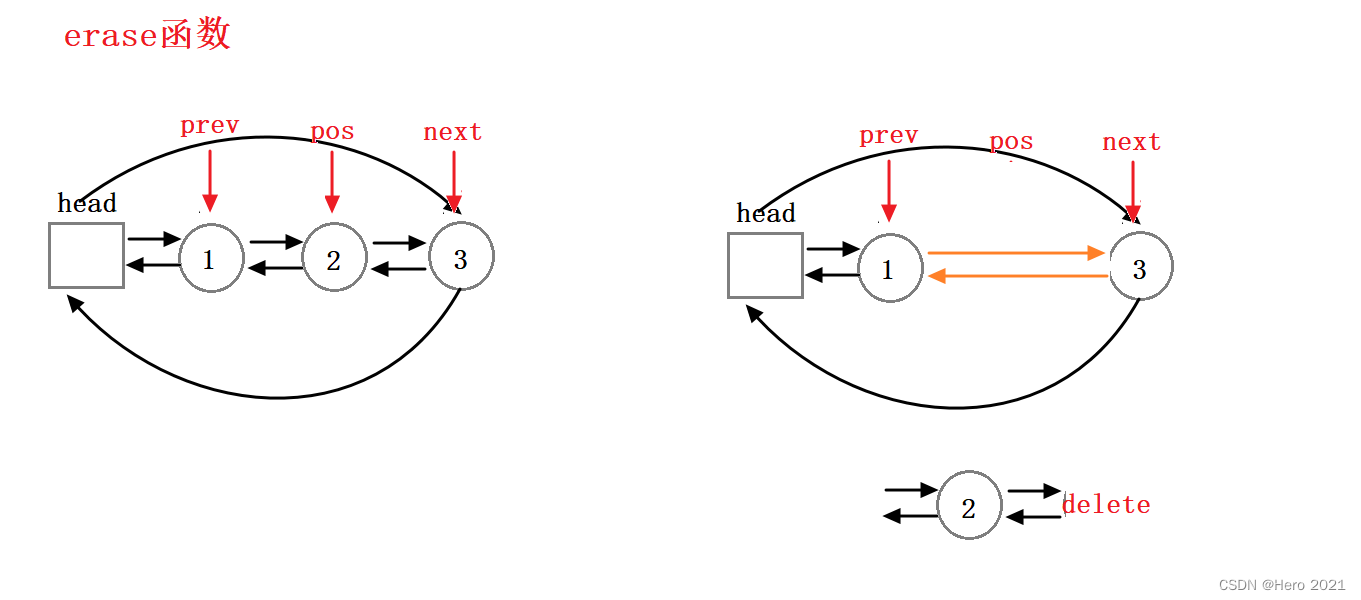
iterator erase(iterator pos) { assert(pos != end());//不能将哨兵位的头结点给删除了 Node* prev = pos._node->_prev; Node* next = pos._node->_next; delete pos._node; prev->_next = next; next->_prev = prev; return iterator(next);// 返回pos位置的下一个位置的迭代器 }- 1
- 2
- 3
- 4
- 5
- 6
- 7
- 8
- 9
- 10
- 11
- 12
- 13
注意:这里的pos位置的迭代器一定会失效,因为都已经将结点给删除了。
pop_front函数
// 复用erase函数 void pop_front() { erase(begin()); }- 1
- 2
- 3
- 4
- 5
- 6
pop_back函数
// 复用erase函数 void pop_back() { erase(--end()); }- 1
- 2
- 3
- 4
- 5
构造函数
list() { _head = new Node(); _head->_next = _head; _head->_prev = _head; } // 函数模板,用迭代器区间进行初始化 template<class InputIterator> list(InputIterator first, InputIterator last) { _head = new Node(); _head->_next = _head; _head->_prev = _head; while (first != last) { push_back(*first); ++first; } } list(size_t n, const T& val = T()) { _head = new Node(); _head->_next = _head; _head->_prev = _head; for (size_t i = 0; i < n; ++i) { push_back(val); } }- 1
- 2
- 3
- 4
- 5
- 6
- 7
- 8
- 9
- 10
- 11
- 12
- 13
- 14
- 15
- 16
- 17
- 18
- 19
- 20
- 21
- 22
- 23
- 24
- 25
- 26
- 27
- 28
- 29
- 30
- 31
- 32
- 33
注意:

这两个构造函数一起使用可能会存在问题,填充版本和构造器版本可能会存在冲突,如下例子:struct Date { int _year; int _month; int _day; Date(int year = 0, int month = 0, int day = 0)//这里要给默认参数,因为有一个哨兵位头结点需要初始化 :_year(year) , _month(month) , _day(day) {} }; void test_list4() { list<Date> lt1(5, Date(2022, 9, 9)); for (auto e : lt1) { cout << e._year << "/" << e._month << "/" << e._day << endl; } cout << endl; list<int> lt2(5, 1); for (auto e : lt2) { cout << e << " "; } cout << endl; }- 1
- 2
- 3
- 4
- 5
- 6
- 7
- 8
- 9
- 10
- 11
- 12
- 13
- 14
- 15
- 16
- 17
- 18
- 19
- 20
- 21
- 22
- 23
- 24
- 25
- 26
对于这两个:在实例化时会调用更加匹配的构造函数初始化
list lt1(5, Date(2022, 9, 9))它会正常调用list(size_t n, const T& val = T())list lt2(5, 1)而它会将5和1推演成两个int,进而去匹配这个迭代器版本的构造函数
template < class InputIterator> list(InputIterator first, InputIterator last),但是与我们的本意,用n个val初始化原意相背,而其中有个*first,这里int去解引用必会报错改进:再多提供第一个参数是int重载版本的list(
intn, const T& val = T())构造函数list(int n, const T& val = T()) { _head = new Node(); _head->_next = _head; _head->_prev = _head; for (size_t i = 0; i < n; ++i) { push_back(val); } }- 1
- 2
- 3
- 4
- 5
- 6
- 7
- 8
- 9
- 10
析构函数
~list() { clear(); // 析构与clear不同,要将哨兵位头结点给删除了 delete _head; _head = nullptr; }- 1
- 2
- 3
- 4
- 5
- 6
- 7
- 8
list拷贝构造函数
浅拷贝会崩溃的原因是,同一块空间被析构了两次,所以我们要完成深拷贝
传统写法
// 传统写法 // lt2(lt1) list(const list<T>& lt) { _head = new Node(); _head->_next = _head; _head->_prev = _head; for (auto e : lt) { push_back(e); } }- 1
- 2
- 3
- 4
- 5
- 6
- 7
- 8
- 9
- 10
- 11
- 12
- 13
注意: 因为要调用push_back函数,push_back的前提是这个链表(lt2)已经被初始化了,所以必须要先搞一个哨兵位头结点,不然会崩溃
现代写法
// 函数模板 template<class InputIterator> list(InputIterator first, InputIterator last) { _head = new Node(); _head->_next = _head; _head->_prev = _head; while (first != last) { push_back(*first); ++first; } } // lt2(lt1) list(const list<T>& lt) { _head = new Node(); _head->_next = _head; _head->_prev = _head; list<T> tmp(lt.begin(), lt.end()); std::swap(_head, tmp._head); }- 1
- 2
- 3
- 4
- 5
- 6
- 7
- 8
- 9
- 10
- 11
- 12
- 13
- 14
- 15
- 16
- 17
- 18
- 19
- 20
- 21
- 22
- 23
- 24
注意:lt2需要一个哨兵位头结点
list赋值重载函数
传统写法
// lt2=lt1 list<T>& operator=(const list<T>& lt) { if (this != lt) { clear(); // 将lt2清空 for (auto e : lt)// 再将值全部拷贝过去 { push_back(e); } } return *this; }- 1
- 2
- 3
- 4
- 5
- 6
- 7
- 8
- 9
- 10
- 11
- 12
- 13
现代写法
// 现代写法 list<T>& operator=(list<T> lt) { std::swap(_head, lt._head); return *this; }- 1
- 2
- 3
- 4
- 5
- 6
其他函数
// 清空 void clear() { /* iterator it = begin(); while (it!=end()) { iterator del = it++;// 利用后置++,返回加加前的迭代器 delete del._node; } // 最后剩下哨兵位头结点 _head->_next = _head; _head->_prev = _head; */ iterator it = begin(); while (it != end()) { erase(it++); // 也可以复用erase,it++返回加加之前的值 } }- 1
- 2
- 3
- 4
- 5
- 6
- 7
- 8
- 9
- 10
- 11
- 12
- 13
- 14
- 15
- 16
- 17
- 18
- 19
- 20
- 21
- 22
-
相关阅读:
【计算机考研 - 英语】唐迟-考研英语阅读的逻辑笔记总结
管理经济学试题及答案
在 360 度绩效评估中应该问的 20 个问题
【中国知名企业高管团队】系列63:青岛啤酒
Shell系统学习之函数
解决 VMware Network Adapter VMnet1 IP 地址冲突导致无法打开路由器管理页面
serveless 思想 Midway.js 框架使用教程(三)
[leetcode] K 和数对的最大数目
远程Debug远端服务器JVM配置
AST的语义特征和结构特征
- 原文地址:https://blog.csdn.net/weixin_57675461/article/details/125339737