-
周志华《机器学习》第三章课后习题
目录
3.1 试析在什么情形下式(3.2) 中不必考虑偏置项 b.
3.2、试证明,对于参数w,对率回归的目标函数(3.18)是非凸的,但其对数似然函数(3.27)是凸的.
3.3、编程实现对率回归,并给出西瓜数据集3.0α上的结果.
3.4 选择两个 UCI 数据集,比较 10 折交叉验证法和留一法所估计出的对率回归的错误率。
3.5 编辑实现线性判别分析,并给出西瓜数据集 3.0α 上的结果.
3.1 试析在什么情形下式(3.2) 中不必考虑偏置项 b.

①b与输入毫无关系,如果没有b,y‘=wx必须经过原点
②当两个线性模型相减时,消除了b。可用训练集中每个样本都减去第一个样本,然后对新的样本做线性回归,不用考虑偏置项b。3.2、试证明,对于参数w,对率回归的目标函数(3.18)是非凸的,但其对数似然函数(3.27)是凸的.
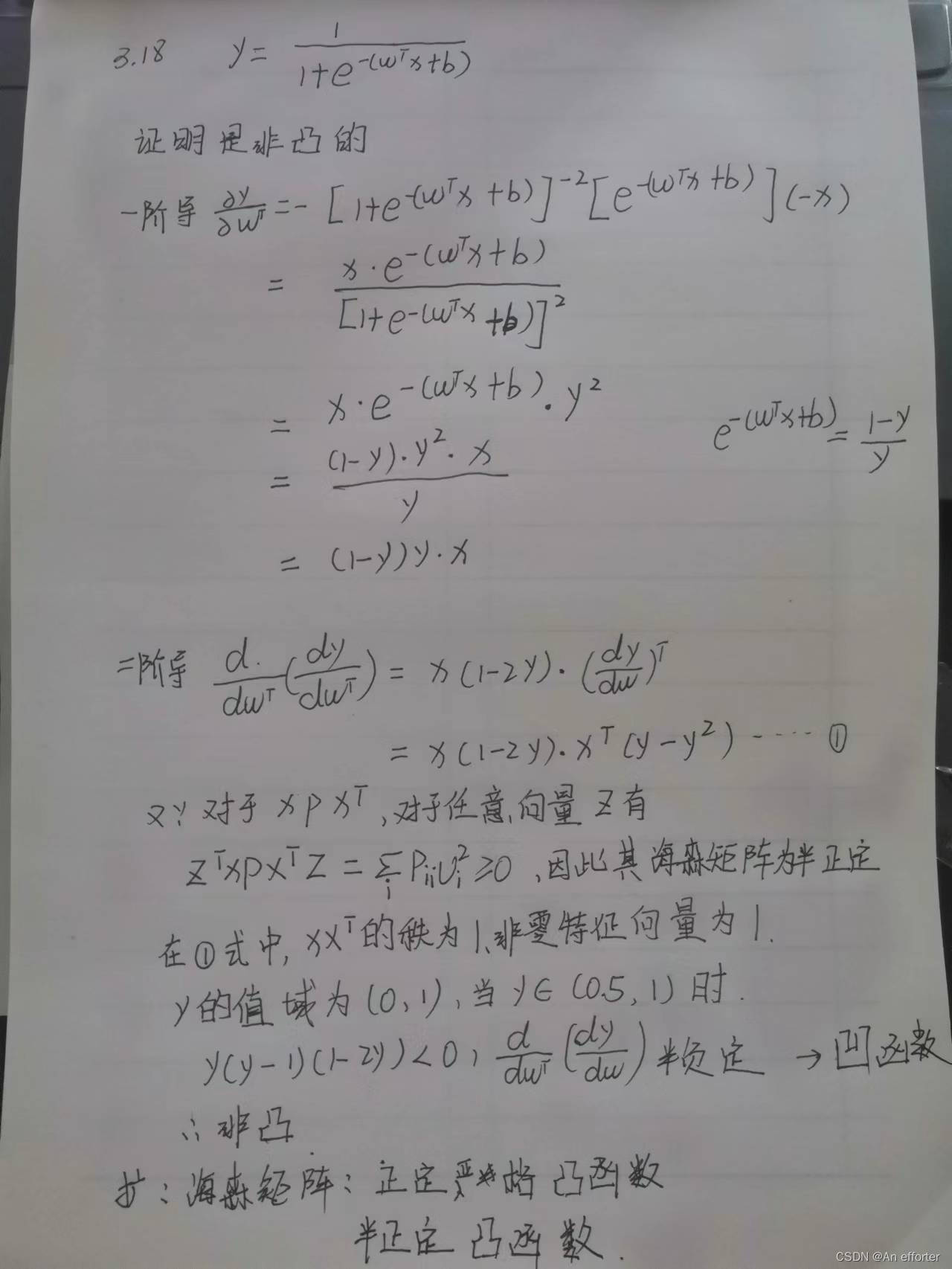
3.27

3.3、编程实现对率回归,并给出西瓜数据集3.0α上的结果.
数据集:

3.3.py
- # -*- coding: utf-8 -*
- '''
- data importion
- '''
- import numpy as np # for matrix calculation
- import matplotlib.pyplot as plt
- # load the CSV file as a numpy matrix
- # 将CSV文件加载为numpy矩阵
- dataset = np.loadtxt('watermelon3_0_Ch.csv', delimiter=",")
- # separate the data from the target attributes
- # 将数据与目标属性分离
- X = dataset[:, 1:3]
- y = dataset[:, 3]
- m, n = np.shape(X)
- # draw scatter diagram to show the raw data
- #绘制出数据点
- f1 = plt.figure(1)
- plt.title('watermelon_3a')
- plt.xlabel('density')
- plt.ylabel('ratio_sugar')
- plt.scatter(X[y == 0, 0], X[y == 0, 1], marker='o', color='k', s=100, label='bad')
- plt.scatter(X[y == 1, 0], X[y == 1, 1], marker='o', color='g', s=100, label='good')
- plt.legend(loc='upper right')
- # plt.show()
- '''
- using sklearn lib for logistic regression
- 使用sklearn库进行逻辑回归
- '''
- from sklearn import metrics
- from sklearn import model_selection
- from sklearn.linear_model import LogisticRegression
- import matplotlib.pylab as pl
- # generalization of test and train set
- # 先划分训练集和测试集,采用sklearn.model_selection.train_test_split()实现
- X_train, X_test, y_train, y_test = model_selection.train_test_split(X, y, test_size=0.5, random_state=0)
- # model training
- # 采用sklearn.linear_model.LogisticRegression,基于训练集直接拟合出逻辑回归模型,然后在测试集上评估模型(查看混淆矩阵和F1值)
- log_model = LogisticRegression() # using log-regression lib model
- log_model.fit(X_train, y_train) # fitting
- # model validation 模型确认
- y_pred = log_model.predict(X_test)
- # summarize the fit of the model 总结模型的拟合情况
- print(metrics.confusion_matrix(y_test, y_pred))
- print(metrics.classification_report(y_test, y_pred))
- precision, recall, thresholds = metrics.precision_recall_curve(y_test, y_pred)
- # show decision boundary in plt 在PLT中显示决策边界
- # X - some data in 2dimensional np.array X -二维np.array中的一些数据
- f2 = plt.figure(2)
- h = 0.001
- x0_min, x0_max = X[:, 0].min() - 0.1, X[:, 0].max() + 0.1
- x1_min, x1_max = X[:, 1].min() - 0.1, X[:, 1].max() + 0.1
- x0, x1 = np.meshgrid(np.arange(x0_min, x0_max, h),
- np.arange(x1_min, x1_max, h))
- # here "model" is your model's prediction (classification) function
- # 这里的“模型”是模型的预测(分类)函数
- z = log_model.predict(np.c_[x0.ravel(), x1.ravel()])
- # Put the result into a color plot 把结果放入颜色图中
- z = z.reshape(x0.shape)
- # 采用matplotlib.contourf绘制的决策区域和边界,可以看出对率回归分类器还是成功的分出了绝大多数类:
- plt.contourf(x0, x1, z, cmap=pl.cm.Paired)
- # Plot also the training pointsplt.title('watermelon_3a')
- plt.title('watermelon_3a')
- plt.xlabel('density')
- plt.ylabel('ratio_sugar')
- plt.scatter(X[y == 0, 0], X[y == 0, 1], marker='o', color='k', s=100, label='bad')
- plt.scatter(X[y == 1, 0], X[y == 1, 1], marker='o', color='g', s=100, label='good')
- # plt.show()
- '''
- coding to implement logistic regression
- 编码以实现逻辑回归
- '''
- from sklearn import model_selection
- import self_def
- # X_train, X_test, y_train, y_test
- np.ones(n)
- m, n = np.shape(X)
- X_ex = np.c_[X, np.ones(m)] # extend the variable matrix to [x, 1]
- X_train, X_test, y_train, y_test = model_selection.train_test_split(X_ex, y, test_size=0.5, random_state=0)
- # using gradDescent to get the optimal parameter beta = [w, b] in page-59
- beta = self_def.gradDscent_2(X_train, y_train)
- # prediction, beta mapping to the model
- y_pred = self_def.predict(X_test, beta)
- m_test = np.shape(X_test)[0]
- # calculation of confusion_matrix and prediction accuracy
- # #混淆矩阵的计算和预测精度
- cfmat = np.zeros((2, 2))
- for i in range(m_test):
- if y_pred[i] == y_test[i] == 0:
- cfmat[0, 0] += 1
- elif y_pred[i] == y_test[i] == 1:
- cfmat[1, 1] += 1
- elif y_pred[i] == 0:
- cfmat[1, 0] += 1
- elif y_pred[i] == 1:
- cfmat[0, 1] += 1
- print(cfmat)
self_def.py 是 需要调用的函数
- import numpy as np
- def likelihood_sub(x, y, beta):
- '''
- @param X: one sample variables
- @param y: one sample label
- @param beta: the parameter vector in 3.27
- @return: the sub_log-likelihood of 3.27
- 3.27式子的变成对象
- '''
- return -y * np.dot(beta, x.T) + np.math.log(1 + np.math.exp(np.dot(beta, x.T)))
- def likelihood(X, y, beta):
- '''
- @param X: the sample variables matrix
- @param y: the sample label matrix
- @param beta: the parameter vector in 3.27
- @return: the log-likelihood of 3.27
- '''
- sum = 0
- m, n = np.shape(X)
- for i in range(m):
- sum += likelihood_sub(X[i], y[i], beta)
- return sum
- def partial_derivative(X, y, beta): # refer to 3.30 on book page 60 请参阅第60页的3.30
- '''
- @param X: the sample variables matrix
- @param y: the sample label matrix
- @param X:样本变量矩阵
- @param y:样本标签矩阵
- @param beta: the parameter vector in 3.27
- @return: the partial derivative of beta [j]
- '''
- m, n = np.shape(X)
- pd = np.zeros(n)
- for i in range(m):
- tmp = y[i] - sigmoid(X[i], beta)
- for j in range(n):
- pd[j] += X[i][j] * (tmp)
- return pd
- def gradDscent_1(X, y): # implementation of fundational gradDscent algorithms 基本梯度算法的实现
- '''
- @param X: X is the variable matrix
- @param y: y is the label array
- @return: the best parameter estimate of 3.27
- 然后基于训练集(注意x->[x,1]),给出基于3.27似然函数的定步长梯度下降法,降低损失,注意这里的偏梯度实现技巧:
- '''
- import matplotlib.pyplot as plt
- h = 0.1 # step length of iterator 迭代器的步长
- max_times = 500 # give the iterative times limit 给出迭代次数的极限
- m, n = np.shape(X)
- b = np.zeros((n, max_times)) # for show convergence curve of parameter 表示参数的收敛曲线
- beta = np.zeros(n) # parameter and initial 参数和初始
- delta_beta = np.ones(n) * h
- llh = 0
- llh_temp = 0
- for i in range(max_times):
- beta_temp = beta.copy()
- for j in range(n):
- # for partial derivative 偏导数
- beta[j] += delta_beta[j]
- llh_tmp = likelihood(X, y, beta)
- delta_beta[j] = -h * (llh_tmp - llh) / delta_beta[j]
- b[j, i] = beta[j]
- beta[j] = beta_temp[j]
- beta += delta_beta
- llh = likelihood(X, y, beta)
- t = np.arange(max_times)
- f2 = plt.figure(3)
- p1 = plt.subplot(311)
- p1.plot(t, b[0])
- plt.ylabel('w1')
- p2 = plt.subplot(312)
- p2.plot(t, b[1])
- plt.ylabel('w2')
- p3 = plt.subplot(313)
- p3.plot(t, b[2])
- plt.ylabel('b')
- plt.show()
- return beta
- '''
- 采用随机梯度下降法来优化:上面采用的是全局定步长梯度下降法(称之为批量梯度下降),
- 这种方法在可能会面临收敛过慢和收敛曲线波动情况的同时,每次迭代需要全局计算,
- 计算量随数据量增大而急剧增大。所以尝试采用随机梯度下降来改善参数迭代寻优过程。
- '''
- def gradDscent_2(X, y): # implementation of stochastic gradDscent algorithms 随机梯度算法的实现
- '''
- @param X: X is the variable matrix
- @param y: y is the label array
- @return: the best parameter estimate of 3.27
- 随机梯度下降法的核心思想是增量学习:一次只用一个新样本来更新回归系数,从而形成在线流式处理。
- 同时为了加快收敛,采用变步长的策略,h随着迭代次数逐渐减小。
- '''
- import matplotlib.pyplot as plt
- m, n = np.shape(X)
- h = 0.5 # step length of iterator and initial
- beta = np.zeros(n) # parameter and initial
- delta_beta = np.ones(n) * h
- llh = 0
- llh_temp = 0
- b = np.zeros((n, m)) # for show convergence curve of parameter
- for i in range(m):
- beta_temp = beta.copy()
- for j in range(n):
- # for partial derivative
- h = 0.5 * 1 / (1 + i + j) # change step length of iterator
- beta[j] += delta_beta[j]
- b[j, i] = beta[j]
- llh_tmp = likelihood_sub(X[i], y[i], beta)
- delta_beta[j] = -h * (llh_tmp - llh) / delta_beta[j]
- beta[j] = beta_temp[j]
- beta += delta_beta
- llh = likelihood_sub(X[i], y[i], beta)
- t = np.arange(m)
- f2 = plt.figure(3)
- p1 = plt.subplot(311)
- p1.plot(t, b[0])
- plt.ylabel('w1')
- p2 = plt.subplot(312)
- p2.plot(t, b[1])
- plt.ylabel('w2')
- p3 = plt.subplot(313)
- p3.plot(t, b[2])
- plt.ylabel('b')
- plt.show()
- return beta
- #sigmoid函数
- def sigmoid(x, beta):
- '''
- @param x: is the predict variable
- @param beta: is the parameter
- @return: the sigmoid function value
- '''
- return 1.0 / (1 + np.math.exp(- np.dot(beta, x.T)))
- def predict(X, beta):
- '''
- prediction the class lable using sigmoid 使用sigmoid预测类标签
- @param X: data sample form like [x, 1] 数据样本形式如[x, 1]
- @param beta: the parameter of sigmoid form like [w, b] 形如[w, b]的参数
- @return: the class lable array 类标签数组
- '''
- m, n = np.shape(X)
- y = np.zeros(m)
- for i in range(m):
- if sigmoid(X[i], beta) > 0.5: y[i] = 1;
- return y
- return
3.4 选择两个 UCI 数据集,比较 10 折交叉验证法和留一法所估计出的对率回归的错误率。
参考代码: han1057578619/MachineLearning_Zhouzhihua_ProblemSets
3.5 编辑实现线性判别分析,并给出西瓜数据集 3.0α 上的结果.
3.5.py
- import numpy as np
- import pandas as pd
- from matplotlib import pyplot as plt
- class LDA(object):
- # 绘图,求出均值向量,根据公式3.34和3.39求出类内散度矩阵和类间散度矩阵
- def fit(self, X_, y_, plot_=False):
- pos = y_ == 1
- neg = y_ == 0
- X0 = X_[neg]
- X1 = X_[pos]
- # 均值向量,(1, 2)
- u0 = X0.mean(0, keepdims=True) # (1, n)
- u1 = X1.mean(0, keepdims=True)
- # 类内散度矩阵,公式3.33,(2, 2)
- sw = np.dot((X0 - u0).T, (X0 - u0)) + np.dot((X1 - u1).T, (X1 - u1))
- # 类间散度矩阵,公式3.37,(1, 2)
- w = np.dot(np.linalg.inv(sw), (u0 - u1).T).reshape(1, -1)
- if plot_:
- fig, ax = plt.subplots()
- ax.spines['right'].set_color('none')
- ax.spines['top'].set_color('none')
- ax.spines['left'].set_position(('data', 0))
- ax.spines['bottom'].set_position(('data', 0))
- plt.scatter(X1[:, 0], X1[:, 1], c='k', marker='o', label='good')
- plt.scatter(X0[:, 0], X0[:, 1], c='r', marker='x', label='bad')
- plt.xlabel('密度', labelpad=1)
- plt.ylabel('含糖量')
- plt.legend(loc='upper right')
- x_tmp = np.linspace(-0.05, 0.15)
- y_tmp = x_tmp * w[0, 1] / w[0, 0]
- plt.plot(x_tmp, y_tmp, '#808080', linewidth=1)
- wu = w / np.linalg.norm(w)
- # 正负样板店
- X0_project = np.dot(X0, np.dot(wu.T, wu))
- plt.scatter(X0_project[:, 0], X0_project[:, 1], c='r', s=15)
- for i in range(X0.shape[0]):
- plt.plot([X0[i, 0], X0_project[i, 0]], [X0[i, 1], X0_project[i, 1]], '--r', linewidth=1)
- X1_project = np.dot(X1, np.dot(wu.T, wu))
- plt.scatter(X1_project[:, 0], X1_project[:, 1], c='k', s=15)
- for i in range(X1.shape[0]):
- plt.plot([X1[i, 0], X1_project[i, 0]], [X1[i, 1], X1_project[i, 1]], '--k', linewidth=1)
- # 中心点的投影
- u0_project = np.dot(u0, np.dot(wu.T, wu))
- plt.scatter(u0_project[:, 0], u0_project[:, 1], c='#FF4500', s=60)
- u1_project = np.dot(u1, np.dot(wu.T, wu))
- plt.scatter(u1_project[:, 0], u1_project[:, 1], c='#696969', s=60)
- # 均值向量的投影点
- ax.annotate(r'u0 投影点',
- xy=(u0_project[:, 0], u0_project[:, 1]),
- xytext=(u0_project[:, 0] - 0.2, u0_project[:, 1] - 0.1),
- size=13,
- va="center", ha="left",
- arrowprops=dict(arrowstyle="->",
- color="k",
- )
- )
- ax.annotate(r'u1 投影点',
- xy=(u1_project[:, 0], u1_project[:, 1]),
- xytext=(u1_project[:, 0] - 0.1, u1_project[:, 1] + 0.1),
- size=13,
- va="center", ha="left",
- arrowprops=dict(arrowstyle="->",
- color="k",
- )
- )
- plt.axis("equal") # 两坐标轴的单位刻度长度保存一致
- plt.show()
- self.w = w
- self.u0 = u0
- self.u1 = u1
- return self
- def predict(self, X):
- project = np.dot(X, self.w.T)
- wu0 = np.dot(self.w, self.u0.T)
- wu1 = np.dot(self.w, self.u1.T)
- return (np.abs(project - wu1) < np.abs(project - wu0)).astype(int)
- if __name__ == '__main__':
- data_path = r'watermelon3_0_Ch.csv'
- data = pd.read_csv(data_path).values
- X = data[:, 1:3].astype(float)
- y = data[:, 3]
- y[y == '是'] = 1
- y[y == '否'] = 0
- y = y.astype(int)
- lda = LDA()
- lda.fit(X, y, plot_=True)
- print(lda.predict(X)) # 和逻辑回归的结果一致
- print(y)

想要代码与数据资源的,可以加我微信好友

参考的博客:
(4条消息) 周志华《机器学习》课后习题第三章解答:Ch3.3 - 编程实现对率回归_zhangriqi的博客-CSDN博客
-
相关阅读:
linux 命令模式下我如何移动光标呢
383.赎金信
CRM系统如何帮助企业数字化转型?分为几个阶段?
一文详解训练LLM流程
21. [Python GUI] PyQt5中的模型与视图框架-抽象模型基类QAbstractItemModel与自定义模型
Java_线程的概念和线程的创建的方法
2021年软件测试面试题大全
博士论文答辩流程
vue3弹性布局 类似九宫格排列(多选选项)
在面试提问环节应该问那些内容
- 原文地址:https://blog.csdn.net/qq_40694323/article/details/125410908