-
Linux多线程开发
1.线程
线程概述
与进程(process)类似,线程(thread)是允许应用程序并发执行多个任务的一种机制。一个进程可以包含多个线程。同一个程序中的所有线程均会独立执行相同程序,且共享同一份全局内存区域,其中包括初始化数据段、未初始化数据段,以及堆内存段。(传统意义上的 UNIX 进程只是多线程程序的一个特例,该进程只包含一个线程)
进程是 CPU 分配资源的最小单位,线程是操作系统调度执行的最小单位。
线程是轻量级的进程(LWP:Light Weight Process),在 Linux 环境下线程的本质仍是进程。
查看指定进程的 LWP 号:
ps –Lf pid线程和进程区别
进程间的信息难以共享。由于除去只读代码段外,父子进程并未共享内存,因此必须采用一些进程间通信方式,在进程间进行信息交换。
调用 fork() 来创建进程的代价相对较高,即便利用写时复制技术,仍然需要复制诸如内存页表和文件描述符表之类的多种进程属性,这意味着 fork() 调用在时间上的开销依然不菲。
线程之间能够方便、快速地共享信息,只需将数据复制到共享(全局或堆)变量中即可。
创建线程比创建进程通常要快 10 倍甚至更多。线程间是共享虚拟地址空间的,无需采用写时复制来复制内存,也无需复制页表。
线程之间共享和非共享资源
共享资源:
进程ID和父进程ID
进程组ID和会话ID
用户ID和用户组ID
文件描述符表
信号处置
文件系统的相关信息:文件权限掩码(umask)、当前工作目录
虚拟地址空间(除栈、.text)非共享资源:
线程ID
信号掩码
线程特有数据
error变量
实时调度策略和优先级
栈,本地变量和函数的调用链接信息创建线程
一般情况下,main函数所在的线程我们称之为主线程(main线程),其余创建的线程称之为子线程。 程序中默认只有一个进程,fork()函数调用,2进程 程序中默认只有一个线程,pthread_create()函数调用,2个线程。 #include <pthread.h> int pthread_create(pthread_t *thread, const pthread_attr_t *attr, void *(*start_routine) (void *), void *arg); 功能:创建一个子线程 参数: - thread:传出参数,线程创建成功后,子线程的线程ID被写到该变量中。 - attr : 设置线程的属性,一般使用默认值,NULL - start_routine : 函数指针,这个函数是子线程需要处理的逻辑代码 - arg : 给第三个参数使用,传参 返回值:成功返回0,失败:返回错误号。获取错误号的信息:char * strerror(int errnum);- 1
- 2
- 3
- 4
- 5
- 6
- 7
- 8
- 9
- 10
- 11
- 12
- 13
示例:
void * callback(void * arg) { printf("child thread...\n"); printf("arg value: %d\n", *(int *)arg); return NULL; } int main() { pthread_t tid; //保存线程ID int num = 10; // 创建一个子线程 int ret = pthread_create(&tid, NULL, callback, (void *)&num); if(ret != 0) { //创建子线程失败 char * errstr = strerror(ret); printf("error : %s\n", errstr); } for(int i = 0; i < 5; i++) { printf("%d\n", i); } sleep(1); //防止主线程结束直接Return 0 return 0; // exit(0); }- 1
- 2
- 3
- 4
- 5
- 6
- 7
- 8
- 9
- 10
- 11
- 12
- 13
- 14
- 15
- 16
- 17
- 18
- 19
- 20
- 21
- 22
- 23
线程不是标准的系统库,是第三方的库,因此需要通过
-l指定库的名称
这里-lpthread和-pthread作用是一样的,相当于简写

终止线程
#include <pthread.h> void pthread_exit(void *retval); 功能:终止一个线程,在哪个线程中调用,就表示终止哪个线程 参数: - retval:需要传递一个指针,作为一个返回值,可以在pthread_join()中获取到。 pthread_t pthread_self(void); 功能:获取当前的线程的线程ID int pthread_equal(pthread_t t1, pthread_t t2); 功能:比较两个线程ID是否相等 不同的操作系统,pthread_t类型的实现不一样,有的是无符号的长整型,有的是使用结构体去实现的- 1
- 2
- 3
- 4
- 5
- 6
- 7
- 8
- 9
- 10
- 11
- 12
示例:
void * callback(void * arg) { printf("child thread id : %ld\n", pthread_self()); //子线程ID return NULL; // pthread_exit(NULL); } int main() { // 创建一个子线程 pthread_t tid; int ret = pthread_create(&tid, NULL, callback, NULL); // 主线程 for(int i = 0; i < 1000; i++) { printf("%d\n", i); } printf("tid : %ld, main thread id : %ld\n", tid ,pthread_self()); ///打印(从主线程中获取子线程ID、主线程ID) // 让主线程退出,当主线程退出时,不会影响其他正常运行的线程。 pthread_exit(NULL); printf("main thread exit\n"); //打印不出来,因为主线程已经退出 return 0; // exit(0); }- 1
- 2
- 3
- 4
- 5
- 6
- 7
- 8
- 9
- 10
- 11
- 12
- 13
- 14
- 15
- 16
- 17
- 18
- 19
- 20
- 21
- 22
先运行主线程、再交替运行子线程


连接已终止的线程
#include <pthread.h> int pthread_join(pthread_t thread, void **retval); 功能:和一个已经终止的线程进行连接 通过连接去回收子线程的资源 这个函数是阻塞函数,调用一次只能回收一个子线程 一般在主线程中使用 参数: - thread:需要回收的子线程的ID - retval: 二级指针,接收子线程退出时的返回值 返回值:成功返回0,失败返回错误号(非0)- 1
- 2
- 3
- 4
- 5
- 6
- 7
- 8
- 9
- 10
示例:
int value = 10; //全局变量 void * callback(void * arg) { printf("child thread id : %ld\n", pthread_self()); // int value = 10; // 局部变量不行 pthread_exit((void *)&value); //相当于return (void *)&value; 子线程退出时的返回值 } int main() { // 创建一个子线程 pthread_t tid; int ret = pthread_create(&tid, NULL, callback, NULL); // 主线程 for(int i = 0; i < 5; i++) { printf("%d\n", i); } printf("tid : %ld, main thread id : %ld\n", tid ,pthread_self()); //打印(从主线程中获取子线程ID、主线程ID) // 主线程调用pthread_join()回收子线程的资源 int * thread_retval; //定义一级指针 ret = pthread_join(tid, (void **)&thread_retval); //需要传递二级指针 if(ret != 0) { char * errstr = strerror(ret); printf("error : %s\n", errstr); } printf("exit data : %d\n", *thread_retval); //输出返回值 printf("回收子线程资源成功!\n"); // 让主线程退出,当主线程退出时,不会影响其他正常运行的线程。 pthread_exit(NULL); return 0; }- 1
- 2
- 3
- 4
- 5
- 6
- 7
- 8
- 9
- 10
- 11
- 12
- 13
- 14
- 15
- 16
- 17
- 18
- 19
- 20
- 21
- 22
- 23
- 24
- 25
- 26
- 27
- 28
- 29
- 30
- 31
- 32

线程分离
#include <pthread.h> int pthread_detach(pthread_t thread); 功能:分离一个线程,被分离的线程在终止的时候,会自动释放资源返回给系统。 1.不能多次分离,会产生不可预料的行为。 2.不能去连接一个已经分离的线程,会报错。 参数:需要分离的线程的ID 返回值:成功返回0,失败返回错误号- 1
- 2
- 3
- 4
- 5
- 6
- 7
void * callback(void * arg) { printf("chid thread id : %ld\n", pthread_self()); return NULL; } int main() { // 创建一个子线程 pthread_t tid; int ret = pthread_create(&tid, NULL, callback, NULL); // 输出主线程和子线程的id printf("tid : %ld, main thread id : %ld\n", tid, pthread_self()); // 设置子线程分离,子线程分离后,子线程结束时对应的资源就不需要主线程释放 ret = pthread_detach(tid); // 设置分离后,对分离的子线程进行连接 pthread_join() // ret = pthread_join(tid, NULL); //会报错 pthread_exit(NULL); return 0; }- 1
- 2
- 3
- 4
- 5
- 6
- 7
- 8
- 9
- 10
- 11
- 12
- 13
- 14
- 15
- 16
- 17
- 18
- 19
- 20
线程取消
#include <pthread.h> int pthread_cancel(pthread_t thread); 功能:取消线程(让线程终止) 取消某个线程,可以终止某个线程的运行, 但并不是立马终止,而是当子线程执行到一个取消点,线程才会终止。 取消点:系统规定好的一些系统调用,可以粗略的理解为从用户区到内核区的切换,这个位置称之为取消点- 1
- 2
- 3
- 4
- 5
- 6
void * callback(void * arg) { printf("child thread...\n"); printf("arg value: %d\n", *(int *)arg); return NULL; } int main() { pthread_t tid; //保存线程ID int num = 10; // 创建一个子线程 int ret = pthread_create(&tid, NULL, callback, (void *)&num); if(ret != 0) { //创建子线程失败 char * errstr = strerror(ret); printf("error : %s\n", errstr); } for(int i = 0; i < 5; i++) { printf("%d\n", i); } sleep(1); //防止主线程结束直接Return 0 return 0; // exit(0); }- 1
- 2
- 3
- 4
- 5
- 6
- 7
- 8
- 9
- 10
- 11
- 12
- 13
- 14
- 15
- 16
- 17
- 18
- 19
- 20
- 21
- 22
- 23

线程属性
线程属性类型 pthread_attr_t int pthread_attr_init(pthread_attr_t *attr); - 初始化线程属性变量 int pthread_attr_destroy(pthread_attr_t *attr); - 释放线程属性的资源 int pthread_attr_getdetachstate(const pthread_attr_t *attr, int *detachstate); - 获取线程分离的状态属性 int pthread_attr_setdetachstate(pthread_attr_t *attr, int detachstate); - 设置线程分离的状态属性- 1
- 2
- 3
- 4
- 5
- 6
- 7
- 8
- 9
2.线程同步
//使用多线程实现买票的案例:有3个窗口,一共卖100张票 int tickets = 100; // 全局变量,所有的线程都共享这一份资源 void * sellticket(void * arg) { // 卖票 while(tickets > 0) { usleep(6000); //睡眠6000微秒 printf("%ld 正在卖第 %d 张门票\n", pthread_self(), tickets); tickets--; } return NULL; } int main() { // 创建3个子线程 pthread_t tid1, tid2, tid3; pthread_create(&tid1, NULL, sellticket, NULL); pthread_create(&tid2, NULL, sellticket, NULL); pthread_create(&tid3, NULL, sellticket, NULL); // 设置线程分离 pthread_detach(tid1); pthread_detach(tid2); pthread_detach(tid3); pthread_exit(NULL); // 退出主线程 return 0; }- 1
- 2
- 3
- 4
- 5
- 6
- 7
- 8
- 9
- 10
- 11
- 12
- 13
- 14
- 15
- 16
- 17
- 18
- 19
- 20
- 21
- 22
- 23
- 24
- 25
- 26
- 27
但是执行之后会发现有三个线程卖同一张票的情况,甚至还会卖-1张票
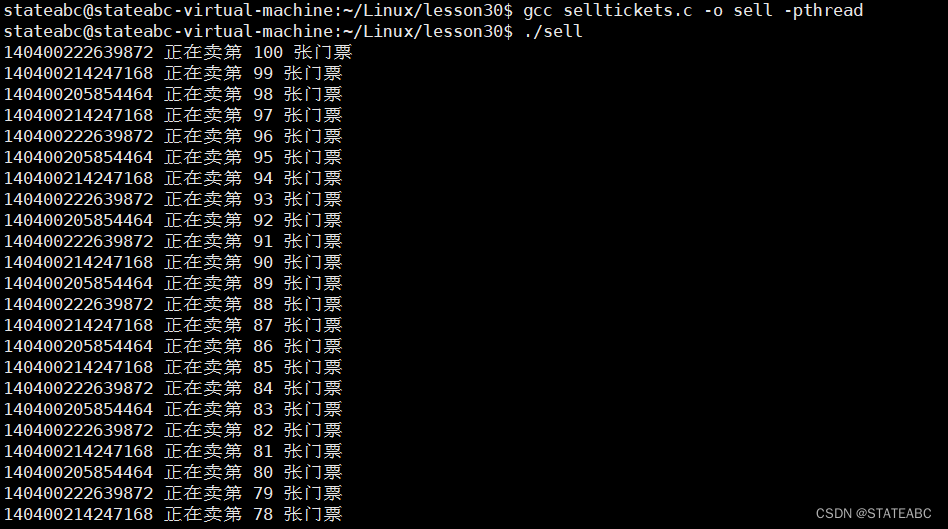
这是因为三个线程并发执行,
假设tickets==1,线程A判断tickets>0,休眠6000微秒,
此时线程B可能执行,判断tickets>0,同样休眠6000微秒后执行执行程序,
就造成了卖-1张门票的情况;
而卖同一张门票的情况也是类似,比如线程A正在打印票数还没有执行–、而线程B已经打印完成这些情况就需要用到线程同步,确保同一时间只能由一个线程操作
线程同步概念
线程的主要优势在于,能够通过全局变量来共享信息。不过,这种便捷的共享是有代价的:必须确保多个线程不会同时修改同一变量,或者某一线程不会读取正在由其他线程修改的变量。
临界区是指访问某一共享资源的代码片段,并且这段代码的执行应为原子操作,也就是同时访问同一共享资源的其他线程不应该中断该片段的执行。
线程同步:即当有一个线程在对内存进行操作时,其他线程都不可以对这个内存地址进行操作,直到该线程完成操作,其他线程才能对该内存地址进行操作,而其他线程则处于等待状态。
互斥量
为避免线程更新共享变量时出现问题,可以使用互斥量(mutex)来确保同时仅有一个线程可以访问某项共享资源,可以使用互斥量来保证对任意共享资源的原子访问。
互斥量有两种状态:已锁定(locked)和未锁定(unlocked)。任何时候,至多只有一个线程可以锁定该互斥量。试图对已经锁定的某一互斥量再次加锁,将可能阻塞线程或者报错失败,具体取决于加锁时使用的方法。
一旦线程锁定互斥量,随即成为该互斥量的所有者,只有所有者才能给互斥量解锁。一般情况下,对每一共享资源(可能由多个相关变量组成)会使用不同的互斥量,每一线程在访问同一资源时将采用如下协议:
针对共享资源锁定互斥量;
访问共享资源;
对互斥量解锁。如果多个线程试图执行这一块代码(一个临界区),事实上只有一个线程能够持有该互斥量(其他线程将遭到阻塞),即同时只有一个线程能够进入这段代码区域,如下图所示:

互斥量相关操作函数
互斥量的类型 pthread_mutex_t int pthread_mutex_init(pthread_mutex_t *restrict mutex, const pthread_mutexattr_t *restrict attr); 初始化互斥量 参数 : - mutex : 需要初始化的互斥量变量 - attr : 互斥量相关的属性,NULL - restrict : C语言的修饰符,被修饰的指针不能由另外的一个指针进行操作 int pthread_mutex_destroy(pthread_mutex_t *mutex); - 释放互斥量的资源 int pthread_mutex_lock(pthread_mutex_t *mutex); - 加锁,阻塞的,如果有一个线程加锁了,那么其他的线程只能阻塞等待 int pthread_mutex_trylock(pthread_mutex_t *mutex); - 尝试加锁,如果加锁失败,不会阻塞,会直接返回。 int pthread_mutex_unlock(pthread_mutex_t *mutex); - 解锁- 1
- 2
- 3
- 4
- 5
- 6
- 7
- 8
- 9
- 10
- 11
- 12
- 13
- 14
- 15
- 16
- 17
- 18
- 19
示例:
// 全局变量,所有的线程都共享这一份资源。 int tickets = 1000; // 创建一个互斥量 pthread_mutex_t mutex; void * sellticket(void * arg) { // 卖票 while(1) { pthread_mutex_lock(&mutex); // 加锁 if(tickets > 0) { usleep(6000); printf("%ld 正在卖第 %d 张门票\n", pthread_self(), tickets); tickets--; }else { //卖完了 pthread_mutex_unlock(&mutex); // 解锁 break; } pthread_mutex_unlock(&mutex); // 解锁 } return NULL; } int main() { // 初始化互斥量 pthread_mutex_init(&mutex, NULL); // 创建3个子线程 pthread_t tid1, tid2, tid3; pthread_create(&tid1, NULL, sellticket, NULL); pthread_create(&tid2, NULL, sellticket, NULL); pthread_create(&tid3, NULL, sellticket, NULL); // 回收子线程的资源,阻塞 pthread_join(tid1, NULL); pthread_join(tid2, NULL); pthread_join(tid3, NULL); // 退出主线程 pthread_exit(NULL); // 释放互斥量资源 pthread_mutex_destroy(&mutex); return 0; }- 1
- 2
- 3
- 4
- 5
- 6
- 7
- 8
- 9
- 10
- 11
- 12
- 13
- 14
- 15
- 16
- 17
- 18
- 19
- 20
- 21
- 22
- 23
- 24
- 25
- 26
- 27
- 28
- 29
- 30
- 31
- 32
- 33
- 34
- 35
- 36
- 37
- 38
- 39
- 40
- 41

死锁
有时,一个线程需要同时访问两个或更多不同的共享资源,而每个资源又都由不同的互斥量管理。当超过一个线程加锁同一组互斥量时,就有可能发生死锁。
两个或两个以上的进程在执行过程中,因争夺共享资源而造成的一种互相等待的现象,若无外力作用,它们都将无法推进下去。此时称系统处于死锁状态或系统产生了死锁。
死锁的几种场景:
忘记释放锁;
重复加锁;
多线程多锁,抢占锁资源。读写锁
当有一个线程已经持有互斥锁时,互斥锁将所有试图进入临界区的线程都阻塞住。但是考虑一种情形,当前持有互斥锁的线程只是要读访问共享资源,而同时有其它几个线程也想读取这个共享资源,但是由于互斥锁的排它性,所有其它线程都无法获取锁,也就无法读访问共享资源了,但是实际上多个线程同时读访问共享资源并不会导致问题。
在对数据的读写操作中,更多的是读操作,写操作较少,例如对数据库数据的读写应用。为了满足当前能够允许多个读出,但只允许一个写入的需求,线程提供了读写锁来实现。
读写锁的特点:
如果有其它线程读数据,则允许其它线程执行读操作,但不允许写操作。
如果有其它线程写数据,则其它线程都不允许读、写操作。
写是独占的,写的优先级高。读写锁相关操作函数
读写锁的类型 pthread_rwlock_t int pthread_rwlock_init(pthread_rwlock_t *restrict rwlock, const pthread_rwlockattr_t *restrict attr); //初始化 int pthread_rwlock_destroy(pthread_rwlock_t *rwlock); //释放资源 int pthread_rwlock_rdlock(pthread_rwlock_t *rwlock); //加读锁 int pthread_rwlock_tryrdlock(pthread_rwlock_t *rwlock); //尝试加读锁 int pthread_rwlock_wrlock(pthread_rwlock_t *rwlock); //加写锁 int pthread_rwlock_trywrlock(pthread_rwlock_t *rwlock); //尝试加写锁 int pthread_rwlock_unlock(pthread_rwlock_t *rwlock); //解锁- 1
- 2
- 3
- 4
- 5
- 6
- 7
- 8
示例:8个线程操作同一个全局变量,3个线程不定时写该全局变量,5个线程不定时的读该全局变量
// 创建一个共享数据 int num = 1; pthread_rwlock_t rwlock; void * writeNum(void * arg) { while(1) { pthread_rwlock_wrlock(&rwlock); //加写锁 num++; printf("++write, tid : %ld, num : %d\n", pthread_self(), num); //打印线程ID和num pthread_rwlock_unlock(&rwlock); //解锁 usleep(100); } return NULL; } void * readNum(void * arg) { while(1) { pthread_rwlock_rdlock(&rwlock); //加读锁 printf("===read, tid : %ld, num : %d\n", pthread_self(), num); //打印线程ID和num pthread_rwlock_unlock(&rwlock); //解锁 usleep(100); } return NULL; } int main() { // 初始化读写锁 pthread_rwlock_init(&rwlock, NULL); // 创建3个写线程,5个读线程 pthread_t wtids[3], rtids[5]; for(int i = 0; i < 3; i++) { pthread_create(&wtids[i], NULL, writeNum, NULL); } for(int i = 0; i < 5; i++) { pthread_create(&rtids[i], NULL, readNum, NULL); } // 设置线程分离 for(int i = 0; i < 3; i++) { pthread_detach(wtids[i]); } for(int i = 0; i < 5; i++) { pthread_detach(rtids[i]); } // 退出主线程 pthread_exit(NULL); // 释放读写锁资源 pthread_rwlock_destroy(&rwlock); return 0; }- 1
- 2
- 3
- 4
- 5
- 6
- 7
- 8
- 9
- 10
- 11
- 12
- 13
- 14
- 15
- 16
- 17
- 18
- 19
- 20
- 21
- 22
- 23
- 24
- 25
- 26
- 27
- 28
- 29
- 30
- 31
- 32
- 33
- 34
- 35
- 36
- 37
- 38
- 39
- 40
- 41
- 42
- 43
- 44
- 45
- 46
- 47
- 48
- 49
- 50

生产者和消费者模型

生产者生产商品,将商品放入容器,消费者从容器中取商品。当产品将容器装满,生产者就不能生产了(阻塞),就需要通知消费者取商品;
当消费者将容器中的产品取完,消费者也就不能取商品了,需要通知生产者进行生产。生产者和消费者模型(粗略版):
// 创建一个互斥量确保线程同步 pthread_mutex_t mutex; // 定义链表 struct Node{ int num; struct Node *next; }; // 头结点 struct Node * head = NULL; void * producer(void * arg) { while(1) { // 不断的创建新的节点,添加到链表中,将链表作为容器保存数据 pthread_mutex_lock(&mutex); // 加锁 struct Node * newNode = (struct Node *)malloc(sizeof(struct Node)); // 创建新节点 newNode->next = head; // 头插法插入新节点 head = newNode; newNode->num = rand() % 1000; printf("add node, num : %d, tid : %ld\n", newNode->num, pthread_self()); pthread_mutex_unlock(&mutex); // 解锁 usleep(100); } return NULL; } void * customer(void * arg) { while(1) { pthread_mutex_lock(&mutex); // 加锁 struct Node * tmp = head; // 保存头结点的指针 if(head != NULL) { // 判断是否有数据 head = head->next; // 头节点后移 printf("del node, num : %d, tid : %ld\n", tmp->num, pthread_self()); free(tmp); // 删除原来头节点 pthread_mutex_unlock(&mutex); // 解锁 usleep(100); } else { // 没有数据 pthread_mutex_unlock(&mutex); // 解锁 } } return NULL; } int main() { // 初始化互斥量 pthread_mutex_init(&mutex, NULL); // 创建5个生产者线程,和5个消费者线程 pthread_t ptids[5], ctids[5]; for(int i = 0; i < 5; i++) { pthread_create(&ptids[i], NULL, producer, NULL); pthread_create(&ctids[i], NULL, customer, NULL); } // 线程分离 for(int i = 0; i < 5; i++) { pthread_detach(ptids[i]); pthread_detach(ctids[i]); } //用死循环保证能一直使用互斥量 while(1) { sleep(10); } // 释放互斥量资源 pthread_mutex_destroy(&mutex); // 退出主线程 pthread_exit(NULL); return 0; }- 1
- 2
- 3
- 4
- 5
- 6
- 7
- 8
- 9
- 10
- 11
- 12
- 13
- 14
- 15
- 16
- 17
- 18
- 19
- 20
- 21
- 22
- 23
- 24
- 25
- 26
- 27
- 28
- 29
- 30
- 31
- 32
- 33
- 34
- 35
- 36
- 37
- 38
- 39
- 40
- 41
- 42
- 43
- 44
- 45
- 46
- 47
- 48
- 49
- 50
- 51
- 52
- 53
- 54
- 55
- 56
- 57
- 58
- 59
- 60
- 61
- 62
- 63
- 64
- 65
- 66
- 67
- 68
- 69
在producer中生产者不断生产,customer中消费者不断消费
但即使链表中没有数据,customer中也会不断判断链表中是否有数据,造成了资源的浪费,
因此可以进行优化,当链表中没有数据,就通知生产者进行生产,生产完成后通知消费者进行消费,此时就要用到条件变量条件变量
满足某个条件时,阻塞线程;
满足某个条件时,解除阻塞。条件变量的类型 pthread_cond_t int pthread_cond_init(pthread_cond_t *restrict cond, const pthread_condattr_t *restrict attr); int pthread_cond_destroy(pthread_cond_t *cond); int pthread_cond_wait(pthread_cond_t *restrict cond, pthread_mutex_t *restrict mutex); - 等待,调用了该函数,线程会阻塞。 int pthread_cond_timedwait(pthread_cond_t *restrict cond, pthread_mutex_t *restrict mutex, const struct timespec *restrict abstime); - 等待多长时间,调用了这个函数,线程会阻塞,直到指定的时间结束。 int pthread_cond_signal(pthread_cond_t *cond); - 唤醒一个或者多个等待的线程 int pthread_cond_broadcast(pthread_cond_t *cond); - 唤醒所有的等待的线程- 1
- 2
- 3
- 4
- 5
- 6
- 7
- 8
- 9
- 10
- 11
案例:
// 创建一个互斥量确保线程同步 pthread_mutex_t mutex; // 创建条件变量 pthread_cond_t cond; // 定义链表 struct Node{ int num; struct Node *next; }; // 头结点 struct Node * head = NULL; void * producer(void * arg) { while(1) { // 不断的创建新的节点,添加到链表中,将链表作为容器保存数据 pthread_mutex_lock(&mutex); // 加锁 struct Node * newNode = (struct Node *)malloc(sizeof(struct Node)); // 创建新节点 newNode->next = head; // 头插法插入新节点 head = newNode; newNode->num = rand() % 1000; printf("add node, num : %d, tid : %ld\n", newNode->num, pthread_self()); pthread_cond_signal(&cond); // 只要生产了一个,就通知消费者消费 pthread_mutex_unlock(&mutex); // 解锁 usleep(100); } return NULL; } void * customer(void * arg) { while(1) { pthread_mutex_lock(&mutex); // 加锁 struct Node * tmp = head; // 保存头结点的指针 if(head != NULL) { // 判断是否有数据 head = head->next; printf("del node, num : %d, tid : %ld\n", tmp->num, pthread_self()); free(tmp); pthread_mutex_unlock(&mutex); usleep(100); } else { // 没有数据,需要等待 // 当这个函数调用阻塞的时候,会对互斥锁进行解锁,当不阻塞的,继续向下执行,会重新加锁。 pthread_cond_wait(&cond, &mutex); pthread_mutex_unlock(&mutex); //解锁 } } return NULL; } int main() { pthread_mutex_init(&mutex, NULL); // 初始化互斥量 pthread_cond_init(&cond, NULL); // 初始化条件变量 // 创建5个生产者线程,和5个消费者线程 pthread_t ptids[5], ctids[5]; for(int i = 0; i < 5; i++) { pthread_create(&ptids[i], NULL, producer, NULL); pthread_create(&ctids[i], NULL, customer, NULL); } // 线程分离 for(int i = 0; i < 5; i++) { pthread_detach(ptids[i]); pthread_detach(ctids[i]); } //用死循环保证能一直使用互斥量 while(1) { sleep(10); } pthread_mutex_destroy(&mutex); // 释放互斥量资源 pthread_cond_destroy(&cond); // 释放条件变量资源 // 退出主线程 pthread_exit(NULL); return 0; }- 1
- 2
- 3
- 4
- 5
- 6
- 7
- 8
- 9
- 10
- 11
- 12
- 13
- 14
- 15
- 16
- 17
- 18
- 19
- 20
- 21
- 22
- 23
- 24
- 25
- 26
- 27
- 28
- 29
- 30
- 31
- 32
- 33
- 34
- 35
- 36
- 37
- 38
- 39
- 40
- 41
- 42
- 43
- 44
- 45
- 46
- 47
- 48
- 49
- 50
- 51
- 52
- 53
- 54
- 55
- 56
- 57
- 58
- 59
- 60
- 61
- 62
- 63
- 64
- 65
- 66
- 67
- 68
- 69
- 70
- 71
- 72
- 73
- 74
- 75
- 76
- 77
- 78
- 79
信号量
信号量的类型 sem_t int sem_init(sem_t *sem, int pshared, unsigned int value); 作用:初始化信号量 参数: - sem : 信号量变量的地址 - pshared : 0 用在线程间 ,非0 用在进程间 - value : 信号量中的值 int sem_destroy(sem_t *sem); - 释放资源 int sem_wait(sem_t *sem); - 对信号量加锁,调用一次对信号量的值-1,如果值为0,就阻塞 int sem_trywait(sem_t *sem); - 尝试阻塞 int sem_timedwait(sem_t *sem, const struct timespec *abs_timeout); - 设置阻塞的时间 int sem_post(sem_t *sem); - 对信号量解锁,调用一次对信号量的值+1 int sem_getvalue(sem_t *sem, int *sval); - 获取信号量中的值- 1
- 2
- 3
- 4
- 5
- 6
- 7
- 8
- 9
- 10
- 11
- 12
- 13
- 14
- 15
- 16
- 17
- 18
- 19
- 20
- 21
- 22
- 23
- 24
- 25
案例:
// 创建一个互斥量 pthread_mutex_t mutex; // 创建两个信号量 sem_t psem; sem_t csem; struct Node{ int num; struct Node *next; }; // 头结点 struct Node * head = NULL; void * producer(void * arg) { // 不断的创建新的节点,添加到链表中 while(1) { sem_wait(&psem); pthread_mutex_lock(&mutex); struct Node * newNode = (struct Node *)malloc(sizeof(struct Node)); newNode->next = head; head = newNode; newNode->num = rand() % 1000; printf("add node, num : %d, tid : %ld\n", newNode->num, pthread_self()); pthread_mutex_unlock(&mutex); sem_post(&csem); } return NULL; } void * customer(void * arg) { while(1) { sem_wait(&csem); pthread_mutex_lock(&mutex); // 保存头结点的指针 struct Node * tmp = head; head = head->next; printf("del node, num : %d, tid : %ld\n", tmp->num, pthread_self()); free(tmp); pthread_mutex_unlock(&mutex); sem_post(&psem); } return NULL; } int main() { pthread_mutex_init(&mutex, NULL); sem_init(&psem, 0, 8); sem_init(&csem, 0, 0); // 创建5个生产者线程,和5个消费者线程 pthread_t ptids[5], ctids[5]; for(int i = 0; i < 5; i++) { pthread_create(&ptids[i], NULL, producer, NULL); pthread_create(&ctids[i], NULL, customer, NULL); } for(int i = 0; i < 5; i++) { pthread_detach(ptids[i]); pthread_detach(ctids[i]); } while(1) { sleep(10); } pthread_mutex_destroy(&mutex); pthread_exit(NULL); return 0; }- 1
- 2
- 3
- 4
- 5
- 6
- 7
- 8
- 9
- 10
- 11
- 12
- 13
- 14
- 15
- 16
- 17
- 18
- 19
- 20
- 21
- 22
- 23
- 24
- 25
- 26
- 27
- 28
- 29
- 30
- 31
- 32
- 33
- 34
- 35
- 36
- 37
- 38
- 39
- 40
- 41
- 42
- 43
- 44
- 45
- 46
- 47
- 48
- 49
- 50
- 51
- 52
- 53
- 54
- 55
- 56
- 57
- 58
- 59
- 60
- 61
- 62
- 63
- 64
- 65
- 66
- 67
- 68
- 69
- 70
- 71
- 72
- 73
- 74
- 75
- 76
- 77
- 78
- 79
-
相关阅读:
智慧路灯杆AI监测应用,让高速出行更安全
MyBatis开荒
【STM32】IIC(Inter Integrated Cirruit--集成电路总线)
电容笔有必要买苹果原装的吗?ipad第三方电容笔了解下
2022DAMA数据治理最佳培训机构奖
Linux--CE--ansible安装以及配置主控服务器和被控服务器
【Vue】ref引用,插槽
PYTHON专题-(11)基操之我要发邮件
百川的大模型KnowHow
【送书活动】Photoshop——神秘生物的艺术创造与文化探索
- 原文地址:https://blog.csdn.net/STATEABC/article/details/125391821