BeautifulSoup4库

和 lxml 一样,Beautiful Soup 也是一个HTML/XML的解析器,主要的功能也是如何解析和提取 HTML/XML 数据。
lxml 只会局部遍历,而Beautiful Soup 是基于HTML DOM(Document Object Model)的,会载入整个文档,解析整个DOM树,因此时间和内存开销都会大很多,所以性能要低于lxml。
Beautiful Soup 3 目前已经停止开发,推荐现在的项目使用Beautiful Soup 4。
安装和文档:
安装:pip install bs4
中文文档:https://www.crummy.com/software/BeautifulSoup/bs4/doc/index.zh.html
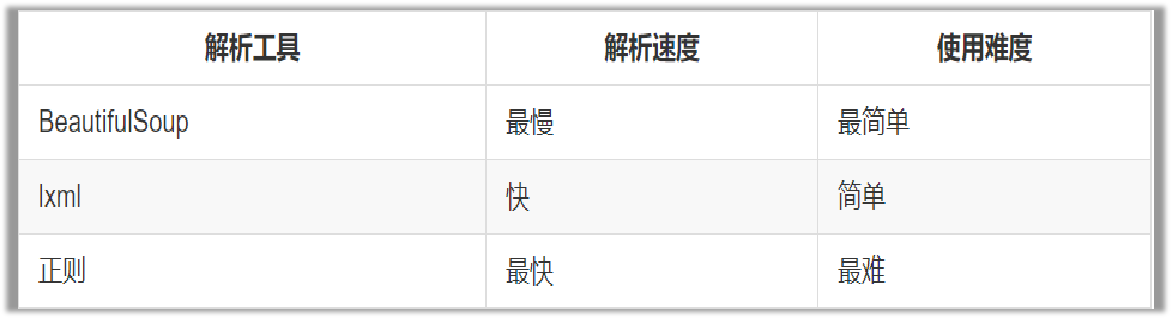
几大解析工具对比:
安装解析器
- pip install lxml (推荐)
- pip install html5lib
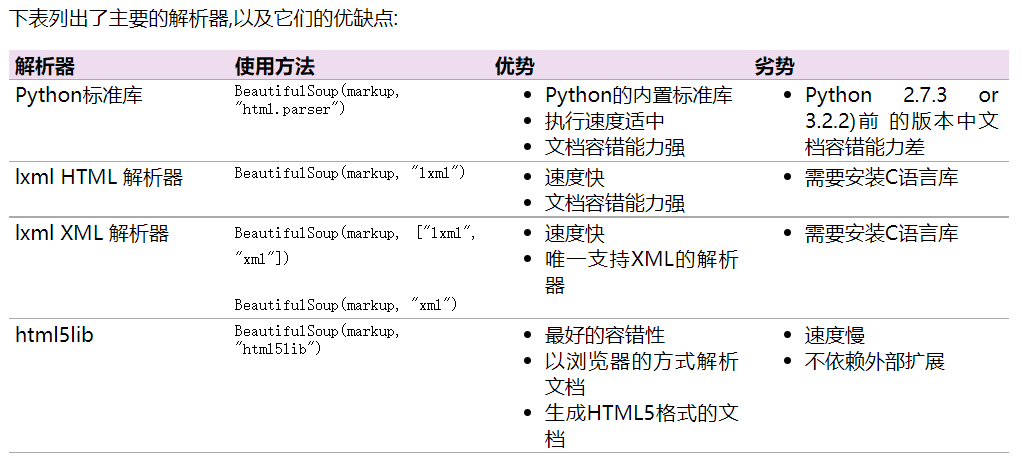
推荐使用lxml作为解析器,因为效率更高. 在Python2.7.3之前的版本和Python3中3.2.2之前的版本,必须安装lxml或html5lib, 因为那些Python版本的标准库中内置的HTML解析方法不够稳定.
提示: 如果一段HTML或XML文档格式不正确的话,那么在不同的解析器中返回的结果可能是不一样的,查看 解析器之间的区别 了解更多细节
简单使用:
from bs4 import BeautifulSoup

html = """
<html><head><title>The Dormouse's story</title></head>
<body>
<p class="title" name="dromouse"><b>The Dormouse's story</b></p>
<p class="story">Once upon a time there were three little sisters; and their names were
<a href="http://example.com/elsie" class="sister" id="link1"><!-- Elsie --></a>,
<a href="http://example.com/lacie" class="sister" id="link2">Lacie</a> and
<a href="http://example.com/tillie" class="sister" id="link3">Tillie</a>;
and they lived at the bottom of a well.</p>
<p class="story">...</p>
"""

soup = BeautifulSoup(html,'lxml')
print(soup.prettify())
常见的四种对象:
1.Tag:#
Tag 通俗点讲就是 HTML 中的一个个标签。我们可以利用 soup 加标签名轻松地获取这些标签的内容,这些对象的类型是bs4.element.Tag。但是注意,它查找的是在所有内容中的第一个符合要求的标签。
2.NavigableString:#
如果拿到标签后,还想获取标签中的内容。那么可以通过tag.string获取标签中的文字,底层继承了str对象,可以当作字符串来使用
from bs4.element import NavigableString
3. BeautifulSoup:#
BeautifulSoup 对象表示的是一个文档的全部内容.大部分时候,可以把它当作 Tag 对象,因为底层继承了Tag对象,它支持 遍历文档树 和 搜索文档树 中描述的大部分的方法.
from bs4 import BeautifulSoup
4.Comment:#
Tag , NavigableString , BeautifulSoup 几乎覆盖了html和xml中的所有内容,但是还有一些特殊对象.容易让人担心的内容是文档的注释部分
Comment 对象是一个特殊类型的 NavigableString 对象,底层继承了NavigableString ;
from bs4.element import Comment
遍历文档树:
contents和children:#
-
contents和children:
- contents:返回所有子节点的列表
- children:返回所有子节点的迭代器
异同:返回某个标签下的直接子元素,其中也包括字符串。他们两的区别是:contents返回来的是一个列表,children返回的是一个迭代器。
-
strings 和 stripped_strings
- strings:如果tag中包含多个字符串 ,可以使用
.strings来循环获取 - stripped_strings:输出的字符串中可能包含了很多空格或空行,使用
.stripped_strings可以去除多余空白内容
- strings:如果tag中包含多个字符串 ,可以使用
string和strings、stripped_strings属性以及get_text方法
- string:获取某个标签下的非标签字符串。返回来的是个字符串。如果这个标签下有多行字符,那么就不能获取到了。
- strings:获取某个标签下的子孙非标签字符串。返回来的是个生成器。
- stripped_strings:获取某个标签下的子孙非标签字符串,会去掉空白字符。返回来的是个生成器。
- get_text:获取某个标签下的子孙非标签字符串,以普通字符串形式返回
from bs4 import BeautifulSoup

html = """
<html><head><title>The Dormouse's story</title></head>
<body>
<p class="title" name="dromouse"><b>The Dormouse's story</b></p>
<p class="story">Once upon a time there were three little sisters; and their names were
<a href="http://example.com/elsie" class="sister" id="link1"><!-- Elsie --></a>,
<a href="http://example.com/lacie" class="sister" id="link2">Lacie</a> and
<a href="http://example.com/tillie" class="sister" id="link3">Tillie</a>;
and they lived at the bottom of a well.</p>
<p class="story">...</p>
<footer><!--注释内容--></footer>
"""
# 实例化
# soup=BeautifulSoup(html,'html.parser')
soup = BeautifulSoup(html,'lxml')

# print(soup)   # 自动补全
# print(soup.prettify())   # 美化输出
'''Tag对象'''
# print(type(soup.p))   # <class 'bs4.element.Tag'> ---> Tag对象
# print(soup.p)   # 返回第一个p标签
# print(soup.p.text)  # The Dormouse's story

# print(soup.p.name)  # 输出p标签的名字 ---> p
# print(soup.title.name) # 输出title标签的名字  --->title
# print(soup.p.attrs)  # 输出p标签属性   ----->   {'class': ['title'], 'name': 'dromouse'}
# print(soup.p.get('class')) # 因为class可能有多个,所以是列表
# print(soup.p['class'])   #  输出p标签的属性值  ----> ['title']

'''NavigableString对象,如果p标签内套了标签需要注意'''
# print(type(soup.p.string))  # <class 'bs4.element.NavigableString'>
# print(soup.p.string)   # 获取标签内容,当标签只有文本或者只有一个子文本才返回,如果有多个文本或标签返回None----->None
# print(soup.p.text)  # 当前标签和子子孙的文本内容拼到一起   ----->HammerZeThe Dormouse's story
# print(soup.p.strings) # 把子子孙孙的文本内容放到generator  -----><generator object _all_strings at 0x0000028DDAE8FA40>
# print(list(soup.p.strings)) # --> ['HammerZe', "The Dormouse's story"]

'''BeautifulSoup对象'''
# print(type(soup))  # <class 'bs4.BeautifulSoup'>

'''Comment对象'''
from bs4.element import Comment
# print(soup.footer.string)  # --->注释内容
# print(type(soup.footer.string))  # <class 'bs4.element.Comment'>

# 嵌套选择
# print(soup.head.title.string)  # The Dormouse's story

# 子节点、子孙节点
# head_tag = soup.head
# print(head_tag.contents)  # 返回子节点---->[<title>The Dormouse's story</title>]
# print(soup.p.contents)  # p下所有子节点,放到列表中 --->[<b>The Dormouse's story</b>]
# print(list(soup.p.children)) # 得到一个迭代器,包含p下所有子节点,跟contents本质一样,只是节约内存  ---> [<b>The Dormouse's story</b>]
# print(list(soup.p.descendants)) # 获取子孙节点,p下所有的标签都会选择出来  子子孙孙  --->   [<b>The Dormouse's story</b>, "The Dormouse's story"]
# for i,child in enumerate(soup.p.children):
#     print(i,child)
# for i,child in enumerate(soup.p.descendants):
#     print(i,child)

# 父节点、祖先节点
# print(soup.a.parent) # 获取a标签的父节点
# print(soup.a.parents) # <generator object parents at 0x000002042AD6FA40>
# print(list(soup.a.parents)) # 找到a标签所有的祖先节点,父亲的父亲,父亲的父亲的父亲...

# 兄弟节点
print(soup.a.next_sibling) # 下一个兄弟
print(soup.a.previous_sibling) # 上一个兄弟

print(list(soup.a.next_siblings)) # 下面的兄弟们=>生成器对象
print(soup.a.previous_siblings) # 上面的兄弟们=>生成器对象
搜索文档树:
find、find_all的使用:#
find和find_all方法:
-
搜索文档树,一般用得比较多的就是两个方法,一个是find,一个是find_all。
-
find方法是找到第一个满足条件的标签后就立即返回,只返回一个元素。
-
find_all方法是把所有满足条件的标签都选到,然后返回回去。
find与find_all的区别:#
- find:找到第一个满足条件的标签就返回。说白了,就是只会返回一个元素。
- find_all:将所有满足条件的标签都返回。说白了,会返回很多标签(以列表的形式)。
使用find和find_all的过滤条件:
- 关键字参数:将属性的名字作为关键字参数的名字,以及属性的值作为关键字参数的值进行过滤。
- attrs参数:将属性条件放到一个字典中,传给attrs参数。
获取标签的属性:
-
通过下标获取:通过标签的下标的方式。
href = a['href'] -
通过attrs属性获取:示例代码:
href = a.attrs['href']demo1
#--coding:utf-8--

from bs4 import BeautifulSoup

html = """
<table class="tablelist" cellpadding="0" cellspacing="0">
    <tbody>
        <tr class="h">
            <td class="l" width="374">职位名称</td>
            <td>职位类别</td>
            <td>人数</td>
            <td>地点</td>
            <td>发布时间</td>
        </tr>
        <tr class="even">
            <td class="l square"><a target="_blank" href="position_detail.php?id=33824&keywords=python&tid=87&lid=2218">22989-金融云区块链高级研发工程师(深圳)</a></td>
            <td>技术类</td>
            <td>1</td>
            <td>深圳</td>
            <td>2017-11-25</td>
        </tr>
        <tr class="odd">
            <td class="l square"><a target="_blank" href="position_detail.php?id=29938&keywords=python&tid=87&lid=2218">22989-金融云高级后台开发</a></td>
            <td>技术类</td>
            <td>2</td>
            <td>深圳</td>
            <td>2017-11-25</td>
        </tr>
        <tr class="even">
            <td class="l square"><a target="_blank" href="position_detail.php?id=31236&keywords=python&tid=87&lid=2218">SNG16-腾讯音乐运营开发工程师(深圳)</a></td>
            <td>技术类</td>
            <td>2</td>
            <td>深圳</td>
            <td>2017-11-25</td>
        </tr>
        <tr class="odd">
            <td class="l square"><a target="_blank" href="position_detail.php?id=31235&keywords=python&tid=87&lid=2218">SNG16-腾讯音乐业务运维工程师(深圳)</a></td>
            <td>技术类</td>
            <td>1</td>
            <td>深圳</td>
            <td>2017-11-25</td>
        </tr>
        <tr class="even">
            <td class="l square"><a target="_blank" href="position_detail.php?id=34531&keywords=python&tid=87&lid=2218">TEG03-高级研发工程师(深圳)</a></td>
            <td>技术类</td>
            <td>1</td>
            <td>深圳</td>
            <td>2017-11-24</td>
        </tr>
        <tr class="odd">
            <td class="l square"><a target="_blank" href="position_detail.php?id=34532&keywords=python&tid=87&lid=2218">TEG03-高级图像算法研发工程师(深圳)</a></td>
            <td>技术类</td>
            <td>1</td>
            <td>深圳</td>
            <td>2017-11-24</td>
        </tr>
        <tr class="even">
            <td class="l square"><a target="_blank" href="position_detail.php?id=31648&keywords=python&tid=87&lid=2218">TEG11-高级AI开发工程师(深圳)</a></td>
            <td>技术类</td>
            <td>4</td>
            <td>深圳</td>
            <td>2017-11-24</td>
        </tr>
        <tr class="odd">
            <td class="l square"><a target="_blank" href="position_detail.php?id=32218&keywords=python&tid=87&lid=2218">15851-后台开发工程师</a></td>
            <td>技术类</td>
            <td>1</td>
            <td>深圳</td>
            <td>2017-11-24</td>
        </tr>
        <tr class="even">
            <td class="l square"><a target="_blank" href="position_detail.php?id=32217&keywords=python&tid=87&lid=2218">15851-后台开发工程师</a></td>
            <td>技术类</td>
            <td>1</td>
            <td>深圳</td>
            <td>2017-11-24</td>
        </tr>
        <tr class="odd">
            <td class="l square"><a id="test" class="test" target='_blank' href="position_detail.php?id=34511&keywords=python&tid=87&lid=2218">SNG11-高级业务运维工程师(深圳)</a></td>
            <td>技术类</td>
            <td>1</td>
            <td>深圳</td>
            <td>2017-11-24</td>
        </tr>
    </tbody>
</table>
"""

soup = BeautifulSoup(html,'lxml')

# 1. 获取所有tr标签
# trs = soup.find_all('tr')  # 列表
# for tr in trs:
#     print(tr)
#     print('-'*50)

# 2. 获取第2个tr标签
# print(soup.find_all('tr', limit=2)[1])

# 3. 获取所有class等于even的tr标签
# trs = soup.find_all('tr',class_ = 'even')
# trs = soup.find_all('tr',attrs={'class':'even'})
# for tr in trs:
#     print(tr)
#     print('-'*50)

# 4. 将所有id等于test,class也等于test的a标签提取出来。
# list = soup.find_all('a',id= 'test',class_='test')
# for a in list:
#     print(a)

# 5. 获取所有a标签的href属性
# alist = soup.find_all('a')
# for a in alist:
#     #1.
#     # href = a['href']
#     # print(href)
#     #2.
#     href = a.attrs['href']
#     print(href)


# 6. 获取所有的职位信息(纯文本)
trs = soup.find_all('tr')[1:]
# print(trs)
lists = []
for tr in trs:
    info = {}
    tds = tr.find_all('td')
    # print(tds)
    name = tds[0].string
    category = tds[1].string
    info['name']=name
    info['category']=category
    # infos = list(tr.stripped_strings)
    infos =tr.get_text()
    print(infos)

    lists.append(info)
print(lists)
demo2
from bs4 import BeautifulSoup

html_doc = """
<html><head><title>The Dormouse's story</title></head>
<body>
<p class="title" id="id_p">lqz<b>The Dormouse's story</b></p>

<p class="story">Once upon a time there were three little sisters; and their names were
<a href="http://example.com/elsie" class="sister" id="link1">Elsie</a>,
<a href="http://example.com/lacie" class="sister" id="link2">Lacie</a> and
<a href="http://example.com/tillie" class="sister" id="link3">Tillie</a>;
and they lived at the bottom of a well.</p>

<p class="story">...</p>
"""
soup = BeautifulSoup(html_doc, 'lxml')


# 1、五种过滤器: 字符串、正则表达式、列表、True、方法
# find:找到第一个      find_all:找所有

# 字符串  --->value值是字符串
# res=soup.find_all(name='p')
# res=soup.find(id='id_p')
# res=soup.find_all(class_='story')
# res=soup.find_all(name='p',class_='story')  # and条件
# res=soup.find(name='a',id='link2').text
# res=soup.find(name='a',id='link2').attrs.get('href')
# res=soup.find(attrs={'id':'link2','class':'sister'}).attrs.get('href')
# print(res)


# 正则表达式--->value是正则表达式
# import re
#
# # res=soup.find_all(name=re.compile('^b'))
# # res=soup.find_all(href=re.compile('^http'))
# res=soup.find_all(class_=re.compile('^s'))
# print(res)


# 列表  value值是列表
# res=soup.find_all(name=['body','a'])
# res=soup.find_all(class_=['sister','story'])
# res=soup.find_all(id=['link2','link3'])
# print(res)

# True   value值是True
# res=soup.find_all(name=True)
# res=soup.find_all(id=True)
# res=soup.find_all(href=True)
# print(res)


# 方法

# def has_class_but_no_id(tag):
#     return tag.has_attr('class') and not tag.has_attr('id')
#
# print(soup.find_all(name=has_class_but_no_id))  # 有class但是没有id的标签


#1 html页面中,只要有的东西,通过bs4都可以解析出来
#2 遍历文档树+搜索文档树混用
# def has_class_but_no_id(tag):
#     return tag.has_attr('class') and not tag.has_attr('id')
# print(soup.find(name=has_class_but_no_id).a.text)

# 3 find_all的其他参数limit:限制取几条  recursive:是否递归查找

# def has_class_but_no_id(tag):
#     return tag.has_attr('class') and not tag.has_attr('id')
# res=soup.find_all(name=has_class_but_no_id,limit=1)
#
# print(res)
#
# res=soup.find_all(name='a',recursive=False)  #不递归查找,速度快,只找一层
# print(res)
CSS选择器:
select方法:#
使用以上方法可以方便的找出元素。但有时候使用css选择器的方式可以更加的方便。使用css选择器的语法,应该使用select方法。以下列出几种常用的css选择器方法:
(1)通过标签名查找:#
print(soup.select('a'))
(2)通过类名查找:#
通过类名,则应该在类的前面加一个.。比如要查找class=sister的标签。示例代码如下:
print(soup.select('.sister'))
(3)通过id查找:#
通过id查找,应该在id的名字前面加一个#号。示例代码如下:
print(soup.select("#link1"))
(4)组合查找:#
组合查找即和写 class 文件时,标签名与类名、id名进行的组合原理是一样的,例如查找 p 标签中,id 等于 link1的内容,二者需要用空格分开:
print(soup.select("p #link1"))
直接子标签查找,则使用 > 分隔:
print(soup.select("head > title"))
(5)通过属性查找:#
查找时还可以加入属性元素,属性需要用中括号括起来,注意属性和标签属于同一节点,所以中间不能加空格,否则会无法匹配到。示例代码如下:
print(soup.select('a[href="http://example.com/elsie"]'))
(6)获取内容#
以上的 select 方法返回的结果都是列表形式,可以遍历形式输出,然后用 get_text() 方法来获取它的内容。
soup = BeautifulSoup(html, 'lxml')
print(type(soup.select('title')))
print(soup.select('title')[0].get_text())

for title in soup.select('title'):
    print(title.get_text())
(7) 页面复制#
# 终极大招
import requests
response=requests.get('https://www.runoob.com/cssref/css-selectors.html')
soup=BeautifulSoup(response.text,'lxml')
res=soup.select_one('#content > table > tbody > tr:nth-child(2) > td:nth-child(3)').text
print(res)