-
OJ题讲解——栈与队列
目录
一.有效的括号
1.问题描述

2.问题详解
对于这道题,采用栈来解决
1.如果是左括号就入栈
2.如果是右括号,取栈顶元素与之匹配
2.1 当栈里面为空时,表明右括号多了,没有左括号与之匹配,返回false
2.2 由于匹配的情况有很多种,无法一一列全,于是我们来判断不匹配的情况,当左右括号不匹配就返回false
2.3 当所有的右括号匹配完后还要检查栈是否为空,可能还有左括号没有匹配
3.代码
注意;
本篇博客都是在c语言的环境下,当涉及到用栈和队列,需要用户自己先创建栈或队列
- bool isValid(char* s) {
- //1.左括号入栈
- //2.右括号与出栈顶的左括号匹配
- ST st;
- STInit(&st);
- while(*s)
- {
- //左括号入栈
- if(*s=='('||*s=='['||*s=='{')
- {
- STPush(&st,*s);
- }
- else//右括号与出栈顶的左括号匹配
- {
- if(STEmpty(&st))
- {
- STDestroy(&st);
- return false;
- }
- char top=STTop(&st);
- STPop(&st);
- //不匹配的情况·
- if((top=='('&&*s!=')')
- ||(top=='['&&*s!=']')
- ||(top=='{'&&*s!='}'))
- {
- STDestroy(&st);
- return false;
- }
- }
- s++;
- }
- //栈不为空,说明左括号比右括号多,不匹配
- bool ret=STEmpty(&st);
- STDestroy(&st);
- return ret;
- }
二.用队列实现栈
1.问题描述
OJ链接:. - 力扣(LeetCode)

2.问题详解
1.先创建一个结构体,里面存储俩个队列
2.对于实现栈push,top,pop,empty四个操作中,最麻烦的是pop操作,因为队列pop的是队头元素,而栈pop的是栈顶元素,因此我们需要用到俩个队列,保持一个队列存数据,一个队列为空,pop数据需要通过空队列导一下,将前size-1个数据按顺序边导到空队列中边删除掉,将最后一个数据保存后再删除掉,这样就获取栈顶的数据并且pop成功
3.top操作可以直接返回非空队列的队尾元素
4.push操作直接导入不为空的队列中
5.empty操作需要对俩个队列都进行判空操作
3.代码
- typedef struct {
- Queue q1;
- Queue q2;
- } MyStack;
- MyStack* myStackCreate() {
- MyStack*pst=(MyStack*)malloc(sizeof(MyStack));
- QueueInit(&(pst->q1));
- QueueInit(&(pst->q2));
- return pst;
- }
- void myStackPush(MyStack* obj, int x) {
- //将数据导入不为空的那个队列
- if(!QueueEmpty(&(obj->q1)))
- {
- //栈顶插入刚好就是队尾插入
- QueuePush(&(obj->q1),x);
- }
- else
- {
- QueuePush(&(obj->q2),x);
- }
- }
- int myStackPop(MyStack* obj) {
- //假设法
- Queue*empty=&(obj->q1);
- Queue*nonempty=&(obj->q2);
- if(!QueueEmpty(&(obj->q1)))
- {
- empty=&(obj->q2);
- nonempty=&(obj->q1);
- }
- //将有数据的队列的前size-1个导到空队列
- while(QueueSize(nonempty)>1)
- {
- QueuePush(empty,Queuefront(nonempty));
- QueuePop(nonempty);
- }
- int top= Queuefront(nonempty);
- QueuePop(nonempty);
- return top;
- }
- int myStackTop(MyStack* obj) {
- if(!QueueEmpty(&(obj->q1)))
- {
- return QueueBack(&(obj->q1));
- }
- else
- {
- return QueueBack(&(obj->q2));
- }
- }
- bool myStackEmpty(MyStack* obj) {
- return QueueEmpty(&(obj->q1))&&QueueEmpty(&(obj->q2));
- }
- void myStackFree(MyStack* obj) {
- QueueDestroy(&(obj->q1));
- QueueDestroy(&(obj->q2));
- free(obj);
- }
三.用栈实现队列1.问题描述
OJ链接:. - 力扣(LeetCode)

2.问题详解
创建俩个栈,分别为pushst和popst,pushst用来插入数据,popst用来导数据,删除队头元素(注意:与上问题的俩个队列不同,用队列实现栈需要俩个队列相互导数据,保证一个队列始终为空,而这个问题不需要俩个栈相互导数据),如下图所示:

通过上面的三个步骤,我们可以看出,当popst栈中为空,又需要pop队头元素时,我们直接将pushst栈中的元素导导popst栈中,然后删除的栈顶元素就是队头元素,同时当pushst和popst中都有元素,又想删除队头元素时,我们不需要再将pushst栈中的元素导到popst栈中去,只需要删除popst栈顶元素就好了。因此,插入数据只需要插入到pushst中,而删除队头数据,只有当popst栈中没有元素时,才需要将pushst中的元素全部导入popst中去,再删除栈顶元素
3.代码
- typedef struct {
- ST pushst;//用来输入数据
- ST popst;//用来倒数据,实现删除
- } MyQueue;
- MyQueue* myQueueCreate() {
- MyQueue*obj=(MyQueue*)malloc(sizeof(MyQueue));
- STInit(&(obj->pushst));
- STInit(&(obj->popst));
- return obj;
- }
- void myQueuePush(MyQueue* obj, int x) {
- STPush(&(obj->pushst),x);
- }
- int myQueuePop(MyQueue* obj) {
- int top=myQueuePeek(obj);
- STPop(&(obj->popst));
- return top;
- }
- int myQueuePeek(MyQueue* obj) {
- if(STEmpty(&(obj->popst)))
- {
- //倒数据
- while(!STEmpty(&(obj->pushst)))
- {
- int top=STTop(&(obj->pushst));
- STPush(&(obj->popst),top);
- STPop(&(obj->pushst));
- }
- }
- return STTop(&(obj->popst));
- }
- bool myQueueEmpty(MyQueue* obj) {
- return STEmpty(&(obj->pushst))&&STEmpty(&(obj->popst));
- }
- void myQueueFree(MyQueue* obj) {
- STDestroy(&(obj->pushst));
- STDestroy(&(obj->popst));
- free(obj);
- }
四.设计循环队列
1.问题描述
OJ链接:. - 力扣(LeetCode)

2.问题详解

循环队列是一种空间大小固定,空间能够反复利用的队列,这个队列也可以采用链表和数组来实现。
首先分析链表,用链表的优势在于它可以实现循环,但是创建链表要比队列大小多开一个节点,避免假溢出问题,因为head和tail初始化为头节点,tail实际表示的是最后一个数据指向的下一个节点。而链表的难点在于尾节点的获取,如果是单链表就需要从头开始遍历节点,增加了时间复杂度,或者再定义一个指针指向tail前一个节点,如果是双向链表恰好可以解决这个问题。
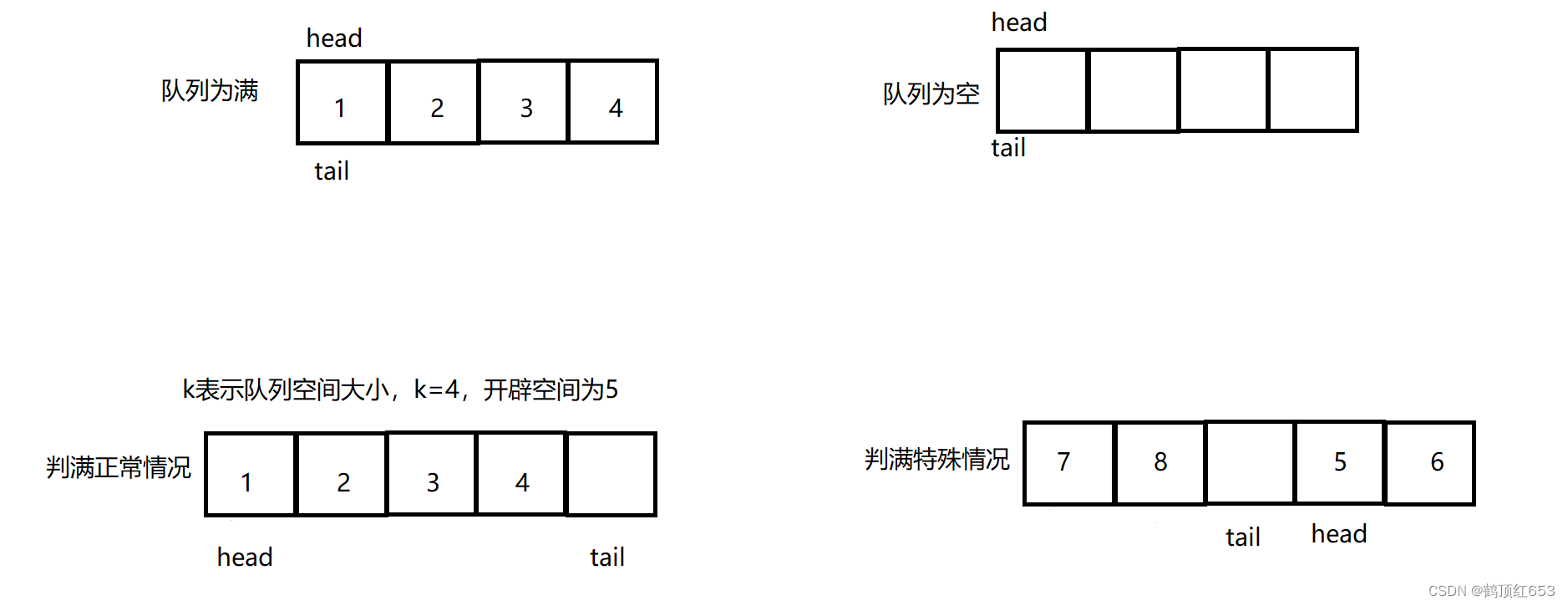
如果用数组来实现的话,当head和tail都初始化为0,我们来看看这个式子head==tail表示的是什么?好像表示队列满了又好像队列为空?这意思不矛盾了吗!对于解决这个有俩个办法,一是再定义一个size记录队列中元素的个数和队列空间大小进行比较,二是再开一个空间,当head==tail为空,当(tail+1)%(k+1)==head为满,而在本题,采用的是第二种解法,额外开辟一个空间。
注意:
插入和删除数据时,要确保这个队列是循环的,我们一定要tail=tail%(k+1),同时,在获取队尾元素时,也要时刻注意tail,确保能够形成一个循环队列
3.代码
- typedef struct {
- int* a;
- int head;//指向头
- int tail;//指向尾的下一个位置
- int k;
- } MyCircularQueue;
- bool myCircularQueueIsEmpty(MyCircularQueue* obj) {
- return obj->head==obj->tail;
- }
- bool myCircularQueueIsFull(MyCircularQueue* obj) {
- return (obj->tail+1)%(obj->k+1)==obj->head;
- }
- MyCircularQueue* myCircularQueueCreate(int k) {
- MyCircularQueue*obj=(MyCircularQueue*)malloc(sizeof(MyCircularQueue));
- //多开一个解决假溢出
- obj->a=(int*)malloc(sizeof(int)*(k+1));
- obj->head=0;
- obj->tail=0;
- obj->k=k;
- return obj;
- }
- bool myCircularQueueEnQueue(MyCircularQueue* obj, int value) {
- if(myCircularQueueIsFull(obj))
- {
- return false;
- }
- obj->a[obj->tail]=value;
- obj->tail++;
- obj->tail%=(obj->k+1);
- return true;
- }
- bool myCircularQueueDeQueue(MyCircularQueue* obj) {
- if(myCircularQueueIsEmpty(obj))
- return false;
- obj->head++;
- obj->head%=(obj->k+1);
- return true;
- }
- int myCircularQueueFront(MyCircularQueue* obj) {
- if(myCircularQueueIsEmpty(obj))
- return -1;
- else
- return obj->a[obj->head];
- }
- int myCircularQueueRear(MyCircularQueue* obj) {
- if(myCircularQueueIsEmpty(obj))
- return -1;
- int real=obj->tail==0?obj->k:obj->tail-1;
- return obj->a[real];
- //return obj->a[(obj->tail+obj->k)%(obj->k+1)];
- }
- void myCircularQueueFree(MyCircularQueue* obj) {
- free(obj->a);
- free(obj);
- }
-
相关阅读:
Spark - 一文搞懂 parquet
IDEA调试并运行Spring源码
软件设计师案例分析题答案汇总!(2)
瑛字取名寓意及含义
MySQL中对于索引的理解
客观评价一下GPT-4o
OpenGL ES Windows 搭建环境(MFC版本)
C#-WinForm-发送邮件
互联网医院|互联网医院建设三级等保不可缺
8位bmp文件获取像素
- 原文地址:https://blog.csdn.net/2303_80552231/article/details/139398273