-
C++之类和对象(2)
目录
3. 用户没有显式实现时,编译器会生成一个默认赋值运算符重载,以值的方式逐字节拷贝。注 意:内置类型成员变量是直接赋值的,而自定义类型成员变量需要调用对应类的赋值运算符 重载完成赋值。
1.类的6个默认成员函数
如果一个类中什么成员都没有,简称为空类。 空类中真的什么都没有吗?并不是,任何类在什么都不写时,编译器会自动生成以下6个默认成员函数。
默认成员函数:用户没有显式实现,编译器会生成的成员函数称为默认成员函数。
意思就是我们在类里不写函数编译器也会为我们生成默认函数,是无参的
class Date {};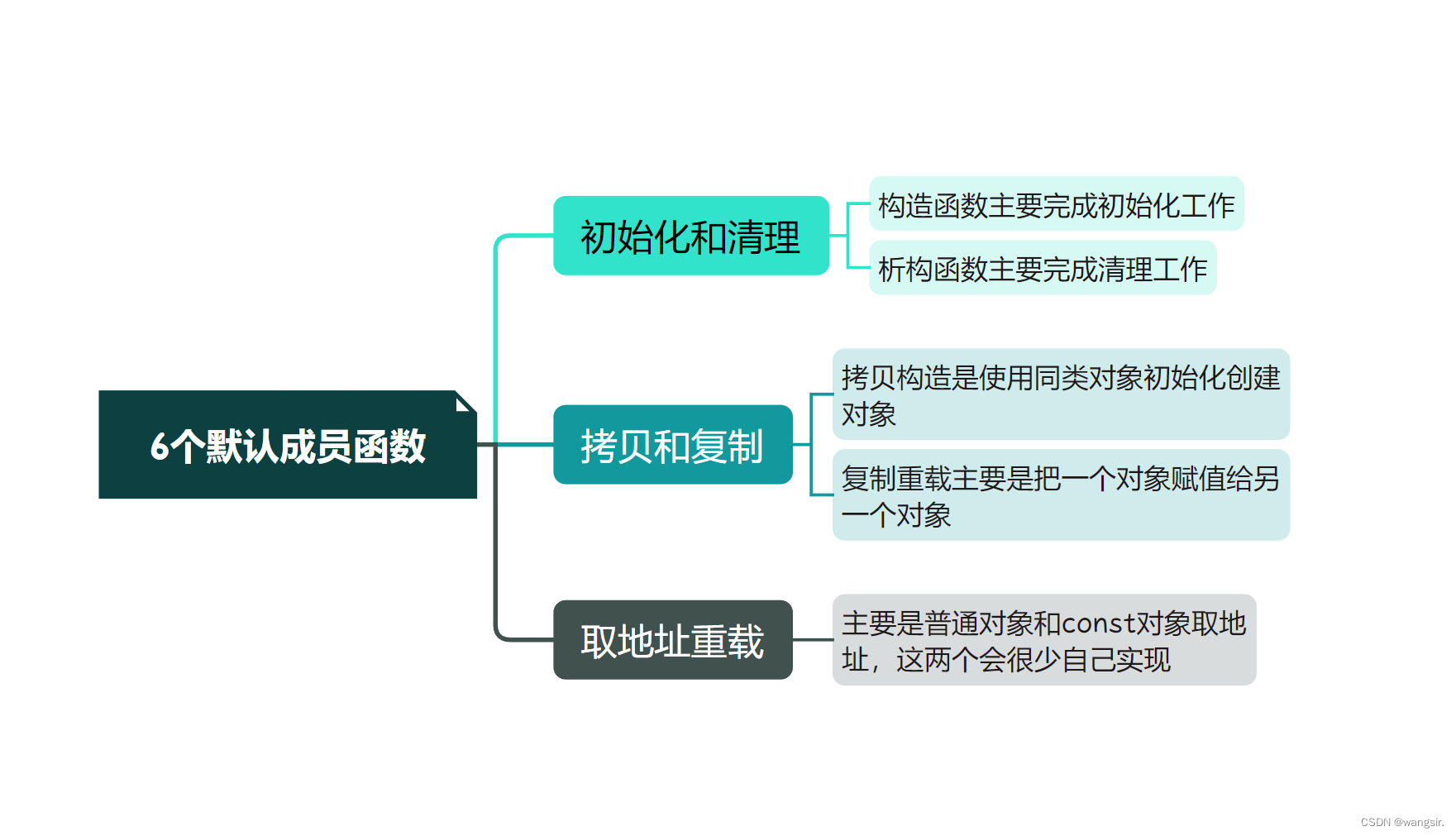
2. 构造函数
2.1 概念
对于以下Date类:
- class Date
- {
- public:
- void Init(int year, int month, int day)
- {
- _year = year;
- _month = month;
- _day = day;
- }
- void Print()
- {
- cout << _year << "-" << _month << "-" << _day << endl;
- }
- private:
- int _year;
- int _month;
- int _day;
- };
- int main()
- {
- Date d1;
- d1.Init(2022, 7, 5);
- d1.Print();
- Date d2;
- d2.Init(2022, 7, 6);
- d2.Print();
- return 0;
- }
用Init初始化容易忘记初始化定义后直接push
对于Date类,可以通过 Init 公有方法给对象设置日期,但如果每次创建对象时都调用该方法设置信息,未免有点麻烦,那能否在对象创建时,就将信息设置进去呢?
构造函数是一个特殊的成员函数,名字与类名相同,创建类类型对象时由编译器自动调用,以保证每个数据成员都有一个合适的初始值,并且在对象整个生命周期内只调用一次。
2.2 特性
对象定义(实例化)的时候一定要调用构造函数
构造函数是特殊的成员函数,需要注意的是,构造函数虽然名称叫构造,但是构造函数的主要任务并不是开空间创建对象,而是初始化对象。
他是一个特殊的成员函数不能以普通函数来对待他,所以比较复杂。
其特征如下:1. 函数名与类名相同。
2. 无返回值。(不是void,而是就不需要写,而且void是空返回值)
3. 对象实例化时编译器自动调用对应的构造函数。
4. 构造函数可以重载。
- #include<iostream>
- using namespace std;
- class Date
- {
- public:
- Date()//无参构造进行初始化
- {
- _year = 1900;
- _month = 1;
- _day = 1;
- }
- void print() {
- cout << _year << endl;
- cout << _month << endl;
- cout << _day << endl;
- }
- private:
- int _year;
- int _month;
- int _day;
- };
- int main()
- {
- Date d1;
- d1.print();
- return 0;
- }

- class Date
- {
- public:
- // 1.无参构造函数
- //Date()
- //{
- // _year = 1900;
- // _month = 1;
- // _day = 1;
- //}
- // 2.带参构造函数
- Date(int year=1, int month=1, int day=1)//还可以构成函数缺省
- {
- _year = year;
- _month = month;
- _day = day;
- }//两个Date形成函数重载,语法上这两个函数都可以存在但是实际上会出问题“Date::Date”: 对重载数数的调用不明确
- //但同时可以发现缺省构造函数可以覆盖无参构造,只有加了缺省才能使用Date d1;d1.print();否则会报错
- void print() {
- cout << _year << endl;
- cout << _month << endl;
- cout << _day << endl;
- }
- private:
- int _year;
- int _month;
- int _day;
- };
- int main()
- {
- Date d1; // 调用无参构造函数
- Date d2(2015, 1, 1); // 调用带参的构造函数
- Date d2(2015); // 调用带参的构造函数且是函数缺省
- // 注意:如果通过无参构造函数创建对象时,对象后面不用跟括号,否则就成了函数声明
- // 以下代码的函数:声明了d3函数,该函数无参,返回一个日期类型的对象
- // warning C4930: “Date d3(void)”: 未调用原型函数(是否是有意用变量定义的?)
- //Date d3();//不能这样写,因为这样可能会与函数声明混淆,date为返回类型,d3()为声明
- d1.print();
- d2.print();
- d3.print();
- return 0;
- }
Date d1;是创建对象并调用默认构造函数初始化,而Date d2();则是声明一个函数而不是创建对象
5. 如果类中没有显式定义构造函数,则C++编译器会自动生成一个无参的默认构造函数,一旦用户显式定义编译器将不再生成。
我们开始调用系统默认的构造函数但是它不发挥作用,打印随机值 - #include<iostream>
- using namespace std;
- class A {
- public:
- A() {
- _a = 0;
- cout << "_a" << endl;
- cout << _a << endl;
- }
- private:
- int _a;
- };
- class Date
- {
- public:
- void Print()
- {
- cout << _year <<" " << _month << " " << _day << endl;
- }
- private:
- int _year=1;
- int _month=2;
- int _day;
- A _aa;
- };
- int main()
- {
- Date d1;
- d1.Print();
- return 0;
- }

C++把数据分为内置类型/基本类型 和自定义类型
内置类型/基本类型:int/char/double/各种指针 语法自身定义的类型
自定义类型:struct/class 也就是更复杂的类型,自己根据需求写的
默认生成的构造函数对于内置类型不做处理,对于自定义类型调用他的默认构造
C++11委员会对语法进行补充,可以在声明的时候给缺省值,需要注意的是,成员变量虽然被附上了值,但这里仍然是一个声明,且不开辟空间
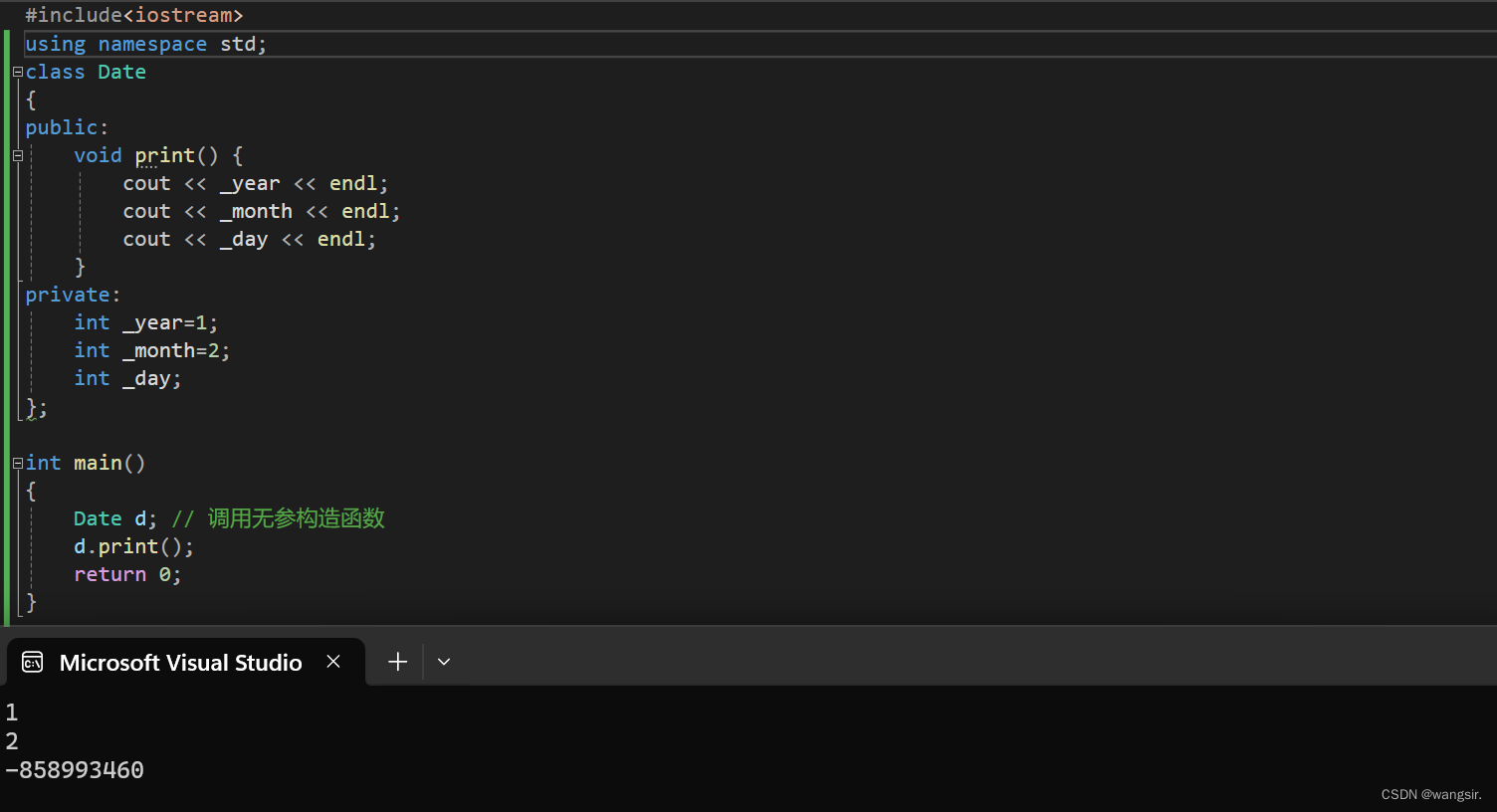
C++11之前不支持 6. 关于编译器生成的默认成员函数,很多童鞋会有疑惑:不实现构造函数的情况下,编译器会 生成默认的构造函数。但是看起来默认构造函数又没什么用?d对象调用了编译器生成的默 认构造函数,但是d对象_year/_month/_day,依旧是随机值。也就说在这里编译器生成的 默认构造函数并没有什么用??
解答:C++把类型分成内置类型(基本类型)和自定义类型。内置类型就是语言提供的数据类 型,如:int/char...,自定义类型就是我们使用class/struct/union等自己定义的类型,看看 下面的程序,就会发现编译器生成默认的构造函数会对自定类型成员_t调用的它的默认成员 函数。
- class Time
- {
- public:
- Time()
- {
- cout << "Time()" << endl;
- _hour = 0;
- _minute = 0;
- _second = 0;
- }
- private:
- int _hour;
- int _minute;
- int _second;
- };
- class Date
- {
- private:
- // 基本类型(内置类型)
- int _year;
- int _month;
- int _day;
- // 自定义类型
- Time _t;
- };
- int main()
- {
- Date d;
- return 0;
- }
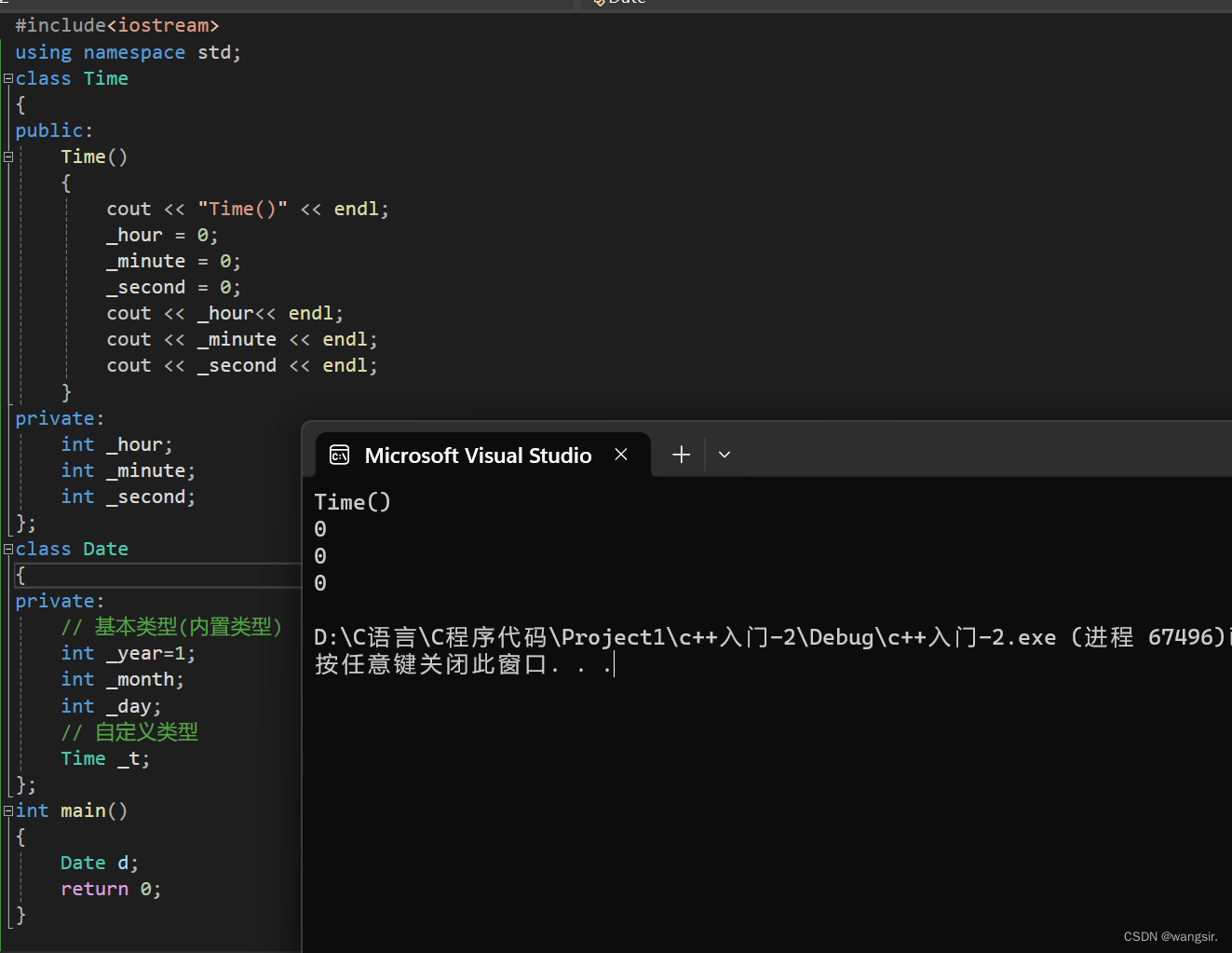
注意:C++11 中针对内置类型成员不初始化的缺陷,又打了补丁,即:内置类型成员变量在 类中声明时可以给默认值。
- class Time
- {
- public:
- Time()
- {
- cout << "Time()" << endl;
- _hour = 0;
- _minute = 0;
- _second = 0;
- }
- private:
- int _hour;
- int _minute;
- int _second;
- };
- class Date
- {
- private:
- // 基本类型(内置类型)
- int _year = 1970;
- int _month = 1;
- int _day = 1;
- // 自定义类型
- Time _t;
- };
- int main()
- {
- Date d;
- return 0;
- }
7. 无参的构造函数和全缺省的构造函数都称为默认构造函数,并且默认构造函数只能有一个。 注意:无参构造函数、全缺省构造函数、我们没写编译器默认生成的构造函数,都可以认为是默认构造函数。
- class Date
- {
- public:
- Date()
- {
- _year = 1900;
- _month = 1;
- _day = 1;
- }
- Date(int year = 1900, int month = 1, int day = 1)
- {
- _year = year;
- _month = month;
- _day = day;
- }
- private:
- int _year;
- int _month;
- int _day;
- };
- // 以下测试函数能通过编译吗?
- void Test()
- {
- Date d1;
- }
不能通过编译,只能有一个
结论:分析一个类型成员和初始化需求,需要写构造函数我们就自己写,不需要时就编译器自己生成。但是绝大部分场景下都需要自己实现构造函数,只要自己构造函数了那么编译器就不会自己生成。
一般情况下建议全缺省
3.析构函数
3.1 概念
通过前面构造函数的学习,我们知道一个对象是怎么来的,那一个对象又是怎么没呢的?
析构函数:与构造函数功能相反,析构函数不是完成对对象本身的销毁,局部对象销毁工作是由编译器完成的。而对象在销毁时会自动调用析构函数,完成对象中资源的清理工作。--即所写的内容清空
3.2 特性
析构函数是特殊的成员函数,其特征如下:
1. 析构函数名是在类名前加上字符 ~。
2. 无参数无返回值类型。
3. 一个类只能有一个析构函数。若未显式定义,系统会自动生成默认的析构函数。注意:析构函数不能重载
4. 对象生命周期结束时,C++编译系统系统自动调用析构函数。
- #include<iostream>
- using namespace std;
- typedef int DataType;
- class Stack
- {
- public:
- Stack(size_t capacity = 3)
- {
- _array = (DataType*)malloc(sizeof(DataType) * capacity);
- if (NULL == _array)
- {
- perror("malloc申请空间失败!!!");
- return;
- }
- _capacity = capacity;
- _size = 0;
- }
- void Push(DataType data)
- {
- // CheckCapacity();
- _array[_size] = data;
- _size++;
- }
- // 其他方法...
- ~Stack()
- {
- if (_array)
- {
- free(_array);
- _array = NULL;
- _capacity = 0;
- _size = 0;
- }
- }
- private:
- DataType* _array;
- int _capacity;
- int _size;
- };
- int main()
- {
- Stack s;
- s.Push(1);
- s.Push(2);
- return 0;
- }
局部变量在函数调用时会被分配在栈内存上,并且它们遵循后进先出的原则。根据生命作用域进行析构
析构顺序:
局部变量(后定义先析构)->局部静态变量(等局部析构完后再后定义先析构)->全局变量(不分静态是否都是后定义先析构)

局部变量后定义先销毁,静态变量最后销毁,s3虽然是局部的但是生命周期是全局的因为他在静态区 5. 关于编译器自动生成的析构函数,是否会完成一些事情呢?下面的程序我们会看到,编译器生成的默认析构函数,对自定类型成员调用它的析构函数。
- #include<iostream>
- using namespace std;
- class Time
- {
- public:
- ~Time()
- {
- cout << "~Time()" << endl;
- }
- private:
- int _hour;
- int _minute;
- int _second;
- };
- class Date
- {
- private:
- // 基本类型(内置类型)
- int _year = 1970;
- int _month = 1;
- int _day = 1;
- // 自定义类型
- Time _t;
- };
- int main()
- {
- Date d;
- return 0;
- }
程序运行结束后输出:~Time()
在main方法中根本没有直接创建Time类的对象,为什么最后会调用Time类的析构函数?
因为:main方法中创建了Date对象d,而d中包含4个成员变量,其中_year, _month, _day三个是内置类型成员,销毁时不需要资源清理,最后系统直接将其内存回收即可;而_t是Time类对象,所以在d销毁时,要将其内部包含的Time类的_t对象销毁,所以要调用Time类的析构函数。但是: main函数中不能直接调用Time类的析构函数,实际要释放的是Date类对象,所以编译器会调用Date 类的析构函数,而Date没有显式提供,则编译器会给Date类生成一个默认的析构函数,目的是在其内部调用Time类的析构函数,即当Date对象销毁时,要保证其内部每个自定义对象都可以正确销毁main函数中并没有直接调用Time类析构函数,而是显式调用编译器为Date类生成的默认析 构函数
注意:创建哪个类的对象则调用该类的析构函数,销毁那个类的对象则调用该类的析构函数
6. 如果类中没有申请资源时,析构函数可以不写,直接使用编译器生成的默认析构函数,比如 Date类;有资源申请时,一定要写,否则会造成资源泄漏,比如Stack类。
4. 拷贝构造函数
4.1 概念
在现实生活中,可能存在一个与你一样的自己,我们称其为双胞胎。
拷贝构造函数也是构造函数的一种,他只是参数不同是一个同类型对象
那在创建对象时,可否创建一个与已存在对象一某一样的新对象呢? 拷贝构造函数:只有单个形参,该形参是对本类类型对象的引用(一般常用const修饰),在用已存 在的类类型对象创建新对象时由编译器自动调用。
4.2 特征
拷贝构造函数也是特殊的成员函数,其特征如下:
1. 拷贝构造函数是构造函数的一个重载形式。
2. 拷贝构造函数的参数只有一个且必须是类类型对象的引用,使用传值方式编译器直接报错, 因为会引发无穷递归调用。
- #include<iostream>
- using namespace std;
- class Date
- {
- public:
- Date(int year = 1900, int month = 1, int day = 1)
- {
- _year = year;
- _month = month;
- _day = day;
- }
- Date(const Date& d) // 正确写法
- //Date(const Date d) // 错误写法:编译报错,会引发无穷递归。
- {
- _year = d._year;
- _month = d._month;
- _day = d._day;
- }
- void init() {
- cout << _year << endl;
- cout << _month << endl;
- cout << _day << endl;
- }
- private:
- int _year;
- int _month;
- int _day;
- };
- int main()
- {
- Date d1;
- Date d2(d1);
- d2.init();
- return 0;
- }

- #include<iostream>
- using namespace std;
- class Date
- {
- public:
- Date(int year = 1900, int month = 1, int day = 1)
- {
- _year = year;
- _month = month;
- _day = day;
- }
- Date( const Date& d) // 正确写法,加const是为了保护对象d不被修改
- //Date(const Date d) // 错误写法:编译报错,会引发无穷递归
- {
- _year = d._year;
- _month = d._month;
- _day = d._day;
- }
- void init() {
- cout << _year << endl;
- cout << _month << endl;
- cout << _day << endl;
- }
- private:
- int _year;
- int _month;
- int _day;
- };
- void func1(Date d) {//d是d1的拷贝
- }
- void func2(Date& rd) {//rd是d1的别名没有拷贝
- }
- int main()
- {
- Date d1(2024,2,28);
- //C++规定自定义的类型都会调用拷贝构造
- func1(d1);//调用func1之前先传参,传参的过程调用的是拷贝构造,回来了以后才能调用函数,所以传值传参调用拷贝构造
- func2(d1);//func2不会调用拷贝构造,因为rd是d1的别名直接完成调用
- return 0;
- }


传值调用->传值调用->传值调用........
3. 若未显式定义,编译器会生成默认的拷贝构造函数。 默认的拷贝构造函数对象(内置类型成员)按内存存储按字节序完成拷贝,这种拷贝叫做浅拷贝,或者值拷贝。
- #include<iostream>
- using namespace std;
- class Time
- {
- public:
- Time()
- {
- _hour = 1;
- _minute = 1;
- _second = 1;
- }
- Time(const Time& t)
- {
- _hour = t._hour;
- _minute = t._minute;
- _second = t._second;
- cout << "Time::Time(const Time&)" << endl;
- }
- private:
- int _hour;
- int _minute;
- int _second;
- };
- class Date
- {
- private:
- // 基本类型(内置类型)
- int _year = 1970;
- int _month = 1;
- int _day = 1;
- // 自定义类型
- Time _t;
- };
- int main()
- {
- Date d1;
- // 用已经存在的d1拷贝构造d2,此处会调用Date类的拷贝构造函数
- // 但Date类并没有显式定义拷贝构造函数,则编译器会给Date类生成一个默认的拷贝构造函数
- Date d2(d1);
- return 0;
- }
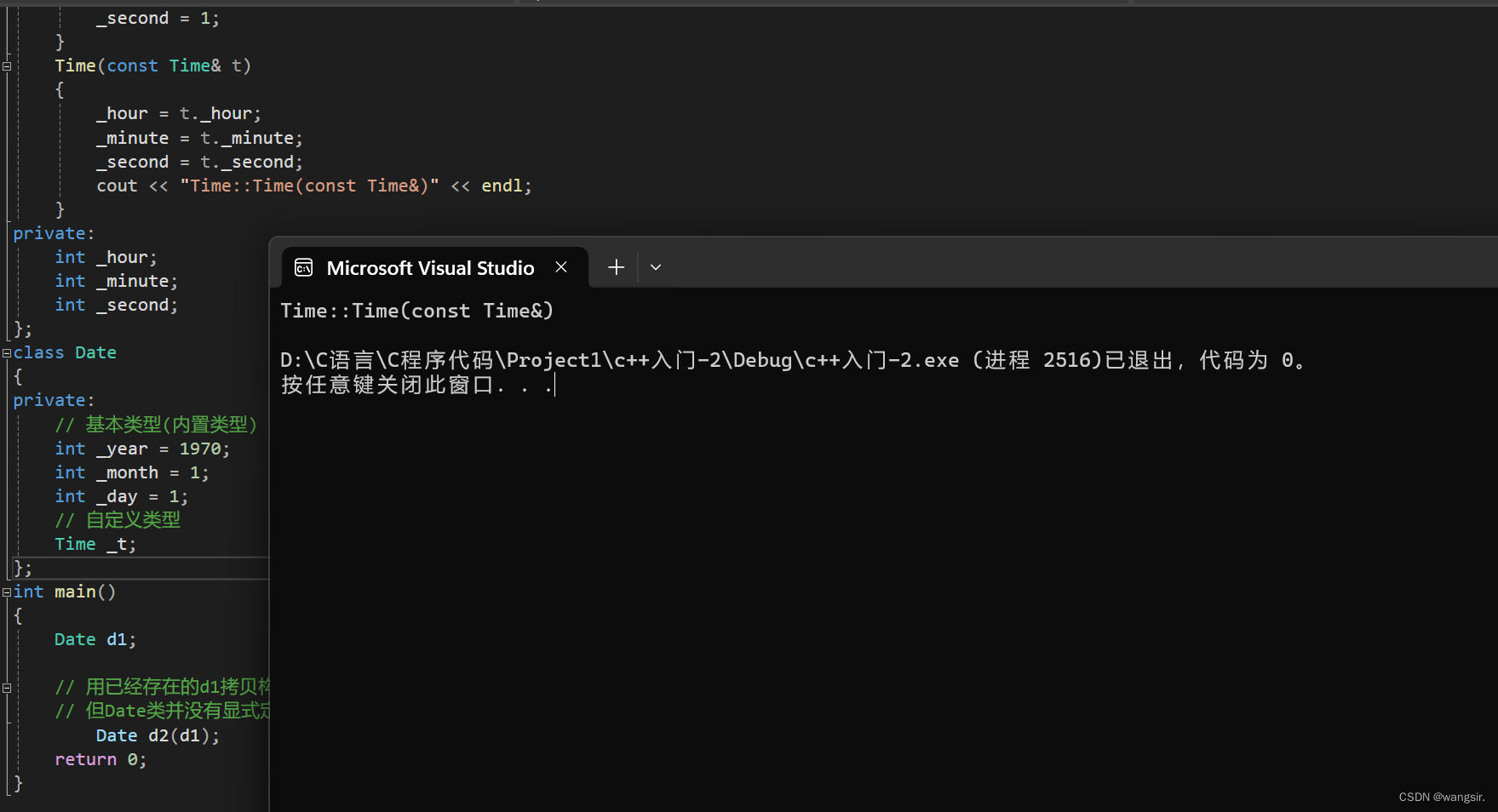
注意:在编译器生成的默认拷贝构造函数中,内置类型是按照字节方式直接拷贝的,而自定 义类型是调用其拷贝构造函数完成拷贝的。
自定义类型的尽头是内置类型
4. 编译器生成的默认拷贝构造函数已经可以完成字节序的值拷贝了,还需要自己显式实现吗? 当然像日期类这样的类是没必要的。那么下面的类呢?验证一下试试?
- // 这里会发现下面的程序会崩溃掉?这里就需要我们以后讲的深拷贝去解决。
- typedef int DataType;
- class Stack
- {
- public:
- Stack(size_t capacity = 10)
- {
- _array = (DataType*)malloc(capacity * sizeof(DataType));
- if (nullptr == _array)
- {
- perror("malloc申请空间失败");
- return;
- }
- _size = 0;
- _capacity = capacity;
- }
- void Push(const DataType& data)
- {
- // CheckCapacity();
- _array[_size] = data;
- _size++;
- }
- ~Stack()
- {
- if (_array)
- {
- free(_array);
- _array = nullptr;
- _capacity = 0;
- _size = 0;
- }
- }
- private:
- DataType *_array;
- size_t _size;
- size_t _capacity;
- };
- int main()
- {
- Stack s1;
- s1.Push(1);
- s1.Push(2);
- s1.Push(3);
- s1.Push(4);
- Stack s2(s1);
- return 0;
- }


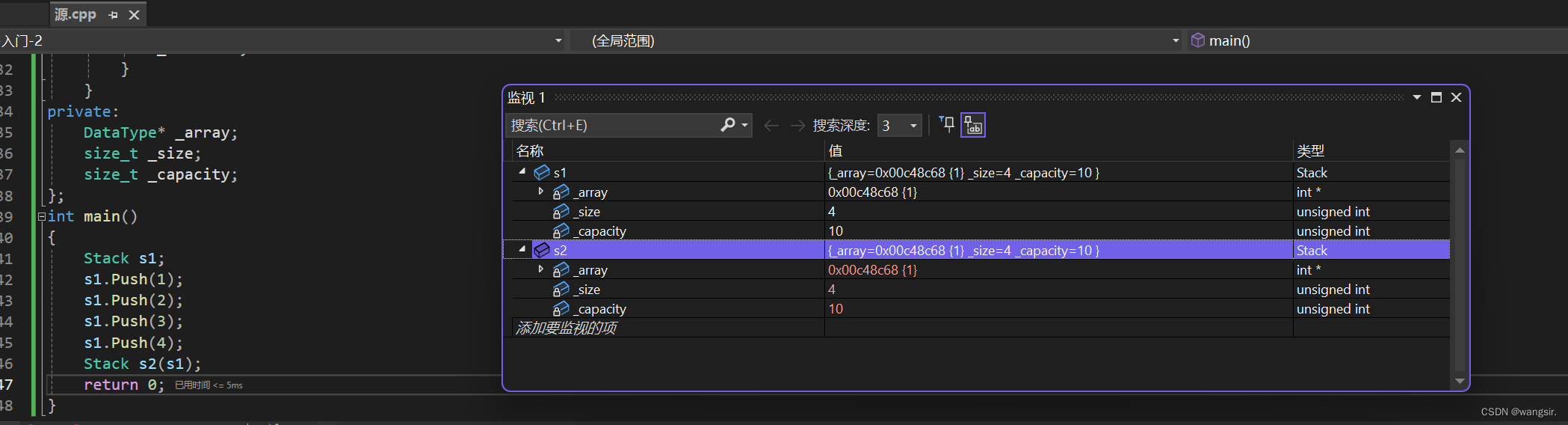
如图所示,这是应用了浅拷贝的栈,s2是s1的拷贝,但是呢,st2把st1中的指针拷贝下来了导致二者指向的是同一个空间,这就会导致最后销毁的时候先销毁了st2 ,st1后销毁,但是st2在销毁时就把空间释放了,导致st1指向的空间没了st1变成了野指针,而st1在之后的操作中就会崩溃 ,对同一空间的多次释放会导致空间崩溃
浅拷贝、深拷贝:
在拷贝构造函数中分为浅拷贝和深拷贝,二者的区别就是浅拷贝可以由编译器自动生成,但浅拷贝就是将需要拷贝的内容完完整整的复制一遍,而深拷贝一般由程序员自己手动进行调整,同时,深拷贝也可以由调用其他自定义类型中的深拷贝生成。
同时,浅拷贝一般应用于简单的函数调用,而深拷贝一般应用于需要动态开辟空间资源的函数中
- #include<iostream>
- using namespace std;
- typedef int DataType;
- typedef int DateType;
- class Stack
- {
- public:
- //构造函数
- Stack(size_t capacity = 3)
- {
- cout << "Stack()" << endl;
- _array = (DateType*)malloc(sizeof(DateType) * capacity);
- if (_array == nullptr)
- {
- perror("malloc fail");
- exit(-1);
- }
- _size = 0;
- _capacity = capacity;
- }
- //深拷贝
- //拷贝构造
- Stack(const Stack& s)
- {
- cout << "Stack(const Stack& s)" << endl;
- _array = (DateType*)malloc(sizeof(DateType) * s._capacity);
- if (_array == nullptr)
- {
- perror("malloc fail");
- exit(-1);
- }
- memcpy(_array, s._array, sizeof(DateType) * s._capacity);
- _size = s._size;
- _capacity = s._capacity;
- }
- //析构函数
- ~Stack()
- {
- cout << "~Stack()" << endl;
- free(_array);
- _array = nullptr;
- _size = _capacity = 0;
- }
- private:
- DateType* _array;
- size_t _capacity;
- size_t _size;
- };
- int main()
- {
- Stack s1(4);
- Stack s2(s1);
- return 0;
- }
5. 拷贝构造函数典型调用场景:
使用已存在对象创建新对象
函数参数类型为类类型对象
函数返回值类型为类类型对象
- class Date
- {
- public:
- Date(int year, int minute, int day)
- {
- cout << "Date(int,int,int):" << this << endl;
- }
- Date(const Date& d)
- {
- cout << "Date(const Date& d):" << this << endl;
- }
- ~Date()
- {
- cout << "~Date():" << this << endl;
- }
- private:
- int _year;
- int _month;
- int _day;
- };
- Date Test(Date d)
- {
- Date temp(d);
- return temp;
- }
- int main()
- {
- Date d1(2022,1,13);
- Test(d1);
- return 0;
- }
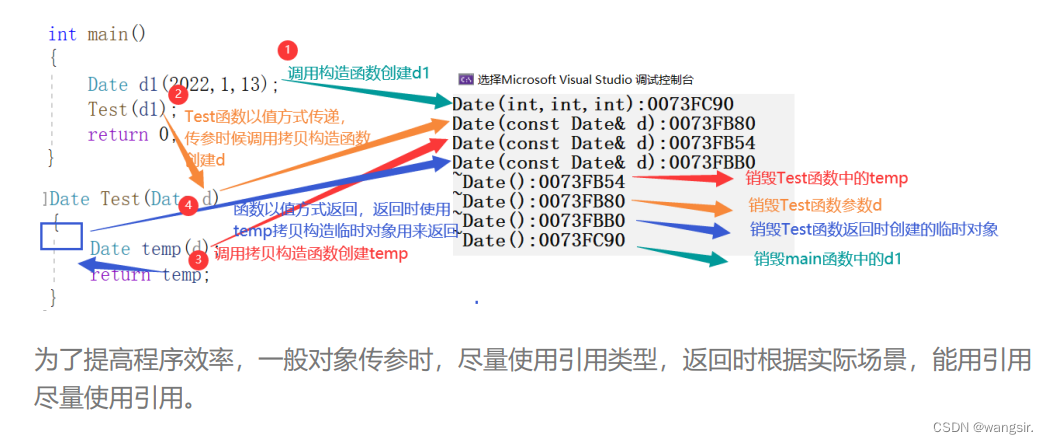
5.赋值运算符重载
5.1 运算符重载
运算符重载和函数重载不是一样的
内置类型可以直接比较但是自定义类型无法直接比较(因为自定义类型包含多个类型编译器无法得知如何比较)
- #include<iostream>
- using namespace std;
- // 全局的operator==
- class Date
- {
- public:
- Date(int year = 1900, int month = 1, int day = 1)
- {
- _year = year;
- _month = month;
- _day = day;
- }
- //private://把私有放出来时类外可以访问
- int _year;
- int _month;
- int _day;
- };
- bool bbb(const Date& d1, const Date& d2)
- {
- return d1._year == d2._year
- && d1._month == d2._month
- && d1._day == d2._day;
- }
- int main() {
- Date d1(2018, 9, 26);
- Date d2(2018, 9, 27);
- cout << bbb(d1, d2) << endl;
- return 0;
- }
- #include<iostream>
- using namespace std;
- // 全局的operator==
- class Date
- {
- public:
- Date(int year = 1900, int month = 1, int day = 1)
- {
- _year = year;
- _month = month;
- _day = day;
- }
- bool operator==(const Date& d2)
- {//operator运算符 做函数名
- return _year == d2._year
- && _month == d2._month
- && _day == d2._day;
- }
- private:
- int _year;
- int _month;
- int _day;
- };
- 和之前的对比函数的差别是,const Date & x 消失了,是因为类的内部有一个this指针指向了const Date & x 所在的空间,所以不需要了。
- int main() {
- Date d1(2018, 9, 26);
- Date d2(2018, 9, 27);
- return 0;
- }

C++为了增强代码的可读性引入了运算符重载,运算符重载是具有特殊函数名的函数,也具有其返回值类型,函数名字以及参数列表,其返回值类型与参数列表与普通的函数类似
函数名字为:关键字operator后面接需要重载的运算符符号。
函数原型:返回值类型 operator操作符(参数列表)
注意:
不能通过连接其他符号来创建新的操作符:比如operator@
重载操作符必须有一个类类型参数
用于内置类型的运算符,其含义不能改变,例如:内置的整型+,不 能改变其含义
作为类成员函数重载时,其形参看起来比操作数数目少1,因为成员函数的第一个参数为隐 藏的this
.* :: sizeof ?: . 注意以上5个运算符不能重载。这个经常在笔试选择题中出 现。
全局的运算符重载:
- //全局的operator==
- bool operator==(const Date& d1, const Date& d2)
- {
- return d1._year == d2._year
- && d1._month == d2._month
- && d1._day == d2._day;
- }
- //全局的operator!=
- bool operator!=(const Date& d1, const Date& d2)
- {
- return !(d1 == d2);
- }
- //全局的operator<
- bool operator<(const Date& d1, const Date& d2)
- {
- if (d1._year < d2._year)
- {
- return true;
- }
- else if (d1._year == d2._year && d1._month < d2._month)
- {
- return true;
- }
- else if (d1._year == d2._year && d1._month == d2._month && d1._day < d2._day)
- {
- return true;
- }
- else
- {
- return false;
- }
- }
- //全局的operator<=
- bool operator<=(const Date& d1, const Date& d2)
- {
- return d1 < d2 || d1 == d2;
- }
- //全局的operator>
- bool operator>(const Date& d1, const Date& d2)
- {
- return !(d1 <= d2);
- }
- //全局的operator>=
- bool operator>=(const Date& d1, const Date& d2)
- {
- return !(d1 < d2);
- }
- //获取天数
- int GetMonth_day(int year, int month)
- {
- int monthArray[13] = { 0,31,28,31,30,31,30,31,31,30,31,30,31 };
- if (month == 2 && (year % 4 == 0 && year % 100 != 0) || year % 400 == 0)
- {
- return 29;
- }
- return monthArray[month];
- }
- //全局的operator+=
- Date& operator+=(Date& d, int day)
- {
- d._day += day;
- while (d._day > GetMonth_day(d._year, d._month))
- {
- //天满了进月
- d._day -= GetMonth_day(d._year, d._month);
- d._month++;
- //月满了进年,月置为1
- if (d._month == 13)
- {
- ++d._year;
- d._month = 1;
- }
- }
- return d;
- }
- //全局的operator+
- Date operator+(Date& d, int day)
- {
- Date tmp(d);
- tmp += day;
- return tmp;
- }
成员函数的运算符重载:
作为类成员函数重载时,其形参看起来比操作数数目少1,因为成员函数的第一个参数为隐藏的this
- class Date
- {
- public:
- //全缺省构造函数
- Date(int year = 0, int month = 0, int day = 0)
- {
- _year = year;
- _month = month;
- _day = day;
- }
- void Print()
- {
- cout << _year << "/" << _month << "/" << _day << endl;
- }
- ///运算符重载/
- //成员函数operator==
- bool operator==(const Date& d)
- {
- return _year == d._year
- && _month == d._month
- && _day == d._day;
- }
- //成员函数operator!=
- bool operator!=(const Date& d)
- {
- return !(*this == d);
- }
- //成员函数operator<
- bool operator<(const Date& d)
- {
- if (_year < d._year)
- {
- return true;
- }
- else if (_year == d._year && _month < d._month)
- {
- return true;
- }
- else if (_year == d._year && _month == d._month && _day < d._day)
- {
- return true;
- }
- else
- {
- return false;
- }
- }
- //成员函数operator<=
- bool operator<=(const Date& d)
- {
- return *this < d || *this == d;
- }
- //成员函数operator>
- bool operator>(const Date& d)
- {
- return !(*this <= d);
- }
- //成员函数operator>=
- bool operator>=(const Date& d)
- {
- return !(*this < d);
- }
- //获取天数
- int GetMonth_day(int year, int month)
- {
- int monthArray[13] = { 0,31,28,31,30,31,30,31,31,30,31,30,31 };
- if (month == 2 && (year % 4 == 0 && year % 100 != 0) || year % 400 == 0)
- {
- return 29;
- }
- return monthArray[month];
- }
- //成员函数operator+=
- Date& operator+=(int day)
- {
- _day += day;
- while (_day > GetMonth_day(_year, _month))
- {
- //天满了进月
- _day -= GetMonth_day(_year, _month);
- _month++;
- //月满了进年,月置为1
- if (_month == 13)
- {
- ++_year;
- _month = 1;
- }
- }
- return *this;
- }
- //成员函数operator+
- Date operator+(int day)
- {
- Date tmp(*this);
- tmp += day;
- return tmp;
- }
- private:
- int _year;
- int _month;
- int _day;
- };
d1
5.2 赋值运算符重载
赋值运算符重载格式:
参数类型:const T&,传递引用可以提高传参效率
返回值类型:T&,返回引用可以提高返回的效率,有返回值目的是为了支持连续赋值
检测是否自己给自己赋值
返回*this :要复合连续赋值的含义
- #include<iostream>
- using namespace std;
- class Date
- {
- public:
- //全缺省构造函数
- Date(int year = 0, int month = 0, int day = 0)
- {
- _year = year;
- _month = month;
- _day = day;
- }
- void Print()
- {
- cout << _year << "/" << _month << "/" << _day << endl;
- }
- //成员函数operator=
- Date& operator=(const Date& d)
- {
- //自己不能给自己赋值
- if (this != &d)//这个&d是取地址,因为this是指针也是地址
- {
- _year = d._year;
- _month = d._month;
- _day = d._day;
- }
- return *this;//*this就是d1
- }
- private:
- int _year;
- int _month;
- int _day;
- };
- int main() {
- Date d1(2018, 9, 26);
- Date d2(2222,2,2);
- d1.Print();
- d1 = d2;//已经存在的对象,一个拷贝赋值给另一个,d2给d1
- d1.Print();
- d2.Print();
- return 0;
- }
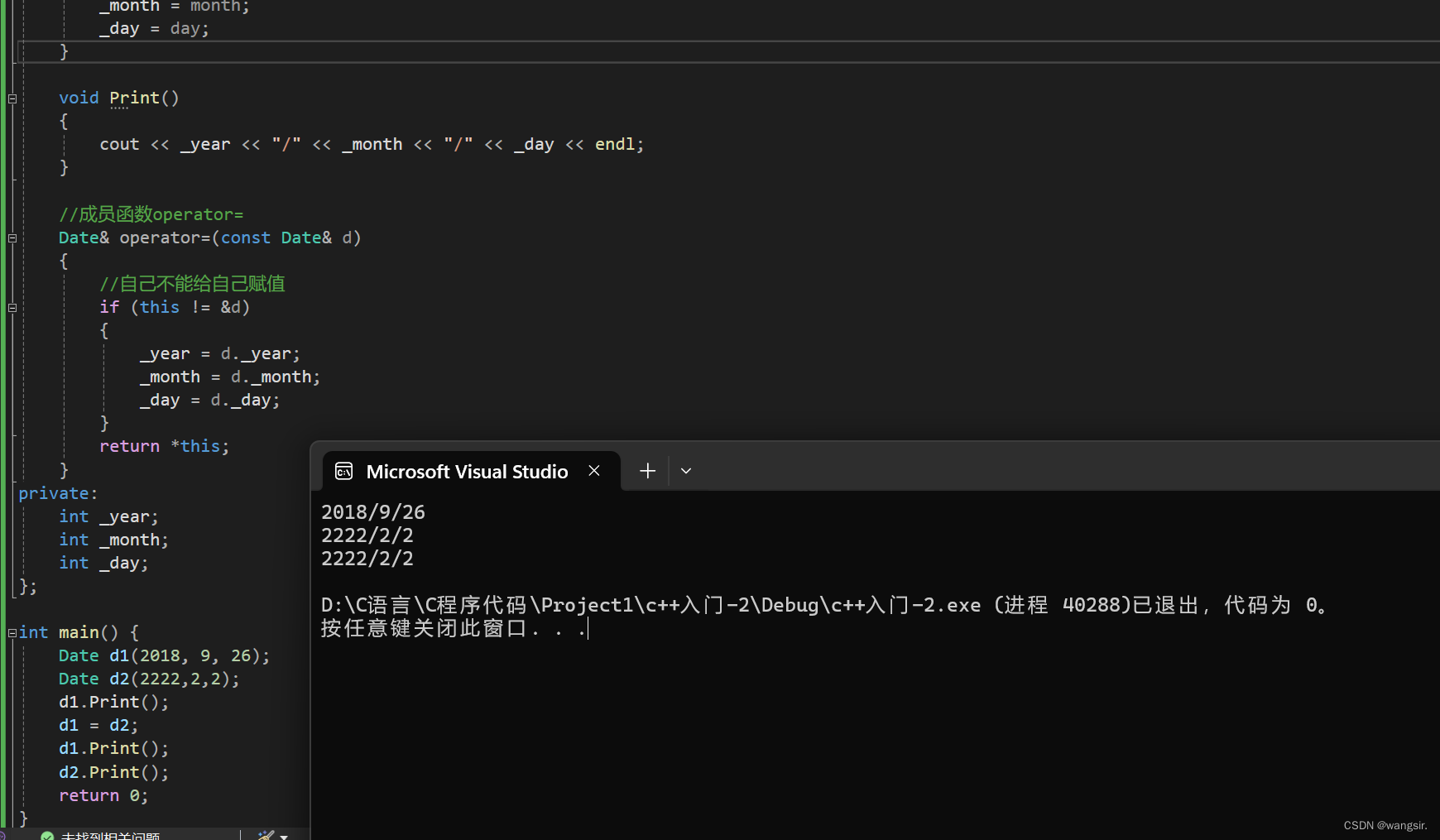
(i = j) = 10;
代表着先将j赋值给i(注意这个表达式返回的不是临时变量)然后将10赋值给i2. 赋值运算符只能重载成类的成员函数不能重载成全局函数
- class Date
- {
- public:
- Date(int year = 1900, int month = 1, int day = 1)
- {
- _year = year;
- _month = month;
- _day = day;
- }
- int _year;
- int _month;
- int _day;
- };
- // 赋值运算符重载成全局函数,注意重载成全局函数时没有this指针了,需要给两个参数
- Date& operator=(Date& left, const Date& right)
- {
- if (&left != &right)
- {
- left._year = right._year;
- left._month = right._month;
- left._day = right._day;
- }
- return left;
- }
- // 编译失败:
- // error C2801: “operator =”必须是非静态成员
原因:赋值运算符如果不显式实现,编译器会生成一个默认的。此时用户再在类外自己实现 一个全局的赋值运算符重载,就和编译器在类中生成的默认赋值运算符重载冲突了,故赋值 运算符重载只能是类的成员函数。

3. 用户没有显式实现时,编译器会生成一个默认赋值运算符重载,以值的方式逐字节拷贝。注 意:内置类型成员变量是直接赋值的,而自定义类型成员变量需要调用对应类的赋值运算符 重载完成赋值。
- class Time
- {
- public:
- Time()
- {
- _hour = 1;
- _minute = 1;
- _second = 1;
- }
- Time& operator=(const Time& t)
- {
- if (this != &t)
- {
- _hour = t._hour;
- _minute = t._minute;
- _second = t._second;
- }
- return *this;
- }
- private:
- int _hour;
- int _minute;
- int _second;
- };
- class Date
- {
- private:
- // 基本类型(内置类型)
- int _year = 1970;
- int _month = 1;
- int _day = 1;
- // 自定义类型
- Time _t;
- };
- int main()
- {
- Date d1;
- Date d2;
- d1 = d2;
- return 0;
- }
既然编译器生成的默认赋值运算符重载函数已经可以完成字节序的值拷贝了,还需要自己实 现吗?当然像日期类这样的类是没必要的。那么下面的类呢?验证一下试试?- // 这里会发现下面的程序会崩溃掉?这里就需要我们以后讲的深拷贝去解决。
- typedef int DataType;
- class Stack
- {
- public:
- Stack(size_t capacity = 10)
- {
- _array = (DataType*)malloc(capacity * sizeof(DataType));
- if (nullptr == _array)
- {
- perror("malloc申请空间失败");
- return;
- }
- _size = 0;
- _capacity = capacity;
- }
- void Push(const DataType& data)
- {
- // CheckCapacity();
- _array[_size] = data;
- _size++;
- }
- ~Stack()
- {
- if (_array)
- {
- free(_array);
- _array = nullptr;
- _capacity = 0;
- _size = 0;
- }
- }
- private:
- DataType *_array;
- size_t _size;
- size_t _capacity;
- };
- int main()
- {
- Stack s1;
- s1.Push(1);
- s1.Push(2);
- s1.Push(3);
- s1.Push(4);
- Stack s2;
- s2 = s1;
- return 0;
- }
注意:如果类中未涉及到资源管理,赋值运算符是否实现都可以;一旦涉及到资源管理则必 须要实现。
6. const成员
- #include<iostream>
- using namespace std;
- void func(const int& x) {
- cout << x << endl;
- }
- int main() {
- int a = 1;
- int& b = a;//b是a的别名,b++则a也会++
- const int& c = a;//c是a的别名,但是加了const后c改变不了a。理解为权限的缩小只为读没有写
- //c++;错误的,无法执行
- //int& y = c;错误的,这样的话权限放大了为读写,但是c本身是只读不符合
- //权限可以缩小但不能放大
- const int& z = 10;//z是常量的别名
- const int& m = a + z;//a+z表达式的返回值为临时对象,具有常性无法修改
- //int& n = a + z;不行
- func(m);//如果形参不加const传入则为权限放大不对
- func(10);//加形参加const代表着常性变量可以传入
- func(a);
- cout << a << " " << b << " " << c << " " <<z<<" "<<m<< endl;
- return 0;
- }
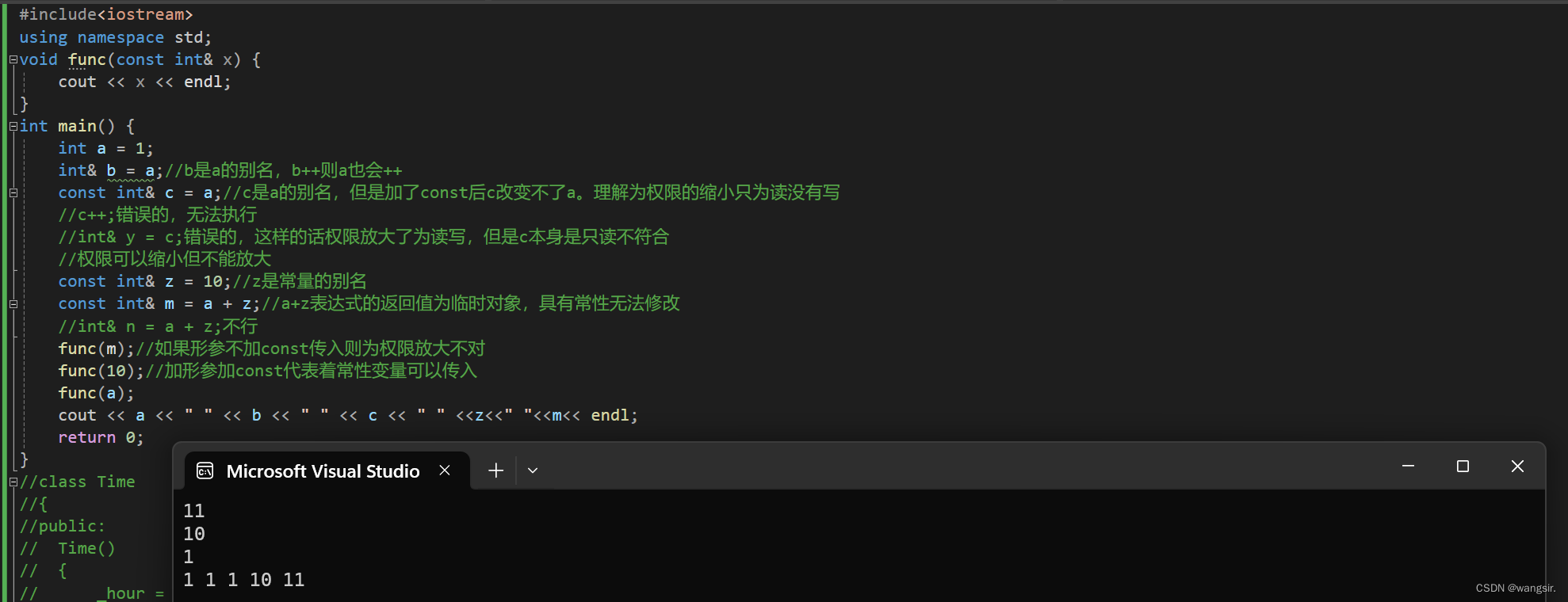
1. const对象(只读)可以调用非const成员函数(读写)吗?
不能,const对象权限小于非const对象,权限不能放大。
2. 非const对象(可读写)可以调用const成员函数吗?
可以,权限缩小。3. const成员函数内可以调用其它的非const成员函数吗?
不能,const成员函数它承诺不会修改对象的状态。因此,const成员函数不能调用非const成员函数,因为非const成员函数可以修改对象的状态,权限的放大。4. 非const成员函数内可以调用其它的const成员函数吗?
非const成员函数内可以调用其它的const成员函数。非const成员函数没有限制对对象的修改,因此可以调用const成员函数,而const成员函数不会修改对象的状态,与非const成员函数的调用不冲突。这种情况下,调用const成员函数不会违反const成员函数的承诺。
- #include<iostream>
- using namespace std;
- int main() {
- double a = 1.1;
- int b = 2;
- int& c = a;//报错
- const int& d = a;//正确形式
- }


是通过临时变量间接起到别名 - #include<iostream>
- using namespace std;
- int main() {
- int i = 97;
- char c = 'a';
- if (i == c) {
- cout << "相等" << endl;
- }
- return 0;
- }

符号位补
-
相关阅读:
pytorch在有限的资源下部署大语言模型(以ChatGLM-6B为例)
git问题,分支直接的提交切换
小白从CentOS7到安装CDH6.3.2入坑实操指北(一)
SMT32F767通过STM32CUBE HAL库配置QSPI和W25Q256驱动
xlsx库实现纯前端导入导出Excel
05 如何写Keil ARM M3汇编函数和汇编宏定义函数
C语言百日刷题第六天
使用 for of 自定义遍历对象
vue3项目学习一:创建vue3项目
Linux常用操作命令大全
- 原文地址:https://blog.csdn.net/yiqizhuashuimub/article/details/136272637
