-
基于CNN-GRU-Attention的时间序列回归预测matlab仿真
目录
1.算法运行效果图预览


2.算法运行软件版本
matlab2022a
3.部分核心程序
- ...................................................................
- %CNN-GRU-ATT
- layers = func_model(Dim);
- %设置
- %迭代次数
- %学习率为0.001
- options = trainingOptions('adam', ...
- 'MaxEpochs', 1500, ...
- 'InitialLearnRate', 1e-4, ...
- 'LearnRateSchedule', 'piecewise', ...
- 'LearnRateDropFactor', 0.1, ...
- 'LearnRateDropPeriod', 1000, ...
- 'Shuffle', 'every-epoch', ...
- 'Plots', 'training-progress', ...
- 'Verbose', false);
- %训练
- Net = trainNetwork(Nsp_train2, NTsp_train, layers, options);
- figure
- subplot(211);
- plot(1: Num1, Tat_train,'-bs',...
- 'LineWidth',1,...
- 'MarkerSize',6,...
- 'MarkerEdgeColor','k',...
- 'MarkerFaceColor',[0.9,0.0,0.0]);
- hold on
- plot(1: Num1, T_sim1,'g',...
- 'LineWidth',2,...
- 'MarkerSize',6,...
- 'MarkerEdgeColor','k',...
- 'MarkerFaceColor',[0.9,0.9,0.0]);
- legend('真实值', '预测值')
- xlabel('预测样本')
- ylabel('预测结果')
- grid on
- subplot(212);
- plot(1: Num1, Tat_train-T_sim1','-bs',...
- 'LineWidth',1,...
- 'MarkerSize',6,...
- 'MarkerEdgeColor','k',...
- 'MarkerFaceColor',[0.9,0.0,0.0]);
- legend('真实值', '预测值')
- xlabel('预测样本')
- ylabel('预测误差')
- grid on
- ylim([-50,50]);
- figure
- subplot(211);
- plot(1: Num2, Tat_test,'-bs',...
- 'LineWidth',1,...
- 'MarkerSize',6,...
- 'MarkerEdgeColor','k',...
- 'MarkerFaceColor',[0.9,0.0,0.0]);
- hold on
- plot(1: Num2, T_sim2,'g',...
- 'LineWidth',2,...
- 'MarkerSize',6,...
- 'MarkerEdgeColor','k',...
- 'MarkerFaceColor',[0.9,0.9,0.0]);
- legend('真实值', '预测值')
- xlabel('测试样本')
- ylabel('测试结果')
- grid on
- subplot(212);
- plot(1: Num2, Tat_test-T_sim2','-bs',...
- 'LineWidth',1,...
- 'MarkerSize',6,...
- 'MarkerEdgeColor','k',...
- 'MarkerFaceColor',[0.9,0.0,0.0]);
- legend('真实值', '预测值')
- xlabel('预测样本')
- ylabel('预测误差')
- grid on
- ylim([-50,50]);
- 116
4.算法理论概述
CNN-GRU-Attention模型结合了卷积神经网络(CNN)、门控循环单元(GRU)和注意力机制(Attention)来进行时间序列数据的回归预测。CNN用于提取时间序列的局部特征,GRU用于捕获时间序列的长期依赖关系,而注意力机制则用于在预测时强调重要的时间步。
4.1 CNN(卷积神经网络)部分
在时间序列回归任务中,CNN用于捕获局部特征和模式:

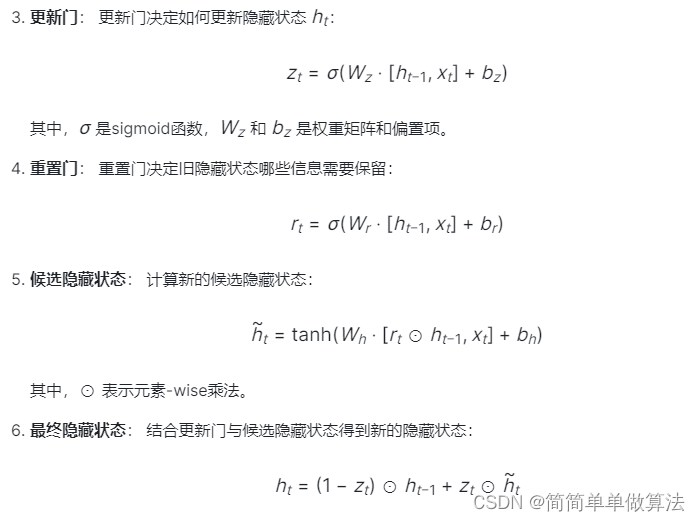
4.2 GRU(门控循环单元)部分
GRU用于捕捉时间序列的长期依赖关系:
4.3 Attention机制部分

最后,通过反向传播算法调整所有参数以最小化预测误差,并在整个训练集上迭代优化模型。
5.算法完整程序工程
OOOOO
OOO
O
-
相关阅读:
Go 锁演进
1.计算机组成与体系结构
docker-elasticsearch集群
2023上海国际电力电工展盛大举行 规模创新高 与行业「升级、转型、融合」
什么是AJAX?如何使用原生JavaScript进行AJAX请求?
LeetCode - 76 最小覆盖子串
字符输入转换流&字符输出转换流
软考高级之系统架构师之计算机硬件基础与嵌入式系统
Espresso Test 3: Fragment Test
C. RationalLee(贪心+思维)
- 原文地址:https://blog.csdn.net/aycd1234/article/details/136215736
