-
Java——Stream流的学习
在开发过程中,经常或忽略流的使用,导致用的不熟练,于是抽时间系统的学习下stream的使用,找了哔哩哔哩的教程跟着看看练练。
准备工作
创建Book、Aurhor实体类,初始化数据
public static List<Author> getAuthors() { Author author1 = new Author(1L, "蒙多", 33, "一个从菜刀中明悟哲理的祖安人", null); Author author2 = new Author(2L, "亚拉索", 15, "狂风也追逐不上他的思考速度", null); Author author3 = new Author(3L, "易", 14, "是这个世界在限制他的思维", null); Author author4 = new Author(3L, "易", 14, "是这个世界在限制他的思维", null); List<Book> books1 = new ArrayList<>(); List<Book> books2 = new ArrayList<>(); List<Book> books3 = new ArrayList<>(); books1.add(new Book(1L, "刀的两侧是光明与黑暗", "哲学,爱情", 88, "用一把刀划分了爱情")); books1.add(new Book(2L, "一个人不能死在同一把刀下", "个人成长,爱情", 99, "讲述如何成功")); books2.add(new Book(3L, "那风吹不到的地方", "哲学", 85, "带你用思维去领略世界的尽头")); books2.add(new Book(3L, "那风吹不到的地方", "哲学", 85, "带你用思维去领略世界的尽头")); books2.add(new Book(4L, "吹或不吹", "爱情,个人传记", 65, "一个哲学家的恋爱观注定很难")); books3.add(new Book(5L, "你的剑就是我的剑", "爱情", 56, "无法想象一个武者")); books3.add(new Book(5L, "风与剑", "个人传记", 100, "两个哲学家灵魂与肉体的碰撞")); books3.add(new Book(5L, "风与剑", "个人传记", 100, "两个哲学家灵魂与肉体的碰撞")); author1.setBooks(books1); author2.setBooks(books2); author3.setBooks(books3); author4.setBooks(books3); List<Author> authors = new ArrayList<>(Arrays.asList(author1, author2, author3, author4)); return authors; }- 1
- 2
- 3
- 4
- 5
- 6
- 7
- 8
- 9
- 10
- 11
- 12
- 13
- 14
- 15
- 16
- 17
- 18
- 19
- 20
- 21
- 22
- 23
- 24
- 25
- 26
- 27
- 28
- 29
创建流
// 1.单列集合 private static void test01(List<Author> authors) { authors.stream().distinct().filter(author -> author.getAge()<18).forEach(author -> System.out.println(author.getName())); }- 1
- 2
- 3
- 4
// 2.数组流 private static void test02() { Integer[] arr = {1,2,3,4,5}; // IntStream stream = Arrays.stream(arr); Stream<Integer> stream = Stream.of(arr); stream.distinct().filter(value -> value > 2).forEach(value -> System.out.println(value)); }- 1
- 2
- 3
- 4
- 5
- 6
- 7
// 3.双列集合 map流 private static void test03() { Map<String, Integer> map = new HashMap<>(); map.put("张三", 18); map.put("李四", 33); map.put("王五", 25); Stream<Map.Entry<String, Integer>> stream = map.entrySet().stream(); stream.filter(entry -> entry.getValue()>20).forEach(entry -> System.out.println(entry.getKey())); }- 1
- 2
- 3
- 4
- 5
- 6
- 7
- 8
- 9
- 10
中间操作
- filter 对流中的操作进行过滤,符合条件的返回
使用的函数式接口是:Predicate,参数是一个实体,拥有抽象方法:boolean test(T t);
authors.stream().filter(new Predicate<Author>() { @Override // 匿名内部类的test方法,将传入的author进行判断,返回符合条件的 public boolean test(Author author) { return author.getName().length() > 1; } }).forEach(author -> System.out.println(author.getName()));- 1
- 2
- 3
- 4
- 5
- 6
- 7
该操作将作者名字长度>1 的作者名列出来
- map 把流中元素进行计算或转换
使用的函数式接口是:Function
(1)进行转换,该操作将作者名字列出来
private static void test05(List<Author> authors) { authors.stream().map(new Function<Author, String>() { @Override // 匿名内部类的apply方法,将传入的author进行需要的结果返回 public String apply(Author author) { return author.getName(); } }).forEach(s -> System.out.println(s)); }- 1
- 2
- 3
- 4
- 5
- 6
- 7
- 8
- 9
(2)进行计算,该操作将作者年龄分别+10
authors.stream().map(author -> author.getAge()) .map(new Function<Integer, Integer>() { @Override public Integer apply(Integer age) { return age + 10; } }) .forEach(s -> System.out.println(s));- 1
- 2
- 3
- 4
- 5
- 6
- 7
- 8
第一个map是获取作者的年龄,然后第二个map则将年龄转换为年龄,只是经过了+10计算,我们打断点看看
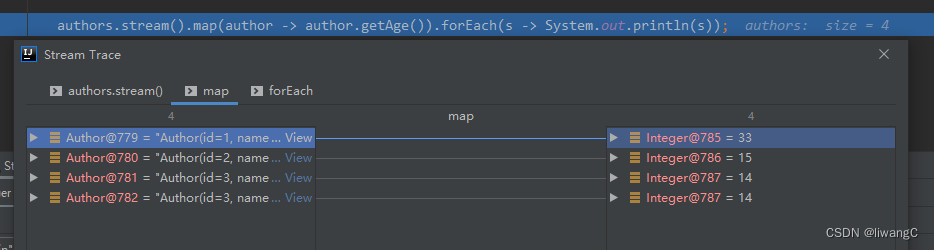
流经过第一个map后转换为了Integer

经过第二个map后将第一个Integer进行+10计算,类型不变- distinct 将元素进行去重操作
注意:distinct 依赖Object 的equals方法来判断对象是否相同,对象要重写equals方法。
authors.stream().distinct().forEach(author -> { System.out.println(author.getName()); });- 1
该操作直接通过distinct去重
当然也可以使用前面的map提取出名字,再去重,比上面的麻烦些authors.stream().distinct().map(new Function<Author, String>() { @Override public String apply(Author author) { return author.getName(); } }).forEach(name -> { System.out.println(name); }); // 一样 authors.stream().distinct().map(author -> author.getName()).forEach(name -> { System.out.println(name); });- 1
- 2
- 3
- 4
- 5
- 6
- 7
- 8
- 9
该操作先使用map将Author对象转换为姓名的String,然后在去重
- flatMap
上面的Map是把一个对象转换成另一个对象作为流中的元素,而flatMap是把一个对象转换为多个对象作为流中的元素
使用的函数式接口是:new Function
(1)打印所有书籍的名字,要求对重复的元素进行去重。
authors.stream() .flatMap(new Function<Author, Stream<Book>>() { // 这里可以通过idea进行lambda转换,为了清晰就不转了 @Override public Stream<Book> apply(Author author) { return author.getBooks().stream(); } }) .distinct() .forEach(name -> { System.out.println(name); });- 1
- 2
- 3
- 4
- 5
- 6
- 7
- 8
- 9
- 10
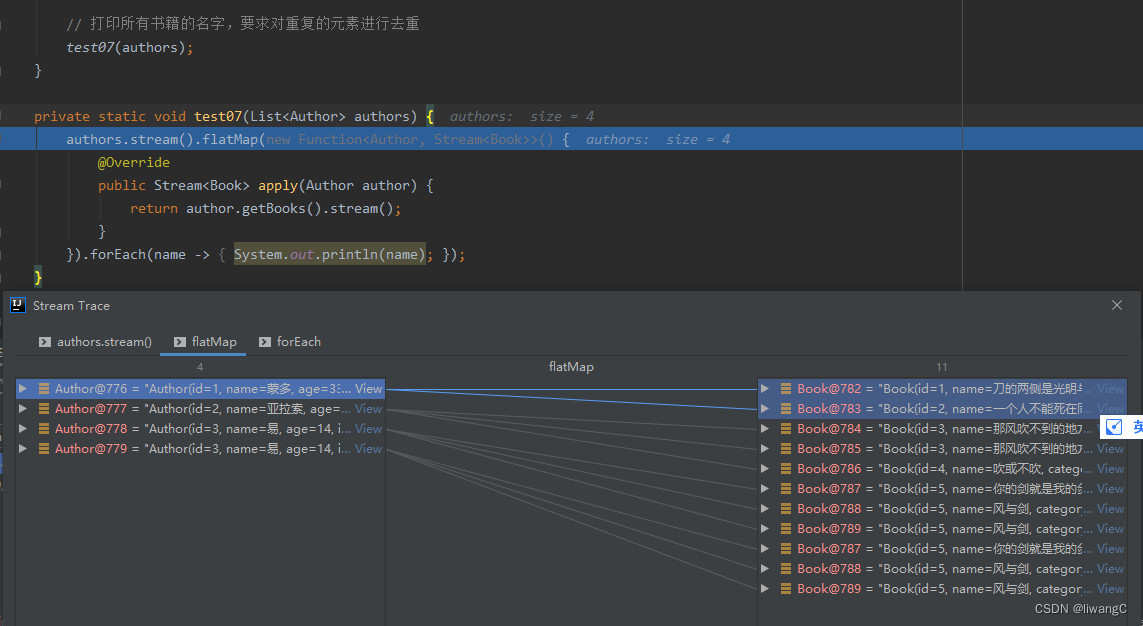
如果使用Map,将作者对象提取出书籍对象,还需要再对书籍对象List进行遍历去重,比较麻烦。
首先使用flatMap将每个作者对象中的书籍对象流提取出来,然后直接在书籍对象流中进行去重,输出书籍名称。

(2)打印现有数据的所有分类,要求对分类进行去重,不能出现这种格式:哲学,爱情,需要转成两个分类authors.stream() .flatMap(author -> author.getBooks().stream()) .distinct() // 将分类进行分割成数组后,转成流进行去重 .flatMap(book -> Arrays.stream(book.getCategory().split(","))) .distinct() .forEach(category -> System.out.println(category));- 1
- 2
- 3
- 4
- 5
- 6
- 7

第一次使用flatmap将作者对象转换成多个书籍对象流

第二次使用flatmap将书籍对象的分类转换成多个分类流
终结操作
- forEach 对流中元素进行遍历操作
- count 获取当前流中元素的个数
(1)打印这些作家所出书籍的数目,注意删除重复元素
因为count属于终结操作,会有返回值
long count = authors.stream() .flatMap(author -> author.getBooks().stream()) .distinct() .count(); System.out.println("书籍count = " + count);- 1
- 2
- 3
- 4
- 5
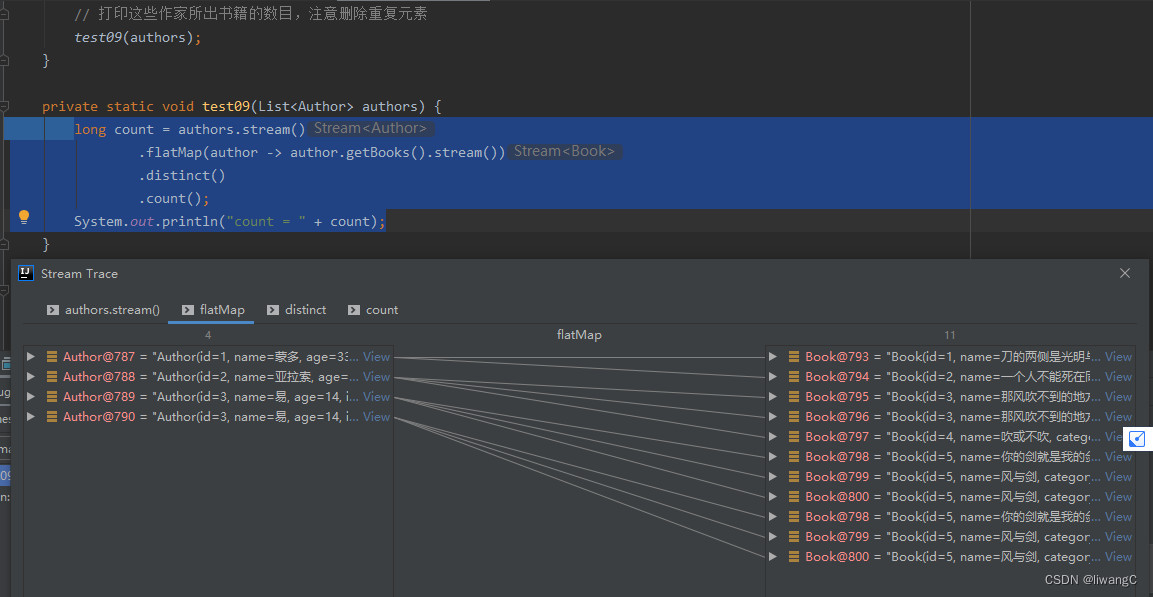
使用flatMap获取每个书籍对象,去重计算

- min和max 求流中的最值
(1)获取这些作家的所出书籍的最高分和最低分
Optional<Integer> max = authors.stream() .flatMap(author -> author.getBooks().stream()) .map(book -> book.getScore()) .max(new Comparator<Integer>() { @Override public int compare(Integer score1, Integer score2) { return score1 - score2; } }); System.out.println("书籍评分max = " + max.get()); Optional<Integer> min = authors.stream() .flatMap(author -> author.getBooks().stream()) .map(book -> book.getScore()) .min(new Comparator<Integer>() { @Override public int compare(Integer score1, Integer score2) { return score1 - score2; } }); System.out.println("书籍评分min = " + min .get());- 1
- 2
- 3
- 4
- 5
- 6
- 7
- 8
- 9
- 10
- 11
- 12
- 13
- 14
- 15
- 16
- 17
- 18
- 19
- 20
- 21
先使用flatMap将作者对象转换成多个书籍对象流,然后用map获取书籍对象中的评分对象,进行max和min计算
- collect 把当前流转换成一个集合
(1)获取一个存放所有作者名字的List集合
List<String> list = authors.stream() .map(author -> author.getName()) .distinct() .collect(Collectors.toList()); System.out.println("list = " + list);- 1
- 2
- 3
- 4
- 5
- 6
(2)获取一个所有书名的set集合
Set<String> set = authors.stream() .flatMap(author -> author.getBooks().stream()) .map(book -> book.getName()) .collect(Collectors.toSet()); System.out.println("set = " + set);- 1
- 2
- 3
- 4
- 5
- 6
(3)获取一个map集合,key为作者名,value为List
Map<String, List<Book>> map = authors.stream() // 去重避免key重复 .distinct() .collect(Collectors.toMap(new Function<Author, String>() { @Override // 这里的匿名内部类将传入作者对象,获取作者名作为key public String apply(Author author) { return author.getName(); } }, new Function<Author, List<Book>>() { @Override // 这里的匿名内部类将传入作者对象,获取书籍list作为value public List<Book> apply(Author author) { return author.getBooks(); } })); System.out.println("map = " + map);- 1
- 2
- 3
- 4
- 5
- 6
- 7
- 8
- 9
- 10
- 11
- 12
- 13
- 14
- 15
- 16
- 17
- 18
简化lambda表达式
Map<String, List<Book>> map = authors.stream() // 去重避免key重复 .distinct() .collect(Collectors.toMap(author -> author.getName(), author -> author.getBooks())); System.out.println("map = " + map);- 1
- 2
- 3
- 4
- 5
- 6
- anyMatch 判断流中是否有任意符合匹配条件的元素,符合返回true
boolean b = authors.stream().anyMatch(author -> author.getAge() > 29); System.out.println("b = " + b);- 1
- 2
- 3
判断是否有年龄在29以上的作家
- allMatch 判断流中元素是否都符合条件,都符合为true,否则为false
boolean b = authors.stream().allMatch(author -> author.getAge() >= 18); System.out.println("b = " + b);- 1
- 2
判断是否所有作家都是成年人
- noneMatch 判断流中元素是否都不符合条件,是为true,否为false
boolean b = authors.stream().noneMatch(author -> author.getAge() > 100); System.out.println("b = " + b);- 1
- 2
判断作家是否都没有超过100岁的
- findAny 获取流中符合条件的任意一个元素,不保证为流中的第一个元素
Optional<Author> au = authors.stream().filter(author -> author.getAge() > 18).findAny(); System.out.println("名字:" + au.get().getName());- 1
- 2
- 3
这里用的get方法获取数据,但是可能出现找不到符合条件的数据,这时候get就会报错,如:

所以改成:Optional<Author> au = authors.stream().filter(author -> author.getAge() > 98).findAny(); au.ifPresent(author -> System.out.println(author.getName()));- 1
- 2
- 3
获取任意一个大于18的作家,输出名字
- findFirst 获取流中的第一个元素
Optional<Author> author = authors.stream() .sorted((o1, o2) -> o1.getAge() - o2.getAge()) .findFirst(); author.ifPresent(author1 -> System.out.println(author1.getName()));- 1
- 2
- 3
- 4
- 5
获取年龄最小的作家,输出名字
- reduce归并 对流中的数据按照指定的计算方式计算出一个结果(缩减操作)
把stream中的元素组合起来,传入初始化值,按照指定的计算方式和元素进行计算,计算结果再和下一个元素进行计算,依次计算完
reduce有三种重载方式
- 2个参数的
T reduce(T identity, BinaryOperator accumulator);
T result = identity; for (T element : this stream) { result = accumulator.apply(result, element) } return result;- 1
- 2
- 3
- 4
- 5
传入初始化值作为第一个参数identity,传入计算方法accumulator.apply 进行初始化值和元素的计算
例子:
(1)使用reduce对作者年龄进行求和Integer result = authors.stream() .distinct() .map(author -> author.getAge()) // 传入初识值和计算方法 .reduce(0, new BinaryOperator<Integer>() { @Override public Integer apply(Integer result, Integer element) { return result + element; } }); System.out.println("result = " + result);- 1
- 2
- 3
- 4
- 5
- 6
- 7
- 8
- 9
- 10
- 11
- 12
lambda写
Integer result = authors.stream() .distinct() .map(author -> author.getAge()) // 传入初识值和计算方法 .reduce(0, (result1, element) -> result1 + element); System.out.println("result = " + result);- 1
- 2
- 3
- 4
- 5
- 6
- 7
(2)使用reduce求所有作者年龄最大值
Integer max = authors.stream() .distinct() .map(author -> author.getAge()) .reduce(Integer.MIN_VALUE, new BinaryOperator<Integer>() { @Override public Integer apply(Integer result, Integer element) { return result > element ? result : element; } }); System.out.println("max = " + max);- 1
- 2
- 3
- 4
- 5
- 6
- 7
- 8
- 9
- 10
(3)使用reduce求所有作者年龄最小值
Integer min = authors.stream() .distinct() .map(author -> author.getAge()) .reduce(Integer.MAX_VALUE, new BinaryOperator<Integer>() { @Override public Integer apply(Integer result, Integer element) { return result > element ? element : result; } }); System.out.println("min = " + min);- 1
- 2
- 3
- 4
- 5
- 6
- 7
- 8
- 9
- 10
- 11
- 1个参数的
Optional reduce(BinaryOperator accumulator);
boolean foundAny = false; T result = null; for (T element : this stream) { if (!foundAny) { foundAny = true; result = element; } else { result = accumulator.apply(result, element); } } return foundAny ? Optional.of(result) : Optional.empty();- 1
- 2
- 3
- 4
- 5
- 6
- 7
- 8
- 9
- 10
- 11
- 12
该方法只传入了一个计算方式,根据实现方法,可以看到将流中的第一个元素作为了第一个元素result,然后后续进行else内部的计算
例如:
Optional<Integer> optional = authors.stream() .distinct() .map(author -> author.getAge()) // 直接传入计算方法 .reduce((result, element) -> result > element ? element : result); optional.ifPresent(integer -> System.out.println(integer));- 1
- 2
- 3
- 4
- 5
- 6
- 7
-
相关阅读:
Android 获取SIM卡号码权限申请
dompdf,这么做就可以支持中文了
B. Bin Packing Problem(线段树+multiset)
MAVEN中三种packaging方式
MySQL导入导出视图
双端队列--二叉树 Z 字层序遍历
logback--进阶--03--日志打印步骤
Python15题day11
Python UI自动化 —— pytest常用运行参数解析、pytest执行顺序解析
Centos7安装配置中文输入法
- 原文地址:https://blog.csdn.net/qq_32015565/article/details/135964670
