-
Vanilla Graph Neural Networks(GNN)
概要:在本文中,我将介绍图形数据集Cora,同时利用Gephi处理数据集中的节点特征。之后,我们尝试在神经网络中包含拓扑信息(topological infomation),并比较加入拓扑信息前后的神经网络的性能。
一、Cora数据集介绍
Cora数据集包括2708份科学出版物,分为7类。引文网络由5429个链接组成。数据集中的每个发布都用一个0/1值的词向量来描述,该词向量表示字典中相应词的缺失/存在。这部词典由1433个独特的单词组成。

图1 Cora nodes 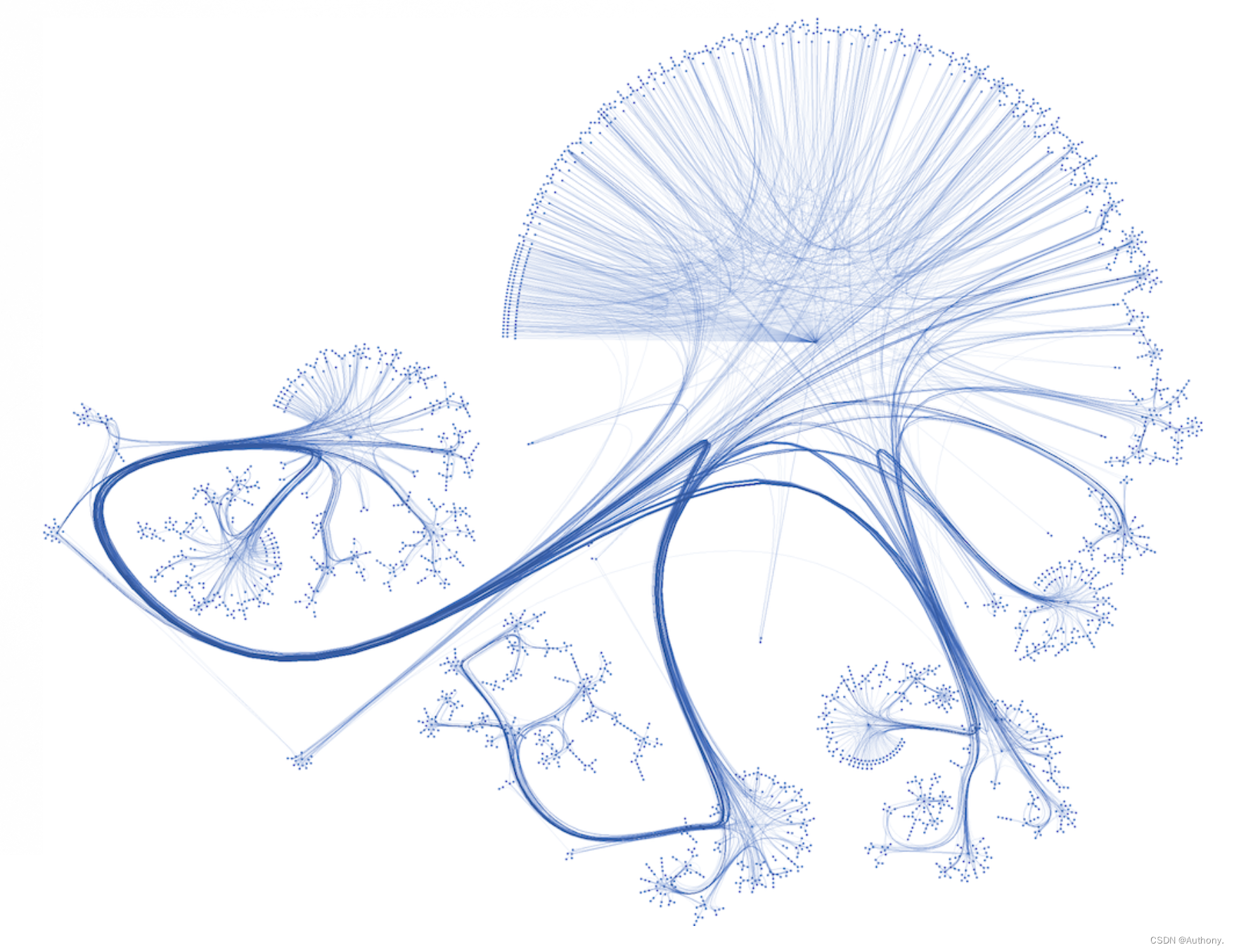
图2 Cora Graph Visualize
提示:以下是本篇文章正文内容,下面案例可供参考二、GNN架构
理解GNN架构首先需要理解多层感知机(MLP)在简单线性层的定义。
一个基本的神经网络对应于一个线性变换:
h A = x A W T h_A=x_AW^T hA=xAWT
式中, x A x_A xA是输入的节点向量, W W W是权重矩阵。
对于图数据集,输入向量是节点特征,这意味着节点之间是完全分离的。但是,我们需要考虑节点的上下文对节点的作用。因此,我们需要查看节点的邻域来帮助我们更好的进行节点分类。
定义 N A N_A NA为节点 A A A的邻域。进而,我们图线性变换层可以写为:
h A = ∑ i ∈ N A x i W T h_A=\sum_{i\in N_A}{x_iW^T} hA=i∈NA∑xiWT
将其转变为神经网络的矩阵运算格式,则为:
H = A ~ T X W T H=\tilde{A}^TXW^T H=A~TXWT
式中: A ~ = A + I \tilde{A}=A+I A~=A+I 表示邻接矩阵和自循环矩阵之和。三、代码解析
首先,我们利用MLP架构对节点进行分类。之后,利用GNN架构进行分类,并比较加入邻接矩阵前后模型的性能。
1、数据库导入
import torch import torch.nn.functional as F import pandas as pd import csv from torch.nn import Linear from torch_geometric.datasets import Planetoid from torch_geometric.datasets import FacebookPagePage from torch_geometric.utils import to_dense_adj torch.manual_seed(0)- 1
- 2
- 3
- 4
- 5
- 6
- 7
- 8
- 9
- 10
2、MLP架构
定义准确度函数以及构建MLP架构。
# Model Create def accuracy(y_pred, y_true): """Calculate accuracy.""" return torch.sum(y_pred == y_true) / len(y_true) class MLP(torch.nn.Module): """Multilayer Perceptron""" # the number of neurons in the input, hidden and output layers def __init__(self, dim_in, dim_h, dim_out): super().__init__() self.linear1 = Linear(dim_in, dim_h) self.linear2 = Linear(dim_h, dim_out) def forward(self, x): x = self.linear1(x) x = torch.relu(x) x = self.linear2(x) return F.log_softmax(x, dim=1) def fit(self, data, epochs): # initialize a loss function and an optimizer criterion = torch.nn.CrossEntropyLoss() optimizer = torch.optim.Adam(self.parameters(), lr=0.01, weight_decay=5e-4) self.train() losses = [] accs = [] val_losses = [] val_accs = [] for epoch in range(epochs+1): optimizer.zero_grad() out = self(data.x) loss = criterion(out[data.train_mask], data.y[data.train_mask]) acc = accuracy(out[data.train_mask].argmax(dim=1), data.y[data.train_mask]) loss.backward() optimizer.step() losses.append(loss) accs.append(acc) val_loss = criterion(out[data.val_mask], data.y[data.val_mask]) val_acc = accuracy(out[data.val_mask].argmax(dim=1), data.y[data.val_mask]) print(f'Epoch {epoch:>3} | Train Loss: {loss:.3f} | Train Acc:' f' {acc*100:>5.2f}% | Val Loss: {val_loss:.2f} | ' f'Val Acc: {val_acc*100:.2f}%') val_losses.append(val_loss) val_accs.append(val_acc) self.train_loss = losses self.train_acc = accs self.val_loss = val_losses self.val_acc = val_accs @torch.no_grad() def test(self, data): self.eval() out = self(data.x) acc = accuracy(out.argmax(dim=1)[data.test_mask], data.y[data.test_mask]) return acc- 1
- 2
- 3
- 4
- 5
- 6
- 7
- 8
- 9
- 10
- 11
- 12
- 13
- 14
- 15
- 16
- 17
- 18
- 19
- 20
- 21
- 22
- 23
- 24
- 25
- 26
- 27
- 28
- 29
- 30
- 31
- 32
- 33
- 34
- 35
- 36
- 37
- 38
- 39
- 40
- 41
- 42
- 43
- 44
- 45
- 46
- 47
- 48
- 49
- 50
- 51
- 52
- 53
- 54
- 55
- 56
- 57
- 58
- 59
- 60
- 61
- 62
- 63
- 64
- 65
- 66
在上述MLP类中,首先初始化了两层线性层,并分别定义了它们的输入输出大小。其次在 f o r w a r d forward forward函数中,分别定义激活函数为 r e l u relu relu和 l o g _ s o f t m a x log\_softmax log_softmax,最后在 f i t fit fit函数中,定义了损失函数和优化器。
3、训练MLP模型
# Create MLP model mlp = MLP(dataset.num_features, 16, dataset.num_classes) print(mlp) # Train mlp.fit(data, epochs=100) # Test acc = mlp.test(data) print(f'\nMLP test accuracy: {acc*100:.2f}%') # plot plt.plot(range(101), np.array(mlp.train_loss), label="Training loss") plt.plot(range(101), np.array(mlp.val_loss), ":", label="Val loss") plt.title("Training and validation loss") plt.style.use('seaborn-colorblind') plt.xlabel("Epochs") plt.ylabel("Loss") plt.legend() plt.show() plt.plot(range(101), np.array(mlp.train_acc), label="Training acc") plt.plot(range(101), np.array(mlp.val_acc), ':', label="Val acc") plt.style.use('seaborn-colorblind') plt.title("Training and validation acc") plt.xlabel("Epochs") plt.ylabel("acc") plt.legend() plt.show()- 1
- 2
- 3
- 4
- 5
- 6
- 7
- 8
- 9
- 10
- 11
- 12
- 13
- 14
- 15
- 16
- 17
- 18
- 19
- 20
- 21
- 22
- 23
- 24
- 25
- 26
- 27
- 28
- 29
保存训练过程中的 l o s s loss loss和 a c c acc acc以便于可视化,通过观察验证集 l o s s loss loss和 a c c acc acc的变化防止过拟合的发生。
训练后得到的结果如图3所示:

图3 训练集和验证集的loss和val曲线 从图3中可以看出,MLP架构的训练结果较差,验证集的准确率只能达到45%,同时在训练次数达到18次左右的时候,训练集的准确率就不在变化。
综上,模型在一定程度上有过拟合的现象发生,模型参数在后续的训练中变化幅度较小。4、GNN架构
首先建立GNN架构中关于邻接矩阵运算的函数。
class VanillaGNNLayer(torch.nn.Module): def __init__(self, dim_in, dim_out): super().__init__() # bias=False: which means without bias self.linear = Linear(dim_in, dim_out, bias=False) def forward(self, x, adjacency): x = self.linear(x) x = torch.sparse.mm(adjacency, x) return x # adjacency matrix # The two lines correspond one to one # [[[ ]]] --> [0] --> [[ ]] adjacency = to_dense_adj(data.edge_index)[0] # self loops # sparse matrix adjacency += torch.eye(len(adjacency))- 1
- 2
- 3
- 4
- 5
- 6
- 7
- 8
- 9
- 10
- 11
- 12
- 13
- 14
- 15
- 16
- 17
- 18
- 19
在上述类中,我们构建了线性模型,并将线性偏置去除,同时用 t o r c h . s p a r s e . m m torch.sparse.mm torch.sparse.mm将邻接矩阵加入到运算中。
在程序运行部分,我们用 t o r c h torch torch中的 t o _ d e n s e _ a d j to\_dense\_adj to_dense_adj函数将相邻节点的对应关系转化为邻接矩阵的形式,并且通过 e y e eye eye函数引入自循环。GNN模型的建立
class VanillaGNN(torch.nn.Module): """Vanilla Graph Neural Network""" def __init__(self, dim_in, dim_h, dim_out): super().__init__() # without bias and connect the adjacency matrix self.gnn1 = VanillaGNNLayer(dim_in, dim_h) self.gnn2 = VanillaGNNLayer(dim_h, dim_out) def forward(self, x, adjacency): h = self.gnn1(x, adjacency) h = torch.relu(h) h = self.gnn2(h, adjacency) return F.log_softmax(h, dim=1) def fit(self, data, epochs): criterion = torch.nn.CrossEntropyLoss() optimizer = torch.optim.Adam(self.parameters(), lr=0.01, weight_decay=5e-4) self.train() losses = [] accs = [] val_losses = [] val_accs = [] for epoch in range(epochs+1): optimizer.zero_grad() out = self(data.x, adjacency) loss = criterion(out[data.train_mask], data.y[data.train_mask]) acc = accuracy(out[data.train_mask].argmax(dim=1), data.y[data.train_mask]) loss.backward() optimizer.step() val_loss = criterion(out[data.val_mask], data.y[data.val_mask]) val_acc = accuracy(out[data.val_mask].argmax(dim=1), data.y[data.val_mask]) print(f'Epoch {epoch:>3} | Train Loss: {loss:.3f} | Train Acc:' f' {acc*100:>5.2f}% | Val Loss: {val_loss:.2f} | ' f'Val Acc: {val_acc*100:.2f}%') losses.append(loss) accs.append(acc) val_losses.append(val_loss) val_accs.append(val_acc) self.train_loss = losses self.train_acc = accs self.val_loss = val_losses self.val_acc = val_accs @torch.no_grad() def test(self, data): self.eval() out = self(data.x, adjacency) acc = accuracy(out.argmax(dim=1)[data.test_mask], data.y[data.test_mask]) return acc- 1
- 2
- 3
- 4
- 5
- 6
- 7
- 8
- 9
- 10
- 11
- 12
- 13
- 14
- 15
- 16
- 17
- 18
- 19
- 20
- 21
- 22
- 23
- 24
- 25
- 26
- 27
- 28
- 29
- 30
- 31
- 32
- 33
- 34
- 35
- 36
- 37
- 38
- 39
- 40
- 41
- 42
- 43
- 44
- 45
- 46
- 47
- 48
- 49
- 50
- 51
- 52
- 53
- 54
- 55
- 56
- 57
- 58
GNN模型同MLP模型相类似,在此不多赘述。
5、训练GNN模型
# Create the Vanilla GNN model gnn = VanillaGNN(dataset.num_features, 16, dataset.num_classes) print(gnn) # Train gnn.fit(data, epochs=100) # Test acc = gnn.test(data) print(f'\nGNN test accuracy: {acc*100:.2f}%') # plot plt.plot(range(101), np.array(gnn.train_loss), label="Training loss") plt.plot(range(101), np.array(gnn.val_loss), ":", label="Val loss") plt.title("GNN Training and validation loss") plt.style.use('seaborn-colorblind') plt.xlabel("Epochs") plt.ylabel("Loss") plt.legend() plt.show() plt.plot(range(101), np.array(gnn.train_acc), label="Training acc") plt.plot(range(101), np.array(gnn.val_acc), ':', label="Val acc") plt.style.use('seaborn-colorblind') plt.title("GNN Training and validation acc") plt.xlabel("Epochs") plt.ylabel("acc") plt.legend() plt.show()- 1
- 2
- 3
- 4
- 5
- 6
- 7
- 8
- 9
- 10
- 11
- 12
- 13
- 14
- 15
- 16
- 17
- 18
- 19
- 20
- 21
- 22
- 23
- 24
- 25
- 26
- 27
- 28
- 29
模型训练结果如图4所示:

 从图4中可以看出,训练次数在18次左右的时候,模型的性能是最优的,因此我们可以通过早停或者手动设置训练次数的方法来停止训练,避免模型过度训练导致的过拟合。将图3和图4比较可以发现,加入邻接矩阵后,模型在验证集上的准确率由45%提高到了75%,模型性能有较大的改善。
图4 GNN训练集和验证集的loss和val曲线 6、Tensorflow库
前文的MLP模型,我们采用 t o r c h torch torch库中关于神经网络的架构。在此,我们更改为 t e n s o r f l o w tensorflow tensorflow库,比较模型的结果。
# 二分类用交叉熵作为损失函数 model.compile(optimizer="rmsprop", loss="categorical_crossentropy", metrics=["accuracy"]) # 训练模型 history = model.fit(X_train, y_train, epochs=40, batch_size=128, validation_data=(X_val, y_val))- 1
- 2
- 3
- 4
- 5
- 6
- 7
- 8
- 9
- 10
- 11
上述是 t e n s o r f l o w tensorflow tensorflow神经网络模型的主要架构。
模型的训练结果如图5所示:
图5 训练集和验证集的loss和val曲线 从图5中我们可以看出,同样是MLP模型,利用 t e n s o r f l o w tensorflow tensorflow库训练的神经网络其验证集的准确率可以达到70%。
利用上述训练好的模型可以得到测试集的混淆矩阵如图6所示。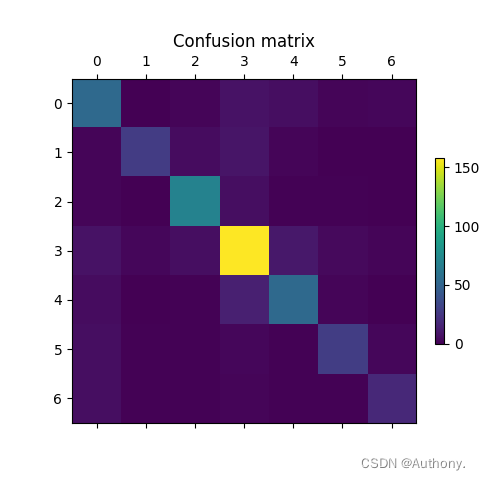 同时测试集的准确率为75%。
图6 测试集混淆矩阵
总结
在本章中,我们了解了MLP和GNN之间不同的环节。我们用我们的直觉和一点线性代数建立了我们自己的GNN架构。我们从科学文献中探索了流行的图数据集来比较我们的两种架构。最后,我们在Python中实现了它们,并评估了它们的性能。
-
相关阅读:
python和go相互调用的两种方法
13.Spring security权限管理
JS构造函数和原型
分布式存储系统之Ceph集群状态获取及ceph配置文件说明
首家!亚信科技AntDB数据库完成中国信通院数据库迁移工具专项测试
大数据学习(3)-hive分区表与分桶表
leetcode146.LRU缓存,从算法题引入,全面学习LRU和链表哈希表知识
JSR303和拦截器
Session与Cookie
阿里云MySQL从 2003->1251->1396
- 原文地址:https://blog.csdn.net/weixin_65191557/article/details/132651400
