-
【Highway-env】IntersectionEnv代码阅读
主要完成任务
IntersectionEnv继承自AbstractEnv,主要完成以下4个任务default_config环境默认的配置define_spaces设置相应的动作空间和观测空间step以一定的频率(policy frequency)执行策略并以一定的频率(simulation frequency)模拟环境render用于显示
代码结构
这部分的代码大致可以分为以下几个部分,我也将从以下几个方面进行分析。

另附上
AbstractEnv部分的代码结构。

1.action space
在
IntersectionEnv类中首先定义了action space,如下所示:分为SLOWER、IDLE和FASTER。默认设置期望速度设置为[0, 4.5, 9]

2.default_config
default_config设置了环境的默认配置,如下所示:@classmethod def default_config(cls) -> dict: config = super().default_config() config.update({ "observation": { "type": "Kinematics", "vehicles_count": 15, "features": ["presence", "x", "y", "vx", "vy", "cos_h", "sin_h"], "features_range": { "x": [-100, 100], "y": [-100, 100], "vx": [-20, 20], "vy": [-20, 20], }, "absolute": True, "flatten": False, "observe_intentions": False }, "action": { "type": "DiscreteMetaAction", "longitudinal": True, "lateral": False, "target_speeds": [0, 4.5, 9] }, "duration": 13, # [s] "destination": "o1", "controlled_vehicles": 1, "initial_vehicle_count": 10, "spawn_probability": 0.6, "screen_width": 600, "screen_height": 600, "centering_position": [0.5, 0.6], "scaling": 5.5 * 1.3, "collision_reward": -5, "high_speed_reward": 1, "arrived_reward": 1, "reward_speed_range": [7.0, 9.0], "normalize_reward": False, "offroad_terminal": False }) return config- 1
- 2
- 3
- 4
- 5
- 6
- 7
- 8
- 9
- 10
- 11
- 12
- 13
- 14
- 15
- 16
- 17
- 18
- 19
- 20
- 21
- 22
- 23
- 24
- 25
- 26
- 27
- 28
- 29
- 30
- 31
- 32
- 33
- 34
- 35
- 36
- 37
- 38
- 39
- 40
- 41
默认配置文件还有
AbstractEnv中所定义的部分。@classmethod def default_config(cls) -> dict: """ Default environment configuration. Can be overloaded in environment implementations, or by calling configure(). :return: a configuration dict """ return { "observation": { "type": "Kinematics" }, "action": { "type": "DiscreteMetaAction" }, "simulation_frequency": 15, # [Hz] "policy_frequency": 1, # [Hz] "other_vehicles_type": "highway_env.vehicle.behavior.IDMVehicle", "screen_width": 600, # [px] "screen_height": 150, # [px] "centering_position": [0.3, 0.5], "scaling": 5.5, "show_trajectories": False, "render_agent": True, "offscreen_rendering": os.environ.get("OFFSCREEN_RENDERING", "0") == "1", "manual_control": False, "real_time_rendering": False }- 1
- 2
- 3
- 4
- 5
- 6
- 7
- 8
- 9
- 10
- 11
- 12
- 13
- 14
- 15
- 16
- 17
- 18
- 19
- 20
- 21
- 22
- 23
- 24
- 25
- 26
- 27
- 28
3.reward
接着来介绍奖励函数部分,在
AbstractEnv中定义了_reward和_rewards函数,其中_rewards只在info中进行使用。def _reward(self, action: Action) -> float: """ Return the reward associated with performing a given action and ending up in the current state. :param action: the last action performed :return: the reward """ raise NotImplementedError def _rewards(self, action: Action) -> Dict[Text, float]: """ Returns a multi-objective vector of rewards. If implemented, this reward vector should be aggregated into a scalar in _reward(). This vector value should only be returned inside the info dict. :param action: the last action performed :return: a dict of {'reward_name': reward_value} """ raise NotImplementedError- 1
- 2
- 3
- 4
- 5
- 6
- 7
- 8
- 9
- 10
- 11
- 12
- 13
- 14
- 15
- 16
- 17
- 18
- 19
- 20
在
IntersectionEnv类中,实现了_reward、_rewards、_agent_reward以及_agent_rewards四个函数,我们首先从第四个函数开始看起:_agent_rewards

def _agent_rewards(self, action: int, vehicle: Vehicle) -> Dict[Text, float]: """Per-agent per-objective reward signal.""" scaled_speed = utils.lmap(vehicle.speed, self.config["reward_speed_range"], [0, 1]) return { "collision_reward": vehicle.crashed, "high_speed_reward": np.clip(scaled_speed, 0, 1), "arrived_reward": self.has_arrived(vehicle), "on_road_reward": vehicle.on_road }- 1
- 2
- 3
- 4
- 5
- 6
- 7
- 8
- 9
首先将车速进行线性映射,得到
scaled_speed。
lmap函数实现线性映射的功能:- 输入待映射的量 v v v,映射前范围: [ x 0 , x 1 ] [x_0,x_1] [x0,x1],映射后范围: [ y 0 , y 1 ] [y_0,y_1] [y0,y1]
- 输出: y 0 + ( v − x 0 ) × ( y 1 − y 0 ) x 1 − x 0 y_0 + \frac{{(v-x_0)}\times{(y_1-y_0)}}{x_1-x_0} y0+x1−x0(v−x0)×(y1−y0)
如:
scaled_speed = utils.lmap(5, [7, 9], [0, 1])输出为-1.utils.py def lmap(v: float, x: Interval, y: Interval) -> float: """Linear map of value v with range x to desired range y.""" return y[0] + (v - x[0]) * (y[1] - y[0]) / (x[1] - x[0])- 1
- 2
- 3
- 4
has_arrived根据如下条件进行判断,lane_index是一个三元组(例,(‘il1’,‘o1’,0)),判断车辆是否在车道上,是否抵达目的地,且是否在车道坐标系中的纵向坐标大于exit_distance。def has_arrived(self, vehicle: Vehicle, exit_distance: float = 25) -> bool: return "il" in vehicle.lane_index[0] \ and "o" in vehicle.lane_index[1] \ and vehicle.lane.local_coordinates(vehicle.position)[0] >= exit_distance- 1
- 2
- 3
- 4
_agent_reward
_agent_reward接受来自_agent_rewards的字典,进行reward求和并判断是否启用奖励归一化。
R t o t a l = ( w c o l l i s i o n ⋅ R c o l l i s i o n + w h i g h s p e e d ⋅ R h i g h s p e e d + w a r r i v e d ⋅ R a r r i v e d ) ∗ w o n r o a d ⋅ R o n r o a dRtotal=(wcollision⋅Rcollision+whighspeed⋅Rhighspeed+warrived⋅Rarrived)∗wonroad⋅RonroadR t o t a l = ( w c o l l i s i o n ⋅ R c o l l i s i o n + w h i g h s p e e d ⋅ R h i g h s p e e d + w a r r i v e d ⋅ R a r r i v e d ) ∗ w o n r o a d ⋅ R o n r o a d 启用归一化:
R = ( R − w c o l l i s i o n ) × ( 1 − 0 ) w a r r i v e d − w c o l l i s i o n R= \frac{{(R-w_{collision})}\times{(1-0)}}{w_{arrived}-w_{collision}} R=warrived−wcollision(R−wcollision)×(1−0)def _agent_reward(self, action: int, vehicle: Vehicle) -> float: """Per-agent reward signal.""" rewards = self._agent_rewards(action, vehicle) reward = sum(self.config.get(name, 0) * reward for name, reward in rewards.items()) reward = self.config["arrived_reward"] if rewards["arrived_reward"] else reward reward *= rewards["on_road_reward"] if self.config["normalize_reward"]: reward = utils.lmap(reward, [self.config["collision_reward"], self.config["arrived_reward"]], [0, 1]) return reward- 1
- 2
- 3
- 4
- 5
- 6
- 7
- 8
- 9
_reward
_reward通过对所有控制的车辆执行某个动作所获得的奖励进行求和,然后除以车辆的数量来得到平均奖励。def _reward(self, action: int) -> float: """Aggregated reward, for cooperative agents.""" return sum(self._agent_reward(action, vehicle) for vehicle in self.controlled_vehicles ) / len(self.controlled_vehicles)- 1
- 2
- 3
- 4
_rewards
_rewards方法计算的是合作智能体的多目标奖励。对于每个动作,它计算所有控制车辆的奖励,并将这些奖励按名称聚合起来,然后除以车辆的数量得到平均奖励。这个方法返回的是一个字典,其中每个键都是一个奖励的名称,每个值都是对应的平均奖励。最后将信息送人info.def _rewards(self, action: int) -> Dict[Text, float]: """Multi-objective rewards, for cooperative agents.""" agents_rewards = [self._agent_rewards(action, vehicle) for vehicle in self.controlled_vehicles] return { name: sum(agent_rewards[name] for agent_rewards in agents_rewards) / len(agents_rewards) for name in agents_rewards[0].keys() }- 1
- 2
- 3
- 4
- 5
- 6
- 7
AbstractEnv def _info(self, obs: Observation, action: Optional[Action] = None) -> dict: """ Return a dictionary of additional information :param obs: current observation :param action: current action :return: info dict """ info = { "speed": self.vehicle.speed, "crashed": self.vehicle.crashed, "action": action, } try: info["rewards"] = self._rewards(action) except NotImplementedError: pass return info- 1
- 2
- 3
- 4
- 5
- 6
- 7
- 8
- 9
- 10
- 11
- 12
- 13
- 14
- 15
- 16
- 17
- 18
- 19
IntersectionEnv def _info(self, obs: np.ndarray, action: int) -> dict: info = super()._info(obs, action) info["agents_rewards"] = tuple(self._agent_reward(action, vehicle) for vehicle in self.controlled_vehicles) info["agents_dones"] = tuple(self._agent_is_terminal(vehicle) for vehicle in self.controlled_vehicles) return info- 1
- 2
- 3
- 4
- 5
- 6
小结

4.terminated & truncated
- 当车辆发生碰撞或者抵达终点或者偏离道路,则视为
_is_terminated - 当车辆所经历的时间大于预定的时间
duration,则truncated _agent_is_terminal方法在info中使用。
def _is_terminated(self) -> bool: return any(vehicle.crashed for vehicle in self.controlled_vehicles) \ or all(self.has_arrived(vehicle) for vehicle in self.controlled_vehicles) \ or (self.config["offroad_terminal"] and not self.vehicle.on_road) def _agent_is_terminal(self, vehicle: Vehicle) -> bool: """The episode is over when a collision occurs or when the access ramp has been passed.""" return (vehicle.crashed or self.has_arrived(vehicle)) def _is_truncated(self) -> bool: """The episode is truncated if the time limit is reached.""" return self.time >= self.config["duration"]- 1
- 2
- 3
- 4
- 5
- 6
- 7
- 8
- 9
- 10
- 11
- 12
- 13
5.reset

_make_road

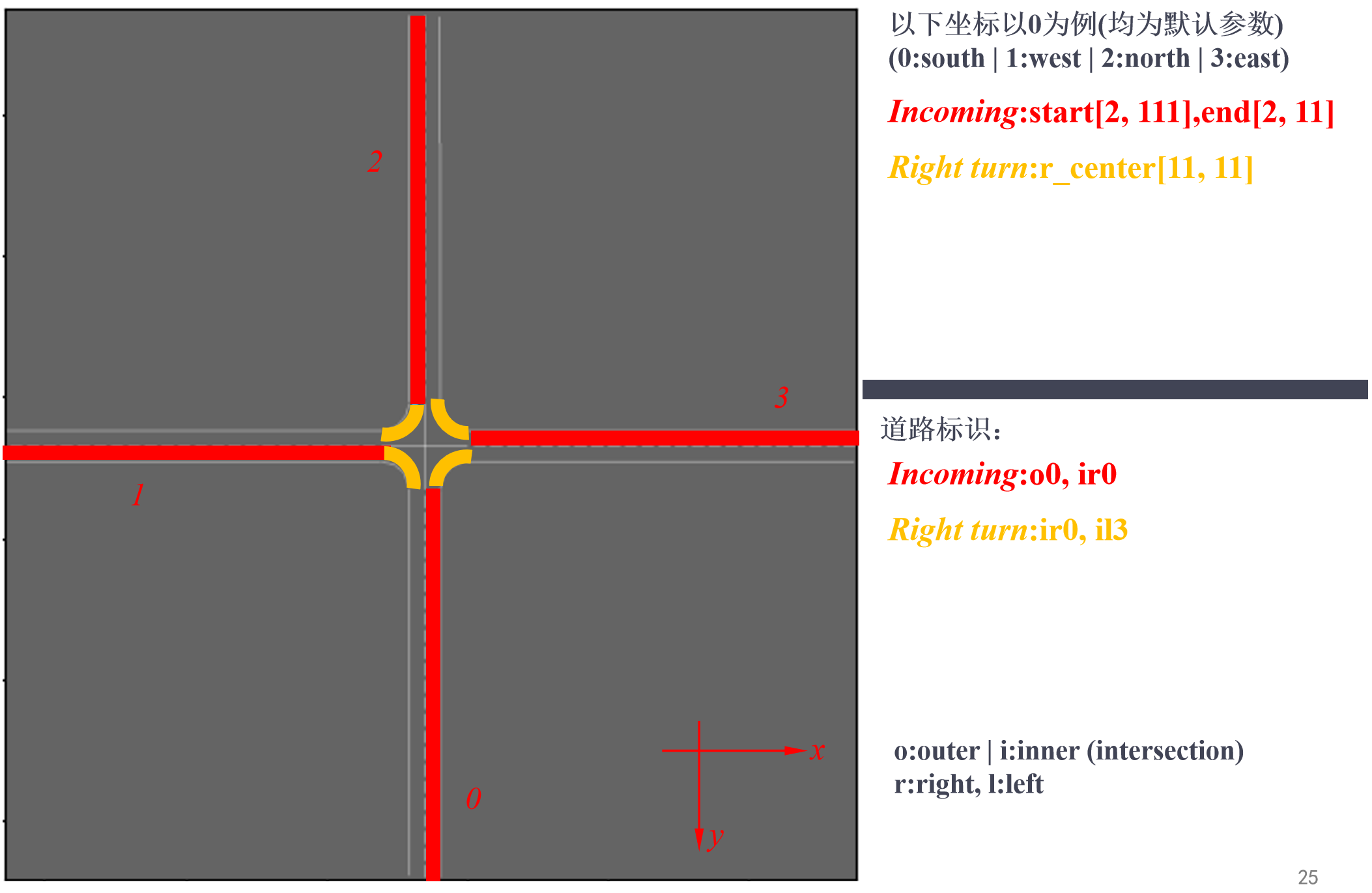
_make_road实现了一个4-way的路口场景,共有以下四种优先级:驾驶行为 优先级 图示 3 horizontal straight lanes and right-turns 
2 horizontal left-turns 
1 vertical straight lanes and right-turns 
0 vertical left-turns 
路网中的节点按如下规则进行标识:
(o:outer | i:inner + [r:right, l:left]) + (0:south | 1:west | 2:north | 3:east)- 1
def _make_road(self) -> None: """ Make an 4-way intersection. The horizontal road has the right of way. More precisely, the levels of priority are: - 3 for horizontal straight lanes and right-turns - 1 for vertical straight lanes and right-turns - 2 for horizontal left-turns - 0 for vertical left-turns The code for nodes in the road network is: (o:outer | i:inner + [r:right, l:left]) + (0:south | 1:west | 2:north | 3:east) :return: the intersection road """ lane_width = AbstractLane.DEFAULT_WIDTH right_turn_radius = lane_width + 5 # [m} left_turn_radius = right_turn_radius + lane_width # [m} outer_distance = right_turn_radius + lane_width / 2 access_length = 50 + 50 # [m] net = RoadNetwork() n, c, s = LineType.NONE, LineType.CONTINUOUS, LineType.STRIPED for corner in range(4): angle = np.radians(90 * corner) is_horizontal = corner % 2 priority = 3 if is_horizontal else 1 rotation = np.array([[np.cos(angle), -np.sin(angle)], [np.sin(angle), np.cos(angle)]]) # Incoming start = rotation @ np.array([lane_width / 2, access_length + outer_distance]) end = rotation @ np.array([lane_width / 2, outer_distance]) net.add_lane("o" + str(corner), "ir" + str(corner), StraightLane(start, end, line_types=[s, c], priority=priority, speed_limit=10)) # Right turn r_center = rotation @ (np.array([outer_distance, outer_distance])) net.add_lane("ir" + str(corner), "il" + str((corner - 1) % 4), CircularLane(r_center, right_turn_radius, angle + np.radians(180), angle + np.radians(270), line_types=[n, c], priority=priority, speed_limit=10)) # Left turn l_center = rotation @ (np.array([-left_turn_radius + lane_width / 2, left_turn_radius - lane_width / 2])) net.add_lane("ir" + str(corner), "il" + str((corner + 1) % 4), CircularLane(l_center, left_turn_radius, angle + np.radians(0), angle + np.radians(-90), clockwise=False, line_types=[n, n], priority=priority - 1, speed_limit=10)) # Straight start = rotation @ np.array([lane_width / 2, outer_distance]) end = rotation @ np.array([lane_width / 2, -outer_distance]) net.add_lane("ir" + str(corner), "il" + str((corner + 2) % 4), StraightLane(start, end, line_types=[s, n], priority=priority, speed_limit=10)) # Exit start = rotation @ np.flip([lane_width / 2, access_length + outer_distance], axis=0) end = rotation @ np.flip([lane_width / 2, outer_distance], axis=0) net.add_lane("il" + str((corner - 1) % 4), "o" + str((corner - 1) % 4), StraightLane(end, start, line_types=[n, c], priority=priority, speed_limit=10)) road = RegulatedRoad(network=net, np_random=self.np_random, record_history=self.config["show_trajectories"]) self.road = road- 1
- 2
- 3
- 4
- 5
- 6
- 7
- 8
- 9
- 10
- 11
- 12
- 13
- 14
- 15
- 16
- 17
- 18
- 19
- 20
- 21
- 22
- 23
- 24
- 25
- 26
- 27
- 28
- 29
- 30
- 31
- 32
- 33
- 34
- 35
- 36
- 37
- 38
- 39
- 40
- 41
- 42
- 43
- 44
- 45
- 46
- 47
- 48
- 49
- 50
- 51
- 52
- 53
- 54
- 55
- 56
首先是
lane_width、right_turn_radius、left_turn_radius、outer_distance、access_length等参数的设置,图示如下:

旋转矩阵: [ cos θ − sin θ sin θ cos θ ] \left[ {
} \right] [cosθsinθ−sinθcosθ]cos θ − sin θ sin θ cos θ 代码遍历4个方向,构建相应的路网,图示如下:


_make_vehicles

def _make_vehicles(self, n_vehicles: int = 10) -> None: """ Populate a road with several vehicles on the highway and on the merging lane :return: the ego-vehicle """ # Configure vehicles vehicle_type = utils.class_from_path(self.config["other_vehicles_type"]) vehicle_type.DISTANCE_WANTED = 7 # Low jam distance vehicle_type.COMFORT_ACC_MAX = 6 vehicle_type.COMFORT_ACC_MIN = -3 # Random vehicles simulation_steps = 3 for t in range(n_vehicles - 1): self._spawn_vehicle(np.linspace(0, 80, n_vehicles)[t]) for _ in range(simulation_steps): [(self.road.act(), self.road.step(1 / self.config["simulation_frequency"])) for _ in range(self.config["simulation_frequency"])] # Challenger vehicle self._spawn_vehicle(60, spawn_probability=1, go_straight=True, position_deviation=0.1, speed_deviation=0) # Controlled vehicles self.controlled_vehicles = [] for ego_id in range(0, self.config["controlled_vehicles"]): ego_lane = self.road.network.get_lane(("o{}".format(ego_id % 4), "ir{}".format(ego_id % 4), 0)) destination = self.config["destination"] or "o" + str(self.np_random.randint(1, 4)) ego_vehicle = self.action_type.vehicle_class( self.road, ego_lane.position(60 + 5*self.np_random.normal(1), 0), speed=ego_lane.speed_limit, heading=ego_lane.heading_at(60)) try: ego_vehicle.plan_route_to(destination) ego_vehicle.speed_index = ego_vehicle.speed_to_index(ego_lane.speed_limit) ego_vehicle.target_speed = ego_vehicle.index_to_speed(ego_vehicle.speed_index) except AttributeError: pass self.road.vehicles.append(ego_vehicle) self.controlled_vehicles.append(ego_vehicle) for v in self.road.vehicles: # Prevent early collisions if v is not ego_vehicle and np.linalg.norm(v.position - ego_vehicle.position) < 20: self.road.vehicles.remove(v)- 1
- 2
- 3
- 4
- 5
- 6
- 7
- 8
- 9
- 10
- 11
- 12
- 13
- 14
- 15
- 16
- 17
- 18
- 19
- 20
- 21
- 22
- 23
- 24
- 25
- 26
- 27
- 28
- 29
- 30
- 31
- 32
- 33
- 34
- 35
- 36
- 37
- 38
- 39
- 40
- 41
- 42
- 43
- 44
_spawn_vehicle
def _spawn_vehicle(self, longitudinal: float = 0, position_deviation: float = 1., speed_deviation: float = 1., spawn_probability: float = 0.6, go_straight: bool = False) -> None: if self.np_random.uniform() > spawn_probability: return route = self.np_random.choice(range(4), size=2, replace=False) route[1] = (route[0] + 2) % 4 if go_straight else route[1] vehicle_type = utils.class_from_path(self.config["other_vehicles_type"]) vehicle = vehicle_type.make_on_lane(self.road, ("o" + str(route[0]), "ir" + str(route[0]), 0), longitudinal=(longitudinal + 5 + self.np_random.normal() * position_deviation), speed=8 + self.np_random.normal() * speed_deviation) for v in self.road.vehicles: if np.linalg.norm(v.position - vehicle.position) < 15: return vehicle.plan_route_to("o" + str(route[1])) vehicle.randomize_behavior() self.road.vehicles.append(vehicle) return vehicle- 1
- 2
- 3
- 4
- 5
- 6
- 7
- 8
- 9
- 10
- 11
- 12
- 13
- 14
- 15
- 16
- 17
- 18
- 19
- 20
- 21
- 22
- 23
6.step

abstract.py def step(self, action: Action) -> Tuple[Observation, float, bool, bool, dict]: """ Perform an action and step the environment dynamics. The action is executed by the ego-vehicle, and all other vehicles on the road performs their default behaviour for several simulation timesteps until the next decision making step. :param action: the action performed by the ego-vehicle :return: a tuple (observation, reward, terminated, truncated, info) """ if self.road is None or self.vehicle is None: raise NotImplementedError("The road and vehicle must be initialized in the environment implementation") self.time += 1 / self.config["policy_frequency"] self._simulate(action) obs = self.observation_type.observe() reward = self._reward(action) terminated = self._is_terminated() truncated = self._is_truncated() info = self._info(obs, action) if self.render_mode == 'human': self.render() return obs, reward, terminated, truncated, info- 1
- 2
- 3
- 4
- 5
- 6
- 7
- 8
- 9
- 10
- 11
- 12
- 13
- 14
- 15
- 16
- 17
- 18
- 19
- 20
- 21
- 22
- 23
- 24
- 25
- 26
intersection_env.py def step(self, action: int) -> Tuple[np.ndarray, float, bool, bool, dict]: obs, reward, terminated, truncated, info = super().step(action) self._clear_vehicles() self._spawn_vehicle(spawn_probability=self.config["spawn_probability"]) return obs, reward, terminated, truncated, info- 1
- 2
- 3
- 4
- 5
- 6
def _simulate(self, action: Optional[Action] = None) -> None: """Perform several steps of simulation with constant action.""" frames = int(self.config["simulation_frequency"] // self.config["policy_frequency"]) for frame in range(frames): # Forward action to the vehicle if action is not None \ and not self.config["manual_control"] \ and self.steps % int(self.config["simulation_frequency"] // self.config["policy_frequency"]) == 0: self.action_type.act(action) self.road.act() self.road.step(1 / self.config["simulation_frequency"]) self.steps += 1 # Automatically render intermediate simulation steps if a viewer has been launched # Ignored if the rendering is done offscreen if frame < frames - 1: # Last frame will be rendered through env.render() as usual self._automatic_rendering() self.enable_auto_render = False- 1
- 2
- 3
- 4
- 5
- 6
- 7
- 8
- 9
- 10
- 11
- 12
- 13
- 14
- 15
- 16
- 17
- 18
- 19
- 20
-
相关阅读:
【OCR】基于Encoder-Decoder的文本识别
【面试题精讲】Java 和 C++ 的区别?
RequestMapping注解
C++基础第9章:序列与关联容器(2)——序列容器
Ubuntu下VScode配置ssh免密远程登录
《游戏编程模式》学习笔记(十四)事件队列 Event Queue
力扣46. 全排列
线程安全的随机数
1143 多少个Fibonacci数
关于 Vue 样式的 7 个你(可能)不知道的技巧
- 原文地址:https://blog.csdn.net/sinat_52032317/article/details/134427401
