-
为什么阿里不推荐使用 keySet() 遍历HashMap?
为什么阿里不推荐使用 keySet() 遍历HashMap?
HashMap相信所有学Java的都一定不会感到陌生,作为一个非常重用且非常实用的Java提供的容器,它在我们的代码里面随处可见。因此遍历操作也是我们经常会使用到的。HashMap的遍历方式现如今有非常多种:
使用迭代器(Iterator)。
使用 keySet() 获取键的集合,然后通过增强的 for 循环遍历键。
使用 entrySet() 获取键值对的集合,然后通过增强的 for 循环遍历键值对。
使用 Java 8+ 的 Lambda 表达式和流。
以上遍历方式的孰优孰劣,在《阿里巴巴开发手册》中写道:
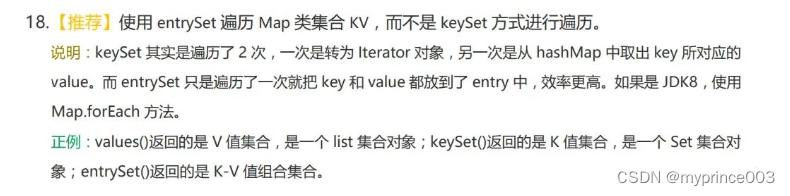
这里推荐使用的是entrySet进行遍历,在Java8中推荐使用Map.forEach()。给出的理由是遍历次数上的不同。keySet遍历,需要经过两次遍历。
entrySet遍历,只需要一次遍历。
其中keySet遍历了两次,一次是转为Iterator对象,另一次是从hashMap中取出key所对应的value。
其中后面一段话很好理解,但是前面这句话却有点绕,为什么转换成了Iterator遍历了一次?
我查阅了各个平台对HashMap的遍历,其中都没有或者原封不动的照搬上句话。
Part2keySet如何遍历了两次
我们首先写一段代码,使用keySet遍历Map。public class Test { public static void main(String[] args) { Map<String, String> map = new HashMap<>(); map.put("k1", "v1"); map.put("k2", "v2"); map.put("k3", "v3"); for (String key : map.keySet()) { String value = map.get(key); System.out.println(key + ":" + value); } } } 运行结果显而易见的是 k1:v1 k2:v2 k3:v3- 1
- 2
- 3
- 4
- 5
- 6
- 7
- 8
- 9
- 10
- 11
- 12
- 13
- 14
- 15
- 16
- 17
- 18
两次遍历,第一次遍历所描述的是转为Iterator对象我们好像没有从代码中看见,我们看到的后面所描述的遍历,也就是遍历map,keySet()所返回的Set集合中的key,然后去HashMap中拿取value的。
Iterator对象呢?如何遍历转换为Iterator对象的呢?
首先我们这种遍历方式大家都应该知道是叫:增强for循环,for-each
这是一种Java的语法糖~。
我们可以通过反编译,或者直接通过Idea在class文件中查看对应的Class文件

public class Test { public Test() { } public static void main(String[] args) { Map<String, String> map = new HashMap(); map.put("k1", "v1"); map.put("k2", "v2"); map.put("k3", "v3"); Iterator var2 = map.keySet().iterator(); while(var2.hasNext()) { String key = (String)var2.next(); String value = (String)map.get(key); System.out.println(key + ":" + value); } } }- 1
- 2
- 3
- 4
- 5
- 6
- 7
- 8
- 9
- 10
- 11
- 12
- 13
- 14
- 15
- 16
- 17
- 18
- 19
和我们编写的是存在差异的,其中我们可以看到其中通过map.keySet().iterator()获取到了我们所需要看见的Iterator对象。
那么它又是怎么转换成的呢?为什么需要遍历呢?我们查看iterator()方法
1iterator()
发现是Set定义的一个接口。返回此集合中元素的迭代器
2HashMap.KeySet#iterator()
我们查看HashMap中keySet类对该方法的实现。final class KeySet extends AbstractSet<K> { public final int size() { return size; } public final void clear() { HashMap.this.clear(); } public final Iterator<K> iterator() { return new KeyIterator(); } public final boolean contains(Object o) { return containsKey(o); } public final boolean remove(Object key) { return removeNode(hash(key), key, null, false, true) != null; } public final Spliterator<K> spliterator() { return new KeySpliterator<>(HashMap.this, 0, -1, 0, 0); } public final void forEach(Consumer<? super K> action) { Node<K,V>[] tab; if (action == null) throw new NullPointerException(); if (size > 0 && (tab = table) != null) { int mc = modCount; for (int i = 0; i < tab.length; ++i) { for (Node<K,V> e = tab[i]; e != null; e = e.next) action.accept(e.key); } if (modCount != mc) throw new ConcurrentModificationException(); } } }- 1
- 2
- 3
- 4
- 5
- 6
- 7
- 8
- 9
- 10
- 11
- 12
- 13
- 14
- 15
- 16
- 17
- 18
- 19
- 20
- 21
- 22
- 23
- 24
- 25
- 26
其中的iterator()方法返回的是一个KeyIterator对象,那么究竟是在哪里进行了遍历呢?我们接着往下看去。
final class KeyIterator extends HashIterator implements Iterator<K> { public final K next() { return nextNode().key; } }- 1
- 2
- 3
- 4
这个类也很简单:
继承了HashIterator类。
实现了Iterator接口。
一个next()方法。
还是没有看见哪里进行了遍历,那么我们继续查看HashIterator类
4HashMap.HashIterator
abstract class HashIterator { Node<K,V> next; // next entry to return Node<K,V> current; // current entry int expectedModCount; // for fast-fail int index; // current slot HashIterator() { expectedModCount = modCount; Node<K,V>[] t = table; current = next = null; index = 0; if (t != null && size > 0) { // advance to first entry do {} while (index < t.length && (next = t[index++]) == null); } } public final boolean hasNext() { return next != null; } final Node<K,V> nextNode() { Node<K,V>[] t; Node<K,V> e = next; if (modCount != expectedModCount) throw new ConcurrentModificationException(); if (e == null) throw new NoSuchElementException(); if ((next = (current = e).next) == null && (t = table) != null) { do {} while (index < t.length && (next = t[index++]) == null); } return e; } public final void remove() { Node<K,V> p = current; if (p == null) throw new IllegalStateException(); if (modCount != expectedModCount) throw new ConcurrentModificationException(); current = null; K key = p.key; removeNode(hash(key), key, null, false, false); expectedModCount = modCount; } }- 1
- 2
- 3
- 4
- 5
- 6
- 7
- 8
- 9
- 10
- 11
- 12
- 13
- 14
- 15
- 16
- 17
- 18
- 19
- 20
- 21
- 22
- 23
- 24
- 25
- 26
- 27
- 28
- 29
- 30
- 31
- 32
- 33
- 34
- 35
- 36
- 37
- 38
- 39
- 40
- 41
- 42
- 43
- 44
- 45
我们可以发现这个构造器中存在了一个do-while循环操作,目的是找到一个第一个不为空的entry。
HashIterator() { expectedModCount = modCount; Node<K,V>[] t = table; current = next = null; index = 0; if (t != null && size > 0) { // advance to first entry do {} while (index < t.length && (next = t[index++]) == null); } }- 1
- 2
- 3
- 4
- 5
- 6
- 7
- 8
- 9
而KeyIterator是extendHashIterator对象的。这里涉及到了继承的相关概念,大家忘记的可以找相关的文章看看,或者我也可以写一篇~~dog。
例如两个类
public class Father { public Father(){ System.out.println("father"); } } public class Son extends Father{ public static void main(String[] args) { Son son = new Son(); } }- 1
- 2
- 3
- 4
- 5
- 6
- 7
- 8
- 9
- 10
- 11
- 12
创建Son对象的同时,会执行Father构造器。也就会打印出father这句话。
那么这个循环操作就是我们要找的循环操作了。
总结
使用keySet遍历,其实内部是使用了对应的iterator()方法。iterator()方法是创建了一个KeyIterator对象。
KeyIterator对象extendHashIterator对象。
HashIterator对象的构造方法中,会遍历找到第一个不为空的entry。
keySet->iterator()->KeyIterator->HashIterator
-
相关阅读:
设计模式学习笔记(九)桥接模式及其应用
y138.第八章 Servless和Knative从入门到精通 -- Knative基础(二)
【WPF系列】- XAML语法规范
MATLAB算法实战应用案例精讲-【人工智能】边缘计算(附python代码实现)
【论文笔记】神经网络压缩调研
【校招VIP】前端JS之深拷贝和浅拷贝
利用Anaconda安装pytorch和paddle深度学习环境
Aptos 深度解读:机遇、挑战与风险
无序和混乱终结者,极狐GitLab Workflow 到底有什么魔力?
MallBook联合人民交通出版社,推动驾培领域新发展,开启驾培智慧交易新生态
- 原文地址:https://blog.csdn.net/weixin_45817985/article/details/134440473
