-
AXI-Stream协议详解(3)—— AXI4-Stream IP核原理分析
一、前言
在之前的文章中,我们介绍了AXI-S协议的一些基础知识,这是我们进行本文学习的前置基础,因此建议在开始本文章的学习前,完整阅读以下两篇文章:
AXI-Stream协议详解(1)—— Introduction
 https://blog.csdn.net/apple_53311083/article/details/134058532?spm=1001.2014.3001.5501AXI-Stream协议详解(2)—— Interface Signalshttps://blog.csdn.net/apple_53311083/article/details/134065597?spm=1001.2014.3001.5501
二、带AXI-Stream接口的IP核
1、IP核创建


在这里我们选择最底下的一项,创建一个带有AXI接口的IP核

接下来我们设置IP核的一些细节信息,这里把名称改成了axis_m,代表这是AXI-Stream协议的主机。
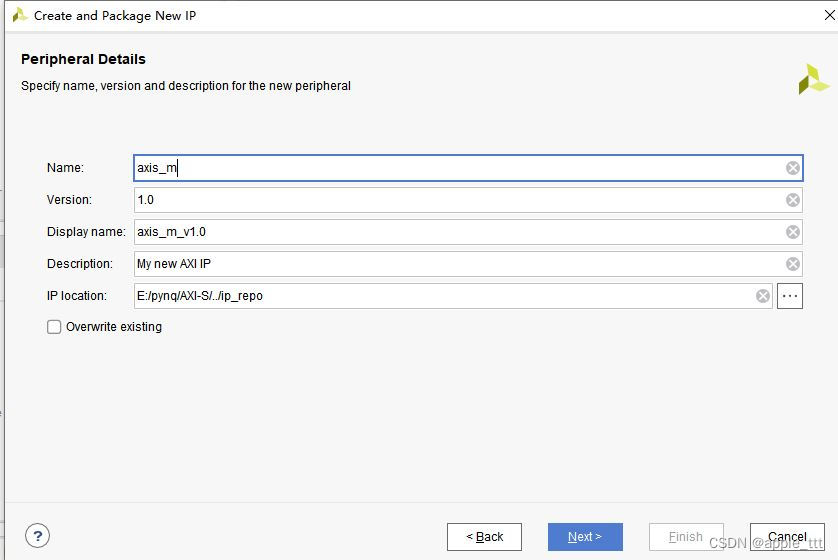
选择stream协议,选择主机类型,相应地完成名称更改,这里的数据位宽我们暂时不做更改,保持默认的32bit就行。

最后这里直接添加到IP库里就完成了。

然后我们通过同样的方式可以完成axi_s(带有AXI-S接口的从机)的创建,这里就省略创建过程了。
2、IP核学习
在IP Catlog下搜索找到我们之前创建的2个带有AXI-Stream协议的IP核

右击选择Edit in packager

我们先以从机为例,显示如何找到AXI-S的设计部分,直接点击OK直到打开一个新的vivado界面


可以看到里面有两个模块
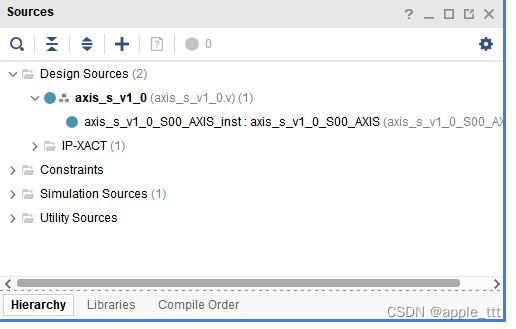
我们依次打开两个文件,同时可以把axis_m IP核中的文件同时打开,方便我们进行学习,打开过程同上,这里不做重复。
对于axis_s_v1_0和axis_m_v1_0这两个模块来说,只是完成了对底层模块的一个例化,所以没有什么可以过多赘述的。


下面我们着重介绍axis_s_v1_0_S00_AXIS和axis_m_v1_0_M00_AXIS两个模块
三、AXI-Stream源代码学习
其实Xilinx官方已经给出了非常详细的英文注释,可以帮助我们快速了解整个AXI-S协议的实现方式,写的真的非常好。这里也只是在其基础上做一个简单的翻译和补充,首先给出笔者中文注释版本,再给出官方的注释版本,推荐阅读后者。
1、AXIS主机部分
1.1 中文注释
- `timescale 1 ns / 1 ps
- module axis_m_v1_0_M00_AXIS #
- (
- /*
- 用户可以在此自定义参数
- */
- parameter integer C_M_AXIS_TDATA_WIDTH = 32, // 发送数据的位宽
- // 初始化的最大计数时钟(等待系统稳定的时间)
- parameter integer C_M_START_COUNT = 32
- )
- (
- /*
- 用户可以在此自定义端口
- */
- //全局信号
- input wire M_AXIS_ACLK, // 时钟信号
- input wire M_AXIS_ARESETN, // 复位信号(低电平有效)
- output wire M_AXIS_TVALID, //有效信号,代表主机已经准备好了
- output wire [C_M_AXIS_TDATA_WIDTH-1 : 0] M_AXIS_TDATA, //数据信号
- output wire [(C_M_AXIS_TDATA_WIDTH/8)-1 : 0] M_AXIS_TSTRB, //数据修饰符,辨别字节类型
- output wire M_AXIS_TLAST, //last信号,拉高代表是传输中的最后一个字节
- input wire M_AXIS_TREADY //ready信号,代表从机准备好了
- );
- localparam NUMBER_OF_OUTPUT_WORDS = 8; //发送数据的个数
- //函数:以2为低求对数,用于计算位宽
- function integer clogb2 (input integer bit_depth);
- begin
- for(clogb2=0; bit_depth>0; clogb2=clogb2+1)
- bit_depth = bit_depth >> 1;
- end
- endfunction
- localparam integer WAIT_COUNT_BITS = clogb2(C_M_START_COUNT-1); //等待计时寄存器的位宽
- localparam bit_num = clogb2(NUMBER_OF_OUTPUT_WORDS); //发送数据寄存器位宽
- //状态机参数
- parameter [1:0] IDLE = 2'b00, //初始状态
- INIT_COUNTER = 2'b01, //初始化计数器,等待计数值达到最大计数时钟,进入下一个状态
- SEND_STREAM = 2'b10; //数据发送状态
- reg [1:0] mst_exec_state; //状态寄存器
- reg [bit_num-1:0] read_pointer; //FIFO读指针
- // AXIS内部信号
- reg [WAIT_COUNT_BITS-1 : 0] count; //等待计数器(实现我们之前说的计时功能)
- wire axis_tvalid; //valid
- reg axis_tvalid_delay; //延时一个时钟周期的valid
- wire axis_tlast; //last
- reg axis_tlast_delay; //延迟一个时钟周期的last
- reg [C_M_AXIS_TDATA_WIDTH-1 : 0] stream_data_out; //data
- wire tx_en; //发送使能
- reg tx_done; //发送完成
- //赋值操作
- assign M_AXIS_TVALID = axis_tvalid_delay;
- assign M_AXIS_TDATA = stream_data_out;
- assign M_AXIS_TLAST = axis_tlast_delay;
- assign M_AXIS_TSTRB = {(C_M_AXIS_TDATA_WIDTH/8){1'b1}}; //全1
- //控制状态机
- always @(posedge M_AXIS_ACLK)
- begin
- if (!M_AXIS_ARESETN)
- begin
- mst_exec_state <= IDLE;
- count <= 0;
- end
- else
- case (mst_exec_state)
- IDLE: //一个周期后直接进入下一个状态
- mst_exec_state <= INIT_COUNTER;
- INIT_COUNTER: //计数器达到最大计数值,进入次态
- if ( count == C_M_START_COUNT - 1 )
- begin
- mst_exec_state <= SEND_STREAM;
- end
- else
- begin
- count <= count + 1;
- mst_exec_state <= INIT_COUNTER;
- end
- SEND_STREAM: //发送状态,完成发送后回到初始态
- if (tx_done)
- begin
- mst_exec_state <= IDLE;
- end
- else
- begin
- mst_exec_state <= SEND_STREAM;
- end
- endcase
- end
- //valid信号(表示主机有没有准备好),当处于发送状态,读指针小于发送数据个数时(也就是处于发送状态且还有数据要发)生效
- assign axis_tvalid = ((mst_exec_state == SEND_STREAM) && (read_pointer < NUMBER_OF_OUTPUT_WORDS));
- //last信号(表示发送的最后一个字节),当读指针等于发送数据个数-1时生效
- assign axis_tlast = (read_pointer == NUMBER_OF_OUTPUT_WORDS-1);
- //完成axis_tvalid_delay,axis_tlast_delay(延迟一个时钟的valid和last)的赋值
- always @(posedge M_AXIS_ACLK)
- begin
- if (!M_AXIS_ARESETN)
- begin
- axis_tvalid_delay <= 1'b0;
- axis_tlast_delay <= 1'b0;
- end
- else
- begin
- axis_tvalid_delay <= axis_tvalid;
- axis_tlast_delay <= axis_tlast;
- end
- end
- //读指针
- always@(posedge M_AXIS_ACLK)
- begin
- if(!M_AXIS_ARESETN) //复位
- begin
- read_pointer <= 0;
- tx_done <= 1'b0;
- end
- else
- if (read_pointer <= NUMBER_OF_OUTPUT_WORDS-1) //读指针小于等于发送数据个数-1,如果tx_en(发送使能),读指针递增,发送完成信号为0
- begin
- if (tx_en)
- begin
- read_pointer <= read_pointer + 1;
- tx_done <= 1'b0;
- end
- end
- else if (read_pointer == NUMBER_OF_OUTPUT_WORDS)
- begin
- tx_done <= 1'b1; //如果读指针等于发送数据个数,完成信号为1
- end
- end
- assign tx_en = M_AXIS_TREADY && axis_tvalid; //读使能信号(从机+主机准备好)
- //生成数据输出
- always @( posedge M_AXIS_ACLK )
- begin
- if(!M_AXIS_ARESETN)
- begin
- stream_data_out <= 1;
- end
- else if (tx_en)
- begin
- stream_data_out <= read_pointer + 32'b1; //定义数据为指针+1
- end
- end
- /*
- 实现用户逻辑
- */
- endmodule
1.2 源码展示
- `timescale 1 ns / 1 ps
- module axis_m_v1_0_M00_AXIS #
- (
- // Users to add parameters here
- // User parameters ends
- // Do not modify the parameters beyond this line
- // Width of S_AXIS address bus. The slave accepts the read and write addresses of width C_M_AXIS_TDATA_WIDTH.
- parameter integer C_M_AXIS_TDATA_WIDTH = 32,
- // Start count is the number of clock cycles the master will wait before initiating/issuing any transaction.
- parameter integer C_M_START_COUNT = 32
- )
- (
- // Users to add ports here
- // User ports ends
- // Do not modify the ports beyond this line
- // Global ports
- input wire M_AXIS_ACLK,
- //
- input wire M_AXIS_ARESETN,
- // Master Stream Ports. TVALID indicates that the master is driving a valid transfer, A transfer takes place when both TVALID and TREADY are asserted.
- output wire M_AXIS_TVALID,
- // TDATA is the primary payload that is used to provide the data that is passing across the interface from the master.
- output wire [C_M_AXIS_TDATA_WIDTH-1 : 0] M_AXIS_TDATA,
- // TSTRB is the byte qualifier that indicates whether the content of the associated byte of TDATA is processed as a data byte or a position byte.
- output wire [(C_M_AXIS_TDATA_WIDTH/8)-1 : 0] M_AXIS_TSTRB,
- // TLAST indicates the boundary of a packet.
- output wire M_AXIS_TLAST,
- // TREADY indicates that the slave can accept a transfer in the current cycle.
- input wire M_AXIS_TREADY
- );
- // Total number of output data
- localparam NUMBER_OF_OUTPUT_WORDS = 8;
- // function called clogb2 that returns an integer which has the
- // value of the ceiling of the log base 2.
- function integer clogb2 (input integer bit_depth);
- begin
- for(clogb2=0; bit_depth>0; clogb2=clogb2+1)
- bit_depth = bit_depth >> 1;
- end
- endfunction
- // WAIT_COUNT_BITS is the width of the wait counter.
- localparam integer WAIT_COUNT_BITS = clogb2(C_M_START_COUNT-1);
- // bit_num gives the minimum number of bits needed to address 'depth' size of FIFO.
- localparam bit_num = clogb2(NUMBER_OF_OUTPUT_WORDS);
- // Define the states of state machine
- // The control state machine oversees the writing of input streaming data to the FIFO,
- // and outputs the streaming data from the FIFO
- parameter [1:0] IDLE = 2'b00, // This is the initial/idle state
- INIT_COUNTER = 2'b01, // This state initializes the counter, once
- // the counter reaches C_M_START_COUNT count,
- // the state machine changes state to SEND_STREAM
- SEND_STREAM = 2'b10; // In this state the
- // stream data is output through M_AXIS_TDATA
- // State variable
- reg [1:0] mst_exec_state;
- // Example design FIFO read pointer
- reg [bit_num-1:0] read_pointer;
- // AXI Stream internal signals
- //wait counter. The master waits for the user defined number of clock cycles before initiating a transfer.
- reg [WAIT_COUNT_BITS-1 : 0] count;
- //streaming data valid
- wire axis_tvalid;
- //streaming data valid delayed by one clock cycle
- reg axis_tvalid_delay;
- //Last of the streaming data
- wire axis_tlast;
- //Last of the streaming data delayed by one clock cycle
- reg axis_tlast_delay;
- //FIFO implementation signals
- reg [C_M_AXIS_TDATA_WIDTH-1 : 0] stream_data_out;
- wire tx_en;
- //The master has issued all the streaming data stored in FIFO
- reg tx_done;
- // I/O Connections assignments
- assign M_AXIS_TVALID = axis_tvalid_delay;
- assign M_AXIS_TDATA = stream_data_out;
- assign M_AXIS_TLAST = axis_tlast_delay;
- assign M_AXIS_TSTRB = {(C_M_AXIS_TDATA_WIDTH/8){1'b1}};
- // Control state machine implementation
- always @(posedge M_AXIS_ACLK)
- begin
- if (!M_AXIS_ARESETN)
- // Synchronous reset (active low)
- begin
- mst_exec_state <= IDLE;
- count <= 0;
- end
- else
- case (mst_exec_state)
- IDLE:
- // The slave starts accepting tdata when
- // there tvalid is asserted to mark the
- // presence of valid streaming data
- //if ( count == 0 )
- // begin
- mst_exec_state <= INIT_COUNTER;
- // end
- //else
- // begin
- // mst_exec_state <= IDLE;
- // end
- INIT_COUNTER:
- // The slave starts accepting tdata when
- // there tvalid is asserted to mark the
- // presence of valid streaming data
- if ( count == C_M_START_COUNT - 1 )
- begin
- mst_exec_state <= SEND_STREAM;
- end
- else
- begin
- count <= count + 1;
- mst_exec_state <= INIT_COUNTER;
- end
- SEND_STREAM:
- // The example design streaming master functionality starts
- // when the master drives output tdata from the FIFO and the slave
- // has finished storing the S_AXIS_TDATA
- if (tx_done)
- begin
- mst_exec_state <= IDLE;
- end
- else
- begin
- mst_exec_state <= SEND_STREAM;
- end
- endcase
- end
- //tvalid generation
- //axis_tvalid is asserted when the control state machine's state is SEND_STREAM and
- //number of output streaming data is less than the NUMBER_OF_OUTPUT_WORDS.
- assign axis_tvalid = ((mst_exec_state == SEND_STREAM) && (read_pointer < NUMBER_OF_OUTPUT_WORDS));
- // AXI tlast generation
- // axis_tlast is asserted number of output streaming data is NUMBER_OF_OUTPUT_WORDS-1
- // (0 to NUMBER_OF_OUTPUT_WORDS-1)
- assign axis_tlast = (read_pointer == NUMBER_OF_OUTPUT_WORDS-1);
- // Delay the axis_tvalid and axis_tlast signal by one clock cycle
- // to match the latency of M_AXIS_TDATA
- always @(posedge M_AXIS_ACLK)
- begin
- if (!M_AXIS_ARESETN)
- begin
- axis_tvalid_delay <= 1'b0;
- axis_tlast_delay <= 1'b0;
- end
- else
- begin
- axis_tvalid_delay <= axis_tvalid;
- axis_tlast_delay <= axis_tlast;
- end
- end
- //read_pointer pointer
- always@(posedge M_AXIS_ACLK)
- begin
- if(!M_AXIS_ARESETN)
- begin
- read_pointer <= 0;
- tx_done <= 1'b0;
- end
- else
- if (read_pointer <= NUMBER_OF_OUTPUT_WORDS-1)
- begin
- if (tx_en)
- // read pointer is incremented after every read from the FIFO
- // when FIFO read signal is enabled.
- begin
- read_pointer <= read_pointer + 1;
- tx_done <= 1'b0;
- end
- end
- else if (read_pointer == NUMBER_OF_OUTPUT_WORDS)
- begin
- // tx_done is asserted when NUMBER_OF_OUTPUT_WORDS numbers of streaming data
- // has been out.
- tx_done <= 1'b1;
- end
- end
- //FIFO read enable generation
- assign tx_en = M_AXIS_TREADY && axis_tvalid;
- // Streaming output data is read from FIFO
- always @( posedge M_AXIS_ACLK )
- begin
- if(!M_AXIS_ARESETN)
- begin
- stream_data_out <= 1;
- end
- else if (tx_en)// && M_AXIS_TSTRB[byte_index]
- begin
- stream_data_out <= read_pointer + 32'b1;
- end
- end
- // Add user logic here
- // User logic ends
- endmodule
2、AXIS从机部分
1.1 中文注释
- `timescale 1 ns / 1 ps
- module axis_s_v1_0_S00_AXIS #
- (
- /*
- 用户可以自定义参数
- */
- //AXIS数据位宽
- parameter integer C_S_AXIS_TDATA_WIDTH = 32
- )
- (
- /*
- 用户可以在此自定义端口
- */
- input wire S_AXIS_ACLK, //时钟信号
- input wire S_AXIS_ARESETN, //复位信号
- output wire S_AXIS_TREADY, //ready信号,代表从机准备好了
- input wire [C_S_AXIS_TDATA_WIDTH-1 : 0] S_AXIS_TDATA, //数据信号
- input wire [(C_S_AXIS_TDATA_WIDTH/8)-1 : 0] S_AXIS_TSTRB, //数据修饰符,辨别字节类型
- input wire S_AXIS_TLAST, //last信号,拉高代表是传输中的最后一个字节
- input wire S_AXIS_TVALID //ready信号,代表从机准备好了
- );
- //函数:以2为低求对数,用于计算位宽
- function integer clogb2 (input integer bit_depth);
- begin
- for(clogb2=0; bit_depth>0; clogb2=clogb2+1)
- bit_depth = bit_depth >> 1;
- end
- endfunction
- localparam NUMBER_OF_INPUT_WORDS = 8; //输入数据个数
- localparam bit_num = clogb2(NUMBER_OF_INPUT_WORDS-1); //输入数据的位宽
- //状态机定义
- parameter [1:0] IDLE = 1'b0, //初始状态
- WRITE_FIFO = 1'b1; //读状态
- wire axis_tready; //ready信号
- reg mst_exec_state; //状态寄存器
- genvar byte_index; //字节索引
- wire fifo_wren; //FIFO写使能
- reg fifo_full_flag; //FIFO满标志
- reg [bit_num-1:0] write_pointer; //FIFO写指针
- reg writes_done; //写满标志
- assign S_AXIS_TREADY = axis_tready;
- //状态机
- always @(posedge S_AXIS_ACLK)
- begin
- if (!S_AXIS_ARESETN)
- begin
- mst_exec_state <= IDLE;
- end
- else
- case (mst_exec_state)
- IDLE:
- if (S_AXIS_TVALID)
- begin
- mst_exec_state <= WRITE_FIFO;
- end
- else
- begin
- mst_exec_state <= IDLE;
- end
- WRITE_FIFO:
- if (writes_done)
- begin
- mst_exec_state <= IDLE;
- end
- else
- begin
- mst_exec_state <= WRITE_FIFO;
- end
- endcase
- end
- //ready信号赋值,写状态+读指针写于等于接收数据总个数
- assign axis_tready = ((mst_exec_state == WRITE_FIFO) && (write_pointer <= NUMBER_OF_INPUT_WORDS-1));
- //写指针,写完成信号
- always@(posedge S_AXIS_ACLK)
- begin
- if(!S_AXIS_ARESETN)
- begin
- write_pointer <= 0;
- writes_done <= 1'b0;
- end
- else
- if (write_pointer <= NUMBER_OF_INPUT_WORDS-1)
- begin
- if (fifo_wren)
- begin
- write_pointer <= write_pointer + 1;
- writes_done <= 1'b0;
- end
- if ((write_pointer == NUMBER_OF_INPUT_WORDS-1)|| S_AXIS_TLAST)
- begin
- writes_done <= 1'b1;
- end
- end
- end
- //FIFO写使能信号
- assign fifo_wren = S_AXIS_TVALID && axis_tready;
- //例化4个宽为8,深度为8的二维数组stream_data_fifo,用来充当FIFO,每个FIFO依次写入数据的0-7;8-15;16-23;24-31位
- generate
- for(byte_index=0; byte_index<= (C_S_AXIS_TDATA_WIDTH/8-1); byte_index=byte_index+1)
- begin:FIFO_GEN
- reg [(C_S_AXIS_TDATA_WIDTH/4)-1:0] stream_data_fifo [0 : NUMBER_OF_INPUT_WORDS-1];
- //写入FIFO数据
- always @( posedge S_AXIS_ACLK )
- begin
- if (fifo_wren)// && S_AXIS_TSTRB[byte_index])
- begin
- stream_data_fifo[write_pointer] <= S_AXIS_TDATA[(byte_index*8+7) -: 8];
- end
- end
- end
- endgenerate
- /*
- 实现用户逻辑
- */
- endmodule
1.2 源码展示
- `timescale 1 ns / 1 ps
- module axis_s_v1_0_S00_AXIS #
- (
- // Users to add parameters here
- // User parameters ends
- // Do not modify the parameters beyond this line
- // AXI4Stream sink: Data Width
- parameter integer C_S_AXIS_TDATA_WIDTH = 32
- )
- (
- // Users to add ports here
- // User ports ends
- // Do not modify the ports beyond this line
- // AXI4Stream sink: Clock
- input wire S_AXIS_ACLK,
- // AXI4Stream sink: Reset
- input wire S_AXIS_ARESETN,
- // Ready to accept data in
- output wire S_AXIS_TREADY,
- // Data in
- input wire [C_S_AXIS_TDATA_WIDTH-1 : 0] S_AXIS_TDATA,
- // Byte qualifier
- input wire [(C_S_AXIS_TDATA_WIDTH/8)-1 : 0] S_AXIS_TSTRB,
- // Indicates boundary of last packet
- input wire S_AXIS_TLAST,
- // Data is in valid
- input wire S_AXIS_TVALID
- );
- // function called clogb2 that returns an integer which has the
- // value of the ceiling of the log base 2.
- function integer clogb2 (input integer bit_depth);
- begin
- for(clogb2=0; bit_depth>0; clogb2=clogb2+1)
- bit_depth = bit_depth >> 1;
- end
- endfunction
- // Total number of input data.
- localparam NUMBER_OF_INPUT_WORDS = 8;
- // bit_num gives the minimum number of bits needed to address 'NUMBER_OF_INPUT_WORDS' size of FIFO.
- localparam bit_num = clogb2(NUMBER_OF_INPUT_WORDS-1);
- // Define the states of state machine
- // The control state machine oversees the writing of input streaming data to the FIFO,
- // and outputs the streaming data from the FIFO
- parameter [1:0] IDLE = 1'b0, // This is the initial/idle state
- WRITE_FIFO = 1'b1; // In this state FIFO is written with the
- // input stream data S_AXIS_TDATA
- wire axis_tready;
- // State variable
- reg mst_exec_state;
- // FIFO implementation signals
- genvar byte_index;
- // FIFO write enable
- wire fifo_wren;
- // FIFO full flag
- reg fifo_full_flag;
- // FIFO write pointer
- reg [bit_num-1:0] write_pointer;
- // sink has accepted all the streaming data and stored in FIFO
- reg writes_done;
- // I/O Connections assignments
- assign S_AXIS_TREADY = axis_tready;
- // Control state machine implementation
- always @(posedge S_AXIS_ACLK)
- begin
- if (!S_AXIS_ARESETN)
- // Synchronous reset (active low)
- begin
- mst_exec_state <= IDLE;
- end
- else
- case (mst_exec_state)
- IDLE:
- // The sink starts accepting tdata when
- // there tvalid is asserted to mark the
- // presence of valid streaming data
- if (S_AXIS_TVALID)
- begin
- mst_exec_state <= WRITE_FIFO;
- end
- else
- begin
- mst_exec_state <= IDLE;
- end
- WRITE_FIFO:
- // When the sink has accepted all the streaming input data,
- // the interface swiches functionality to a streaming master
- if (writes_done)
- begin
- mst_exec_state <= IDLE;
- end
- else
- begin
- // The sink accepts and stores tdata
- // into FIFO
- mst_exec_state <= WRITE_FIFO;
- end
- endcase
- end
- // AXI Streaming Sink
- //
- // The example design sink is always ready to accept the S_AXIS_TDATA until
- // the FIFO is not filled with NUMBER_OF_INPUT_WORDS number of input words.
- assign axis_tready = ((mst_exec_state == WRITE_FIFO) && (write_pointer <= NUMBER_OF_INPUT_WORDS-1));
- always@(posedge S_AXIS_ACLK)
- begin
- if(!S_AXIS_ARESETN)
- begin
- write_pointer <= 0;
- writes_done <= 1'b0;
- end
- else
- if (write_pointer <= NUMBER_OF_INPUT_WORDS-1)
- begin
- if (fifo_wren)
- begin
- // write pointer is incremented after every write to the FIFO
- // when FIFO write signal is enabled.
- write_pointer <= write_pointer + 1;
- writes_done <= 1'b0;
- end
- if ((write_pointer == NUMBER_OF_INPUT_WORDS-1)|| S_AXIS_TLAST)
- begin
- // reads_done is asserted when NUMBER_OF_INPUT_WORDS numbers of streaming data
- // has been written to the FIFO which is also marked by S_AXIS_TLAST(kept for optional usage).
- writes_done <= 1'b1;
- end
- end
- end
- // FIFO write enable generation
- assign fifo_wren = S_AXIS_TVALID && axis_tready;
- // FIFO Implementation
- generate
- for(byte_index=0; byte_index<= (C_S_AXIS_TDATA_WIDTH/8-1); byte_index=byte_index+1)
- begin:FIFO_GEN
- reg [(C_S_AXIS_TDATA_WIDTH/4)-1:0] stream_data_fifo [0 : NUMBER_OF_INPUT_WORDS-1];
- // Streaming input data is stored in FIFO
- always @( posedge S_AXIS_ACLK )
- begin
- if (fifo_wren)// && S_AXIS_TSTRB[byte_index])
- begin
- stream_data_fifo[write_pointer] <= S_AXIS_TDATA[(byte_index*8+7) -: 8];
- end
- end
- end
- endgenerate
- // Add user logic here
- // User logic ends
- endmodule
四、仿真测试
1、top
- module top(
- input clk,
- input rst_n
- );
- wire [31:0] axis_tdata;
- wire [3:0] axis_tstrb;
- wire axis_tlast;
- wire axis_tready;
- wire axis_tvalid;
- axis_m_0 axis_m_u0
- (
- .m00_axis_tdata (axis_tdata),
- .m00_axis_tstrb (axis_tstrb),
- .m00_axis_tlast (axis_tlast),
- .m00_axis_tvalid (axis_tvalid),
- .m00_axis_tready (axis_tready),
- .m00_axis_aclk (clk),
- .m00_axis_aresetn (rst_n)
- );
- axis_s_0 axis_s_u0
- (
- .s00_axis_tdata (axis_tdata),
- .s00_axis_tstrb (axis_tstrb),
- .s00_axis_tlast (axis_tlast),
- .s00_axis_tvalid (axis_tvalid),
- .s00_axis_tready (axis_tready),
- .s00_axis_aclk (clk),
- .s00_axis_aresetn (rst_n)
- );
- endmodule
2、tb
- `timescale 1ns / 1ps
- module tb_top();
- reg clk,rst_n;
- initial begin
- clk = 0;
- rst_n = 1;
- #10
- rst_n = 0;
- #10
- rst_n = 1;
- end
- always #5 clk <= ~clk;
- top top_u1(.clk(clk),
- .rst_n(rst_n));
- endmodule
3、结果

-
相关阅读:
Docker—概述与安装
牛客刷题系列之进阶版(组队竞赛,排序子序列,倒置字符串, 删除公共字符,修理牧场)
Ps:选框工具
GitHub2022年度前100的Java面试真题&高频知识点汇总
谷歌验证码无法显示问题
哈希加盐算法
java计算机毕业设计小区物业管理系统演示录像2020源码+数据库+系统+lw文档+mybatis+运行部署
基于工业互联网平台智能制造方案【工业互联网甄选联盟】
垃圾回收 - 复制算法
RandomForestClassifier 与 GradientBoostingClassifier 的区别
- 原文地址:https://blog.csdn.net/apple_53311083/article/details/134071768
