-
C++——IO流
目录

一.C语言的输入与输出
C语言中我们用到的最频繁的输入输出方式就是scanf ()与printf()。 scanf(): 从标准输入设备(键
盘)读取数据,并将值存放在变量中。printf(): 将指定的文字/字符串输出到标准输出设备(屏幕)。
C语言借助了相应的缓冲区来进行输入与输出。如下图所示:
对输入输出缓冲区的理解:
- 可以屏蔽掉低级I/O的实现,低级I/O的实现依赖操作系统本身内核的实现,所以如果能够屏蔽这部分的差异,可以很容易写出可移植的程序。
- 可以使用这部分的内容实现“行”读取的行为,对于计算机而言是没有“行”这个概念,有了这部分,就可以定义“行”的概念,然后解析缓冲区的内容,返回一个“行”。
二.C++标准IO流
1.流是什么
“流”即是流动的意思,是物质从一处向另一处流动的过程,是对一种有序连续且具有方向性的数
据( 其单位可以是bit,byte,packet )的抽象描述。
C++流是指信息从外部输入设备(如键盘)向计算机内部(如内存)输入和从内存向外部输出设
备(显示器)输出的过程。这种输入输出的过程被形象的比喻为“流”。
它的特性是:有序连续、具有方向性。为了实现这种流动,C++定义了I/O标准类库,这些每个类都称为流/流类,用以完成某方面的功
能。2.C++IO流
C++系统实现了一个庞大的类库,其中ios为基类,其他类都是直接或间接派生自ios类。

C++标准库提供了4个全局流对象cin、cout、cerr、clog,使用cout进行标准输出,即数据从内
存流向控制台(显示器)。使用cin进行标准输入即数据通过键盘输入到程序中,同时C++标准库还
提供了cerr用来进行标准错误的输出,以及clog进行日志的输出,从上图可以看出,cout、cerr、clog是ostream类的三个不同的对象,因此这三个对象现在基本没有区别,只是应用场景不同。在使用时候必须要包含文件并引入std标准命名空间。
注意:
- cin为缓冲流。键盘输入的数据保存在缓冲区中,当要提取时,是从缓冲区中拿。如果一次输入过多,会留在那儿慢慢用,如果输入错了,必须在回车之前修改,如果回车键按下就无法挽回了。只有把输入缓冲区中的数据取完后,才要求输入新的数据。
- 输入的数据类型必须与要提取的数据类型一致,否则出错。出错只是在流的状态字state中对应位置位(置1),程序继续。
- 空格和回车都可以作为数据之间的分格符,所以多个数据可以在一行输入,也可以分行输入。但如果是字符型和字符串,则空格(ASCII码为32)无法用cin输入,字符串中也不能有空格。回车符也无法读入。
- cin和cout可以直接输入和输出内置类型数据,原因:标准库已经将所有内置类型的输入和输出全部重载了:
- 对于自定义类型,如果要支持cin和cout的标准输入输出,需要对<<和>>进行重载。
在线OJ中的输入和输出:
- 对于IO类型的算法,一般都需要循环输入:
- 输出:严格按照题目的要求进行,多一个少一个空格都不行。
- 连续输入时,vs系列编译器下在输入ctrl+Z时结束

实际上我们看到使用while(cin>>i)去流中提取对象数据时,调用的是operator>>,返回值是
istream类型的对象,那么这里可以做逻辑条件值,源自于istream的对象又调用了operator
bool,operator bool调用时如果接收流失败,或者有结束标志,则返回false。- istream& operator>> (int& val);
- explicit operator bool() const;
例如:
- class Date
- {
- friend ostream& operator << (ostream& out, const Date& d);
- friend istream& operator >> (istream& in, Date& d);
- public:
- Date(int year = 1, int month = 1, int day = 1)
- :_year(year)
- , _month(month)
- , _day(day)
- {}
- operator bool()
- {
- // 这里是随意写的,假设输入_year为0,则结束
- if (_year == 0)
- return false;
- else
- return true;
- }
- private:
- int _year;
- int _month;
- int _day;
- };
- istream& operator >> (istream& in, Date& d)
- {
- in >> d._year >> d._month >> d._day;
- return in;
- }
- ostream& operator << (ostream& out, const Date& d)
- {
- out << d._year << " " << d._month << " " << d._day;
- return out;
- }
- // C++ IO流,使用面向对象+运算符重载的方式
- // 能更好的兼容自定义类型,流插入和流提取
- int main()
- {
- Date d;
- while (d)
- {
- cin >> d;
- cout << d;
- }
- return 0;
- }

三.C++文件IO流
C++根据文件内容的数据格式分为二进制文件和文本文件。采用文件流对象操作文件的一般步
骤:1. 定义一个文件流对象。
- ifstream ifile(只输入用)
- ofstream ofile(只输出用)
- fstream iofile(既输入又输出用)
2. 使用文件流对象的成员函数打开一个磁盘文件,使得文件流对象和磁盘文件之间建立联系。
3. 使用提取和插入运算符对文件进行读写操作,或使用成员函数进行读写。
4. 关闭文件。- class Date
- {
- friend ostream& operator << (ostream& out, const Date& d);
- friend istream& operator >> (istream& in, Date& d);
- public:
- Date(int year = 1, int month = 1, int day = 1)
- :_year(year)
- , _month(month)
- , _day(day)
- {}
- operator bool()
- {
- // 这里是随意写的,假设输入_year为0,则结束
- if (_year == 0)
- return false;
- else
- return true;
- }
- private:
- int _year;
- int _month;
- int _day;
- };
- istream& operator >> (istream& in, Date& d)
- {
- in >> d._year >> d._month >> d._day;
- return in;
- }
- ostream& operator << (ostream& out, const Date& d)
- {
- out << d._year << " " << d._month << " " << d._day;
- return out;
- }
- struct ServerInfo
- {
- char _address[32];
- int _port;
- Date _date;
- };
- struct ConfigManager
- {
- public:
- ConfigManager(const char* filename)
- :_filename(filename)
- {}
- void WriteBin(ServerInfo& info)
- {
- //二进制流输出的方式创建一个文件对象
- ofstream ofs(_filename, ios_base::out | ios_base::binary);
- ofs.write((const char*)&info,sizeof(info));
- }
- void ReadBin(ServerInfo& info)
- {
- //二进制流输入的方式创建一个文件对象
- ifstream ifs(_filename, ios_base::in | ios_base::binary);
- ifs.read((char*)&info, sizeof(info));
- }
- void WriteText(const ServerInfo& info)
- {
- ofstream ofs(_filename);
- ofs << info._address << " " << info._port << " " << info._date;
- }
- void ReadText(ServerInfo& info)
- {
- ifstream ifs(_filename);
- ifs >> info._address >> info._port >> info._date;
- }
- private:
- string _filename; // 配置文件
- };
- int main()
- {
- ServerInfo winfo = { "192.0.0.1", 80, { 2022, 4, 10 } };
- // 二进制读写
- ConfigManager cf_bin("test.bin");
- cf_bin.WriteBin(winfo);
- ServerInfo rbinfo;
- cf_bin.ReadBin(rbinfo);
- cout << rbinfo._address << " " << rbinfo._port << " "
- << rbinfo._date << endl;
- // 文本读写
- ConfigManager cf_text("test.text");
- cf_text.WriteText(winfo);
- ServerInfo rtinfo;
- cf_text.ReadText(rtinfo);
- cout << rtinfo._address << " " << rtinfo._port << " " <<
- rtinfo._date << endl;
- return 0;
- }

四.stringstream的简单介绍
在C语言中,如果想要将一个整形变量的数据转化为字符串格式,如何去做?
1. 使用itoa()函数
2. 使用sprintf()函数
但是两个函数在转化时,都得需要先给出保存结果的空间,那空间要给多大呢,就不太好界定,
而且转化格式不匹配时,可能还会得到错误的结果甚至程序崩溃。- int main()
- {
- int n = 123456789;
- double f = 12345.6789;
- char s1[32];
- _itoa(n, s1, 10);
- char s2[32];
- sprintf(s2, "%d", n);
- char s3[32];
- sprintf(s3, "%f", f);
- cout << "s3:" << s3 << endl;
- cout << "s2:" << s2 << endl;
- cout << "s1:" << s1 << endl;
- return 0;
- }

在C++中,可以使用stringstream类对象来避开此问题。
在程序中如果想要使用stringstream,必须要包含头文件
。在该头文件下,标准库三个类:istringstream、ostringstream 和 stringstream,分别用来进行流的输入、输出和输入输出操
作,本文主要介绍stringstream。1. 将数值类型数据格式化为字符串
- #include
- int main()
- {
- int a = 12345678;
- string sa;
- // 将一个整形变量转化为字符串,存储到string类对象中
- stringstream s;
- s << a;
- s >> sa;
- cout << sa << endl;
- // clear()
- // 注意多次转换时,必须使用clear将上次转换状态清空掉
- // stringstreams在转换结尾时(即最后一个转换后),会将其内部状态设置为badbit
- // 因此下一次转换是必须调用clear()将状态重置为goodbit才可以转换
- // 但是clear()不会将stringstreams底层字符串清空掉
- // s.str("");
- // 将stringstream底层管理string对象设置成"",
- // 否则多次转换时,会将结果全部累积在底层string对象中
- s.str("");
- s.clear(); // 清空s, 不清空会转化失败
- double d = 12.34;
- s << d;
- s >> sa;
- string sValue;
- sValue = s.str(); // str()方法:返回stringsteam中管理的string类型
- cout << sValue << endl;
- return 0;
- }

2. 字符串拼接
- int main()
- {
- stringstream s;
- // 将多个字符串放入 s 中
- s << "first" << " " << "string";
- s << " second string";
- cout << "strResult is: " << s.str() << endl;
- string s1;
- string s2;
- //从s中提取字符串
- s >> s1;
- s >> s2;
- cout << s1 << endl;
- cout << s2 << endl;
- return 0;
- }

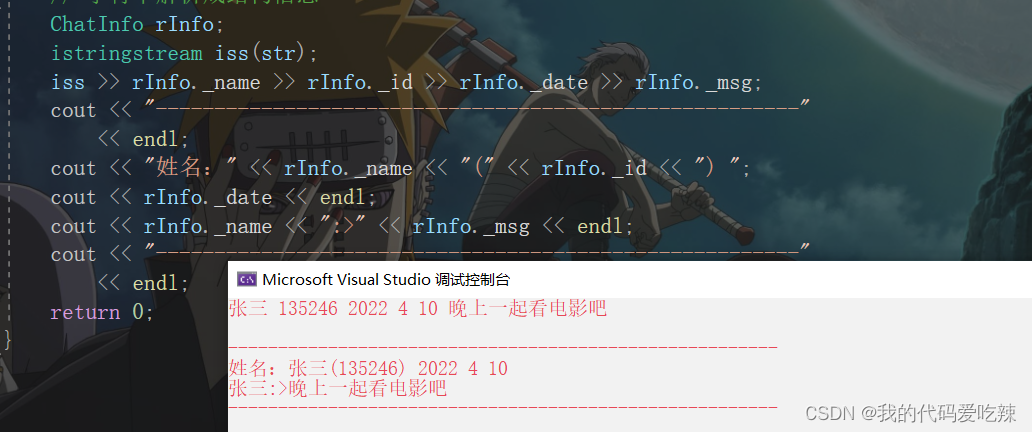
3. 序列化和反序列化结构数据
- struct ChatInfo
- {
- string _name;// 名字
- int _id; // id
- Date _date; // 时间
- string _msg; // 聊天信息
- };
- int main()
- {
- // 结构信息序列化为字符串
- ChatInfo winfo = { "张三", 135246, { 2022, 4, 10 }, "晚上一起看电影吧"};
- ostringstream oss;
- oss << winfo._name << " " << winfo._id << " " << winfo._date << " "
- << winfo._msg;
- string str = oss.str();
- cout << str << endl << endl;
- // 我们通过网络这个字符串发送给对象,实际开发中,信息相对更复杂,
- // 一般会选用Json、xml等方式进行更好的支持
- // 字符串解析成结构信息
- ChatInfo rInfo;
- istringstream iss(str);
- iss >> rInfo._name >> rInfo._id >> rInfo._date >> rInfo._msg;
- cout << "-------------------------------------------------------"
- << endl;
- cout << "姓名:" << rInfo._name << "(" << rInfo._id << ") ";
- cout << rInfo._date << endl;
- cout << rInfo._name << ":>" << rInfo._msg << endl;
- cout << "-------------------------------------------------------"
- << endl;
- return 0;
- }
-
相关阅读:
剖析 Kubernetes 控制器:Deployment、ReplicaSet 和 StatefulSet 的功能与应用场景
“农场”技术栈是什么?浅聊FARM Stack
09/10的一周
Docker 在 M1 Mac arm64架构上构建 amd64镜像。
2024-06-02 问AI: 在大语言模型中,什么是multi agent?
Zabbix使用手册
区间搜索指令(博途SCL)
LeetCode·376.摆动序列·贪心·动态规划
进化的京东云DaaS:向大模型要解
E. Till I Collapse
- 原文地址:https://blog.csdn.net/qq_63943454/article/details/133998458