-
ZKP3.2 Programming ZKPs (Arkworks & Zokrates)
ZKP学习笔记
ZK-Learning MOOC课程笔记
Lecture 3: Programming ZKPs (Guest Lecturers: Pratyush Mishra and Alex Ozdemir)
3.3 Using a library (+ tutorial)
- R1CS Libraries
- A library in a host language (Eg: Rust, OCaml, C++, Go, …)
- Key type: constraint system
- Maintains state about R1CS constraints and variables
- Key operations:
- create variable
- create linear combinations of variables
- add constraint
- ConstraintSystem Operations
//Variable creation cs.add_var(p, v) → id //Linear Combination creation cs.zero() lc.add(c, id) → lc_ //lc_ := lc + c * id //Adding constraints cs.constrain(lcA, lcB, lcC) //Adds a constraint lcA × lcB = lcC- 1
- 2
- 3
- 4
- 5
- 6
- 7
- 8
- 9
- 10
- 11
- Arkworks Tutorial
// main.rs use ark_ff::PrimeField; use ark_r1cs_std::{ prelude::{Boolean, EqGadget, AllocVar}, uint8::UInt8 }; use ark_relations::r1cs::{SynthesisError, ConstraintSystem}; use cmp::CmpGadget; mod cmp; mod alloc; pub struct Puzzle<const N: usize, ConstraintF: PrimeField>([[UInt8<ConstraintF>; N]; N]); pub struct Solution<const N: usize, ConstraintF: PrimeField>([[UInt8<ConstraintF>; N]; N]); fn check_rows<const N: usize, ConstraintF: PrimeField>( solution: &Solution<N, ConstraintF>, ) -> Result<(), SynthesisError> { for row in &solution.0 { for (j, cell) in row.iter().enumerate() { for prior_cell in &row[0..j] { cell.is_neq(&prior_cell)? .enforce_equal(&Boolean::TRUE)?; } } } Ok(()) } fn check_puzzle_matches_solution<const N: usize, ConstraintF: PrimeField>( puzzle: &Puzzle<N, ConstraintF>, solution: &Solution<N, ConstraintF>, ) -> Result<(), SynthesisError> { for (p_row, s_row) in puzzle.0.iter().zip(&solution.0) { for (p, s) in p_row.iter().zip(s_row) { // Ensure that the solution `s` is in the range [1, N] s.is_leq(&UInt8::constant(N as u8))? .and(&s.is_geq(&UInt8::constant(1))?)? .enforce_equal(&Boolean::TRUE)?; // Ensure that either the puzzle slot is 0, or that // the slot matches equivalent slot in the solution (p.is_eq(s)?.or(&p.is_eq(&UInt8::constant(0))?)?) .enforce_equal(&Boolean::TRUE)?; } } Ok(()) } fn check_helper<const N: usize, ConstraintF: PrimeField>( puzzle: &[[u8; N]; N], solution: &[[u8; N]; N], ) { let cs = ConstraintSystem::<ConstraintF>::new_ref(); let puzzle_var = Puzzle::new_input(cs.clone(), || Ok(puzzle)).unwrap(); let solution_var = Solution::new_witness(cs.clone(), || Ok(solution)).unwrap(); check_puzzle_matches_solution(&puzzle_var, &solution_var).unwrap(); check_rows(&solution_var).unwrap(); assert!(cs.is_satisfied().unwrap()); } fn main() { use ark_bls12_381::Fq as F; // Check that it accepts a valid solution. let puzzle = [ [1, 0], [0, 2], ]; let solution = [ [1, 2], [1, 2], ]; check_helper::<2, F>(&puzzle, &solution); // Check that it rejects a solution with a repeated number in a row. let puzzle = [ [1, 0], [0, 2], ]; let solution = [ [1, 0], [1, 2], ]; check_helper::<2, F>(&puzzle, &solution); } // cmp.rs use ark_ff::PrimeField; use ark_r1cs_std::{prelude::{Boolean, EqGadget}, R1CSVar, uint8::UInt8, ToBitsGadget}; use ark_relations::r1cs::SynthesisError; pub trait CmpGadget<ConstraintF: PrimeField>: R1CSVar<ConstraintF> + EqGadget<ConstraintF> { #[inline] fn is_geq(&self, other: &Self) -> Result<Boolean<ConstraintF>, SynthesisError> { // self >= other => self == other || self > other // => !(self < other) self.is_lt(other).map(|b| b.not()) } #[inline] fn is_leq(&self, other: &Self) -> Result<Boolean<ConstraintF>, SynthesisError> { // self <= other => self == other || self < other // => self == other || other > self // => self >= other other.is_geq(self) } #[inline] fn is_gt(&self, other: &Self) -> Result<Boolean<ConstraintF>, SynthesisError> { // self > other => !(self == other || self < other) // => !(self <= other) self.is_leq(other).map(|b| b.not()) } fn is_lt(&self, other: &Self) -> Result<Boolean<ConstraintF>, SynthesisError>; } impl<ConstraintF: PrimeField> CmpGadget<ConstraintF> for UInt8<ConstraintF> { fn is_lt(&self, other: &Self) -> Result<Boolean<ConstraintF>, SynthesisError> { // Determine the variable mode. if self.is_constant() && other.is_constant() { let self_value = self.value().unwrap(); let other_value = other.value().unwrap(); let result = Boolean::constant(self_value < other_value); Ok(result) } else { let diff_bits = self.xor(other)?.to_bits_be()?.into_iter(); let mut result = Boolean::FALSE; let mut a_and_b_equal_so_far = Boolean::TRUE; let a_bits = self.to_bits_be()?; let b_bits = other.to_bits_be()?; for ((a_and_b_are_unequal, a), b) in diff_bits.zip(a_bits).zip(b_bits) { let a_is_lt_b = a.not().and(&b)?; let a_and_b_are_equal = a_and_b_are_unequal.not(); result = result.or(&a_is_lt_b.and(&a_and_b_equal_so_far)?)?; a_and_b_equal_so_far = a_and_b_equal_so_far.and(&a_and_b_are_equal)?; } Ok(result) } } } #[cfg(test)] mod test { use ark_r1cs_std::{prelude::{AllocationMode, AllocVar, Boolean, EqGadget}, uint8::UInt8}; use ark_relations::r1cs::{ConstraintSystem, SynthesisMode}; use ark_bls12_381::Fr as Fp; use itertools::Itertools; use crate::cmp::CmpGadget; #[test] fn test_comparison_for_u8() { let modes = [AllocationMode::Constant, AllocationMode::Input, AllocationMode::Witness]; for (a, a_mode) in (0..=u8::MAX).cartesian_product(modes) { for (b, b_mode) in (0..=u8::MAX).cartesian_product(modes) { let cs = ConstraintSystem::<Fp>::new_ref(); cs.set_mode(SynthesisMode::Prove { construct_matrices: true }); let a_var = UInt8::new_variable(cs.clone(), || Ok(a), a_mode).unwrap(); let b_var = UInt8::new_variable(cs.clone(), || Ok(b), b_mode).unwrap(); if a < b { a_var.is_lt(&b_var).unwrap() .enforce_equal(&Boolean::TRUE).unwrap(); a_var.is_leq(&b_var).unwrap().enforce_equal(&Boolean::TRUE).unwrap(); a_var.is_gt(&b_var).unwrap().enforce_equal(&Boolean::FALSE).unwrap(); a_var.is_geq(&b_var).unwrap().enforce_equal(&Boolean::FALSE).unwrap(); } else if a == b { a_var.is_lt(&b_var).unwrap().enforce_equal(&Boolean::FALSE).unwrap(); a_var.is_leq(&b_var).unwrap().enforce_equal(&Boolean::TRUE).unwrap(); a_var.is_gt(&b_var).unwrap().enforce_equal(&Boolean::FALSE).unwrap(); a_var.is_geq(&b_var).unwrap().enforce_equal(&Boolean::TRUE).unwrap(); } else { a_var.is_lt(&b_var).unwrap().enforce_equal(&Boolean::FALSE).unwrap(); a_var.is_leq(&b_var).unwrap().enforce_equal(&Boolean::FALSE).unwrap(); a_var.is_gt(&b_var).unwrap().enforce_equal(&Boolean::TRUE).unwrap(); a_var.is_geq(&b_var).unwrap().enforce_equal(&Boolean::TRUE).unwrap(); } assert!(cs.is_satisfied().unwrap(), "a: {a}, b: {b}"); } } } } //alloc.rs use std::borrow::Borrow; use ark_ff::PrimeField; use ark_r1cs_std::{prelude::{AllocVar, AllocationMode}, uint8::UInt8}; use ark_relations::r1cs::{Namespace, SynthesisError}; use crate::{Puzzle, Solution}; impl<const N: usize, F: PrimeField> AllocVar<[[u8; N]; N], F> for Puzzle<N, F> { fn new_variable<T: Borrow<[[u8; N]; N]>>( cs: impl Into<Namespace<F>>, f: impl FnOnce() -> Result<T, SynthesisError>, mode: AllocationMode, ) -> Result<Self, SynthesisError> { let cs = cs.into(); let row = [(); N].map(|_| UInt8::constant(0)); let mut puzzle = Puzzle([(); N].map(|_| row.clone())); let value = f().map_or([[0; N]; N], |f| *f.borrow()); for (i, row) in value.into_iter().enumerate() { for (j, cell) in row.into_iter().enumerate() { puzzle.0[i][j] = UInt8::new_variable(cs.clone(), || Ok(cell), mode)?; } } Ok(puzzle) } } impl<const N: usize, F: PrimeField> AllocVar<[[u8; N]; N], F> for Solution<N, F> { fn new_variable<T: Borrow<[[u8; N]; N]>>( cs: impl Into<Namespace<F>>, f: impl FnOnce() -> Result<T, SynthesisError>, mode: AllocationMode, ) -> Result<Self, SynthesisError> { let cs = cs.into(); let row = [(); N].map(|_| UInt8::constant(0)); let mut solution = Solution([(); N].map(|_| row.clone())); let value = f().map_or([[0; N]; N], |f| *f.borrow()); for (i, row) in value.into_iter().enumerate() { for (j, cell) in row.into_iter().enumerate() { solution.0[i][j] = UInt8::new_variable(cs.clone(), || Ok(cell), mode)?; } } Ok(solution) } }- 1
- 2
- 3
- 4
- 5
- 6
- 7
- 8
- 9
- 10
- 11
- 12
- 13
- 14
- 15
- 16
- 17
- 18
- 19
- 20
- 21
- 22
- 23
- 24
- 25
- 26
- 27
- 28
- 29
- 30
- 31
- 32
- 33
- 34
- 35
- 36
- 37
- 38
- 39
- 40
- 41
- 42
- 43
- 44
- 45
- 46
- 47
- 48
- 49
- 50
- 51
- 52
- 53
- 54
- 55
- 56
- 57
- 58
- 59
- 60
- 61
- 62
- 63
- 64
- 65
- 66
- 67
- 68
- 69
- 70
- 71
- 72
- 73
- 74
- 75
- 76
- 77
- 78
- 79
- 80
- 81
- 82
- 83
- 84
- 85
- 86
- 87
- 88
- 89
- 90
- 91
- 92
- 93
- 94
- 95
- 96
- 97
- 98
- 99
- 100
- 101
- 102
- 103
- 104
- 105
- 106
- 107
- 108
- 109
- 110
- 111
- 112
- 113
- 114
- 115
- 116
- 117
- 118
- 119
- 120
- 121
- 122
- 123
- 124
- 125
- 126
- 127
- 128
- 129
- 130
- 131
- 132
- 133
- 134
- 135
- 136
- 137
- 138
- 139
- 140
- 141
- 142
- 143
- 144
- 145
- 146
- 147
- 148
- 149
- 150
- 151
- 152
- 153
- 154
- 155
- 156
- 157
- 158
- 159
- 160
- 161
- 162
- 163
- 164
- 165
- 166
- 167
- 168
- 169
- 170
- 171
- 172
- 173
- 174
- 175
- 176
- 177
- 178
- 179
- 180
- 181
- 182
- 183
- 184
- 185
- 186
- 187
- 188
- 189
- 190
- 191
- 192
- 193
- 194
- 195
- 196
- 197
- 198
- 199
- 200
- 201
- 202
- 203
- 204
- 205
- 206
- 207
- 208
- 209
- 210
- 211
- 212
- 213
- 214
- 215
- 216
- 217
- 218
- 219
- 220
- 221
- 222
- 223
- 224
- 225
- 226
- 227
- 228
- 229
3.4 Using a compiler (+ tutorial)
- HDLs & Circuit Libraries
- Difference: Host language v. custom language
- Similarities: explicit wire creation (explicitly wire values); explicit constraint creation
- ZoKrates Tutorial
struct Puzzle{ u8[N][N] elems; } struct Solution { u8[N][N] elems; } def check_rows (Solution sol) -> bool { // for each row for u32 i in 0..N { // for each column for u32 j in 0..N { // Check that the (i, j)-th element is not equal to any of the // the elements preceding it in the same row. for u32 k in 0..j { assert(sol.elems[i][j] != sol.elems[i][k]); } } } return true; } def check_puzzle_matches_solution (Solution sol, Puzzle puzzle) -> bool { for u32 i in 0..N { for u32 j in 0..N { assert((sol.elems[i][j] > 0) && (sol.elems[i][j] < 10)); assert(\ (puzzle.elems[i][j] == 0) ||\ (puzzle.elems[i][j] == sol.elems[i][j])\ ); } } return true; } def main(public Puzzle<2> puzzle, private Solution<2> sol) { assert(check_puzzle_matches_solution(sol, puzzle)); assert(check_rows(sol)); } - 1
- 2
- 3
- 4
- 5
- 6
- 7
- 8
- 9
- 10
- 11
- 12
- 13
- 14
- 15
- 16
- 17
- 18
- 19
- 20
- 21
- 22
- 23
- 24
- 25
- 26
- 27
- 28
- 29
- 30
- 31
- 32
- 33
- 34
- 35
- 36
- 37
- 38
- 39
3.5 An overview of prominent ZKP toolchains
- Toolchain Type

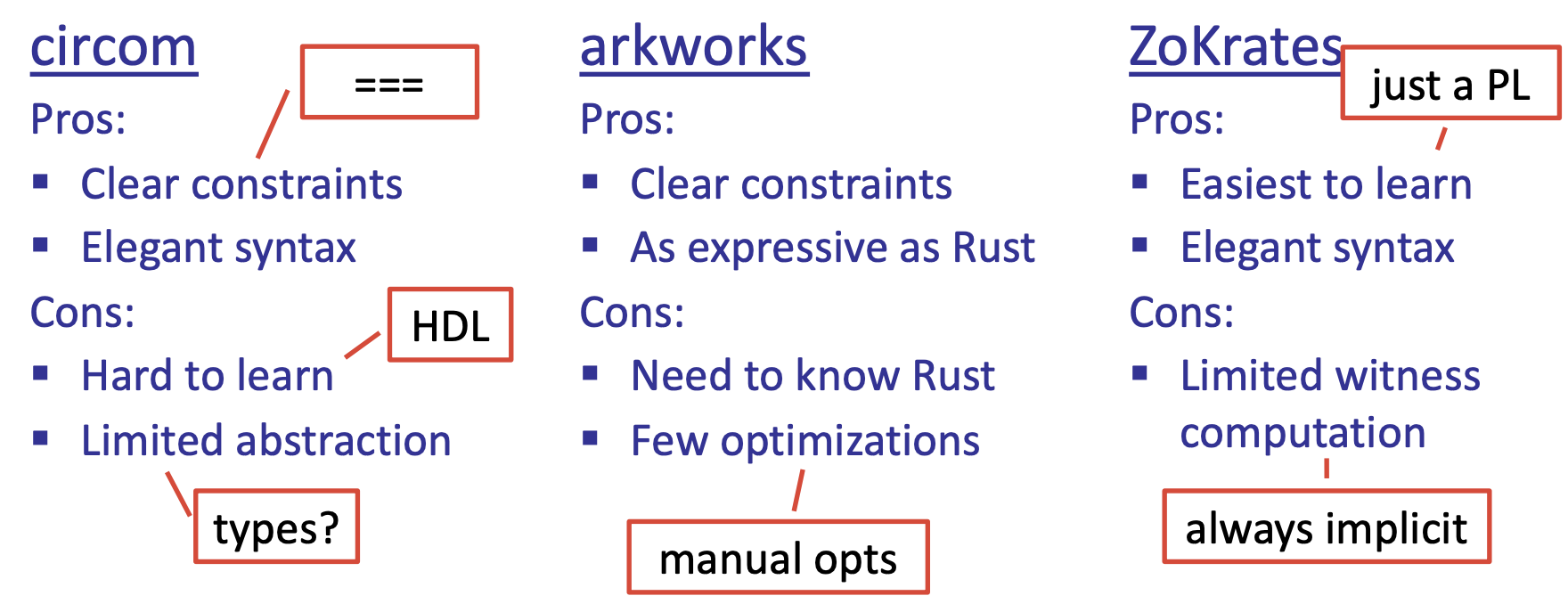
-
Other toolchains

-
Shared Compiler Infrastructure
- CirC: https://github.com/circify/circ

- CirC: https://github.com/circify/circ
- R1CS Libraries
-
相关阅读:
@Bean 与 @Component 用在同一个类上,会发生什么?
1148 Werewolf - Simple Version
四川云汇优想:短视频矩阵运营方案
第一章《初学者问题大集合》第1节:我能学会编程吗
【全开源】Java无人共享棋牌室茶室台球室系统JAVA版本支持微信小程序+微信公众号
文举论金:黄金原油全面走势分析策略指导。
如何为预先数据库创建自定义SQL Server复制
代码混淆不再愁:一篇掌握核心技巧
qt使用QProcess实现进程通信
JAVA基于局域网的聊天室系统(源代码+论文)
- 原文地址:https://blog.csdn.net/weixin_45347752/article/details/133896246
