-
分类预测 | MATLAB实现WOA-LSTM鲸鱼算法优化长短期记忆网络数据分类预测
分类预测 | MATLAB实现WOA-LSTM鲸鱼算法优化长短期记忆网络数据分类预测
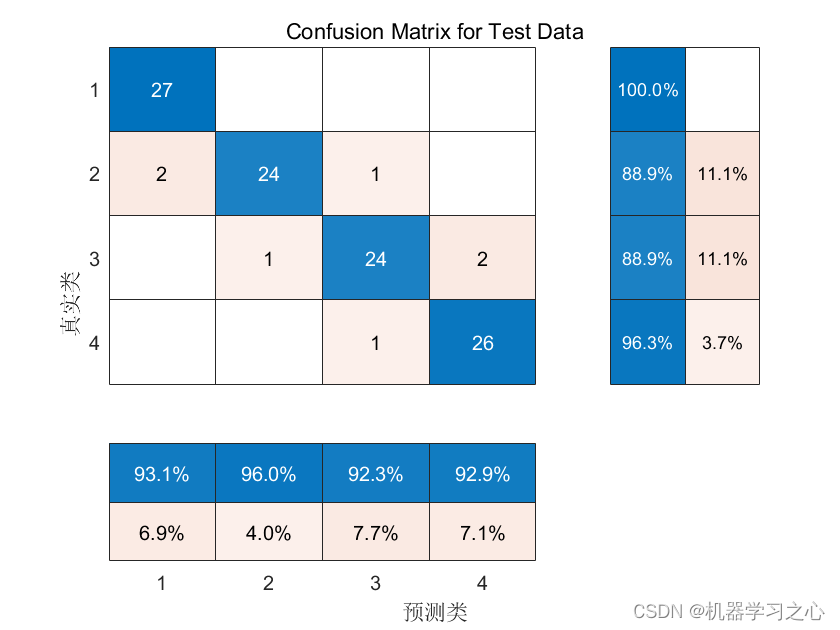
分类效果


基本描述
1.MATLAB实现WOA-LSTM鲸鱼算法优化长短期记忆网络数据分类预测,运行环境Matlab2020b及以上;
2.基于鲸鱼算法(WOA)优化长短期记忆网络(LSTM)分类预测,优化参数为,学习率,隐含层节点,正则化参数;
3.多特征输入单输出的二分类及多分类模型。程序内注释详细,直接替换数据就可以用;
程序语言为matlab,程序可出分类效果图,迭代优化图,混淆矩阵图;
4.data为数据集,输入12个特征,分四类;main为主程序,其余为函数文件,无需运行,可在下载区获取数据和程序内容。模型描述
WOA-LSTM(Whale Optimization Algorithm-Long Short-Term Memory)是一种利用鲸鱼优化算法来优化长短期记忆网络(LSTM)进行数据分类预测的方法。WOA-LSTM结合了鲸鱼优化算法和LSTM神经网络,以提高数据分类预测的准确性和效率。
鲸鱼优化算法是一种基于自然界中鲸鱼群体行为的启发式优化算法。它模拟了鲸鱼的迁徙、捕食和社交行为,并通过搜索空间中的随机跳跃和逐渐收敛的方式来寻找最优解。这种算法具有全局搜索能力和快速收敛性,适用于解决复杂的优化问题。
LSTM是一种递归神经网络(RNN)的变体,专门用于处理具有时间依赖性的序列数据。它通过使用门控单元来捕捉长期依赖关系,能够有效地处理分类数据,并在许多领域取得了显著的成果。程序设计
- 完整程序和数据获取方式1:私信博主,同等价值程序兑换;
- 完整程序和数据下载方式2(资源处直接下载):MATLAB实现WOA-LSTM鲸鱼算法优化长短期记忆网络数据分类预测
% The Whale Optimization Algorithm function [Best_Cost,Best_pos,curve]=WOA(pop,Max_iter,lb,ub,dim,fobj) % initialize position vector and score for the leader Best_pos=zeros(1,dim); Best_Cost=inf; %change this to -inf for maximization problems curve=zeros(1,Max_iter); t=0;% Loop counter % Main loop while t<Max_iter for i=1:size(Positions,1) % Return back the search agents that go beyond the boundaries of the search space Flag4ub=Positions(i,:)>ub; Flag4lb=Positions(i,:)<lb; Positions(i,:)=(Positions(i,:).*(~(Flag4ub+Flag4lb)))+ub.*Flag4ub+lb.*Flag4lb; % Calculate objective function for each search agent fitness=fobj(Positions(i,:)); % Update the leader if fitness<Best_Cost % Change this to > for maximization problem Best_Cost=fitness; % Update alpha Best_pos=Positions(i,:); end end a=2-t*((2)/Max_iter); % a decreases linearly fron 2 to 0 in Eq. (2.3) % a2 linearly dicreases from -1 to -2 to calculate t in Eq. (3.12) a2=-1+t*((-1)/Max_iter); % Update the Position of search agents for i=1:size(Positions,1) r1=rand(); % r1 is a random number in [0,1] r2=rand(); % r2 is a random number in [0,1] A=2*a*r1-a; % Eq. (2.3) in the paper C=2*r2; % Eq. (2.4) in the paper b=1; % parameters in Eq. (2.5) l=(a2-1)*rand+1; % parameters in Eq. (2.5) p = rand(); % p in Eq. (2.6) for j=1:size(Positions,2) if p<0.5 if abs(A)>=1 rand_leader_index = floor(pop*rand()+1); X_rand = Positions(rand_leader_index, :); D_X_rand=abs(C*X_rand(j)-Positions(i,j)); % Eq. (2.7) Positions(i,j)=X_rand(j)-A*D_X_rand; % Eq. (2.8) elseif abs(A)<1 D_Leader=abs(C*Best_pos(j)-Positions(i,j)); % Eq. (2.1) Positions(i,j)=Best_pos(j)-A*D_Leader; % Eq. (2.2) end elseif p>=0.5 distance2Leader=abs(Best_pos(j)-Positions(i,j)); % Eq. (2.5) Positions(i,j)=distance2Leader*exp(b.*l).*cos(l.*2*pi)+Best_pos(j); end end end t=t+1; curve(t)=Best_Cost; [t Best_Cost] end- 1
- 2
- 3
- 4
- 5
- 6
- 7
- 8
- 9
- 10
- 11
- 12
- 13
- 14
- 15
- 16
- 17
- 18
- 19
- 20
- 21
- 22
- 23
- 24
- 25
- 26
- 27
- 28
- 29
- 30
- 31
- 32
- 33
- 34
- 35
- 36
- 37
- 38
- 39
- 40
- 41
- 42
- 43
- 44
- 45
- 46
- 47
- 48
- 49
- 50
- 51
- 52
- 53
- 54
- 55
- 56
- 57
- 58
- 59
- 60
- 61
- 62
- 63
- 64
- 65
- 66
- 67
- 68
- 69
- 70
- 71
- 72
- 73
- 74
- 75
- 76
- 77
- 78
- 79
- 80
- 81
参考资料
[1] https://blog.csdn.net/kjm13182345320/article/details/129036772?spm=1001.2014.3001.5502
[2] https://blog.csdn.net/kjm13182345320/article/details/128690229 -
相关阅读:
zookeeper入门到精通06——zookeeper客户端API创建节点
基于GoFrame+Vue+ElementUI企业级 Go 应用开发框架
I/O软件层次
软件测试概念集锦
nginx配置二级域名
NoSQL之Redis高可用与优化
网络原理---封装和分用
boost.regex正则表达式
接口自动化框架搭建(九):接入钉钉消息通知
Win7安装nvme协议的SSD硬盘方法
- 原文地址:https://blog.csdn.net/kjm13182345320/article/details/133882457
