-
【附代码】使用Shapely计算点面关系
作者:小猪快跑基础数学&计算数学,从事优化领域5年+,主要研究方向:MIP求解器、整数规划、随机规划、智能优化算法
本文档介绍如何使用 Shapely Python 包 计算几何点面关系&距离。
如有错误,欢迎指正。如有更好的算法,也欢迎交流!!!——@小猪快跑
相关文献
基础
Point、LineString、Polygon的通用属性
object.area 返回对象的面积 object.bounds 返回包含对象的x、y的最大值最小值的元组 object.length 返回对象的长度 object.geom_type 返回图形的类型 字符串 object.distance(other) 返回两个对象的最小距离 object.hausdorff_distance(other) 返回两个对象之间的哈多夫距离 object.representative_point() 返回一个保证在对象上的点- 1
- 2
- 3
- 4
- 5
- 6
- 7
创建Point、LineString、Polygon:
from shapely import Point, Polygon, GeometryCollection,LineString point = Point(3, 3) polygon = Polygon([(0, 5), (1, 1), (3, 0)]) circ = Point(4, 0).buffer(2) line = LineString([(0, 0), (2, 2)]) polygon.intersection(circ) GeometryCollection([point, polygon, circ,line])- 1
- 2
- 3
- 4
- 5
- 6
- 7
- 8
- 9
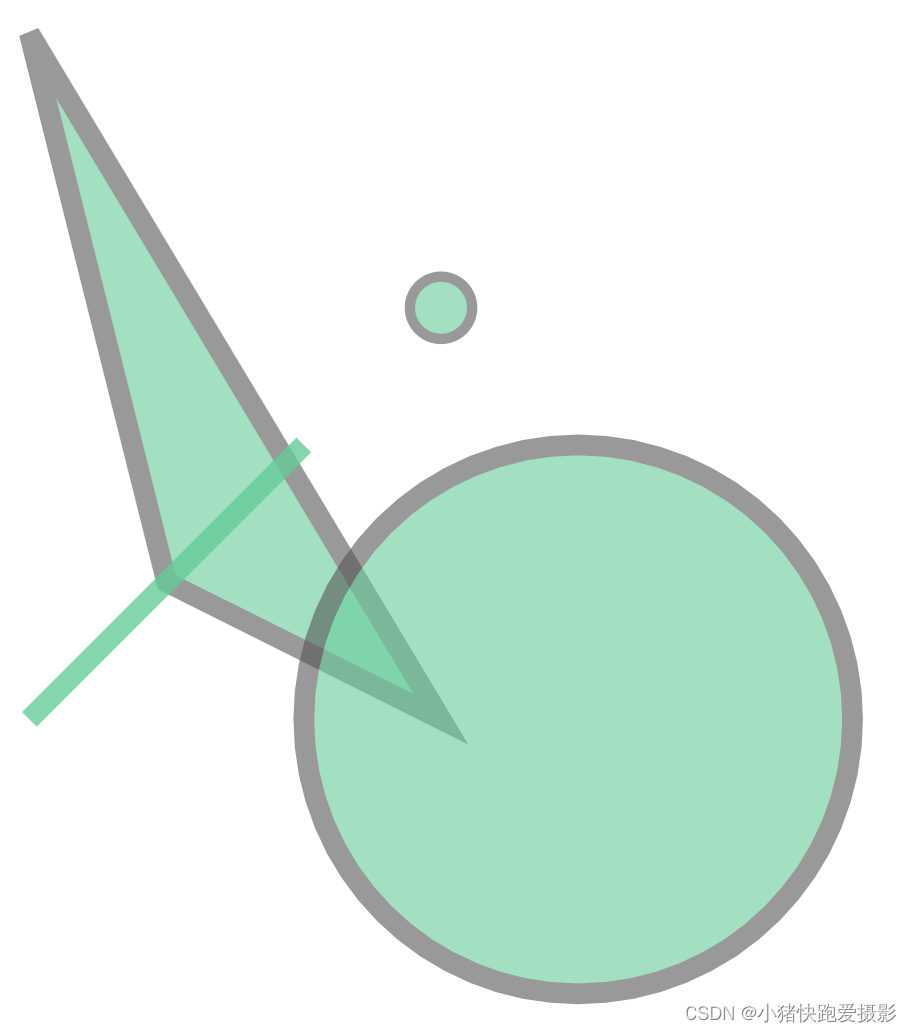
Point对象
point = Point(0, 1) # 创建点对象,可以是三维的 print(point.area) # 0.0 print(point.length) # 0.0 print(point.bounds) # (0.0, 1.0, 0.0, 1.0) print(point.geom_type) # Point print(point.coords) #print(point.coords[:]) # [(0.0, 1.0)] print(list(point.coords)) # [(0.0, 1.0)] print(point.x, point.y) # 0.0 1.0 - 1
- 2
- 3
- 4
- 5
- 6
- 7
- 8
- 9
LineString对象
# 可以自己相交 line = LineString([(0, 0), (1, 1)]) print(line.area) # 0.0 print(line.length) # 1.4142135623730951 print(line.bounds) # (0.0, 0.0, 1.0, 1.0) print(line.geom_type) # LineString print(line.coords) #print(line.coords[:], type(line.coords[:])) # [(0.0, 0.0), (1.0, 1.0)] - 1
- 2
- 3
- 4
- 5
- 6
- 7
- 8
Polygon对象
# 可以传入两个参数,第一个是有序的外边缘轮廓,第二个是无序的内边缘轮廓,多边形内所有的环形最多只能有一个焦点,否则都是无效的 polygon = Polygon([(0, 0), (-1, 1), (2, 1), (3, -2)]) print(polygon.area) # 5.0 print(polygon.length) # 11.182042498005464 print(polygon.bounds) # (-1.0, -2.0, 3.0, 1.0) x_min, y_min, x_max, y_max = polygon.bounds print(x_min, y_min, x_max, y_max) # -1.0 -2.0 3.0 1.0 print(polygon.geom_type) # Polygon print(polygon.exterior.coords) #print(polygon.exterior.coords[:]) # [(0.0, 0.0), (-1.0, 1.0), (2.0, 1.0), (3.0, -2.0), (0.0, 0.0)] print(polygon.interiors) # print(polygon.interiors[:]) # [] - 1
- 2
- 3
- 4
- 5
- 6
- 7
- 8
- 9
- 10
- 11
- 12
一元判定
has_z 判断是否有z坐标
p = Point(0, 0) print(p.has_z) # False p = Point(0, 0, 0) print(p.has_z) # True- 1
- 2
- 3
- 4
is_ccw 判断是否是逆时针的
lr = LinearRing([(1, 0), (1, 1), (0, 0)]) print(lr.is_ccw) # True lr = LinearRing([(1, 0), (0, 0), (1, 1)]) print(lr.is_ccw) # False- 1
- 2
- 3
- 4
is_ring 闭合返回TRUE
line = LineString([(0, 0), (1, 1), (1, 0)]) print(line.is_ring) # False line = LineString([(0, 0), (1, 1), (1, 0), (0, 0)]) print(line.is_ring) # True lr = LinearRing([(0, 0), (1, 1), (1, 0)]) print(lr.is_ring) # True lr = LinearRing([(0, 0), (1, 1), (1, 0), (0, 0)]) print(lr.is_ring) # True- 1
- 2
- 3
- 4
- 5
- 6
- 7
- 8

is_empty 返回TRUE如果内部和边界都是空
p = Point() print(p.is_empty) # True p = Point(0, 0) print(p.is_empty) # False- 1
- 2
- 3
- 4
is_simple 自己不相交,返回TRUE
line = LineString([(0, 0), (1, 1), (1, -1), (0, 1)]) print(line.is_simple) # False line = LineString([(0, 0), (0, 1), (1, 1), (1, 0)]) print(line.is_simple) # True- 1
- 2
- 3
- 4

二元判定
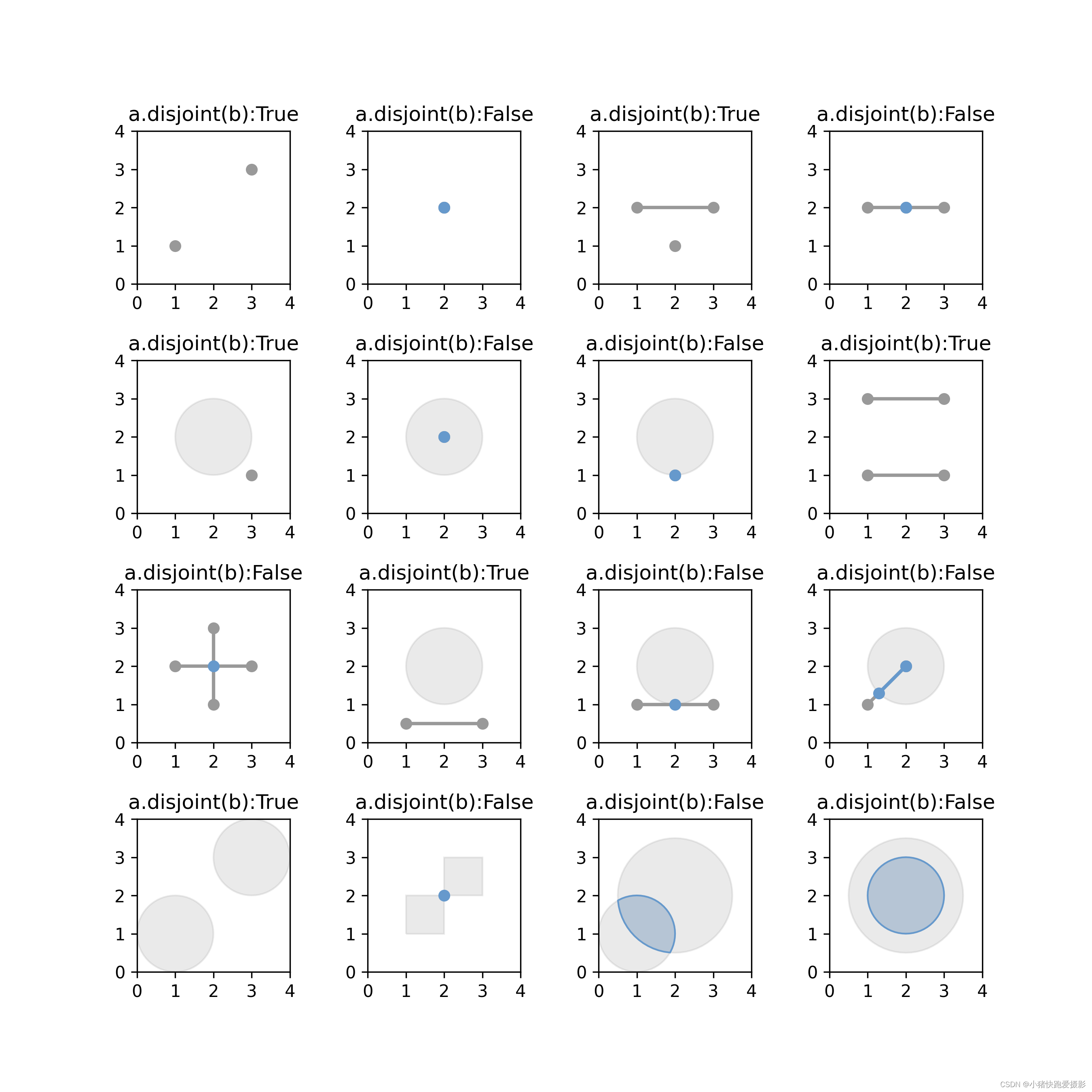
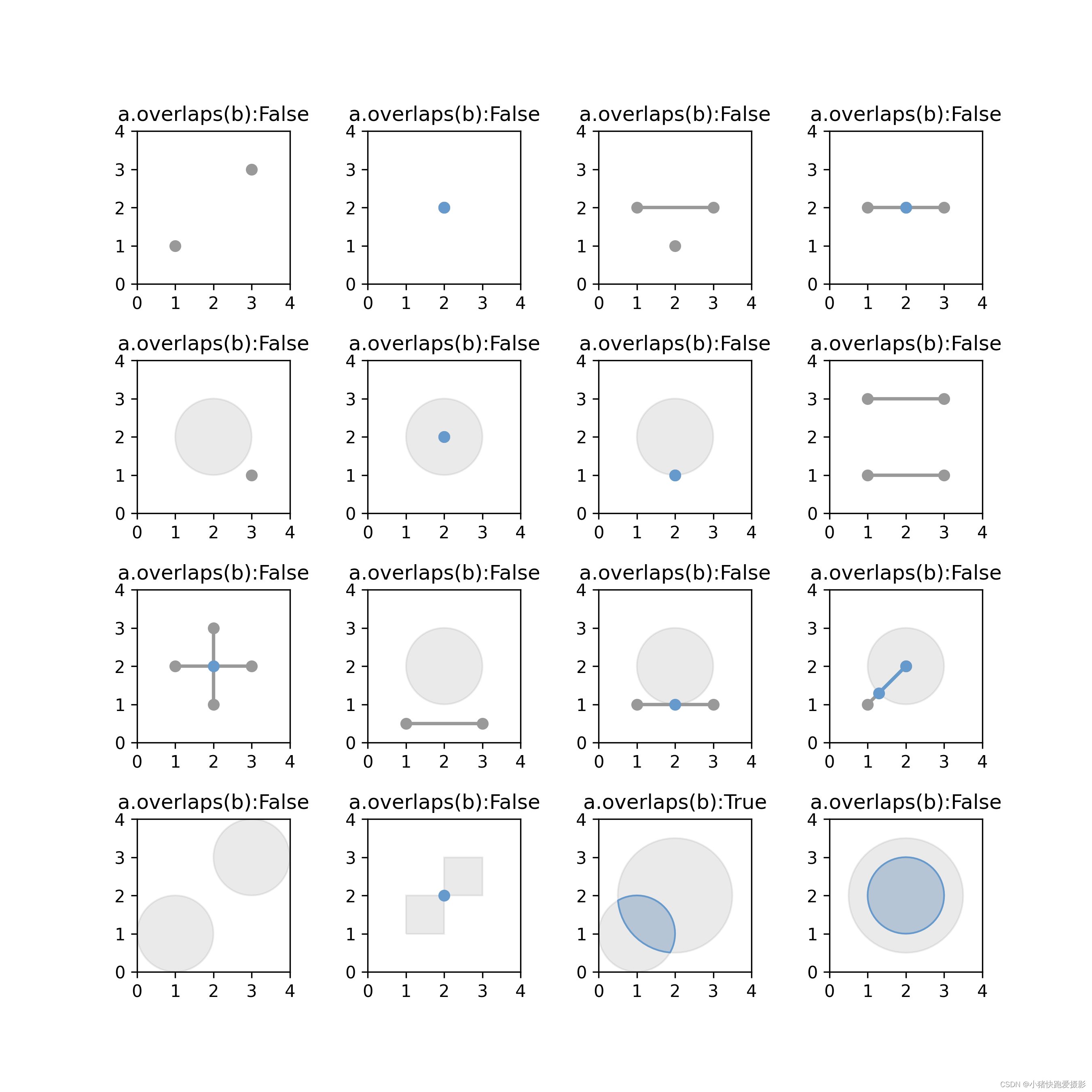
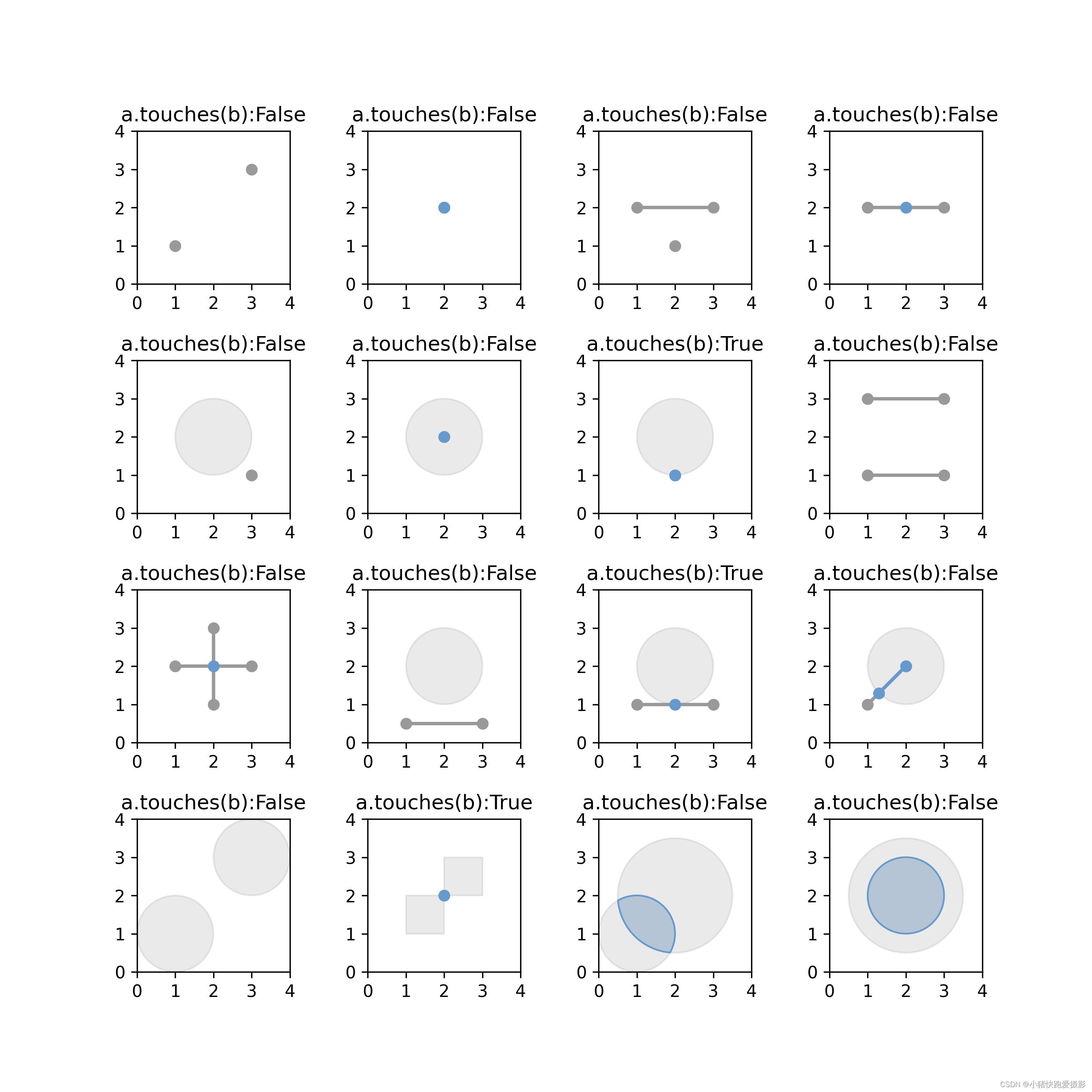
object.__eq__(other) # 类型和坐标点相同返回TRUE,和坐标点顺序有关 object.equals(other) # boundary, interior, and exterior完全相同返回TRUE,和坐标点顺序无关 object.almost_equals(other[, decimal=6]) # 近似相等返回TRUE decimal是小数点的位数完全相同,和坐标点的顺序有关 object.contains(other) # other里没有点在object的exterior,且other的interior里至少有一个点在object的interior,和坐标点的顺序无关 object.crosses(other) # object的interior与other的interior相交,且不包含他,该判断只适用于图形与线之间的判定 object.disjoint(other) # object的interior和boundary 和other的interior和boundary都不想交 返回True,完全不相交才返回True,有一个点都不行 object.intersects(other) # object的interior或者boundary和other的interior或者boundary相交 返回TRUE object.overlaps(other) # object的interior或者boundary和other的interior或者boundary相交,且不包含他, 返回TRUE object.touches(other) # other和object至少有一个共同的点,且他们的interior不相交,也就是说在边界上- 1
- 2
- 3
- 4
- 5
- 6
- 7
- 8
- 9
contains
a = Point(1, 1) b = Point(3, 3) print(a.contains(b)) a = Point(2, 2) b = Point(2, 2) print(a.contains(b)) a = Point(2, 1) b = LineString([(1, 2), (3, 2)]) print(a.contains(b)) a = Point(2, 2) b = LineString([(1, 2), (3, 2)]) print(a.contains(b)) a = Point(3, 1) b = Point(2, 2).buffer(1) print(a.contains(b)) a = Point(2, 2) b = Point(2, 2).buffer(1) print(a.contains(b)) a = Point(2, 1) b = Point(2, 2).buffer(1) print(a.contains(b)) a = LineString([(1, 1), (3, 1)]) b = LineString([(1, 3), (3, 3)]) print(a.contains(b)) a = LineString([(1, 2), (3, 2)]) b = LineString([(2, 1), (2, 3)]) print(a.contains(b)) a = LineString([(1, 0.5), (3, 0.5)]) b = Point(2, 2).buffer(1) print(a.contains(b)) a = LineString([(1, 1), (3, 1)]) b = Point(2, 2).buffer(1) print(a.contains(b)) a = LineString([(1, 1), (2, 2)]) b = Point(2, 2).buffer(1) print(a.contains(b)) a = Point(1, 1).buffer(1) b = Point(3, 3).buffer(1) print(a.contains(b)) a = Polygon([(2, 2), (2, 3), (3, 3), (3, 2)]) b = Polygon([(1, 1), (1, 2), (2, 2), (2, 1)]) print(a.contains(b)) a = Point(1, 1).buffer(1) b = Point(2, 2).buffer(1.5) print(a.contains(b)) a = Point(2, 2).buffer(1) b = Point(2, 2).buffer(1.5) print(a.contains(b))- 1
- 2
- 3
- 4
- 5
- 6
- 7
- 8
- 9
- 10
- 11
- 12
- 13
- 14
- 15
- 16
- 17
- 18
- 19
- 20
- 21
- 22
- 23
- 24
- 25
- 26
- 27
- 28
- 29
- 30
- 31
- 32
- 33
- 34
- 35
- 36
- 37
- 38
- 39
- 40
- 41
- 42
- 43
- 44
- 45
- 46
- 47
- 48


crosses
a = Point(1, 1) b = Point(3, 3) print(a.crosses(b)) a = Point(2, 2) b = Point(2, 2) print(a.crosses(b)) a = Point(2, 1) b = LineString([(1, 2), (3, 2)]) print(a.crosses(b)) a = Point(2, 2) b = LineString([(1, 2), (3, 2)]) print(a.crosses(b)) a = Point(3, 1) b = Point(2, 2).buffer(1) print(a.crosses(b)) a = Point(2, 2) b = Point(2, 2).buffer(1) print(a.crosses(b)) a = Point(2, 1) b = Point(2, 2).buffer(1) print(a.crosses(b)) a = LineString([(1, 1), (3, 1)]) b = LineString([(1, 3), (3, 3)]) print(a.crosses(b)) a = LineString([(1, 2), (3, 2)]) b = LineString([(2, 1), (2, 3)]) print(a.crosses(b)) a = LineString([(1, 0.5), (3, 0.5)]) b = Point(2, 2).buffer(1) print(a.crosses(b)) a = LineString([(1, 1), (3, 1)]) b = Point(2, 2).buffer(1) print(a.crosses(b)) a = LineString([(1, 1), (2, 2)]) b = Point(2, 2).buffer(1) print(a.crosses(b)) a = Point(1, 1).buffer(1) b = Point(3, 3).buffer(1) print(a.crosses(b)) a = Polygon([(2, 2), (2, 3), (3, 3), (3, 2)]) b = Polygon([(1, 1), (1, 2), (2, 2), (2, 1)]) print(a.crosses(b)) a = Point(1, 1).buffer(1) b = Point(2, 2).buffer(1.5) print(a.crosses(b)) a = Point(2, 2).buffer(1) b = Point(2, 2).buffer(1.5) print(a.crosses(b))- 1
- 2
- 3
- 4
- 5
- 6
- 7
- 8
- 9
- 10
- 11
- 12
- 13
- 14
- 15
- 16
- 17
- 18
- 19
- 20
- 21
- 22
- 23
- 24
- 25
- 26
- 27
- 28
- 29
- 30
- 31
- 32
- 33
- 34
- 35
- 36
- 37
- 38
- 39
- 40
- 41
- 42
- 43
- 44
- 45
- 46
- 47
- 48
disjoint
a = Point(1, 1) b = Point(3, 3) print(a.disjoint(b)) a = Point(2, 2) b = Point(2, 2) print(a.disjoint(b)) a = Point(2, 1) b = LineString([(1, 2), (3, 2)]) print(a.disjoint(b)) a = Point(2, 2) b = LineString([(1, 2), (3, 2)]) print(a.disjoint(b)) a = Point(3, 1) b = Point(2, 2).buffer(1) print(a.disjoint(b)) a = Point(2, 2) b = Point(2, 2).buffer(1) print(a.disjoint(b)) a = Point(2, 1) b = Point(2, 2).buffer(1) print(a.disjoint(b)) a = LineString([(1, 1), (3, 1)]) b = LineString([(1, 3), (3, 3)]) print(a.disjoint(b)) a = LineString([(1, 2), (3, 2)]) b = LineString([(2, 1), (2, 3)]) print(a.disjoint(b)) a = LineString([(1, 0.5), (3, 0.5)]) b = Point(2, 2).buffer(1) print(a.disjoint(b)) a = LineString([(1, 1), (3, 1)]) b = Point(2, 2).buffer(1) print(a.disjoint(b)) a = LineString([(1, 1), (2, 2)]) b = Point(2, 2).buffer(1) print(a.disjoint(b)) a = Point(1, 1).buffer(1) b = Point(3, 3).buffer(1) print(a.disjoint(b)) a = Polygon([(2, 2), (2, 3), (3, 3), (3, 2)]) b = Polygon([(1, 1), (1, 2), (2, 2), (2, 1)]) print(a.disjoint(b)) a = Point(1, 1).buffer(1) b = Point(2, 2).buffer(1.5) print(a.disjoint(b)) a = Point(2, 2).buffer(1) b = Point(2, 2).buffer(1.5) print(a.disjoint(b))- 1
- 2
- 3
- 4
- 5
- 6
- 7
- 8
- 9
- 10
- 11
- 12
- 13
- 14
- 15
- 16
- 17
- 18
- 19
- 20
- 21
- 22
- 23
- 24
- 25
- 26
- 27
- 28
- 29
- 30
- 31
- 32
- 33
- 34
- 35
- 36
- 37
- 38
- 39
- 40
- 41
- 42
- 43
- 44
- 45
- 46
- 47
- 48
intersects
a = Point(1, 1) b = Point(3, 3) print(a.intersects(b)) a = Point(2, 2) b = Point(2, 2) print(a.intersects(b)) a = Point(2, 1) b = LineString([(1, 2), (3, 2)]) print(a.intersects(b)) a = Point(2, 2) b = LineString([(1, 2), (3, 2)]) print(a.intersects(b)) a = Point(3, 1) b = Point(2, 2).buffer(1) print(a.intersects(b)) a = Point(2, 2) b = Point(2, 2).buffer(1) print(a.intersects(b)) a = Point(2, 1) b = Point(2, 2).buffer(1) print(a.intersects(b)) a = LineString([(1, 1), (3, 1)]) b = LineString([(1, 3), (3, 3)]) print(a.intersects(b)) a = LineString([(1, 2), (3, 2)]) b = LineString([(2, 1), (2, 3)]) print(a.intersects(b)) a = LineString([(1, 0.5), (3, 0.5)]) b = Point(2, 2).buffer(1) print(a.intersects(b)) a = LineString([(1, 1), (3, 1)]) b = Point(2, 2).buffer(1) print(a.intersects(b)) a = LineString([(1, 1), (2, 2)]) b = Point(2, 2).buffer(1) print(a.intersects(b)) a = Point(1, 1).buffer(1) b = Point(3, 3).buffer(1) print(a.intersects(b)) a = Polygon([(2, 2), (2, 3), (3, 3), (3, 2)]) b = Polygon([(1, 1), (1, 2), (2, 2), (2, 1)]) print(a.intersects(b)) a = Point(1, 1).buffer(1) b = Point(2, 2).buffer(1.5) print(a.intersects(b)) a = Point(2, 2).buffer(1) b = Point(2, 2).buffer(1.5) print(a.intersects(b))- 1
- 2
- 3
- 4
- 5
- 6
- 7
- 8
- 9
- 10
- 11
- 12
- 13
- 14
- 15
- 16
- 17
- 18
- 19
- 20
- 21
- 22
- 23
- 24
- 25
- 26
- 27
- 28
- 29
- 30
- 31
- 32
- 33
- 34
- 35
- 36
- 37
- 38
- 39
- 40
- 41
- 42
- 43
- 44
- 45
- 46
- 47
- 48

overlaps
a = Point(1, 1) b = Point(3, 3) print(a.overlaps(b)) a = Point(2, 2) b = Point(2, 2) print(a.overlaps(b)) a = Point(2, 1) b = LineString([(1, 2), (3, 2)]) print(a.overlaps(b)) a = Point(2, 2) b = LineString([(1, 2), (3, 2)]) print(a.overlaps(b)) a = Point(3, 1) b = Point(2, 2).buffer(1) print(a.overlaps(b)) a = Point(2, 2) b = Point(2, 2).buffer(1) print(a.overlaps(b)) a = Point(2, 1) b = Point(2, 2).buffer(1) print(a.overlaps(b)) a = LineString([(1, 1), (3, 1)]) b = LineString([(1, 3), (3, 3)]) print(a.overlaps(b)) a = LineString([(1, 2), (3, 2)]) b = LineString([(2, 1), (2, 3)]) print(a.overlaps(b)) a = LineString([(1, 0.5), (3, 0.5)]) b = Point(2, 2).buffer(1) print(a.overlaps(b)) a = LineString([(1, 1), (3, 1)]) b = Point(2, 2).buffer(1) print(a.overlaps(b)) a = LineString([(1, 1), (2, 2)]) b = Point(2, 2).buffer(1) print(a.overlaps(b)) a = Point(1, 1).buffer(1) b = Point(3, 3).buffer(1) print(a.overlaps(b)) a = Polygon([(2, 2), (2, 3), (3, 3), (3, 2)]) b = Polygon([(1, 1), (1, 2), (2, 2), (2, 1)]) print(a.overlaps(b)) a = Point(1, 1).buffer(1) b = Point(2, 2).buffer(1.5) print(a.overlaps(b)) a = Point(2, 2).buffer(1) b = Point(2, 2).buffer(1.5) print(a.overlaps(b))- 1
- 2
- 3
- 4
- 5
- 6
- 7
- 8
- 9
- 10
- 11
- 12
- 13
- 14
- 15
- 16
- 17
- 18
- 19
- 20
- 21
- 22
- 23
- 24
- 25
- 26
- 27
- 28
- 29
- 30
- 31
- 32
- 33
- 34
- 35
- 36
- 37
- 38
- 39
- 40
- 41
- 42
- 43
- 44
- 45
- 46
- 47
- 48
touches
a = Point(1, 1) b = Point(3, 3) print(a.touches(b)) a = Point(2, 2) b = Point(2, 2) print(a.touches(b)) a = Point(2, 1) b = LineString([(1, 2), (3, 2)]) print(a.touches(b)) a = Point(2, 2) b = LineString([(1, 2), (3, 2)]) print(a.touches(b)) a = Point(3, 1) b = Point(2, 2).buffer(1) print(a.touches(b)) a = Point(2, 2) b = Point(2, 2).buffer(1) print(a.touches(b)) a = Point(2, 1) b = Point(2, 2).buffer(1) print(a.touches(b)) a = LineString([(1, 1), (3, 1)]) b = LineString([(1, 3), (3, 3)]) print(a.touches(b)) a = LineString([(1, 2), (3, 2)]) b = LineString([(2, 1), (2, 3)]) print(a.touches(b)) a = LineString([(1, 0.5), (3, 0.5)]) b = Point(2, 2).buffer(1) print(a.touches(b)) a = LineString([(1, 1), (3, 1)]) b = Point(2, 2).buffer(1) print(a.touches(b)) a = LineString([(1, 1), (2, 2)]) b = Point(2, 2).buffer(1) print(a.touches(b)) a = Point(1, 1).buffer(1) b = Point(3, 3).buffer(1) print(a.touches(b)) a = Polygon([(2, 2), (2, 3), (3, 3), (3, 2)]) b = Polygon([(1, 1), (1, 2), (2, 2), (2, 1)]) print(a.touches(b)) a = Point(1, 1).buffer(1) b = Point(2, 2).buffer(1.5) print(a.touches(b)) a = Point(2, 2).buffer(1) b = Point(2, 2).buffer(1.5) print(a.touches(b))- 1
- 2
- 3
- 4
- 5
- 6
- 7
- 8
- 9
- 10
- 11
- 12
- 13
- 14
- 15
- 16
- 17
- 18
- 19
- 20
- 21
- 22
- 23
- 24
- 25
- 26
- 27
- 28
- 29
- 30
- 31
- 32
- 33
- 34
- 35
- 36
- 37
- 38
- 39
- 40
- 41
- 42
- 43
- 44
- 45
- 46
- 47
- 48
计算距离
distance
from shapely.geometry import Point, LineString, Polygon a = Point(1, 1) b = Point(3, 3) print(a.distance(b)) a = Point(2, 2) b = Point(2, 2) print(a.distance(b)) a = Point(2, 1) b = LineString([(1, 2), (3, 2)]) print(a.distance(b)) a = Point(2, 2) b = LineString([(1, 2), (3, 2)]) print(a.distance(b)) a = Point(3, 1) b = Point(2, 2).buffer(1) print(a.distance(b)) a = Point(2, 2) b = Point(2, 2).buffer(1) print(a.distance(b)) a = Point(2, 1) b = Point(2, 2).buffer(1) print(a.distance(b)) a = LineString([(1, 1), (3, 1)]) b = LineString([(1, 3), (3, 2)]) print(a.distance(b)) a = LineString([(1, 2), (3, 2)]) b = LineString([(2, 1), (2, 3)]) print(a.distance(b)) a = LineString([(1, 0.5), (3, 0.5)]) b = Point(2, 2).buffer(1) print(a.distance(b)) a = LineString([(1, 1), (3, 1)]) b = Point(2, 2).buffer(1) print(a.distance(b)) a = LineString([(1, 1), (2, 2)]) b = Point(2, 2).buffer(1) print(a.distance(b)) a = Point(1, 1).buffer(1) b = Point(3, 3).buffer(1) print(a.distance(b)) a = Polygon([(2, 2), (2, 3), (3, 3), (3, 2)]) b = Polygon([(1, 1), (1, 2), (2, 2), (2, 1)]) print(a.distance(b)) a = Point(1, 1).buffer(1) b = Point(2, 2).buffer(1.5) print(a.distance(b)) a = Point(2, 2).buffer(1) b = Point(2, 2).buffer(1.5) print(a.distance(b))- 1
- 2
- 3
- 4
- 5
- 6
- 7
- 8
- 9
- 10
- 11
- 12
- 13
- 14
- 15
- 16
- 17
- 18
- 19
- 20
- 21
- 22
- 23
- 24
- 25
- 26
- 27
- 28
- 29
- 30
- 31
- 32
- 33
- 34
- 35
- 36
- 37
- 38
- 39
- 40
- 41
- 42
- 43
- 44
- 45
- 46
- 47
- 48
- 49
- 50
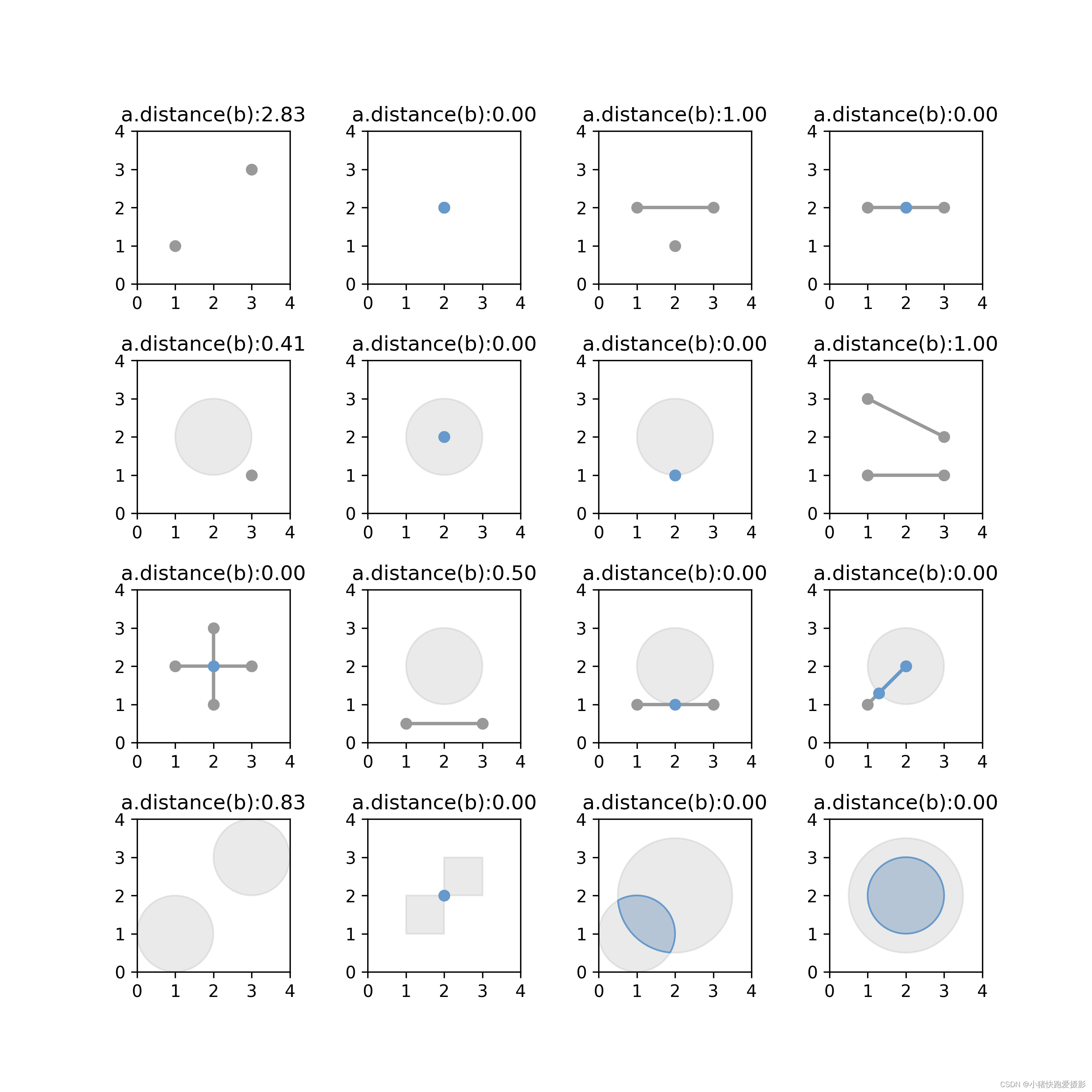
点面关系图代码
# figures.py from math import sqrt from shapely import affinity GM = (sqrt(5)-1.0)/2.0 W = 8.0 H = W*GM SIZE = (W, H) BLUE = '#6699cc' GRAY = '#999999' DARKGRAY = '#333333' YELLOW = '#ffcc33' GREEN = '#339933' RED = '#ff3333' BLACK = '#000000' def add_origin(ax, geom, origin): x, y = xy = affinity.interpret_origin(geom, origin, 2) ax.plot(x, y, 'o', color=GRAY, zorder=1) ax.annotate(str(xy), xy=xy, ha='center', textcoords='offset points', xytext=(0, 8)) def set_limits(ax, x0, xN, y0, yN): ax.set_xlim(x0, xN) ax.set_xticks(range(x0, xN+1)) ax.set_ylim(y0, yN) ax.set_yticks(range(y0, yN+1)) ax.set_aspect("equal")- 1
- 2
- 3
- 4
- 5
- 6
- 7
- 8
- 9
- 10
- 11
- 12
- 13
- 14
- 15
- 16
- 17
- 18
- 19
- 20
- 21
- 22
- 23
- 24
- 25
- 26
- 27
- 28
- 29
- 30
- 31
# main.py import matplotlib.pyplot as plt from shapely.geometry import Point, LineString, Polygon from shapely.plotting import plot_polygon, plot_points, plot_line from figures import BLUE, GRAY, set_limits fig = plt.figure(1, figsize=(9, 9), dpi=300) fig.subplots_adjust(wspace=0.5, hspace=0.5) # 调整边距和子图的间距 ax = fig.add_subplot(4, 4, 1) a = Point(1, 1) b = Point(3, 3) plot_points(a, ax=ax, color=GRAY) plot_points(b, ax=ax, color=GRAY) plot_points(a.intersection(b), ax=ax, color=BLUE) ax.set_title(f'a.touches(b):{a.touches(b)}') set_limits(ax, 0, 4, 0, 4) ax = fig.add_subplot(4, 4, 2) a = Point(2, 2) b = Point(2, 2) plot_points(a, ax=ax, color=GRAY) plot_points(b, ax=ax, color=GRAY) plot_points(a.intersection(b), ax=ax, color=BLUE) ax.set_title(f'a.touches(b):{a.touches(b)}') set_limits(ax, 0, 4, 0, 4) ax = fig.add_subplot(4, 4, 3) a = Point(2, 1) b = LineString([(1, 2), (3, 2)]) plot_points(a, ax=ax, color=GRAY) plot_line(b, ax=ax, color=GRAY) plot_points(a.intersection(b), ax=ax, color=BLUE) ax.set_title(f'a.touches(b):{a.touches(b)}') set_limits(ax, 0, 4, 0, 4) ax = fig.add_subplot(4, 4, 4) a = Point(2, 2) b = LineString([(1, 2), (3, 2)]) plot_points(a, ax=ax, color=GRAY) plot_line(b, ax=ax, color=GRAY) plot_points(a.intersection(b), ax=ax, color=BLUE) ax.set_title(f'a.touches(b):{a.touches(b)}') set_limits(ax, 0, 4, 0, 4) ax = fig.add_subplot(4, 4, 5) a = Point(3, 1) b = Point(2, 2).buffer(1) plot_points(a, ax=ax, color=GRAY) plot_polygon(b, ax=ax, add_points=False, color=GRAY, alpha=0.2) plot_points(a.intersection(b), ax=ax, color=BLUE) ax.set_title(f'a.touches(b):{a.touches(b)}') set_limits(ax, 0, 4, 0, 4) ax = fig.add_subplot(4, 4, 6) a = Point(2, 2) b = Point(2, 2).buffer(1) plot_points(a, ax=ax, color=GRAY) plot_polygon(b, ax=ax, add_points=False, color=GRAY, alpha=0.2) plot_points(a.intersection(b), ax=ax, color=BLUE) ax.set_title(f'a.touches(b):{a.touches(b)}') set_limits(ax, 0, 4, 0, 4) ax = fig.add_subplot(4, 4, 7) a = Point(2, 1) b = Point(2, 2).buffer(1) plot_points(a, ax=ax, color=GRAY) plot_polygon(b, ax=ax, add_points=False, color=GRAY, alpha=0.2) plot_points(a.intersection(b), ax=ax, color=BLUE) ax.set_title(f'a.touches(b):{a.touches(b)}') set_limits(ax, 0, 4, 0, 4) ax = fig.add_subplot(4, 4, 8) a = LineString([(1, 1), (3, 1)]) b = LineString([(1, 3), (3, 3)]) plot_line(a, ax=ax, color=GRAY) plot_line(b, ax=ax, color=GRAY) plot_points(a.intersection(b), ax=ax, color=BLUE) ax.set_title(f'a.touches(b):{a.touches(b)}') set_limits(ax, 0, 4, 0, 4) ax = fig.add_subplot(4, 4, 9) a = LineString([(1, 2), (3, 2)]) b = LineString([(2, 1), (2, 3)]) plot_line(a, ax=ax, color=GRAY) plot_line(b, ax=ax, color=GRAY) plot_points(a.intersection(b), ax=ax, color=BLUE) ax.set_title(f'a.touches(b):{a.touches(b)}') set_limits(ax, 0, 4, 0, 4) ax = fig.add_subplot(4, 4, 10) a = LineString([(1, 0.5), (3, 0.5)]) b = Point(2, 2).buffer(1) plot_line(a, ax=ax, color=GRAY) plot_polygon(b, ax=ax, add_points=False, color=GRAY, alpha=0.2) plot_points(a.intersection(b), ax=ax, color=BLUE) ax.set_title(f'a.touches(b):{a.touches(b)}') set_limits(ax, 0, 4, 0, 4) ax = fig.add_subplot(4, 4, 11) a = LineString([(1, 1), (3, 1)]) b = Point(2, 2).buffer(1) plot_line(a, ax=ax, color=GRAY) plot_polygon(b, ax=ax, add_points=False, color=GRAY, alpha=0.2) plot_line(a.intersection(b), ax=ax, color=BLUE) ax.set_title(f'a.touches(b):{a.touches(b)}') set_limits(ax, 0, 4, 0, 4) ax = fig.add_subplot(4, 4, 12) a = LineString([(1, 1), (2, 2)]) b = Point(2, 2).buffer(1) plot_line(a, ax=ax, color=GRAY) plot_polygon(b, ax=ax, add_points=False, color=GRAY, alpha=0.2) plot_line(a.intersection(b), ax=ax, color=BLUE) ax.set_title(f'a.touches(b):{a.touches(b)}') set_limits(ax, 0, 4, 0, 4) ax = fig.add_subplot(4, 4, 13) a = Point(1, 1).buffer(1) b = Point(3, 3).buffer(1) plot_polygon(a, ax=ax, add_points=False, color=GRAY, alpha=0.2) plot_polygon(b, ax=ax, add_points=False, color=GRAY, alpha=0.2) plot_points(a.intersection(b), ax=ax, color=BLUE) ax.set_title(f'a.touches(b):{a.touches(b)}') set_limits(ax, 0, 4, 0, 4) ax = fig.add_subplot(4, 4, 14) a = Polygon([(2, 2), (2, 3), (3, 3), (3, 2)]) b = Polygon([(1, 1), (1, 2), (2, 2), (2, 1)]) plot_polygon(a, ax=ax, add_points=False, color=GRAY, alpha=0.2) plot_polygon(b, ax=ax, add_points=False, color=GRAY, alpha=0.2) plot_points(a.intersection(b), ax=ax, color=BLUE) ax.set_title(f'a.touches(b):{a.touches(b)}') set_limits(ax, 0, 4, 0, 4) ax = fig.add_subplot(4, 4, 15) a = Point(1, 1).buffer(1) b = Point(2, 2).buffer(1.5) plot_polygon(a, ax=ax, add_points=False, color=GRAY, alpha=0.2) plot_polygon(b, ax=ax, add_points=False, color=GRAY, alpha=0.2) plot_polygon(a.intersection(b), ax=ax, add_points=False, color=BLUE) ax.set_title(f'a.touches(b):{a.touches(b)}') set_limits(ax, 0, 4, 0, 4) ax = fig.add_subplot(4, 4, 16) a = Point(2, 2).buffer(1) b = Point(2, 2).buffer(1.5) plot_polygon(a, ax=ax, add_points=False, color=GRAY, alpha=0.2) plot_polygon(b, ax=ax, add_points=False, color=GRAY, alpha=0.2) plot_polygon(a.intersection(b), ax=ax, add_points=False, color=BLUE) ax.set_title(f'a.touches(b):{a.touches(b)}') set_limits(ax, 0, 4, 0, 4) plt.savefig('output.png') plt.show()- 1
- 2
- 3
- 4
- 5
- 6
- 7
- 8
- 9
- 10
- 11
- 12
- 13
- 14
- 15
- 16
- 17
- 18
- 19
- 20
- 21
- 22
- 23
- 24
- 25
- 26
- 27
- 28
- 29
- 30
- 31
- 32
- 33
- 34
- 35
- 36
- 37
- 38
- 39
- 40
- 41
- 42
- 43
- 44
- 45
- 46
- 47
- 48
- 49
- 50
- 51
- 52
- 53
- 54
- 55
- 56
- 57
- 58
- 59
- 60
- 61
- 62
- 63
- 64
- 65
- 66
- 67
- 68
- 69
- 70
- 71
- 72
- 73
- 74
- 75
- 76
- 77
- 78
- 79
- 80
- 81
- 82
- 83
- 84
- 85
- 86
- 87
- 88
- 89
- 90
- 91
- 92
- 93
- 94
- 95
- 96
- 97
- 98
- 99
- 100
- 101
- 102
- 103
- 104
- 105
- 106
- 107
- 108
- 109
- 110
- 111
- 112
- 113
- 114
- 115
- 116
- 117
- 118
- 119
- 120
- 121
- 122
- 123
- 124
- 125
- 126
- 127
- 128
- 129
- 130
- 131
- 132
- 133
- 134
- 135
- 136
- 137
- 138
- 139
- 140
- 141
- 142
- 143
- 144
- 145
- 146
- 147
- 148
- 149
- 150
- 151
- 152
- 153
- 154
- 155
-
相关阅读:
springboot - 2.7.3版本 - (七)整合Kafka
Java抽象类和接口
scratch班级成绩处理 电子学会图形化编程scratch等级考试四级真题和答案解析2022年9月
百题千解计划【CSDN每日一练】收件邮箱(使用Python、Java、JavaScript解决)无敌的Python正则表达式、零宽负向断言
APS在印刷行业的应用前景和应用效益
HBase在大数据集群的安装部署及整合Phoenix
Python学习笔记——存储容器
开源实时数仓 Apache Doris 毕业了,未来如何走得更远?
Java基础语法
128-根据给定的字符串,建立二叉树
- 原文地址:https://blog.csdn.net/ymzhu385/article/details/133613409
