-
侯捷 C++ STL标准库和泛型编程 —— 6 算法 + 7 仿函数
6 算法
算法的标准样式:需要传进去两个指针

6.1 算法源码
6.1.1 accumulate
两个版本:
-
元素累加到 init 上
template <class InputIterator, class T> T accumulate(InputIterator first, InputIterator last, T init) { for (; first != last; ++first) init = init + *first; // 累加到init return init; }- 1
- 2
- 3
- 4
- 5
- 6
- 7
-
元素累运算到 init 上
template <class InputIterator, class T, class BinaryOperation> T accumulate(InputIterator first, InputIterator last, T init, BinaryOperation binary_op) { for (; first != last; ++first) init = binary_op(init, *first); // 累运算到init上 return init; }- 1
- 2
- 3
- 4
- 5
- 6
- 7
这里可以用任意的二元操作(可以是函数,也可以是仿函数)
测试:
#include// std::cout #include // std::minus #include // std::accumulate // 函数 int myfunc (int x, int y) {return x+2*y;} // 仿函数 struct myclass { int operator()(int x, int y) {return x+3*y;} } myobj; void test_accumulate() { cout << "\ntest_accumulate().......... \n"; int init = 100; int nums[] = {10,20,30}; cout << "using default accumulate: "; cout << accumulate(nums,nums+3,init); //160 cout << '\n'; cout << "using functional's minus: "; cout << accumulate(nums, nums+3, init, minus<int>()); //40 cout << '\n'; cout << "using custom function: "; cout << accumulate(nums, nums+3, init, myfunc); //220 cout << '\n'; cout << "using custom object: "; cout << accumulate(nums, nums+3, init, myobj); //280 cout << '\n'; } - 1
- 2
- 3
- 4
- 5
- 6
- 7
- 8
- 9
- 10
- 11
- 12
- 13
- 14
- 15
- 16
- 17
- 18
- 19
- 20
- 21
- 22
- 23
- 24
- 25
- 26
- 27
- 28
- 29
- 30
- 31
- 32
- 33
- 34
6.1.2 for_each
让范围里的所有元素都依次做同一件事情
Function 可以是函数也可以是仿函数
template <class InputIterator, class Function> Function for_each(InputIterator first, InputIterator last, Function f) { for (; first != last; ++first) { f(*first); } return f; }- 1
- 2
- 3
- 4
- 5
- 6
- 7
- 8
与C++11中的 range-based for statement 差不多
6.1.3 replace…
-
replace:范围内的所有等于 old_value 的,都被 new_value 取代template <class ForwardIterator, class T> void replace(ForwardIterator first, ForwardIterator last, const T& old_value, const T& new_value) { for (; first != last; ++first) { if (*first == old_value) *first = new_value; } }- 1
- 2
- 3
- 4
- 5
- 6
- 7
- 8
- 9
-
replace_if:范围内所有满足pred()为 true 的元素都被 new_value 取代template <class ForwardIterator,class Predicate, class T> void replace_if(ForwardIterator first, ForwardIterator last, Predicate pred, const T& new_value) { for (; first != last; ++first) { if (pred(*first)) *first = new_value; } }- 1
- 2
- 3
- 4
- 5
- 6
- 7
- 8
- 9
-
replace_copy:范围内的元素全部 copy 到新地方,其中所有等于 old_value 的,都被替代为 new_valuetemplate <class InputIterator, class OutputIterator, class T> OutputIterator replace_copy(InputIterator first, InputIterator last, OutputIterator result, const T& old_value, const T& new_value) { for (; first != last; ++first, ++result) { *result = (*first == old_value) ? new_value : *first; } return result; }- 1
- 2
- 3
- 4
- 5
- 6
- 7
- 8
- 9
- 10
6.1.4 count…
-
count:在范围中计数值等于 value 的个数template <class InputIterator, class T> typename iterator_traits<InputIterator>::difference_type // 返回类型 count (InputIterator first, InputIterator last, const T& value) { typename iterator_traits<InputIterator>::difference_type n = 0; for (; first != last; ++first) { if (*first == value) ++n; } return n; }- 1
- 2
- 3
- 4
- 5
- 6
- 7
- 8
- 9
- 10
- 11
-
count_if:在范围中计数满足条件pred()的个数template <class InputIterator, class Predicate> typename iterator_traits<InputIterator>::difference_type // 返回类型 count_if (InputIterator first, InputIterator last, Predicate pred) { typename iterator_traits<InputIterator>::difference_type n = 0; for (; first != last; ++first) { if (pred(*first)) ++n; } return n; }- 1
- 2
- 3
- 4
- 5
- 6
- 7
- 8
- 9
- 10
- 11
- 容器不带成员函数
count():array,vector,forward_list,deque - 容器自带成员函数
count():set / multiset,map / multimap,unordered_set / unordered_multiset,unordered_map / unorderd_multimap —— 所有关联式容器
6.1 5 find…
-
find:在范围内找到值等于 value 的元素template <class InputIterator, class T> InputIterator find(InputIterator first, InputIterator last, const T& value) { while (first != last && *first != value) ++first; return first; }- 1
- 2
- 3
- 4
- 5
- 6
-
find_if:在范围内找到满足pred()的元素template <class InputIterator, class Predicate> InputIterator find_if(InputIterator first, InputIterator last, Predicate pred) { while (first != last && !pred(*first)) ++first; return first; }- 1
- 2
- 3
- 4
- 5
- 6
都是循序查找,效率低
- 容器不带成员函数
find():array,vector,forward_list,deque - 容器自带成员函数
find():set / multiset,map / multimap,unordered_set / unordered_multiset,unordered_map / unorderd_multimap —— 所有关联式容器
6.1.6 sort
源码复杂
测试:
// 函数 bool myfunc (int i,int j) { return (i<j); } //仿函数 struct myclass { bool operator() (int i,int j) { return (i<j);} } myobj; // 定义向量 int myints[] = {32,71,12,45,26,80,53,33}; vector<int> myvec(myints, myints+8); // 32 71 12 45 26 80 53 33 // 用默认的比较(operator <) sort(myvec.begin(), myvec.begin()+4); //(12 32 45 71)26 80 53 33 // 用自己的函数作比较 sort(myvec.begin()+4, myvec.end(), myfunc); // 12 32 45 71(26 33 53 80) // 用自己的仿函数作比较 sort(myvec.begin(), myvec.end(), myobj); //(12 26 32 33 45 53 71 80) // 用反向迭代器 reverse iterator 和默认的比较(operator <) sort(myvec.rbegin(), myvec.rend()); // 80 71 53 45 33 32 26 12 // 用显式默认比较(operator <) sort(myvec.begin(), myvec.end(), less<int>()); // 12 26 32 33 45 53 71 80 // 使用另一个比较标准(operator >) sort(myvec.begin(), myvec.end(), greater<int>()); // 80 71 53 45 33 32 26 12- 1
- 2
- 3
- 4
- 5
- 6
- 7
- 8
- 9
- 10
- 11
- 12
- 13
- 14
- 15
- 16
- 17
- 18
- 19
- 20
- 21
- 22
- 23
- 24
- 25
- 26
- 27
- 28
- 29
- 30
- 容器不带成员函数
sort():array,vector,deque,所有关联式容器(本身就排好序了) - 容器自带成员函数
sort():list,forward_list(只能用自带)
reverse iterator:

其中用的是 reverse_iterator —— iterator adapter
6.1.7 binary_search
二分查找是否存在目标元素(并不给予位置),使用前必须先排序;其主要使用
lower_bound()来找到能放入 val 的最低位置,再判断该元素是否存在template <class ForwardIterator, class T> bool binary_search(ForwardIterator first, ForwardIterator last, const T& value) { first = lower_bound(first, last, value); return (first != last && !(value < *first)); // first == last 就是序列中所有元素都小于value // first == last 时,*first是没有值的,所以需要先检查 // value < *first 就是序列中没有等于value的 }- 1
- 2
- 3
- 4
- 5
- 6
- 7
- 8
- 9
- 10
lower_bound():用于在有序序列中查找==第一个大于等于==该值的元素(包括目标值本身),并返回一个指向该位置的迭代器- 如果目标值在序列中多次出现,返回第一个出现的位置
- 如果目标值在序列中不存在,它将返回指向比目标值大的第一个元素位置,或者返回
last
upper_bound():用于在有序序列中查找==第一个大于==该值的元素(不包括目标值本身),并返回一个指向该位置的迭代器- 如果目标值在序列中多次出现,返回第一个大于目标值的位置
- 如果目标值在序列中不存在,它将返回与
lower_bound()一样的位置
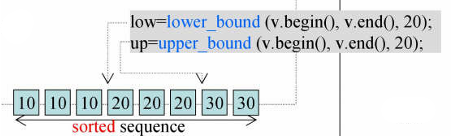
一样是前闭后开的原则,且他们都用的是二分查找的方法
7 仿函数
仿函数专门为算法服务,设计成一个函数/仿函数是为了能传入算法
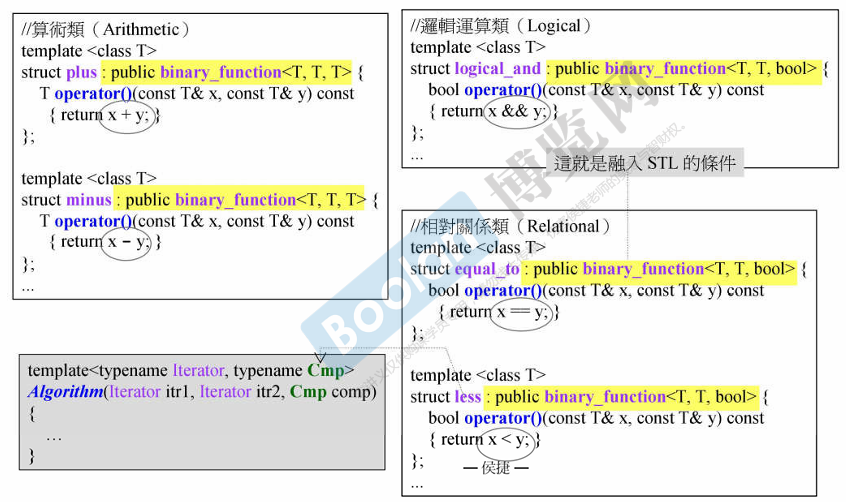
STL中的每个仿函数都继承了
binary_function/unary_function—— 融入到STL中STL规定每个 Adaptable Function(之后可以改造的函数)都应该继承其中一个(因为之后 Function Adapter 将会提问)
// 一个操作数的操作,例如“!” template <class Arg, class Result> struct unary_function { typedef Arg argument_type; typedef Result result_type; }; // 两个操作数的操作,例如“+” template <class Arg1, class Arg2, class Result> struct binary_function { typedef Arg1 first_argument_type; typedef Arg2 second_argument_type; typedef Result result_type; }; // 理论大小都是0,实际上可能是1(如果有人继承,那就一定是0)- 1
- 2
- 3
- 4
- 5
- 6
- 7
- 8
- 9
- 10
- 11
- 12
- 13
- 14
- 15
- 16
- 17
- 18
防函数是我们自己可能会写的,所以自己写的时候,如果想要融入STL,就要继承上面的两个之一
-
-
相关阅读:
数据结构--》连接世界的无限可能—— 图
【SA8295P 源码分析 (四)】23 - QNX Ethernet MAC 驱动 之 emac1_config.conf 配置文件解析
使用HTML制作静态网站作业——我的校园运动会(HTML+CSS)
Webview+AppbarLayout上下滑动冲突
17秒短视频竟引爆B站,吸引无数UP主、品牌轮番二创!
【C++】宏函数的巧用
Xception --tensorflow2.x
dpdk环境搭建
EDF文件格式/规格说明
嵌入式C 语言中的三块技术难点
- 原文地址:https://blog.csdn.net/WJwwwwwww/article/details/133513074
