-
Python入门自学进阶-Web框架——42、Web框架了解-bottle、flask
WEB框架的三大组件:路由系统、控制器(含模板渲染)、数据库操作
微型框架:依赖第三方写的socket,WSGI, 本身功能少
安装:
pip install bottle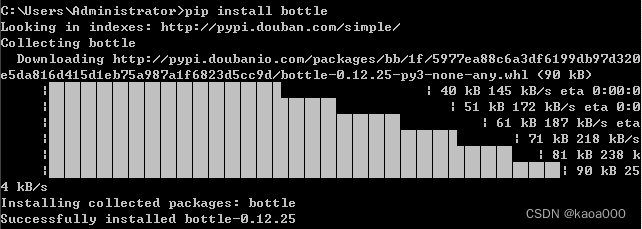
pip install flask
安装flask,同时安装了MarkupSafe、Werkzeug、Jinja2、itsdangerous。
Werkzeug是Python的WSGI规范的实用函数库。使用广泛,基于BSD协议,是Flask使用的底层WSGI库;
itsdangerous是flask中引用的一个第三方包,用来解决生成token等网络安全问题;
MarkupSafe为 Python 实现 XML/HTML/XHTML 标记安全字符串;
Jinja2是一个模板语言,是一个现代的、设计友好的、依照django模板的python模板语言;pip install tornado

已经安装过。
Bottle:
一个程序文件完成整个网站:
- from bottle import template,Bottle
- root = Bottle()
- @root.route('/hello/')
- # 装饰器,定义了URL,即/hello/这个url由index这个函数来处理,就是路由系统
- def index():
- return "Hello World!"
- root.run(host='localhost', port=8080)
- # 这里就是启动webserver服务器,然后等待请求
运行整个Python程序:

浏览器端请求:

上面的路由(即装饰器)是静态路由,还可以使用动态路由:
@root.route('/wiki/')
defcallback(pagename):
...
pagename作为参数变量名,匹配字符串。@root.route('/object/
defcallback(id):
...
id是一个int型的参数变量名。@root.route('/show/
defcallback(name):
...
name是一个正则表达式参数变量。@root.route('/static/
defcallback(path):
returnstatic_file(path, root='static')
定义路径,类似Django中的静态文件路径,主要是定义文件在服务器存储中的位置。
root指定的是项目中的一个目录,这里指定了项目中的static,在这个目录下有testcss.css文件,可以访问:
修改一下:


如果root为'static'不变,还可以这样访问:
对于路由对应的函数,除了返回字符串,还可以使用模板:
- @root.route('/hello/')
- # 装饰器,定义了URL,即/hello/这个url由index这个函数来处理
- def index():
- # return "Hello World!"
- return template('Hello {{name}}!',name="小花")
对于template(),除了像上面直接在其中写模板外,还可以直接指定一个模板文件,如
return template(‘index.html’)
创建index.html文件。这里要注意的是默认bottle找模板的路径,在bottle中有如下配置变量
TEMPLATE_PATH = ['./', './views/'],即默认模板查找顺序是先在项目根目录,然后是views目录,我们可以添加自己定义的目录
最终程序:
- from bottle import template,Bottle,static_file
- import bottle
- bottle.TEMPLATE_PATH.append('./templates/')
- root = Bottle()
- # 装饰器,定义了URL,即/hello/这个url由index这个函数来处理
- @root.route('/hello/')
- def index():
- print(bottle.TEMPLATE_PATH)
- # return "Hello World!"
- # return template('Hello {{name}}!',name="小花")
- return template("index.html")
- @root.route('/sta/
- def callback(path):
- return static_file(path,root='static')
- root.run(host='localhost', port=8080)
运行程序后,打印的TEMPLATE_PATH为:['./', './views/', './templates/'],但是却找不到模板文件:
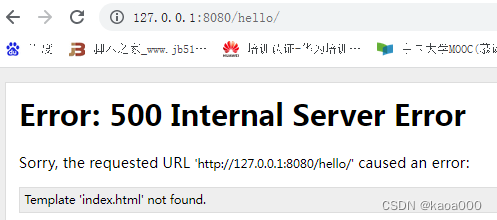
经过反复的测试,查找资料,这个问题我个人的理解是:
这个路径是linux系统的路径,在windows系统下失去效果,windows系统下,需要添加windows的绝对路径,使用os.path.abspath(os.path.join(os.path.dirname(__file__), "views")来获取windows下的绝对路径:
- from bottle import run,template,Bottle,TEMPLATE_PATH
- import os
- app = Bottle()
- TEMPLATE_PATH.insert(0, os.path.abspath(os.path.join(os.path.dirname(__file__), "templates")))
- TEMPLATE_PATH.append(os.path.abspath(os.path.join(os.path.dirname(__file__), "views")))
- print(TEMPLATE_PATH)
- @app.route('/')
- @app.route('/hello/
' ) - def index(name='default'):
- return template('hello.html',name=name)
- run(app,host='localhost',port=8080)
这时的TEMPLATE_PATH为:
['D:\\website\\bottlepro\\templates', './', './views/', 'D:\\website\\bottlepro\\views']
这时再访问,就没有问题了。

请求方法路由
@root.route('/hello/', method='POST')
def index():
...
@root.get('/hello/')
def index():
...
@root.post('/hello/')
def index():
...
@root.put('/hello/')
def index():
...
@root.delete('/hello/')
def index():
...一个简单的登陆:
- from bottle import template,Bottle,static_file,TEMPLATE_PATH,request,redirect
- import os
- TEMPLATE_PATH.append(os.path.abspath(os.path.join(os.path.dirname(__file__),'templates')))
- root = Bottle()
- # 装饰器,定义了URL,即/hello/这个url由index这个函数来处理
- @root.route('/login/',method=['GET','POST'])
- def login():
- if request.method == "GET":
- return template('login.html')
- else:
- # v = request.forms # POST的数据都保存
- # v = request.query # GET发来的请求数据
- # v = request.body # POST发来的请求数据
- u = request.forms.get('user')
- p = request.forms.get('pwd')
- print(u,p)
- return redirect('/index/')
- @root.route('/index/')
- def index():
- return template('index.html')
- @root.route('/sta/
- def callback(path):
- return static_file(path,root='static')
- root.run(host='localhost', port=8080)
- # 这里就是启动webserver服务器,然后等待请求
- html>
- <html lang="en">
- <head>
- <meta charset="UTF-8">
- <title>Titletitle>
- head>
- <body>
- <h1>Bottle登录h1>
- <form action="/login/" method="post">
- <input type="text" name="user" placeholder="用户名">
- <input type="password" name="pwd" placeholder="密码">
- <input type="submit" value="提交">
- form>
- body>
- html>
Bottle中的request其实是一个LocalReqeust对象,其中封装了用户请求的相关信息:
request.headers : 请求头信息request.query : get请求信息request.forms :post请求信息request.files :上传文件信息request.params :get和post请求信息request.GET :get请求信息request.POST :post和上传信息request.cookies :cookie信息request.environ :环境相关相关bottle的模板,在使用for循环遍历列表生成
- 时的问题:
- @root.route('/index/')
- def index():
- user_list = [
- {'id': 1, 'name': 'root1', 'age': 18},
- {'id': 2, 'name': 'root2', 'age': 19},
- {'id': 3, 'name': 'root3', 'age': 20},
- {'id': 4, 'name': 'root4', 'age': 21},
- ]
- return template('index.html', user_list=user_list)
模板index.html:
- <body>
- {{user_list}}
- <hr/>
- <ul>
- % for item in user_list :
- <li>{{item}}<li/>
- % end
- ul>
- body>
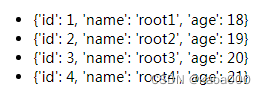
预想的是这样:
实际是这样:

多出来的这些空行,都是
- ::marker ,为何会多产生这些标签??怎么去掉?希望高手指点一二。
Flask:
基本框架与Bottle差不多,如下:
- from flask import Flask
- app = Flask(__name__)
- @app.route('/index/')
- def index():
- return "hello world!"
- if __name__ == "__main__":
- app.run()
启动后:
默认是在5000端口。访问:

在Flask()中,可以对静态文件和模板路径进行配置:相关参数如下

默认模板路径就是templates,
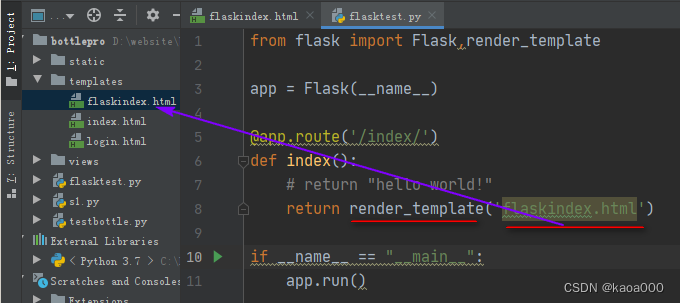
这个不像Bottle,项目下创建了templates,就可以直接找到。
传递参数:
- @app.route('/index/')
- def index():
- # return "hello world!"
- return render_template('flaskindex.html',k1='hello',k2=['a','b','c'],k3={'name':'haha1','age':17})
模板:
- html>
- <html lang="en">
- <head>
- <meta charset="UTF-8">
- <title>Titletitle>
- head>
- <body>
- <h1>Flask indexh1>
- {{k1}}
- {{k2}}
- <hr/>
- <ul>
- {% for item in k2 %}
- <li>{{item}}li>
- {% endfor %}
- ul>
- {{k3}}
- <hr/>
- {% for k,v in k3.items() %}
- {{k}}--{{v}}<br>
- {% endfor %}
- body>
- html>
还可以传递函数:

模板中:要在变量后加上小括号

Flask的动态路由方式:
- @app.route('/user/
') - @app.route('/post/
- @app.route('/post/
- @app.route('/post/
- @app.route('/login', methods=['GET', 'POST'])
DEFAULT_CONVERTERS = {
'default': UnicodeConverter,
'string': UnicodeConverter,
'any': AnyConverter,
'path': PathConverter,
'int': IntegerConverter,
'float': FloatConverter,
'uuid': UUIDConverter,
}与bottle一样,也有方法请求路由,即在路由中增加“method=”参数
对于Http请求,Flask会讲请求信息封装在request中(werkzeug.wrappers.BaseRequest),提供的如下常用方法和字段以供使用:
request.method
request.args
request.form
request.values
request.files
request.cookies
request.headers
request.path
request.full_path
request.script_root
request.url
request.base_url
request.url_root
request.host_url
request.hostFlask中使用cookie:使用make_response函数包装render_template,生成的对象有set_cookie方法。先导入make_response
- @app.route('/index/')
- def index():
- # return "hello world!"
- # return render_template('flaskindex.html',k0=myfun,k1='hello',k2=['a','b','c'],k3={'name':'haha1','age':17})
- obj = make_response(render_template('flaskindex.html',k0=myfun,k1='hello',k2=['a','b','c'],k3={'name':'haha1','age':17}))
- obj.set_cookie('usern','xiaohua')
- return obj
Flask中重定向:redirect
url_for(别名),这里的别名就是函数名,不需要在route中单独定义
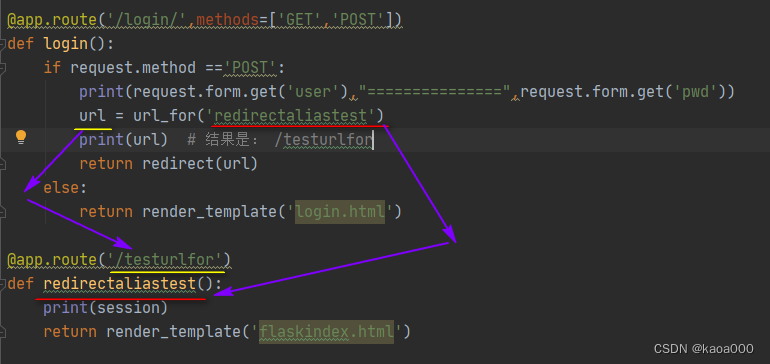
Flask中使用session,先导入session,from flask import session
要使用session,需要先配置一个SECRET_KEY,在Flask对象上设置,设置后才能在函数中使用:session['key']=value的方式
- from flask import Flask,render_template,make_response,session,request,redirect,url_for
- app = Flask(__name__)
- app.config.update(SECRET_KEY=b'_5#y2L"F4Q8z\n\xec]/') # 要使用session,必须设置这个参数
- def myfun():
- return "测试传递函数"
- @app.route('/index/')
- def index():
- # return "hello world!"
- # return render_template('flaskindex.html',k0=myfun,k1='hello',k2=['a','b','c'],k3={'name':'haha1','age':17})
- obj = make_response(render_template('flaskindex.html',k0=myfun,k1='hello',k2=['a','b','c'],k3={'name':'haha1','age':17}))
- obj.set_cookie('usern','xiaohua')
- return obj
- @app.route('/login/',methods=['GET','POST'])
- def login():
- if request.method =='POST':
- session['user'] = request.form.get('user') # 设置session内容
- url = url_for('redirectaliastest')
- return redirect(url)
- else:
- return render_template('login.html')
- @app.route('/testurlfor')
- def redirectaliastest():
- print(session) # login中设置的session在这里能打印出
- return render_template('flaskindex.html')
- if __name__ == "__main__":
- app.run()
关于Flask的中间件调用机制:
所有的WSGI在执行时,即实例化时,要先执行__call__()方法,
def __call__(self, environ: dict, start_response: t.Callable) -> t.Any:

    return self.wsgi_app(environ, start_response)
这个方法返回的是是执行wsgi_app方法的结果,然后在进入到Flask。
我们可以将这个wsgi_app换成我们自定义的类,在__call__方法中添加我们自己的代码,最后在调用原来的wsgi_app,这样就在请求处理前,先经过了我们自己的处理,像Django的中间件就是这种机制实现的。
- from flask import Flask,render_template,make_response,session,request,redirect,url_for
- app = Flask(__name__)
- app.config.update(SECRET_KEY=b'_5#y2L"F4Q8z\n\xec]/')
- def myfun():
- return "测试传递函数"
- @app.route('/index/')
- def index():
- # return "hello world!"
- # return render_template('flaskindex.html',k0=myfun,k1='hello',k2=['a','b','c'],k3={'name':'haha1','age':17})
- obj = make_response(render_template('flaskindex.html',k0=myfun,k1='hello',k2=['a','b','c'],k3={'name':'haha1','age':17}))
- obj.set_cookie('usern','xiaohua')
- return obj
- @app.route('/login/',methods=['GET','POST'])
- def login():
- if request.method =='POST':
- session['user'] = request.form.get('user')
- url = url_for('redirectaliastest')
- return redirect(url)
- else:
- return render_template('login.html')
- @app.route('/testurlfor')
- def redirectaliastest():
- print(session)
- return render_template('flaskindex.html')
- class Foo:
- def __init__(self,w):
- self.w = w
- def __call__(self, environ,start_response):
- print("自己的中间件")
- obj = self.w(environ,start_response)
- return obj
- if __name__ == "__main__":
- app.wsgi_app = Foo(app.wsgi_app)
- # 将原来的wsgi_app换成我们的类,Foo加上括号,即Foo()会先init,然后call
- # call的时候先执行我们的逻辑(相当于中间件),最后执行原来的wsgi_app
- # 这种方法有点装饰器的设计模式
- app.run()
启动后,页面请求过程:

Flask的消息:取一次就消失:
放置在session中,使用flash(value),取用,get_flashed_message(),取完就删除了。
-
相关阅读:
Java 在PDF中替换文字(详解)
resvr.exe 电脑病毒清理
记录YDLidar驱动包交叉编译时出现的一点问题
java中函数
【生成对抗网络学习 其一】经典GAN与其存在的问题和相关改进
C高级day1
ArcGIS Pro设置谷歌影像(无水印)
搭建vue3.2+vite+ts+pinia项目
力扣(LeetCode)181. 超过经理收入的员工(2022.06.29)
Docker--harbor私有仓库部署与管理
- 原文地址:https://blog.csdn.net/kaoa000/article/details/132686075
