-
浅谈C++|模板篇

一.模板模板概念
模板就是建立通用的模具,大大提高复用性
模板的特点:
1.模板不可以直接使用,它只是一个框架
2.模板的通用并不是万能的
·C++另一种编程思想称为泛型编程,主要利用的技术就是模板。
·C++提供两种模板机制:函数模板和类模板
二.函数模板
函数模板作用:
建立一个通用函数,其函数返回值类型和形参类型可以不具体制定,用一个虚拟的类型来代表。2.1语法
- template<typename T>
- 函数声明或定义
自动推导类型代码实例:
- #include
- using namespace std;
- template<typename T>
- void my_swap(T& a, T& b) {
- T temp = a;
- a = b;
- b = temp;
- }
- int main() {
- int a = 10,b = 20;
- char a2 = 'a', b2 = 'b';
- string a3 = "abc", b3 = "efg";
- my_swap(a, b);
- my_swap(a2, b2);
- my_swap(a3, b3);
- cout << "a=" << a << " b=" << b << endl;
- cout << "a2=" << a2 << " b2=" << b2 << endl;
- cout << "a3=" << a3 << " b3=" << b3 << endl;
- return 0;
- }

显示指定类型代码:
- #include
- using namespace std;
- template<typename T>
- void my_swap(T& a, T& b) {
- T temp = a;
- a = b;
- b = temp;
- }
- int main() {
- int a = 10,b = 20;
- char a2 = 'a', b2 = 'b';
- string a3 = "abc", b3 = "efg";
- my_swap<int>(a, b);
- my_swap<char>(a2, b2);
- my_swap
(a3, b3); - cout << "a=" << a << " b=" << b << endl;
- cout << "a2=" << a2 << " b2=" << b2 << endl;
- cout << "a3=" << a3 << " b3=" << b3 << endl;
- return 0;
- }

2.2注意事项
注意事项:
1.自动类型推导,必须推导出一致的数据类型T,才可以使用2.模板必须要确定出T的数据类型,才可以使用
代码实例:
- #include
- using namespace std;
- template<typename T>
- void my_swap(T a, T B) {
- T temp = a;
- a = b;
- b = a;
- }
- template<typename T>
- void fun() {
- cout << "函数模板调用" << endl;
- }
- int mian() {
- //fun();//报错,因为不能推理出T的类型
- int a = 10, b = 20;
- fun<int>();
- //必须这样写,int换为其它类型也可
- //my_swap(10, 'p');
- //报错,类型不一致
- my_swap(20, 90);
- my_swap<int>(20, 90);
- my_swap(a, b);
- return 0;
- }
2.3普通函数和模板函数的区别
普通函数与函数模板区别:
·普通函数调用时可以发生自动类型转换(隐式类型转换)
·函数模板调用时,如果利用自动类型推导,不会发生隐式类型转换
·如果利用显示指定类型的方式,可以发生隐式类型转换
- #include
- using namespace std;
- void fun(int one, int two) {
- cout << "one=" << one << " two=" << two << endl;
- }
- template<typename T>
- void fun1(T one, T two) {
- cout << "one=" << one << " two=" << two << endl;
- }
- void ce() {
- int a = 10, b = 20;
- char c = 'a';
- fun(a, b);
- fun(a, c);
- fun1(a, b);
- //fun1(a, c);
- //报错,因为自动推理类型不会发生隐式转换
- fun1<int>(a, c);
- }
- int main() {
- ce();
- return 0;
- }

总结:建议使用显示指定类型的方式,调用函数模板,因为可以自己确定通用类型T
2.4普通函数和函数模板的调用规则
调用规则如下:
1.如果函数模板和普通函数都可以实现,优先调用普通函数2.可以通过空模板参数列表来强制调用函数模板
3.函数模板也可以发生重载
4.如果函数模板可以产生更好的匹配,优先调用函数模板代码实例:
- #include
- using namespace std;
- void fun(int a,int b) {
- cout << a << ' ' << b << ' ' << endl;
- cout << "普通函数调用" << endl;
- }
- template<class T>
- void fun(T a, T b) {
- cout << a << ' ' << b << ' ' << endl;
- cout << "模板函数调用" << endl;
- }
- template<class T>
- void fun(T a, T b,T c) {
- cout << a << ' ' << b << ' ' <cout << "模板函数调用" << endl;}int main() {fun(10,20); //默认调用普通函数fun<>(10,90); //空列表强制调用模板函数fun<>(10,90,90); //模板函数可以发生重载return 0;}

2.5模板的局限性
局限性:
模板的通用性并不是万能的
代码实例:
- #include
- using namespace std;
- class person {
- public:
- person(string name, int temp) {
- this->name = name;
- this->temp = temp;
- }
- int temp;
- string name;
- };
- template <class T>
- bool eq(T a, T b) {
- if (a == b) {
- return true;
- }
- else {
- return false;
- }
- }
- int main() {
- person p1("tom", 20);
- person p2("tom", 20);
- //报错,因为自定义的类型,重载‘=’运算符
- if (eq(p1, p2)) {
- cout << "=" << endl;
- }
- else {
- cout << "!=" << endl;
- }
- return 0;
- }
此时模板函数不报错,但运行时会报错。因为类的‘==’没有重载。
代码实例:
- #include
- using namespace std;
- class person {
- public:
- person(string name, int temp) {
- this->name = name;
- this->temp = temp;
- }
- int temp;
- string name;
- };
- template <class T>
- bool eq(T a, T b) {
- if (a == b) {
- return true;
- }
- else {
- return false;
- }
- }
- //实例化模板函数
- template<> bool eq(person a, person b) {
- if (a.name == b.name && a.temp == b.temp) {
- return true;
- }
- else {
- return false;
- }
- }
- int main() {
- person p1("tom", 20);
- person p2("tom", 20);
- //报错,因为自定义的类型,重载‘=’运算符
- if (eq(p1, p2)) {
- cout << "=" << endl;
- }
- else {
- cout << "!=" << endl;
- }
- return 0;
- }
此时可以运行,函数模板实例化,相当于模板的补充。
三.类模板
类模板作用:
·建立一个通用类,类中的成员数据类型可以不具体制定,用一个虚拟的类型来代表。类模板不能使用自动推导类型,只能用显示指定的方法。
3.1语法
- template<typename T1, typename T2>
- class person {
- public:
- person(T1 name, T2 age) {
- this->name = name;
- this->age = age;
- }
- T1 name;
- T2 age;
- };
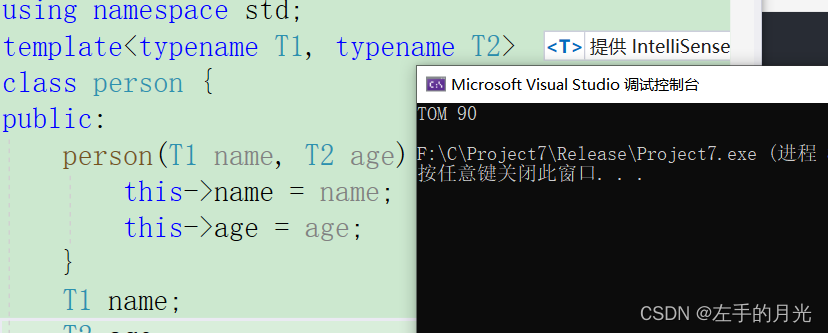
代码实例:
- #include
- using namespace std;
- template<typename T1, typename T2>
- class person {
- public:
- person(T1 name, T2 age) {
- this->name = name;
- this->age = age;
- }
- T1 name;
- T2 age;
- };
- int main() {
- person
- cout << P.name << ' ' << P.age << endl;
- return 0;
- }
3.2类模板和函数模板区别
类模板与函数模板区别主要有两点:
1.类模板没有自动类型推导的使用方式
2.类模板在模板参数列表中可以有默认参数
代码实例:
- #include
- using namespace std;
- //类模板可以添加默认参数,但是要优先右边全有默认参数yuanze
- template<class T1=string, typename T2=int>
- class person {
- public:
- person(T1 name, T2 age) {
- this->name = name;
- this->age = age;
- }
- T1 name;
- T2 age;
- };
- int main() {
- //person P("TOM", 90); //报错因为。类模板没有自动推导型
- person
- //有默认参数,可以省略类型,但是<>不能省略
- person<> P1("SOM", 900);
- cout << P.name << ' ' << P.age << endl;
- cout << P1.name << ' ' << P.age << endl;
- return 0;
- }
注意:< >不可以省略,设置默认参数时,优先右边。
3.3类模板中成员函数创建时机
类模板中成员函数和普通类中成员函数创建时机是有区别的:
1.普通类中的成员函数—开始就可以创建
2.类模板中的成员函数在调用时才创建代码实例:
- #include
- using namespace std;
- class person1 {
- public:
- void fun1() {
- cout << "person1的fun函数调用" << endl;
- }
- };
- class person2 {
- public:
- void fun2() {
- cout << "person2的fun函数调用" << endl;
- }
- };
- template<typename T>
- class p {
- public:
- p(T p) {
- this->fun = p;
- }
- T fun;
- void fun1() {
- //定义时不报错,只有实例化后,调用此函数才会检测是否报错。
- fun.fun1();
- }
- void fun2() {
- //定义时不报错,只有实例化后,调用此函数才会检测是否报错。
- fun.fun2();
- }
- };
- int main() {
- person1 p1;
- p
p(p1) ; - //此时会正常运行,不会报错,因为没有调用p.fun2();
- p.fun1();
- //p.fun2(); 运行报错
- return 0;
- }
3.4类模板做函数参数
—共有三种传入方式:
1.指定传入的类型------------直接显示对象的数据类型⒉参数模板化------------------将对象中的参数变为模板进行传递
3.整个类模板化----------------将这个对象类型模板化进行传递3.4.1指定传入
代码实例:
- #include
- using namespace std;
- //默认参数
- template<class T1=string,class T2=int>
- class person {
- public:
- T1 name;
- T2 id;
- person(T1 name, T2 id) {
- this->name = name;
- this->id = id;
- }
- void fun() {
- cout << name << ' ' << id << endl;
- }
- };
- //此函数不是模板函数,所以其参数要具体的参数
- void fun(person
- p.fun();
- }
- int main() {
- person
- fun(p);
- return 0;
- }

3.4.2参数模板化
代码实例:
- #include
- using namespace std;
- //默认参数
- template<class T1 = string, class T2 = int>
- class person {
- public:
- T1 name;
- T2 id;
- person(T1 name, T2 id) {
- this->name = name;
- this->id = id;
- }
- void fun() {
- cout << name << ' ' << id << endl;
- }
- };
- //实际上是创建模板函数
- template<class T1,class T2>
- void fun(person
- p.fun();
- }
- int main() {
- person
- fun(p);
- return 0;
- }
3.4.3类模板化
代码实例:
- #include
- #include
- using namespace std;
- //默认参数
- template<class T1 = string, class T2 = int>
- class person {
- public:
- T1 name;
- T2 id;
- person(T1 name, T2 id) {
- this->name = name;
- this->id = id;
- }
- void fun() {
- cout << name << ' ' << id << endl;
- }
- };
- //将整个类作为一个类型,创建模板函数
- template<class T1>
- void fun(T1& p) {
- p.fun();
- }
- int main() {
- person
- fun(p);
- return 0;
- }
总结:
通过类模板创建的对象,可以有三种方式向函数中进行传参使用比较广泛是第一种:指定传入的类型
3.5类模板与继承
当类模板碰到继承时,需要注意一下几点:
1.当子类继承的父类是一个类模板时,子类在声明的时候,要指定出父类中T的类型,如果不指定,编译器无法给子类分配内存。
2.如果想灵活指定出父类中T的类型,子类也需变为类模板。1.代码实例:
- #include
- using namespace std;
- template<typename T>
- class father {
- public:
- T name;
- };
- //class father :public son
- //如果想灵活指定出父类中T的类型,子类也需变为类模板。
- class son :public father
{ - public:
- son(string name) {
- this->name = name;
- }
- void fun() {
- cout << this->name << endl;
- }
- };
- int main() {
- son s("Tom");
- s.fun();
- return 0;
- }

2.代码实例:
- #include
- using namespace std;
- template<typename T>
- class father {
- public:
- T name;
- };
- //class father :public son
- //父类是模板类时,子类继承时要指定模板列表
- template<class T1,class T2>
- class son :public father
{ - public:
- T1 id;
- son(T1 id,T2 name) {
- this->name = name;
- this->id = id;
- }
- void fun() {
- cout << this->name << endl;
- cout << this->id << endl;
- }
- };
- int main() {
- son<int,string> s(100,"Tom");
- s.fun();
- return 0;
- }

3.6类模板成员函数类外实现
代码实例:
- #include
- using namespace std;
- template<class T1,class T2>
- class person {
- public:
- T1 name;
- T2 id;
- person(T1 name, T2 id);
- void fun();
- };
- template<class T1, class T2>
- person
- this->name = name;
- this->id = id;
- }
- template<class T1, class T2>
- void person
- cout << name << endl;
- cout << id << endl;
- }
- int main() {
- person
- p.fun();
- return 0;
- }

总结:类模板中成员函数类外实现时,需要加上模板参数列表
3.7类模板分文件编写
问题:
·类模板中成员函数创建时机是在调用阶段,导致分文件编写时链接不到
解决
·解决方式1:直接包含.cpp源文件
·解决方式2∶将声明和实现写到同一个文件中,并更改后缀名为.hpp,hpp是约定的名称,并不是强制代码:
person.hpp
- #include
- using namespace std;
- template<class T1 = string, class T2 = int>
- class person {
- public:
- T1 name;
- T2 age;
- person(T1 name, T2 age);
- void person_show();
- };
- template<class T1, class T2>
- person
- this->name = name;
- this->age = age;
- }
- template<class T1, class T2>
- void person
- cout << this->name << endl << this->age << endl;
- }
person.cpp
- #include "person.hpp";
- int main() {
- person<> p("猪八戒", 100);
- p.person_show();
- return 0;
- }
3.8类模板和友元
全局函数类内实现-直接在类内声明友元即可
全局函数类外实现·需要提前让编译器知道全局函数的存在类内实现
代码:
- #include
- using namespace std;
- template<class T1=string,class T2=int>
- class person {
- //定义友元函数,属于全局函数
- friend void person_show(person
- cout << p.name << endl << p.age << endl;
- }
- public:
- person(T1 name, T2 age);
- private:
- T1 name;
- T2 age;
- };
- template<class T1, class T2>
- person
- this->name = name;
- this->age = age;
- }
- int main() {
- person<> p("小明", 100);
- person_show(p);
- return 0;
- }

类外实现
代码:
- #include
- using namespace std;
- //先声明有person类,防止报错
- template<class T1, class T2>
- class person;
- //写在person定义之前,防止找不到报错
- template<class T1, class T2>
- void person_show(person
- cout << p.name << endl << p.age << endl;
- }
- template<class T1,class T2>
- class person {
- //friend void person_show(person
- //错误写法,因为person_show是模板函数,此时T1是模板没的T1
- friend void person_show<>(person
- //正确写法,加入模板列表声明是模板
- public:
- person(T1 name, T2 age);
- private:
- T1 name;
- T2 age;
- };
- template<class T1, class T2>
- person
- this->name = name;
- this->age = age;
- }
- int main() {
- person
- person_show(p);
- return 0;
- }
总结:建议全局函数做类内实现,用法简单,而且编译器可以直接识别
类模板案例
案例描述: 实现一个通用的数组类,要求如下
。可以对内置数据类型以及自定义数据类型的数据进行存储
。将数组中的数据存储到堆区
。构造函数中可以传入数组的容量
。提供对应的拷贝构造函数以及operator=防止浅拷贝问题。。提供尾插法和尾删法对数组中的数据进行增加和删除。
。可以通过下标的方式访问数组中的元素。
。可以获取数组中当前元素个数和数组的容量
代码
myArray.hpp
- #pragma
- #include
- using namespace std;
- template<class T>
- class myArray {
- public:
- myArray(int capacity);
- myArray(myArray& p);
- ~myArray();
- //重载=,防止浅拷贝
- myArray& operator=(const myArray& p) {
- if (this->Array != NULL) {
- delete[] this->Array;
- this->Array = NULL;
- }
- this->capacity = p.capacity;
- this->size = p.size;
- this->Array = p.Array;
- for (int i = 0; i < this->size; ++i) {
- this->Array[i] = p.Array[i];
- }
- }
- T& operator[](int index) {
- return this->Array[index];
- }
- void push_back(const T& val);
- void pop_back();
- int getsize() {
- return this->size;
- }
- int getcapacity() {
- return this->capacity;
- }
- private:
- T* Array;
- int size;
- int capacity;
- };
- //拷贝构造函数,注意要用深拷贝
- template<class T>
- myArray
::myArray(myArray& p) { - this->size = p.size;
- this->capacity = p.capacity;
- this->Array = new T[this->capacity];
- for (int i = 0; i < this->size; ++i) {
- this->Array[i] = p.Array[i];
- }
- }
- //有参构造函数
- template<class T>
- myArray
::myArray(int capacity) { - this->capacity = capacity;
- this->Array = new T[this->capacity];
- this->size = 0;
- }
- //析构函数
- template<class T>
- myArray
::~myArray() { - if (this->Array != NULL) {
- delete[] this->Array;
- this->Array = NULL;
- }
- }
- template<class T>
- void myArray
:: push_back(const T& val) { - if (this->size == this->capacity) {
- return;
- }
- this->Array[this->size++] = val;
- }
- template<class T>
- void myArray
::pop_back() { - if (this->size == 0) {
- return;
- }
- --this->size;
- }
main.cpp
- #include "myArray.hpp"
- class person {
- public:
- string name;
- int age;
- person() {}
- person(string name, int age) {
- this->name = name;
- this->age = age;
- }
- };
- void myprintf(myArray
& p) { - for (int i = 0; i < p.getsize(); ++i) {
- cout << p[i].name << " " << p[i].age << endl;
- }
- }
- void fun() {
- person p1("小明", 100);
- person p2("小壮", 130);
- person p3("小聪", 103);
- person p4("小红", 1560);
- person p5("小懒", 190);
- //调用默认构造函数
- myArray
p(10) ; - p.push_back(p1);
- p.push_back(p2);
- p.push_back(p3);
- p.push_back(p4);
- p.push_back(p5);
- cout << p.getsize() << endl;
- cout << p.getcapacity() << endl;
- myprintf(p);
- p.pop_back();
- cout << "弹出最后一个" << endl;
- myprintf(p);
- cout << "判断拷贝构造函数" << endl;
- myArray
p6(p) ; - myprintf(p6);
- cout << "判断operator=" << endl;
- myArray
p7(0) ; - p7 = p;
- myprintf(p7);
- }
- int main() {
- fun();
- return 0;
- }
- 相关阅读:
目标检测——ADAS实战
CSS之margin塌陷
【目标检测】【AnchorFree】【P-PicoDet】 移动端的目标检测器
服务器cpu一直处于100%解决思路
语义熵:QoE-Aware Resource Allocation for Semantic Communication Networks
Java高级——内存分配机制
Linux日志超详细使用操作
数据结构——排序
OSPFv2 和 OSPFv3 的区别?
伯俊ERP与金蝶云星空对接集成表头表体组合查询打通应收单新增
- 原文地址:https://blog.csdn.net/m0_73731708/article/details/132892775