-
✔ ★算法基础笔记(Acwing)(二)—— 数据结构(17道题)【java版本】
数据结构
1. 单链表模板
1. 单链表
class MyLinkedList { int size; ListNode head; public MyLinkedList() { size = 0; head = new ListNode(0); } public int get(int index) { if (index < 0 || index >= size) { return -1; } ListNode cur = head; for (int i = 0; i <= index; i++) { cur = cur.next; } return cur.val; } public void addAtHead(int val) { addAtIndex(0, val); } public void addAtTail(int val) { addAtIndex(size, val); } public void addAtIndex(int index, int val) { if (index > size) { return; } index = Math.max(0, index); size++; ListNode pred = head; for (int i = 0; i < index; i++) { pred = pred.next; } ListNode toAdd = new ListNode(val); toAdd.next = pred.next; pred.next = toAdd; } public void deleteAtIndex(int index) { if (index < 0 || index >= size) { return; } size--; ListNode pred = head; for (int i = 0; i < index; i++) { pred = pred.next; } pred.next = pred.next.next; } } class ListNode { int val; ListNode next; public ListNode(int val) { this.val = val; } }- 1
- 2
- 3
- 4
- 5
- 6
- 7
- 8
- 9
- 10
- 11
- 12
- 13
- 14
- 15
- 16
- 17
- 18
- 19
- 20
- 21
- 22
- 23
- 24
- 25
- 26
- 27
- 28
- 29
- 30
- 31
- 32
- 33
- 34
- 35
- 36
- 37
- 38
- 39
- 40
- 41
- 42
- 43
- 44
- 45
- 46
- 47
- 48
- 49
- 50
- 51
- 52
- 53
- 54
- 55
- 56
- 57
- 58
- 59
- 60
- 61
- 62
- 63
- 64
- 65
import java.util.*; public class Main { static int[] e = new int[100010]; static int[] ne = new int[100010]; static int idx,head; public static void init() { idx = 0; head = -1; } public static void add_head(int x) { e[idx] = x; ne[idx] = head; head = idx++; } public static void add(int k,int x) { e[idx] = x; ne[idx] = ne[k]; ne[k] = idx++; } public static void remove(int k) { ne[k] = ne[ne[k]]; } public static void main(String[] args) { Scanner scan = new Scanner(System.in); int m = scan.nextInt(); init(); while(m -- > 0){ String s = scan.next(); char op = s.charAt(0); if(op == 'H'){ int x = scan.nextInt(); add_head(x); }else if(op == 'D'){ int k = scan.nextInt(); if(k == 0) head = ne[head]; else remove(k-1); }else { int k = scan.nextInt(); int x = scan.nextInt(); add(k-1,x); } } for(int i = head;i != -1;i = ne[i] ){ System.out.print(e[i] + " "); } } }- 1
- 2
- 3
- 4
- 5
- 6
- 7
- 8
- 9
- 10
- 11
- 12
- 13
- 14
- 15
- 16
- 17
- 18
- 19
- 20
- 21
- 22
- 23
- 24
- 25
- 26
- 27
- 28
- 29
- 30
- 31
- 32
- 33
- 34
- 35
- 36
- 37
- 38
- 39
- 40
- 41
- 42
- 43
- 44
- 45
- 46
- 47
- 48
- 49
- 50
- 51
- 52
2. 双链表模板
void init() { r[0] = 1; l[1] = 0; idx = 2; }- 1
- 2
- 3
- 4
- 5
- 6
1. 双链表
import java.util.Scanner; public class Main{ static int N = 100010; static int[] e = new int[N]; static int[] r = new int[N]; static int[] l = new int[N]; static int idx; //删除第k位插入的数 public static void remove(int k){ r[l[k]] = r[k]; l[r[k]] = l[k]; } //这是在第k位数后面插入一个数x public static void add_all(int k,int x){ e[idx] = x; r[idx] = r[k]; l[idx] = k; l[r[k]] = idx; r[k] = idx++; } public static void main(String[] args){ Scanner scan = new Scanner(System.in); int m = scan.nextInt(); r[0] = 1;l[1] = 0;idx = 2; while(m -- > 0){ String s = scan.next(); char op = s.charAt(0); if(op == 'L'){ int x = scan.nextInt(); add_all(0,x); }else if(op == 'R'){ int x = scan.nextInt(); add_all(l[1],x); }else if(op == 'D'){ int k = scan.nextInt(); remove(k + 1); }else if(s.equals("IR")){ int k = scan.nextInt(); int x = scan.nextInt(); add_all(k + 1,x); }else { int k = scan.nextInt(); int x = scan.nextInt(); add_all(l[k+1],x); } } for(int i = r[0];i != 1; i= r[i]){ System.out.print(e[i] + " "); } } }- 1
- 2
- 3
- 4
- 5
- 6
- 7
- 8
- 9
- 10
- 11
- 12
- 13
- 14
- 15
- 16
- 17
- 18
- 19
- 20
- 21
- 22
- 23
- 24
- 25
- 26
- 27
- 28
- 29
- 30
- 31
- 32
- 33
- 34
- 35
- 36
- 37
- 38
- 39
- 40
- 41
- 42
- 43
- 44
- 45
- 46
- 47
- 48
- 49
- 50
- 51
- 52
- 53
- 54
3. 模拟栈
1. 模拟栈(一个数组即可)
import java.util.Scanner; public class Main{ public static void main(String[] args){ Scanner scan = new Scanner(System.in); int m = scan.nextInt(); int[] stl = new int[100010]; int tt = 0; while(m -- > 0){ String s = scan.next(); if(s.equals("push")){ int x= scan.nextInt(); stl[++tt] = x; }else if(s.equals("pop")){ tt--; }else if(s.equals("empty")){ if(tt > 0){ System.out.println("NO"); }else System.out.println("YES"); }else{ System.out.println(stl[tt]); } } } }- 1
- 2
- 3
- 4
- 5
- 6
- 7
- 8
- 9
- 10
- 11
- 12
- 13
- 14
- 15
- 16
- 17
- 18
- 19
- 20
- 21
- 22
- 23
- 24
- 25
- 26
2. 表达式求值
import java.util.*; public class Main{ public static void main(String[] args){ Scanner scan = new Scanner(System.in); //以字符串形式输入表达式 String s = scan.next(); //map来添加运算符号进去,定义优先级 Map<Character,Integer> map = new HashMap<>(); map.put('+',1); map.put('-',1); map.put('*',2); map.put('/',2); Stack<Character> op = new Stack<>();//存运算符号 Stack<Integer> num = new Stack<>();//存数字 for(int i = 0 ; i < s.length(); i ++ ){ char c = s.charAt(i); //判断c字符是不是数字 if(Character.isDigit(c)){ int x = 0,j = i; //数字可能会是多位数, while(j < s.length() && Character.isDigit(s.charAt(j))){ x = x * 10 + s.charAt(j) - '0'; j++; } num.push(x);//将数字x存入数字栈栈顶 i = j - 1;//重新赋值i }else if(c == '('){ op.push(c); // 将左括号存入字符栈栈顶 }else if(c == ')'){ //如果栈顶不等于左括号,一直计算下去; while(op.peek() != '('){ eval(op,num); } op.pop(); // 将左括号弹出栈顶 }else { //如果是正常字符 while(!op.empty() && op.peek() != '(' && map.get(op.peek()) >= map.get(c)){ eval(op,num); } op.push(c); } } while(!op.empty()) eval(op,num); System.out.println(num.peek()); } public static void eval(Stack<Character> op,Stack<Integer> num){ int b = num.pop(); int a = num.pop(); char c = op.pop(); if(c == '+'){ num.push(a+b); }else if(c == '-'){ num.push(a-b); }else if(c == '*'){ num.push(a*b); }else { num.push(a/b); } } }- 1
- 2
- 3
- 4
- 5
- 6
- 7
- 8
- 9
- 10
- 11
- 12
- 13
- 14
- 15
- 16
- 17
- 18
- 19
- 20
- 21
- 22
- 23
- 24
- 25
- 26
- 27
- 28
- 29
- 30
- 31
- 32
- 33
- 34
- 35
- 36
- 37
- 38
- 39
- 40
- 41
- 42
- 43
- 44
- 45
- 46
- 47
- 48
- 49
- 50
- 51
- 52
- 53
- 54
- 55
- 56
- 57
- 58
- 59
- 60
- 61
- 62
4. 队列 tt = -1,hh = 0;
1. 模拟队列
import java.util.Scanner; public class Main{ public static void main(String[] args){ Scanner scan = new Scanner(System.in); int m = scan.nextInt(); //队列是在tt队尾插入元素,队头hh弹出元素 int[] dl = new int[100010]; int hh = 0; int tt = -1; while(m -- > 0){ String s = scan.next(); if(s.equals("push")){ int x = scan.nextInt(); dl[++tt] = x; }else if(s.equals("pop")){ hh++; }else if(s.equals("empty")){ if(hh <= tt) System.out.println("NO"); else System.out.println("YES"); }else { System.out.println(dl[hh]); } } } }- 1
- 2
- 3
- 4
- 5
- 6
- 7
- 8
- 9
- 10
- 11
- 12
- 13
- 14
- 15
- 16
- 17
- 18
- 19
- 20
- 21
- 22
- 23
- 24
- 25
5. 单调栈
常见模型:找出每个数左边离它最近的比它大/小的数 int tt = 0; for (int i = 1; i <= n; i ++ ) { while (tt && check(stk[tt], i)) tt -- ; stk[ ++ tt] = i; }- 1
- 2
- 3
- 4
- 5
- 6
- 7
1. 单调栈
import java.util.*; public class Main { public static void main(String[] args) { Scanner scanner = new Scanner(System.in); int n = scanner.nextInt(); int[] nums = new int[n+2]; int[] st = new int[n+2]; int tt = 0; for (int i = 0; i < n; i++) nums[i] = scanner.nextInt(); for (int i = 0; i < n; i++) { while (tt != 0 && st[tt-1] >= nums[i]) { tt--; } if (tt == 0) { System.out.print(-1 + " "); } else { System.out.print(st[tt-1] + " "); } st[tt++] = nums[i]; } } }- 1
- 2
- 3
- 4
- 5
- 6
- 7
- 8
- 9
- 10
- 11
- 12
- 13
- 14
- 15
- 16
- 17
- 18
- 19
- 20
- 21
- 22
- 23
- 24
6. 单调队列
1. 滑动窗口最大值
class Solution { public int[] maxSlidingWindow(int[] nums, int k) { int[] q = new int[nums.length]; int hh = 0, tt = -1; int[] ans = new int[nums.length-k+1]; for (int i = 0; i < nums.length; i++) { int x = nums[i]; if (hh <= tt && q[hh] + k <= i) { hh++; } while (hh <= tt && x >= nums[q[tt]]) { tt--; } q[++tt] = i; if (i+1 >= k) { ans[i-k+1] = nums[q[hh]]; } } return ans; } }- 1
- 2
- 3
- 4
- 5
- 6
- 7
- 8
- 9
- 10
- 11
- 12
- 13
- 14
- 15
- 16
- 17
- 18
- 19
- 20
- 21
7. KMP
1. KMP字符串
class Solution { public int strStr(String haystack, String needle) { int[] ne = new int[haystack.length()+2]; ne[0] = -1; for (int i = 1,j = -1; i < needle.length(); i++) { while (j != -1 && needle.charAt(j+1) != needle.charAt(i)) { j = ne[j]; } if (needle.charAt(j+1) == needle.charAt(i)) { j++; } ne[i] = j; } int ans = 0; for (int i = 0,j = -1; i < haystack.length(); i++) { while (j != -1 && haystack.charAt(i) != needle.charAt(j+1)) { j = ne[j]; } if (haystack.charAt(i) == needle.charAt(j+1)) { j++; } if (j == needle.length()-1) { return i-needle.length()+1; } } return -1; } }- 1
- 2
- 3
- 4
- 5
- 6
- 7
- 8
- 9
- 10
- 11
- 12
- 13
- 14
- 15
- 16
- 17
- 18
- 19
- 20
- 21
- 22
- 23
- 24
- 25
- 26
- 27
- 28
8. Trie树
1. Trie字符串统计
import java.util.Scanner; public class Main{ static int N = 100010,idx = 0; static int[][] song = new int[N][26]; static int[] cnt = new int[N]; static char[] str = new char[N]; public static void insert(char[] str){ int p = 0; //下标0表示头结点,根节点 for(int i = 0 ; i < str.length; i ++ ){ // 将字符串每个字符都转化成数字;0-25 int u = str[i] - 'a'; //如果这个的儿子分支没有字符,说明这条分支还没有这个字符插入过 //就新建一个然后赋值为然后把【idx】下标赋值上去,作为每个分支的专属坐标 if(song[p][u] == 0) song[p][u] = ++idx; //然后将p往下前进一层 p = song[p][u]; } //最后停在那一层的那个数字就做标记,说明这是一个字符串的结束。 cnt[p]++; } public static int query(char[] str){ int p = 0;//从根节点开始,下标是0表示根节点,头结点 for(int i = 0 ; i < str.length; i ++){ int u = str[i] - 'a'; // 将字符串每个字符都转化成数字0-25 //如果这个点上面没有标记,就说明没有存入过这个字符,所以返回0 if(song[p][u] == 0) return 0; //如果这个点上面能寻找到这个字符,就让他往下一层继续寻找; p = song[p][u]; } //最后查找完之后输出最后一个做标记的点为下标的cnt数组的值。 return cnt[p]; } public static void main(String[] args){ Scanner scan = new Scanner(System.in); int n = scan.nextInt(); String sss = scan.nextLine(); while(n -- > 0){ String s = scan.nextLine(); String[] st = s.split(" "); String s1 = st[0]; String s2 = st[1]; if(s1.equals("I")){ insert(s2.toCharArray()); }else{ System.out.println(query(s2.toCharArray())); } } } }- 1
- 2
- 3
- 4
- 5
- 6
- 7
- 8
- 9
- 10
- 11
- 12
- 13
- 14
- 15
- 16
- 17
- 18
- 19
- 20
- 21
- 22
- 23
- 24
- 25
- 26
- 27
- 28
- 29
- 30
- 31
- 32
- 33
- 34
- 35
- 36
- 37
- 38
- 39
- 40
- 41
- 42
- 43
- 44
- 45
- 46
- 47
- 48
- 49
- 50
★2. 最大异或对
for(int i = 0; i < n; i++) { for(int j = 0; j < n; j++) { res = max(res,a[i]^a[j]); } }- 1
- 2
- 3
- 4
- 5
- 6
- 7
- 优化:创建一个Trie树,针对一个数,去遍历Trie树
(怎么想到用Trie树去优化呢?Trie树可以存储组合性质的信息)
import java.io.*; public class Main{ static int N = 3100010,idx = 0; static int[][] song = new int[N][2]; //插入 public static void add(int x){ int p = 0;//从头结点开始 for(int i = 30 ; i >= 0 ; i -- ){ //因为每一个数的二进制是有31位组成,所以需要从大开始遍历 int u = x >> i & 1;//每一个数的二进制31个二进制每一位看0还是1 if(song[p][u] == 0) song[p][u] = ++idx;//判断这一层是空的,就创建,然后赋值下标 p = song[p][u];//然后让往下前进一层 } } //查询 public static int query(int x){ int p = 0,res = 0;//从根节点0开始。res进就算异或后的最大值 for(int i = 30; i>= 0 ; i --){ int u = x >> i & 1; if(song[p][1-u] != 0){ //如果该节点的u是0,则判断一下在这一层有没有跟他相反的0-1,1-0,如果相反对应位置有数 res += (1 << i);//res就将该二进制位对应异或之后的最优解1每一位顺次加起来。因为是异或相反数就是1,这是最优解 p = song[p][1-u];//然后往最优解那边前进一层。 }else{//否则就不是最优解的0匹配1,1匹配0,所以就异或之后的值是0 //res += (0 << i);因为是0所以可以省略, p = song[p][u];//然后让他往不优解那边前进一层。 } } return res;//最后返回异或之后的最大值res } public static void main(String[] args)throws IOException{ BufferedReader re = new BufferedReader(new InputStreamReader(System.in)); BufferedWriter wt = new BufferedWriter(new OutputStreamWriter(System.out)); int n = Integer.parseInt(re.readLine()); String[] s = re.readLine().split(" "); for(int i = 0 ; i < n ; i ++ ){ add(Integer.parseInt(s[i])); } int res = 0; for(int i = 0 ; i < n ; i ++ ){ //因为输入的是字符串所以需要转成整形。然后每一次比较res的值谁大,然后将最大值重新赋值给res res = Math.max(res,query(Integer.parseInt(s[i]))); } wt.write(res +" ");//最后输出res,因为快输出输出的是字符串,所以需要在后面加上“ ”; wt.close(); } }- 1
- 2
- 3
- 4
- 5
- 6
- 7
- 8
- 9
- 10
- 11
- 12
- 13
- 14
- 15
- 16
- 17
- 18
- 19
- 20
- 21
- 22
- 23
- 24
- 25
- 26
- 27
- 28
- 29
- 30
- 31
- 32
- 33
- 34
- 35
- 36
- 37
- 38
- 39
- 40
- 41
- 42
- 43
- 44
- 45
- 46
- 47
9. 并查集 find merge
1. 合并集合(5分钟)
import java.util.Scanner; public class Main{ static int N = 100010; static int[] p = new int[N]; public static void main(String[] args){ Scanner scan = new Scanner(System.in); int n = scan.nextInt(); // 全部有n个数 int m = scan.nextInt(); // 读入m个操作 //将n个数每个数各自都在一个集合里面。都指向自己,说明现在有多少个集合 for(int i = 1 ; i <= n ; i ++) p[i] = i; while(m -- > 0){ String s = scan.next(); int a = scan.nextInt(); int b = scan.nextInt(); //合并集合 if(s.equals("M")) p[find(a)] = find(b); //将a集合的根节点即祖先指向b集合的祖先 else{ //是否同个集合 if(find(a) == find(b))System.out.println("Yes"); //如果两个集合的祖先相同说明两个集合在同个集合中。 else System.out.println("No"); //否则相反 } } } //并查集的核心操作,寻找根节点祖先 + 路径压缩 public static int find(int x){ // 如果这个集合的父节点指向的不是自己,说明不是根节点,递归寻找, //最后找到根节点之后,把路径上的所有集合都指向根节点、 if(p[x] != x) p[x] = find(p[x]); return p[x]; // 最后返回根节点 } }- 1
- 2
- 3
- 4
- 5
- 6
- 7
- 8
- 9
- 10
- 11
- 12
- 13
- 14
- 15
- 16
- 17
- 18
- 19
- 20
- 21
- 22
- 23
- 24
- 25
- 26
- 27
- 28
- 29
- 30
- 31
2. 连通块中点的数量(每个集合有多少个元素)
import java.util.Scanner; public class Main{ static int N = 100010; static int[] p = new int[N]; static int[] size = new int[N];//size用来存每个集合中数的个数 public static void main(String[] args){ Scanner scan = new Scanner(System.in); int n = scan.nextInt(); int m = scan.nextInt(); for(int i = 1 ; i <= n ;i ++){ p[i] = i; size[i] = 1;// 一开始每个数是一个集合,各自都是个数为1; } while(m -- > 0){ String s = scan.next(); if(s.equals("C")){ int a = scan.nextInt(); int b = scan.nextInt(); if(find(a) == find(b)) continue; // 这里需要特判一下,如果两个数是同个集合中的数,就结束; else{ size[find(b)] += size[find(a)]; // 只有两个数的根节点,也就是祖先的size值才是有用的, //两个集合中的赋值给另一个祖先的,即赋值给另一个祖先的这个祖先就是合并之后的两个集合的祖先 // b的size[] + =a的size[] 因为b是合并之后的新祖先,所以要让b加上被合并的a p[find(a)] = find(b); //合并操作,p[a]的祖先指向b,说明b是合并之后的祖先 } }else if(s.equals("Q1")){ int a = scan.nextInt(); int b = scan.nextInt(); if(find(a) == find(b))System.out.println("Yes"); else System.out.println("No"); }else{ int a = scan.nextInt(); //只有根节点的size才是有用的,则通过find(a)找到他的根节点然后输出根节点的size; System.out.println(size[find(a)]); } } } public static int find(int x){ if(p[x] != x) p[x] = find(p[x]); return p[x]; } }- 1
- 2
- 3
- 4
- 5
- 6
- 7
- 8
- 9
- 10
- 11
- 12
- 13
- 14
- 15
- 16
- 17
- 18
- 19
- 20
- 21
- 22
- 23
- 24
- 25
- 26
- 27
- 28
- 29
- 30
- 31
- 32
- 33
- 34
- 35
- 36
- 37
- 38
- 39
- 40
- 41
- 42
- 43
★3. 食物链
法一: x,x+n,x+n+n merge(f[x+n],f[x])
思路:
- 因为有三种物种,A吃B,B吃C,C吃A
- 如果我们用一个数组存储,那么比如1吃2,那么我们让2的角标处的值标记成1,如果3吃2,那怎么标记?一个数组指定标记不过来。
- 那么我们想用三个数组存储,其实也存储不过来,因为角标就那么几个,
- 最好的方法就是,用x,x+n,x+n+n来表示
比如1吃2,那么就可能有三种情况,
A类中的1吃B类的2 : fa[1] = fa[2+n+n]
B类中的1吃C类的2 : fa[1+n] = fa[2]
C类中的1中A类的2 : fa[1+n+n] = fa[2+n];
这样的话,就会有3*n个角标,就可以充分表达
A中的1吃B中的2(B中的2用2+n表示)
这样的话就不会出现数字冲突
A吃B
则让f[A] = B二刷总结
a吃b
f[a+n] = f[b]
或者
f[b+n] = f[a]/* */ #includeusing namespace std; int fa[200000]; int n,m,k,x,y,ans; int get(int x) { if(x==fa[x]) return x; return fa[x]=get(fa[x]); } void merge(int x,int y) { fa[get(x)]=get(y); } int main() { cin>>n>>m; for(int i=1;i<=3*n;i++) fa[i]=i; for(int i=1;i<=m;i++) { scanf("%d%d%d",&k,&x,&y); if(x>n || y>n) ans++; else if(k==1) { if(get(x)==get(y+n) || get(x)==get(y+n+n)) //如果x,y是同类,但是x是y的捕食中的动物,或者x是y天敌中的动物,那么错误. ans++; else { merge(x,y); merge(x+n,y+n); merge(x+n+n,y+n+n); } } else { if(x==y || get(x)==get(y) || get(x)==get(y+n)) //x就是y,或者他们是同类,再或者是y的同类中有x ans++;//都是假话 else { merge(x,y+n+n);//y的捕食域加入x merge(x+n,y);//x的天敌域加入y merge(x+n+n,y+n);//x的捕食域是y的同类域. } } } cout<<ans<<endl; } - 1
- 2
- 3
- 4
- 5
- 6
- 7
- 8
- 9
- 10
- 11
- 12
- 13
- 14
- 15
- 16
- 17
- 18
- 19
- 20
- 21
- 22
- 23
- 24
- 25
- 26
- 27
- 28
- 29
- 30
- 31
- 32
- 33
- 34
- 35
- 36
- 37
- 38
- 39
- 40
- 41
- 42
- 43
- 44
- 45
- 46
- 47
- 48
- 49
- 50
- 51
- 52
- 53
法二:将有关系的都存储在一个部落,用到根节点的距离表示关系
二刷总结
- X吃Y 让x的祖宗等于y的祖宗 或者 y的祖宗等于x的祖宗都可以
- find查找函数中,具有压缩路径的作用,所以在写的时候,先找到此根节点,然后依次压缩,如下代码
find中 d[x] += d[p[x]];
int find(int x) { if (p[x] != x) { int t = find(p[x]); d[x] += d[p[x]]; p[x] = t; } return p[x]; }- 1
- 2
- 3
- 4
- 5
- 6
- 7
- 8
- 9
- 10
不可以如下代码
int find(int x) { if (p[x] != x) { d[x] += d[p[x]]; return p[x] = find(p[x]); } return p[x]; }- 1
- 2
- 3
- 4
- 5
- 6
- 7
- 8
- 9
- 10
- 在查询合并过程中,比如查询x的父节点,应该用一个变量记录下来,不能多次find,不然找不到x的原来父节点了
- 初始化 p[i] = i; d[i] = 0;
- 合并的时候,画图即可明白彼此的距离
具体过程如下:
#includeusing namespace std; const int N = 50010; int n, m; int p[N], d[N]; int find(int x) { if (p[x] != x) { int t = find(p[x]); d[x] += d[p[x]]; p[x] = t; } return p[x]; } int main() { scanf("%d%d", &n, &m); for (int i = 1; i <= n; i ++ ) p[i] = i; int res = 0; while (m -- ) { int t, x, y; scanf("%d%d%d", &t, &x, &y); if (x > n || y > n) res ++ ; else { int px = find(x), py = find(y); if (t == 1) { if (px == py && (d[x] - d[y]) % 3) res ++ ; else if (px != py) { p[px] = py; d[px] = d[y] - d[x]; } } else { if (px == py && (d[x] - d[y] - 1) % 3) res ++ ; else if (px != py) { p[px] = py; d[px] = d[y] + 1 - d[x]; } } } } printf("%d\n", res); return 0; } - 1
- 2
- 3
- 4
- 5
- 6
- 7
- 8
- 9
- 10
- 11
- 12
- 13
- 14
- 15
- 16
- 17
- 18
- 19
- 20
- 21
- 22
- 23
- 24
- 25
- 26
- 27
- 28
- 29
- 30
- 31
- 32
- 33
- 34
- 35
- 36
- 37
- 38
- 39
- 40
- 41
- 42
- 43
- 44
- 45
- 46
- 47
- 48
- 49
- 50
- 51
- 52
- 53
- 54
- 55
- 56
- 57
- 58
- 59
- 60
- 61
10. 堆 ✔ ✔
模板
// h[N]存储堆中的值, h[1]是堆顶,x的左儿子是2x, 右儿子是2x + 1 // ph[k]存储第k个插入的点在堆中的位置 // hp[k]存储堆中下标是k的点是第几个插入的 int h[N], ph[N], hp[N], size; // 交换两个点,及其映射关系 void heap_swap(int a, int b) { swap(ph[hp[a]],ph[hp[b]]); swap(hp[a], hp[b]); swap(h[a], h[b]); } void down(int u) { int t = u; if (u * 2 <= size && h[u * 2] < h[t]) t = u * 2; if (u * 2 + 1 <= size && h[u * 2 + 1] < h[t]) t = u * 2 + 1; if (u != t) { heap_swap(u, t); down(t); } } void up(int u) { while (u / 2 && h[u] < h[u / 2]) { heap_swap(u, u / 2); u >>= 1; } } // O(n)建堆 for (int i = n / 2; i; i -- ) down(i);- 1
- 2
- 3
- 4
- 5
- 6
- 7
- 8
- 9
- 10
- 11
- 12
- 13
- 14
- 15
- 16
- 17
- 18
- 19
- 20
- 21
- 22
- 23
- 24
- 25
- 26
- 27
- 28
- 29
- 30
- 31
- 32
- 33
- 34
- 35
- 36
- 向下调整
法一:如果孩子节点 小于当前节点 那么交换 然后递归
void down(int u) { int t = u; if (u * 2 <= size && h[u * 2] < h[t]) t = u * 2; if (u * 2 + 1 <= size && h[u * 2 + 1] < h[t]) t = u * 2 + 1; if (u != t) { heap_swap(u, t); down(t); } }- 1
- 2
- 3
- 4
- 5
- 6
- 7
- 8
- 9
- 10
- 11
法二:parent = child * 2 直到 超出范围
public void createHeap() { for (int parent = (usedSize-1-1) / 2; parent >= 0 ; parent--) { shiftDown(parent,usedSize); } } /** * 实现 向下调整 * @param parent 每棵子树的根节点的下标 * @param len 每棵子树的结束位置 */ private void shiftDown(int parent ,int len) { int child = 2 * parent + 1; //最起码是有左孩子 while (child < len) { //判断 左孩子 和 右孩子 谁最大,前提是 必须有 右孩子 if(child+1 < len && elem[child] < elem[child+1]) { child++;//此时 保存了最大值的下标 } if(elem[child] > elem[parent]) { swap(elem,child,parent); parent = child; child = 2*parent+1; }else { break; } } } private void swap(int[] array,int i,int j) { int tmp = array[i]; array[i] = array[j]; array[j] = tmp; }- 1
- 2
- 3
- 4
- 5
- 6
- 7
- 8
- 9
- 10
- 11
- 12
- 13
- 14
- 15
- 16
- 17
- 18
- 19
- 20
- 21
- 22
- 23
- 24
- 25
- 26
- 27
- 28
- 29
- 30
- 31
- 32
- 33
- 34
- 35
堆的操作
- 删除最值
- 因为最小值,位于数组的最前端,所以我们可以让最前端等于最后端的值,(此时堆的最小值已经没了)
- 但是呢,堆里出现了两个最前端的值,所以需要再–sz删除最后段的值(不要怕,最后段的值,已经保存到最前端的结点上,)
- 最后把最顶端的点 用down
- 修改值(改,先down,后up)


孩子和父亲的关系
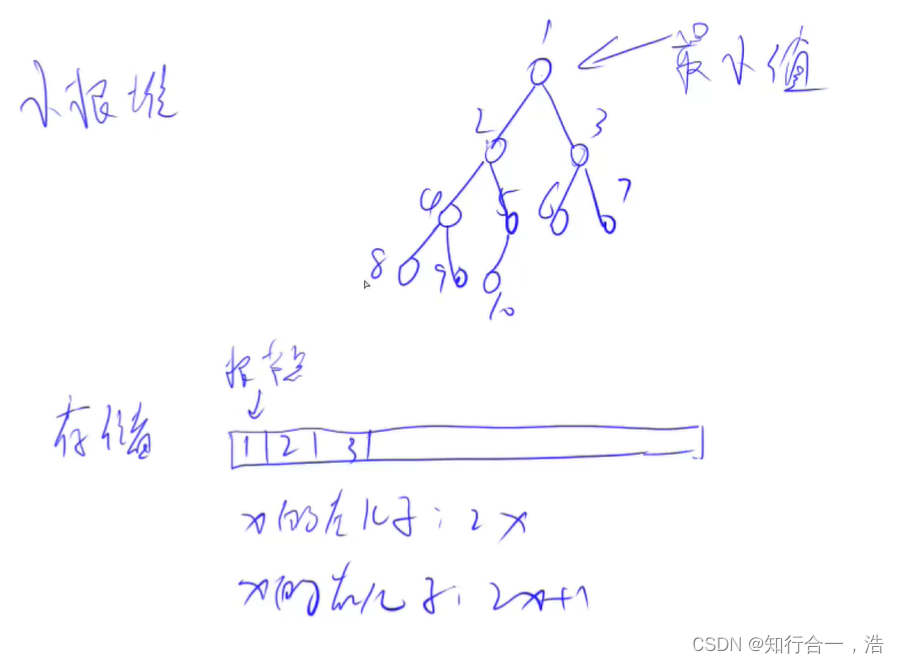
数组建堆

1. 堆排序 ✔ ✔

import java.util.Scanner; public class Main{ static int N = 100010; static int[] h = new int[N]; static int size; //交换函数 public static void swap(int x,int y){ int temp = h[x]; h[x] = h[y]; h[y] = temp; } //堆函数核心函数,堆排序函数,传入的参数u是下标 public static void down(int u){ int t = u; // t用来分身变量 //u的左分支下标小于size说明该数存在,然后如果这个数小于t,则让左下标赋值给t,即u的分身 if(u * 2 <= size && h[u * 2] < h[t]) t = u * 2; //u的右分支下标小于size说明该数存在,然后如果这个数小于t,因为可能上面的if语句会重置t,则判断是不是小于新或旧t, //如果小于t的话,就让右下标赋值给t ,即u的分身。 if(u * 2 + 1 <= size && h[u * 2 + 1] < h[t]) t = u * 2 + 1; //如果u不等于t,说明左或者右下标有比较小的值赋值给t了,分身变了 if(u != t){ //就让u跟t这两个数交换一下位置,让小的数替代u的位置 swap(u,t); //然后继续递归t下标小的位置 down(t); } } public static void main(String[] args){ Scanner scan = new Scanner(System.in); int n = scan.nextInt(); int m = scan.nextInt(); for(int i = 1 ; i <= n ; i ++ ) h[i] = scan.nextInt(); //首先将所有数先存入数组中 size = n;//长度为n //从n/2的位置开始将数组中的值插入堆中 //堆结构是一个完全二叉树,所有有分支的数等于没有分支的数,即最后一排的数量等于上面所有的数 //最下面一排没有分支的数不用参与插入,所以从n/2开始进行插入 for(int i = n/2 ; i >= 0; --i ) down(i);//就是让他进行向下排序处理 while(m -- > 0){ //输出前m小的m个元素 System.out.print(h[1] + " "); //每一次输出头节点 //因为是数组,删除第一个数复杂,删除最后一个元素比较简单 //所以就将最后一个元素将第一个元素覆盖掉,然后删除掉最后一个元素 h[1] = h[size--]; //然后进行堆排序,对第一个元素进行处理 down(1); } } }- 1
- 2
- 3
- 4
- 5
- 6
- 7
- 8
- 9
- 10
- 11
- 12
- 13
- 14
- 15
- 16
- 17
- 18
- 19
- 20
- 21
- 22
- 23
- 24
- 25
- 26
- 27
- 28
- 29
- 30
- 31
- 32
- 33
- 34
- 35
- 36
- 37
- 38
- 39
- 40
- 41
- 42
- 43
- 44
- 45
- 46
- 47
- 48
- 49
2. 模拟堆 ✔ ✔

import java.util.Scanner; public class Main{ static int N = 100010,size,m; static int[] h = new int[N]; static int[] hp = new int[N];//自身被映射数组 static int[] ph = new int[N];//映射数组 public static void swap(int[] a,int x,int y){ int temp = a[x]; a[x] = a[y]; a[y] = temp; } public static void head_swap(int x,int y){ //这里因为映射数组跟被映射数组是互相指向对方,如果有两个数更换位置,映射下标也要进行更换 //ph的下标指向是按顺序插入的下标,hp所对应的值是ph的按顺序的下标,用这两个属性进行交换 swap(ph,hp[x],hp[y]); //因为按照顺序插入ph到指向交换了,对应指向ph的hp也要进行交换 swap(hp,x,y); //最后两个值进行交换 swap(h,x,y); } public static void down(int x){ int t = x;//x的分身 //判断一下左下标是不是存在 //判断一下左下标的值是不是比我t的值小 。那么就将左下标的值赋予t;否则不变 if(x * 2 <= size && h[x * 2] < h[t]) t = x * 2; //判断一下右下标的值是不是比我t的值小。那么就将右下标的值赋予t,否则不变 if(x *2 + 1 <= size && h[x * 2 + 1] < h[t]) t = x * 2 + 1; if(t != x){//如果x不等于他的分身 head_swap(x,t);//那就进行交换顺序 down(t);//然后一直向下进行操作 } } public static void up(int x){ //向上操作,判断一下根节点还不是存在 //看一下根节点是不是比我左分支或者右分支的值大,大的话就进行交换 while(x / 2 > 0 && h[x / 2] > h[x]){ head_swap(x,x/2); x = x / 2;//相当于一直up } } public static void main(String[] args){ Scanner scan = new Scanner(System.in); int n = scan.nextInt(); size = 0;//size是原数组的下标 m = 0;//m是映射数组的下标 while(n -- > 0){ String s = scan.next(); if(s.equals("I")){//插入操作 int x= scan.nextInt(); size ++;m ++;//插入一个数两个数组的下标都加上1; ph[m] = size;hp[size] = m;//ph与hp数组是映射关系 h[size] = x;//将数插入到堆中最后位置 up(size);//然后up,往上面排序一遍 }else if(s.equals("PM")){ //输出当前集合中的最小值 System.out.println(h[1]); }else if(s.equals("DM")){//删除当前集合中的最小值 //因为需要用到映射数组与被映射数组,因为需要找到k的位置在哪里,需要让映射的顺序, //因为如果用size,size是会随时改变的,不是按顺序的,因为会被up或者down顺序会被修改 head_swap(1,size);//将最后一个数替换掉第一个最小值元素,然后数量减1,size-- size--; down(1);//插入之后进行向下操作,因为可能不符合小根堆 }else if(s.equals("D")){//删除当前集合中第k个插入得数 int k = scan.nextInt(); k = ph[k];//ph[k] 是一步一步插入映射的下标,不会乱序, head_swap(k,size);//然后将k与最后一个元素进行交换,然后长度减1,size-- size--; up(k);//进行排序一遍,为了省代码量,up一遍down一遍。因为只会执行其中一个 down(k); }else{ int k = scan.nextInt(); int x = scan.nextInt(); k = ph[k];//ph[k] 是一步一步插入映射的下标,顺序是按照插入时候的顺序 h[k] = x;//然后将第k为数修改为数x up(k);//up一遍,down一遍 down(k); } } } }- 1
- 2
- 3
- 4
- 5
- 6
- 7
- 8
- 9
- 10
- 11
- 12
- 13
- 14
- 15
- 16
- 17
- 18
- 19
- 20
- 21
- 22
- 23
- 24
- 25
- 26
- 27
- 28
- 29
- 30
- 31
- 32
- 33
- 34
- 35
- 36
- 37
- 38
- 39
- 40
- 41
- 42
- 43
- 44
- 45
- 46
- 47
- 48
- 49
- 50
- 51
- 52
- 53
- 54
- 55
- 56
- 57
- 58
- 59
- 60
- 61
- 62
- 63
- 64
- 65
- 66
- 67
- 68
- 69
- 70
- 71
- 72
- 73
- 74
- 75
- 76
- 77
- 78
- 79
- 80
11. 哈希表 ✔ ✔
模板
(1) 拉链法 int h[N], e[N], ne[N], idx; // 向哈希表中插入一个数 void insert(int x) { int k = (x % N + N) % N; e[idx] = x; ne[idx] = h[k]; h[k] = idx ++ ; } // 在哈希表中查询某个数是否存在 bool find(int x) { int k = (x % N + N) % N; for (int i = h[k]; i != -1; i = ne[i]) if (e[i] == x) return true; return false; } (2) 开放寻址法 int h[N]; // 如果x在哈希表中,返回x的下标;如果x不在哈希表中,返回x应该插入的位置 int find(int x) { int t = (x % N + N) % N; while (h[t] != null && h[t] != x) { t ++ ; if (t == N) t = 0; } return t; }- 1
- 2
- 3
- 4
- 5
- 6
- 7
- 8
- 9
- 10
- 11
- 12
- 13
- 14
- 15
- 16
- 17
- 18
- 19
- 20
- 21
- 22
- 23
- 24
- 25
- 26
- 27
- 28
- 29
- 30
- 31
- 32
- 33
- 34
- 35
- 36
- 37
例1. 模拟散列表 ✔ ✔
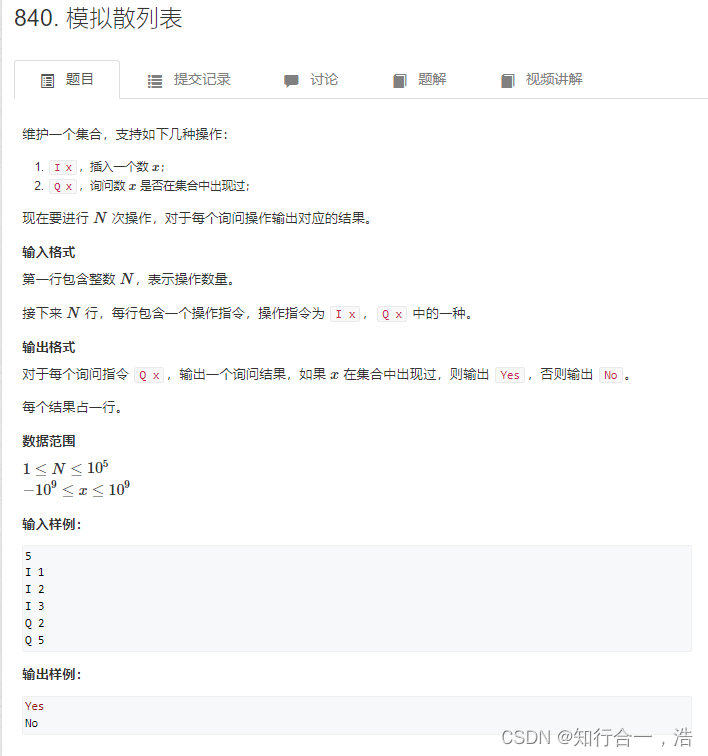
拉链法代码(链表)
- N取大于范围的第一个质数
- k = (x % N + N) % N; (%N 为了避免超级大的值 + N 为了避免出现负数 再%N为了正数+N超出范围)
- memset(h, -1, sizeof h);
import java.util.Scanner; public class Main{ static int N = 100003,idx; static int[] h = new int[N]; static int[] e = new int[N]; static int[] ne = new int[N]; public static void add(int x){ int k = (x % N + N) % N; e[idx] = x; ne[idx] = h[k]; h[k] = idx ++ ; } public static boolean find(int x){ int k = (x % N + N) % N; for(int i = h[k];i != -1;i = ne[i]){ if(e[i] == x){ return true; } } return false; } public static void main(String[] args){ Scanner scan = new Scanner(System.in); int n = scan.nextInt(); idx = 0; for(int i = 0 ; i < N ; i++ ){ h[i] = -1; } while(n -- > 0){ String x = scan.next(); if(x.equals("I")){ int a = scan.nextInt(); add(a); }else{ int b = scan.nextInt(); if(find(b)) System.out.println("Yes"); else System.out.println("No"); } } } }- 1
- 2
- 3
- 4
- 5
- 6
- 7
- 8
- 9
- 10
- 11
- 12
- 13
- 14
- 15
- 16
- 17
- 18
- 19
- 20
- 21
- 22
- 23
- 24
- 25
- 26
- 27
- 28
- 29
- 30
- 31
- 32
- 33
- 34
- 35
- 36
- 37
- 38
- 39
- 40
- 41
开放寻址法代码(有空位就存,空位用null=0x3f3f3f3f)
- 大于2倍的第一个质数
#include#include using namespace std; //开放寻址法一般开 数据范围的 2~3倍, 这样大概率就没有冲突了 const int N = 2e5 + 3; //大于数据范围的第一个质数 const int null = 0x3f3f3f3f; //规定空指针为 null 0x3f3f3f3f int h[N]; int find(int x) { int t = (x % N + N) % N; while (h[t] != null && h[t] != x) { t++; if (t == N) { t = 0; } } return t; //如果这个位置是空的, 则返回的是他应该存储的位置 } int n; int main() { cin >> n; memset(h, 0x3f, sizeof h); //规定空指针为 0x3f3f3f3f while (n--) { string op; int x; cin >> op >> x; if (op == "I") { h[find(x)] = x; } else { if (h[find(x)] == null) { puts("No"); } else { puts("Yes"); } } } return 0; } - 1
- 2
- 3
- 4
- 5
- 6
- 7
- 8
- 9
- 10
- 11
- 12
- 13
- 14
- 15
- 16
- 17
- 18
- 19
- 20
- 21
- 22
- 23
- 24
- 25
- 26
- 27
- 28
- 29
- 30
- 31
- 32
- 33
- 34
- 35
- 36
- 37
- 38
- 39
- 40
- 41
- 42
- 43
- 44
- 45
★例2. 字符串哈希 ✔ ✔
二刷思路
- 把一段字符串转成一段数字,便可以直接比较相等
- 怎么转?进制大于26
- 样例没找全 p[r-l+1] 这个点没找到
import java.util.Scanner ; public class Main{ //开的是long类型数组,本来是需要进行前缀hash求完之后需要进行模2的64次方来防止相同的冲突,可能超过我们给的数组大小 static int N = 100010,P = 131;//p是进制数,惊艳值 static long[] h = new long[N];//这是存放hash前缀值得数组 static long[] p = new long[N];//这是存放p的n次方的数组 public static long get(int l,int r){//这里是将运用了一点前缀和公式的方式进行计算 //求l-r区间的hash值,就要用h[r] - h[l-1],因为两者位数不用需要让h[l-1]向左边移到跟h[r]对齐 //就比如求1234的3-4区间位,1234 - 12,12左移然后就让12*10^(4-3+1)=12*10^2=1200,然后1234-1200 = 34,这样进行计算出来 //然后本题是p进制,所以需要将上面公式中的10换成p就行了 //h[0] = 0 //h[1] = h[i-1] * P + str[1] = 0*P+a = a //h[2] = a * P + b //h[3] = (a*P+b)*P+c = a*p[2]+b*P+c //h[4] = (a*p[2]+b*P+c)*P+d = a*p[3]+b*p[2]+c*P+d //比如abcd求3-4区间位,就是让h[d]-h[b],h[b]位数不用需要向左移对齐h[d], //h[2]*P^(4-3+1)=(a*P+b)*P^2 = a*P^3+b*P^2 //然后就让h[d] - h[b]求出34区间值,(a*p[3]+b*p[2]+c*P+d) - (a*P^3+b*P^2) = c*P+d return h[r] - h[l-1]*p[r-l+1]; } public static void main(String[] args){ Scanner scan = new Scanner(System.in); int n = scan.nextInt(); int m = scan.nextInt(); String s = scan.next(); p[0] = 1;//这个是p的0次方的值,需要单独写出来,非常重要 for(int i = 1 ; i <= n ; i++ ){ p[i] = p[i-1] * P;//这里对应每一个下标对应对应P的多少次方 h[i] = h[i-1] * P + s.charAt(i-1);//这里是公式,预处理前缀哈希的值,因为是P进制,所以中间乘的是P } while(m -- > 0){ int l1 = scan.nextInt(); int r1 = scan.nextInt(); int l2 = scan.nextInt(); int r2 = scan.nextInt(); //判断两个区间是不是相同,用get的方法返回值一样说明区间的hash值是一样的 if(get(l1,r1) == get(l2,r2)) System.out.println("Yes"); else System.out.println("No"); } } }- 1
- 2
- 3
- 4
- 5
- 6
- 7
- 8
- 9
- 10
- 11
- 12
- 13
- 14
- 15
- 16
- 17
- 18
- 19
- 20
- 21
- 22
- 23
- 24
- 25
- 26
- 27
- 28
- 29
- 30
- 31
- 32
- 33
- 34
- 35
- 36
- 37
- 38
- 39
- 40
- 41
- 42
-
相关阅读:
MAUI Blazor (Windows) App 动态设置窗口标题
如何用小程序端进行测试?
Fedora 39 正式发布
Netty入门案例 与 Netty异步模型
代码 Revert 后再次 Merge 会丢失的问题,已解决
线程的可见性
数据结构绪论、顺序表课后练习题
Linux安装Redis数据库,无需公网IP实现远程连接
free -m 命令详解
编程架构演化史:远古时代,从打孔卡(Punched Card)开始
- 原文地址:https://blog.csdn.net/m0_63571404/article/details/132801587

