-
matlab和python做zscore结果不一样的问题
解决matlab和python做zscore标准化结果不一样的问题
总结:
matlab和python做zscore时使用的求std公式的默认方法有差异,导致了结果差异。
想要结果相同则使用以下代码:td = rand(50,15,39)%td是三维矩阵,求zscore结果 #Python代码: tdzInPy = (td - np.mean(td, axis=1, keepdims=True)) / np.std(td,ddof=1, axis=1, keepdims=True) #%对td第二维进行zscore,使用population standard deviation。 #Maltab代码: tdzInMatlab = zscore(td,0,2);%对td第二维进行zscore,使用population standard deviation。 或 tdzInMatlab = zscore(td,[],2);%对td第二维进行zscore,使用population standard deviation。- 1
- 2
- 3
- 4
- 5
- 6
- 7
- 8
- 9
代码中,变量tdzInPy 与tdzInMatlab 的计算结果是完全一致的。都是使用的总体标准差:population standard deviation。
举一反三,若要使用样本标准差sample standard deviation:则:
td = rand(50,15,39,100) #Python代码: tdzInPy = (td - np.mean(td, axis=1, keepdims=True)) / np.std(td,ddof=0, axis=1, keepdims=True) #%对td第二维进行zscore,使用population standard deviation。 #Maltab代码: tdzInMatlab = zscore(td,1,2);%对td第二维进行zscore,使用population standard deviation。- 1
- 2
- 3
- 4
- 5
- 6
- 7
总之: python中,ddof =0代表求总体标准差(Population Standard Deviation)【不指定时默认此方法】,ddof =1代表求样本标准差(Sample Standard Deviation)。而matlab中,flag =0代表求样本标准差【不指定时默认此方法】,flag =1代表总体标准差。
matlab和python做zscore使用的默认方法有差异,导致了结果差异。原理:
matlab官方文档中给出了样本标准差总体标准差2者的计算公式:
Z = zscore(X, flag, dim) scales X using the standard deviation indicated by flag.
If flag is 0 (default默认是0), then zscore scales X using the sample standard deviation, with n - 1 in the denominator of the standard deviation formula. zscore(X,0) is the same as zscore(X).
If flag is 1, then zscore scales X using the population standard deviation, with n in the denominator of standard deviation formula.
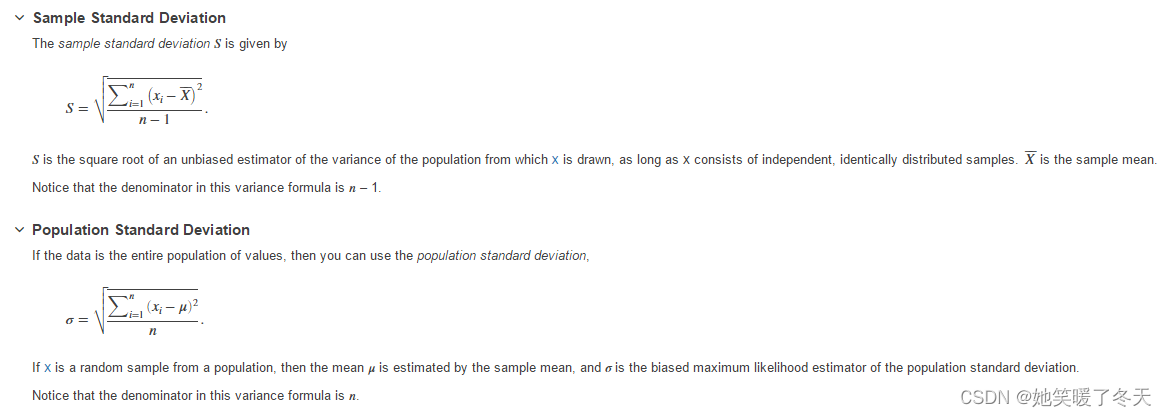
上图是求样本标准差总体标准差的公式,样本标准差和总体标准差的差异就在分母上,差别其实不大。python中:
在Python中,你可以使用NumPy库来计算样本标准差和总体标准差。下面是如何计算它们的示例:
首先,导入NumPy库:
import numpy as np- 1
然后,假设你有一个数据集data,可以使用以下方法计算样本标准差和总体标准差:
计算样本标准差(Sample Standard Deviation):
sample_std_deviation = np.std(data, ddof=1)- 1
其中,ddof参数用于指定自由度(degrees of freedom),通常设置为1以计算样本标准差。如果你的数据集代表整个总体而不是样本,你可以将ddof设置为0。
计算总体标准差(Population Standard Deviation):
population_std_deviation = np.std(data, ddof=0)- 1
这两个函数将返回相应的标准差值。请根据你的数据集和需求使用适当的函数来计算标准差。
官方解释:
numpy.std(a, axis=None, dtype=None, out=None, ddof=0, keepdims=, *, where=)[source]
The average squared deviation is typically calculated as x.sum() / N, where N = len(x). If, however, ddof is specified, the divisor N - ddof is used instead. In standard statistical practice, ddof=1 provides an unbiased estimator of the variance of the infinite population. ddof=0 provides a maximum likelihood estimate of the variance for normally distributed variables. The standard deviation computed in this function is the square root of the estimated variance, so even with ddof=1, it will not be an unbiased estimate of the standard deviation per se.总之
总之就是,python中,ddof =0代表求总体标准差(Population Standard Deviation)【不指定时默认此方法】,ddof =1代表求样本标准差(Sample Standard Deviation)。而matlab中,flag =0代表求样本标准差【不指定时默认此方法】,flag =1代表总体标准差。
#标准化
#归一化
#zscore
#maltab
#python -
相关阅读:
(四)Windows网络模型之完成端口模型详解
【MySQL】复合查询
科普达人丨一文看懂阿里云的秘密武器“神龙架构”
计算机网络,网络(OSI)七层模型,三次握手四次挥手,get与post请求区别,网络IO(BIO\NIO\AIO),TCP与UDP区别
ATFX:美股持续走高,空头趋势或将终结?
【手把手教学webpack5】前端为什么需要webpack
【Linux】信号量
编译 --> 链接
一文教会你如何用 Python 分割合并大文件
207. 课程表
- 原文地址:https://blog.csdn.net/qq_38330266/article/details/132739931