-
遥感图像应用:在低分辨率图像上实现洪水损害检测(迁移学习)
本文是上一篇关于“在低分辨率图像上实现洪水损害检测”的博客的延申。
代码来源:https://github.com/weining20000/Flooding-Damage-Detection-from-Post-Hurricane-Satellite-Imagery-Based-on-CNN/tree/master
数据储存地址:https://github.com/JeffereyWu/FloodDamageDetection/tree/main
目标:利用迁移学习训练两个预训练的CNN模型(VGG和Resnet),自动化识别一个区域是否存在洪水损害。
运行环境:Google Colab
1. 导入库
# Pytoch import torch from torchvision import datasets, models from torch.utils.data import Dataset, DataLoader import torchvision.transforms as transforms import torch.nn as nn from torch_lr_finder import LRFinder # Data science tools import numpy as np import pandas as pd import os from sklearn.metrics import accuracy_score from sklearn.metrics import confusion_matrix from PIL import Image # Visualizations import matplotlib.pyplot as plt import seaborn as sns- 1
- 2
- 3
- 4
- 5
- 6
- 7
- 8
- 9
- 10
- 11
- 12
- 13
- 14
- 15
- 16
- 17
- 18
- 19
- 20
2. 迁移学习知识点
- 对于卷积神经网络(CNN)等模型,通常包括一些卷积层和池化层,这些层的权重用于提取图像的特征。当这些层的参数被冻结时,这些权重将保持不变,不会在训练过程中进行更新。这意味着模型会继续使用预训练模型的特征提取能力。
- 如果模型还包含其他的预训练层,例如预训练的全连接层,这些层的权重也将被冻结,不会更新。
- 通常,当使用预训练模型进行微调时,会替换模型的最后一层或几层,以适应新的任务。新添加的自定义分类器层的权重将被训练和更新,以适应特定的分类任务。
3. 加载和配置预训练的深度学习模型
#Load pre-trained model def get_pretrained_model(model_name): """ 获取预训练模型的函数。 参数: model_name: 要加载的预训练模型的名称(例如,'vgg16' 或 'resnet50') 返回: MODEL: 加载并配置好的预训练模型 """ if model_name == 'vgg16': model = models.vgg16(pretrained=True) # 将模型的参数(权重)冻结,不进行微调。这意味着这些参数在训练过程中不会更新 for param in model.parameters(): param.requires_grad = False n_inputs = model.classifier[6].in_features # 获取模型分类器最后一层的输入特征数 n_classes = 2 # 替换模型的分类器部分,添加自定义的分类器 model.classifier[6] = nn.Sequential( nn.Linear(n_inputs, 256), nn.ReLU(), nn.Dropout(0.2), nn.Linear(256, n_classes)) elif model_name == 'resnet50': model = models.resnet50(pretrained=True) for param in model.parameters(): param.requires_grad = False # 获取模型最后一层全连接层的输入特征数 n_inputs = model.fc.in_features n_classes = 2 model.fc = nn.Sequential( nn.Linear(n_inputs, 256), nn.ReLU(), nn.Dropout(0.2), nn.Linear(256, n_classes)) # Move to GPU MODEL = model.to(device) return MODEL # 返回加载和配置好的预训练模型- 1
- 2
- 3
- 4
- 5
- 6
- 7
- 8
- 9
- 10
- 11
- 12
- 13
- 14
- 15
- 16
- 17
- 18
- 19
- 20
- 21
- 22
- 23
- 24
- 25
- 26
- 27
- 28
- 29
- 30
- 31
- 32
- 33
- 34
- 35
- 36
- 37
- 38
- 39
- 40
- 41
- 42
- 43
注意,这里vgg16的classifier结构原本为:
Sequential(
(0): Linear(in_features=25088, out_features=4096, bias=True)
(1): ReLU(inplace=True)
(2): Dropout(p=0.5, inplace=False)
(3): Linear(in_features=4096, out_features=4096, bias=True)
(4): ReLU(inplace=True)
(5): Dropout(p=0.5, inplace=False)
(6): Linear(in_features=4096, out_features=1000, bias=True)
)
以上代码替换了最后一层的classifier,改为:
Sequential(
(0): Linear(in_features=25088, out_features=4096, bias=True)
(1): ReLU(inplace=True)
(2): Dropout(p=0.5, inplace=False)
(3): Linear(in_features=4096, out_features=4096, bias=True)
(4): ReLU(inplace=True)
(5): Dropout(p=0.5, inplace=False)
(6): Sequential(
(0): Linear(in_features=4096, out_features=256, bias=True)
(1): ReLU()
(2): Dropout(p=0.2, inplace=False)
(3): Linear(in_features=256, out_features=2, bias=True)
)
)注意,这里resnet50的fc结构原本为:
Linear(in_features=2048, out_features=1000, bias=True)
以上代码替换了最后一层fc,改为:
Sequential(
(0): Linear(in_features=2048, out_features=256, bias=True)
(1): ReLU()
(2): Dropout(p=0.2, inplace=False)
(3): Linear(in_features=256, out_features=2, bias=True)
)4. 建立模型
# VGG 16 model_vgg = get_pretrained_model('vgg16') # 包含加载和配置好的 VGG16 模型 criterion_vgg = nn.CrossEntropyLoss() optimizer_vgg = torch.optim.Adam(model_vgg.parameters(), lr=0.00002) # ResNet 50 model_resnet50 = get_pretrained_model('resnet50') # 包含加载和配置好的 ResNet50 模型 criterion_resnet50 = nn.CrossEntropyLoss() optimizer_resnet50 = torch.optim.Adam(model_resnet50.parameters(), lr=0.001)- 1
- 2
- 3
- 4
- 5
- 6
- 7
- 8
- 9
5. 定义计算准确率的函数
def acc_vgg(x, y, return_labels=False): with torch.no_grad(): # 禁止梯度计算,因为在准确率计算中不需要梯度信息 logits = model_vgg(x) pred_labels = np.argmax(logits.cpu().numpy(), axis=1) if return_labels: return pred_labels else: return 100*accuracy_score(y.cpu().numpy(), pred_labels) def acc_resnet50(x, y, return_labels=False): with torch.no_grad(): logits = model_resnet50(x) pred_labels = np.argmax(logits.cpu().numpy(), axis=1) if return_labels: return pred_labels else: return 100*accuracy_score(y.cpu().numpy(), pred_labels)- 1
- 2
- 3
- 4
- 5
- 6
- 7
- 8
- 9
- 10
- 11
- 12
- 13
- 14
- 15
- 16
- 17
- 18
- 19
6. 定义一个用于训练深度学习模型的函数
def train(model, criterion, optimizer, acc, xtrain, ytrain, xval, yval, save_file_name, n_epochs, BATCH_SIZE): """ 训练深度学习模型的函数。 参数: model: 要训练的深度学习模型 criterion: 损失函数 optimizer: 优化器 acc: 准确率计算函数 xtrain: 训练数据 ytrain: 训练标签 xval: 验证数据 yval: 验证标签 save_file_name: 保存训练后模型权重的文件名 n_epochs: 训练的总轮数(epochs) BATCH_SIZE: 每个批次的样本数量 返回: 训练完成的模型和训练历史记录 """ history1 = [] # Number of epochs already trained (if using loaded in model weights) try: print(f'Model has been trained for: {model.epochs} epochs.\n') except: model.epochs = 0 print(f'Starting Training from Scratch.\n') # Main loop for epoch in range(n_epochs): # keep track of training and validation loss each epoch train_loss = 0.0 val_loss = 0.0 train_acc = 0 val_acc = 0 # Set to training model.train() #Training loop for batch in range(len(xtrain)//BATCH_SIZE): idx = slice(batch * BATCH_SIZE, (batch+1)*BATCH_SIZE) # Clear gradients optimizer.zero_grad() # Predicted outputs output = model(xtrain[idx]) # Loss and BP of gradients loss = criterion(output, ytrain[idx]) loss.backward() # Update the parameters optimizer.step() # Track train loss train_loss += loss.item() train_acc = acc(xtrain, ytrain) # After training loops ends, start validation # set to evaluation mode model.eval() # Don't need to keep track of gradients with torch.no_grad(): # Evaluation loop # F.P. y_val_pred = model(xval) # Validation loss loss = criterion(y_val_pred, yval) val_loss = loss.item() val_acc = acc(xval, yval) history1.append([train_loss / BATCH_SIZE, val_loss, train_acc, val_acc]) torch.save(model.state_dict(), save_file_name) # 保存模型权重 torch.cuda.empty_cache() # Print training and validation results print("Epoch {} | Train Loss: {:.5f} | Train Acc: {:.2f} | Valid Loss: {:.5f} | Valid Acc: {:.2f} |".format( epoch, train_loss / BATCH_SIZE, acc(xtrain, ytrain), val_loss, acc(xval, yval))) # Format history history = pd.DataFrame(history1, columns=['train_loss', 'val_loss', 'train_acc', 'val_acc']) return model, history- 1
- 2
- 3
- 4
- 5
- 6
- 7
- 8
- 9
- 10
- 11
- 12
- 13
- 14
- 15
- 16
- 17
- 18
- 19
- 20
- 21
- 22
- 23
- 24
- 25
- 26
- 27
- 28
- 29
- 30
- 31
- 32
- 33
- 34
- 35
- 36
- 37
- 38
- 39
- 40
- 41
- 42
- 43
- 44
- 45
- 46
- 47
- 48
- 49
- 50
- 51
- 52
- 53
- 54
- 55
- 56
- 57
- 58
- 59
- 60
- 61
- 62
- 63
- 64
- 65
- 66
- 67
- 68
- 69
- 70
- 71
- 72
- 73
- 74
- 75
- 76
- 77
- 78
- 79
- 80
- 81
- 82
- 83
7. 开始训练
N_EPOCHS = 30 model_vgg, history_vgg = train(model_vgg, criterion_vgg, optimizer_vgg, acc_vgg, x_train, y_train, x_val, y_val, save_file_name = 'model_vgg.pt', n_epochs = N_EPOCHS, BATCH_SIZE = 3) model_resnet50, history_resnet50 = train(model_resnet50, criterion_resnet50, optimizer_resnet50, acc_resnet50, x_train, y_train, x_val, y_val, save_file_name = 'model_resnet50.pt', n_epochs = N_EPOCHS, BATCH_SIZE = 4)- 1
- 2
- 3
- 4
- 5
- 6
- 7
- 8
- 9
- 10
- 11
- 12
- 13
- 14
- 15
- 16
- 17
- 18
- 19
- 20
- 21
- 22
- 23
- 24
- 25
8. 绘画VGG训练和验证准确率的曲线图
plt.figure() # 创建一个新的绘图窗口 vgg_train_acc = history_vgg['train_acc'] vgg_val_acc = history_vgg['val_acc'] vgg_epoch = range(0, len(vgg_train_acc), 1) # 创建一个包含训练轮次(epochs)的范围对象 plot1, = plt.plot(vgg_epoch, vgg_train_acc, linestyle = "solid", color = "skyblue") plot2, = plt.plot(vgg_epoch, vgg_val_acc, linestyle = "dashed", color = "orange") plt.legend([plot1, plot2], ['training acc', 'validation acc']) # 添加图例,以标识图中的两条曲线 plt.xlabel('Epoch') plt.ylabel('Average Accuracy per Batch') plt.title('Model VGG-16: Training and Validation Accuracy', pad = 20) plt.savefig('VGG16-Acc-Plot.png')- 1
- 2
- 3
- 4
- 5
- 6
- 7
- 8
- 9
- 10
- 11

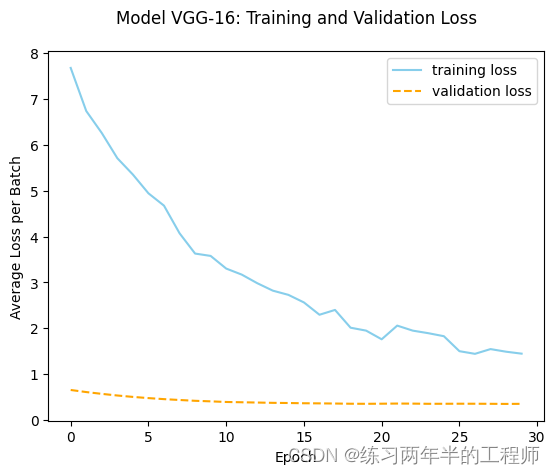
9. 绘画VGG训练和验证损失的曲线图
plt.figure() vgg_train_loss = history_vgg['train_loss'] vgg_val_loss = history_vgg['val_loss'] vgg_epoch = range(0, len(vgg_train_loss), 1) plot3, = plt.plot(vgg_epoch, vgg_train_loss, linestyle = "solid", color = "skyblue") plot4, = plt.plot(vgg_epoch, vgg_val_loss, linestyle = "dashed", color = "orange") plt.legend([plot3, plot4], ['training loss', 'validation loss']) plt.xlabel('Epoch') plt.ylabel('Average Loss per Batch') plt.title('Model VGG-16: Training and Validation Loss', pad = 20) plt.savefig('VGG16-Loss-Plot.png')- 1
- 2
- 3
- 4
- 5
- 6
- 7
- 8
- 9
- 10
- 11
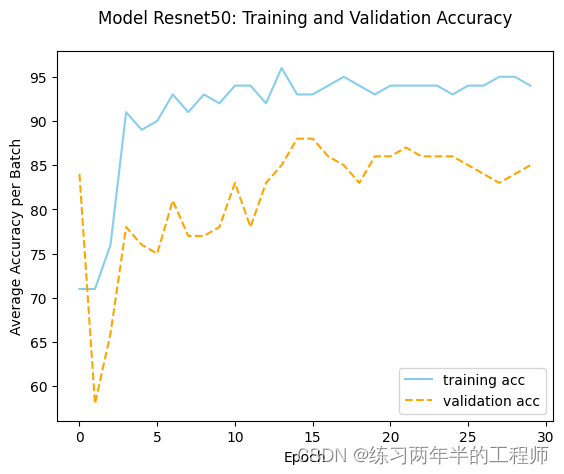
10. 绘画Resnet训练和验证准确率的曲线图
# Training Reseults: Resnet50 plt.figure() resnet50_train_acc = history_resnet50['train_acc'] resnet50_val_acc = history_resnet50['val_acc'] resnet50_epoch = range(0, len(resnet50_train_acc), 1) plot5, = plt.plot(resnet50_epoch, resnet50_train_acc, linestyle = "solid", color = "skyblue") plot6, = plt.plot(resnet50_epoch, resnet50_val_acc, linestyle = "dashed", color = "orange") plt.legend([plot5, plot6], ['training acc', 'validation acc']) plt.xlabel('Epoch') plt.ylabel('Average Accuracy per Batch') plt.title('Model Resnet50: Training and Validation Accuracy', pad = 20) plt.savefig('Resnet50-Acc-Plot.png')- 1
- 2
- 3
- 4
- 5
- 6
- 7
- 8
- 9
- 10
- 11
- 12
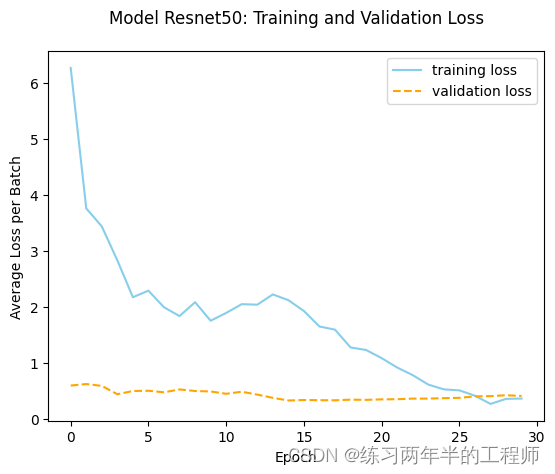
11. 绘画Resnet训练和验证损失的曲线图
plt.figure() resnet50_train_loss = history_resnet50['train_loss'] resnet50_val_loss = history_resnet50['val_loss'] resnet50_epoch = range(0, len(resnet50_train_loss), 1) plot7, = plt.plot(resnet50_epoch, resnet50_train_loss, linestyle = "solid", color = "skyblue") plot8, = plt.plot(resnet50_epoch, resnet50_val_loss, linestyle = "dashed", color = "orange") plt.legend([plot7, plot8], ['training loss', 'validation loss']) plt.xlabel('Epoch') plt.ylabel('Average Loss per Batch') plt.title('Model Resnet50: Training and Validation Loss', pad = 20) plt.savefig('Resnet50-Loss-Plot.png')- 1
- 2
- 3
- 4
- 5
- 6
- 7
- 8
- 9
- 10
- 11
12. 绘画验证损失的比较图
plt.figure() df_valid_loss = pd.DataFrame({'Epoch': range(0, N_EPOCHS, 1), 'valid_loss_vgg': history_vgg['val_loss'], 'valid_loss_resnet50':history_resnet50['val_loss'] }) plota, = plt.plot('Epoch', 'valid_loss_vgg', data=df_valid_loss, linestyle = '--', color = 'skyblue') plotb, = plt.plot('Epoch', 'valid_loss_resnet50', data=df_valid_loss, color = 'orange') plt.xlabel('Epoch') plt.ylabel('Average Validation Loss per Batch') plt.title('Validation Loss Comparison', pad = 20) plt.legend([plota, plotb], ['VGG16', 'Resnet50']) plt.savefig('Result_Comparison.png')- 1
- 2
- 3
- 4
- 5
- 6
- 7
- 8
- 9
- 10
- 11
- 12

13. 定义并执行预测函数
def predict(mymodel, model_name_pt, loader): model = mymodel model.load_state_dict(torch.load(model_name_pt)) model.to(device) model.eval() y_actual_np = [] y_pred_np = [] for idx, data in enumerate(loader): test_x, test_label = data[0], data[1] test_x = test_x.to(device) y_actual_np.extend(test_label.cpu().numpy().tolist()) with torch.no_grad(): y_pred_logits = model(test_x) pred_labels = np.argmax(y_pred_logits.cpu().numpy(), axis=1) print("Predicting ---->", pred_labels) y_pred_np.extend(pred_labels.tolist()) return y_actual_np, y_pred_np y_actual_vgg, y_predict_vgg = predict(model_vgg, "model_vgg.pt", test_loader) y_actual_resnet50, y_predict_resnet50 = predict(model_resnet50, "model_resnet50.pt", test_loader)- 1
- 2
- 3
- 4
- 5
- 6
- 7
- 8
- 9
- 10
- 11
- 12
- 13
- 14
- 15
- 16
- 17
- 18
- 19
- 20
- 21
- 22
- 23
14. 计算VGG的准确性和混淆矩阵
# VGG-16 Accuracy print("=====================================================") acc_rate_vgg = 100*accuracy_score(y_actual_vgg, y_predict_vgg) print("The Accuracy rate for the VGG-16 model is: ", acc_rate_vgg) # Confusion matrix for model-VGG-16 print("The Confusion Matrix for VGG-16 is as below:") print(confusion_matrix(y_actual_vgg, y_predict_vgg))- 1
- 2
- 3
- 4
- 5
- 6
- 7
输出为:
The Accuracy rate for the VGG-16 model is: 88.16666666666667
The Confusion Matrix for VGG-16 is as below:
[[7106 894]
[ 171 829]]15. 计算Resnet的准确性和混淆矩阵
print("=====================================================") acc_rate_resnet50 = 100*accuracy_score(y_actual_resnet50, y_predict_resnet50) print("The Accuracy rate for the Resnet50 model is: ", acc_rate_resnet50) # Confusion matrix for model Resnet50 print("The Confusion Matrix for Resnet50 is as below:") print(confusion_matrix(y_actual_resnet50, y_predict_resnet50))- 1
- 2
- 3
- 4
- 5
- 6
输出为:
The Accuracy rate for the Resnet50 model is: 85.35555555555555
The Confusion Matrix for Resnet50 is as below:
[[6843 1157]
[ 161 839]] -
相关阅读:
【文件编码转换】将GBK编码项目转为UTF-8编码项目
Python可变参数*args和**kwargs
mp4视频太大怎么压缩?几种常见压缩方法
嘉立创EDA专业版--指定位置加客编
Docker安全及日志管理
Windows工业三防平板全功能NFC近距离感应一维/二维扫描
Duchefa丨MS培养基含维生素说明书
【开发篇】三、web下单元测试与mock数据
1053 Path of Equal Weight
MySQL—MySQL的存储引擎之InnoDB
- 原文地址:https://blog.csdn.net/weixin_57266891/article/details/132714761
