-
16字节协议的串口通信
1.协议要求
协议为帧传输,一共16字节。主要是2字节的固定帧头 EB 90,2字节的帧计数(用来计数发出的帧),10字节的数据和2字节的校验位

帧头:2字节,固定值 8’HEB、8’H90
帧计数:2字节,用来说明发出去帧是第几帧
数据:10字节,用于发送数据
校验位:2字节,和校验,将数据位累计后取反
2.架构设计
2.1整体架构设计
本架构基于黑金开发版Ax7101,开发工具vivado2022.3,整个协议的架构图设计如下:
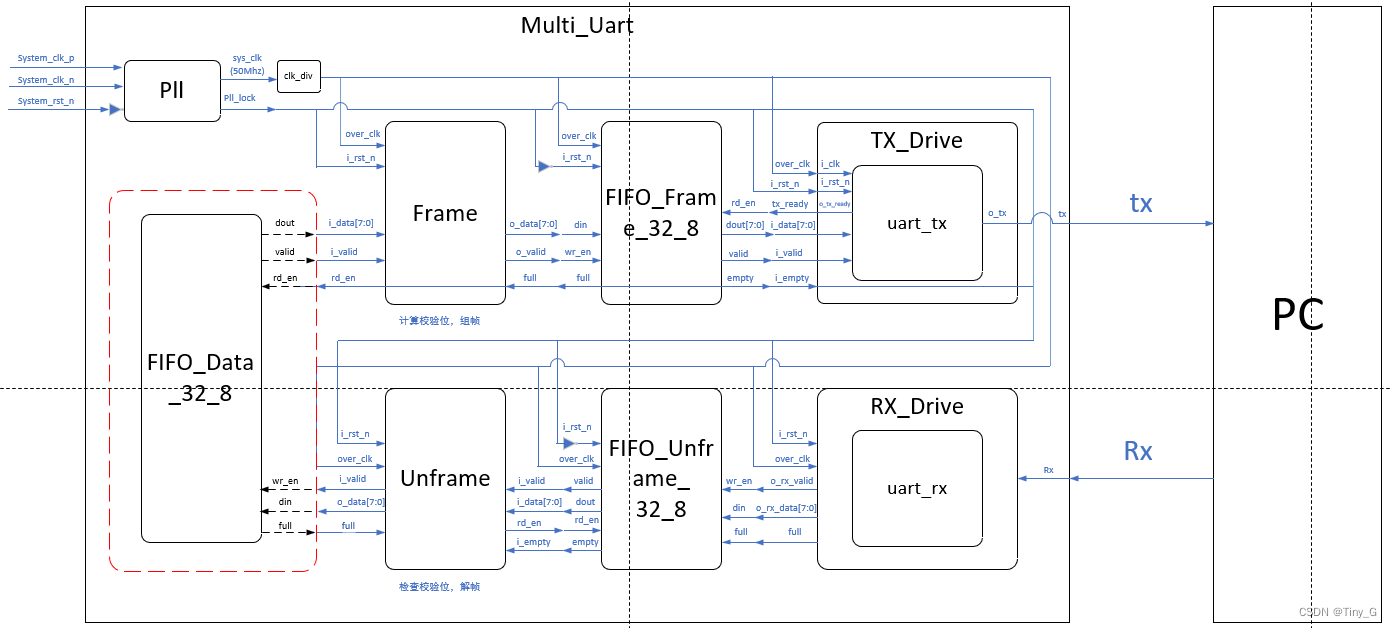
整个架构的功能是实现帧的接收和帧的发送,该架构可以分成两个部分:解帧使用和组帧发送的两个部分。
数据流向解析:
-
组帧发送部分
晶振时钟(200Mhz)和板上复位信号先流入锁相环PLL,得到的是50Mhz的时钟(因为200Mzh时钟经PLL分频不能一次性分频到波特率时钟如9600,因此需要再次分频)。
50Mhz的时钟先流入分频模块clk_div将分频得到波特率率时钟的16倍时钟(如9600*16,这里之所以不用波特率时钟,是因为要在单字节接收模块uart_rx用过采样,为了节省资源所有的时钟都用这个波特时钟的16时钟,本文称之为over_clk)
经过分频后的over_clk 流入所有模块作为输入时钟,同时pll_lock信号作为复位信号sys_rst_n.(这里用plll_lock作为复位信号是因为,在pll_lock为低电平的时候,输出时钟是不稳定的,是有毛刺的。而当时pll_lock输入为高电平的时候才是输出的稳定时钟over_clk)
接着来到了主要功能实现模块,首先是用户会给你一个数据,让你把这个数据发出去,这里假设给你一帧数据(10字节),如果10字节每个字节是一样的,如都是8’H01。那么就是用uart_tx发送10次单字节模块就好了。然后,用户为了保证传输安全,他给你规定了一个协议(2byte帧头+2byte帧计数+10byte数据+2byte校验)。因此,你拿到数据,首先应该做的是先封装成一帧,然后再去想怎么将这一帧发出去的问题。
这就有了组帧模块Frame,通过Frame模块将用户输入的10字节数据封装成一帧,为了隔离组帧模块和单字节发送模块Tx_Drive,所以在这两个模块之间加了异步FIFO(FIFO_Frame),同时也是为了平衡组帧和发送这一帧的速率。因为组帧模块组帧完成后,输入的FIFO_Frame的是连续的16个字节,而发送模块是一字节一字节的发送的,两模块之间的速度存在差异。
而组帧模块Frame所做的就是将组帧好的16字节数据送入FIFO_Frame,然后继续组帧,继续送入…就这样一直工作。而Tx_Drive模块的功能是先从FIFO_Frame取出1字节,然后将1字节的数据通过串口tx发送出去。然后再到FIFO_Frame里面去取,再发…就这样就这实现了整个组帧发送部分。
-
解帧使用部分
首先输入端口是由tx发出的二进制数据流,所以先需要Rx_Drive模块将这个数据转换成16字节的8位数据,而在收到16字节之后,这16字节中只有10字节的数据,而用户需要只是这10字节的数据,而不是带帧格式的整个帧,所以需要解帧模块Unframe模块将16字节的模块中10字节数据提取出来。而中间的流动过程跟组帧模块相反,但思想几乎一模一样,唯一区别就是解帧模块Unframe要在Rx_Drive一字节一字节存入的FIFO_Unframe中一次性取出16字节,然后从这16字节中把数据取出来。
2.1.1组帧发送
主要构成:Frame(组帧模块)+FIFO_Frame(同步FIFO)+Tx_Drive(串口发送模块)
**主要功能:**将用户给的数据,先组帧,然后通过单字节串口将数据一字节一字节的方式发出去。
2.1.2解帧使用
主要构成:Unframe(解帧模块)+FIFO_Unframe(同步FIFO)+Rx_Drive(串口发送模块)
主要功能:将收到数据流解析成16字节,然后解帧模块再将其中的数据取出来,供用户使用。
2.2 定时发送架构设计
定时发送模块是属于上面整体架构的组帧发送部分,因为组帧发送需要出入10字节的数据,才能将数据组帧,然后发送出去,所以需要一个定时产生数据的模块。

3.模块代码分析
本章叙述流程,将会先从从定时发送发送多字节模块(即多了定时发送的组帧发送模块)展开叙述每个模块的具体细节和实现思路,然后将再将定时发送tx端产生的数据流,流入解帧接收部分,从而一点点随着数据的流动,逐渐由表及里,剖析代码。
3.1 定时模块 Timeout_Send
定时发送模块Timeout_Send为顶层模块,该模块是下面两个功能的封装:
(1)定时
(2)产生一帧要发送的数据(10字节)
参数控制:
- P_SYS_CLK :输入时钟,默认是9600*16
- P_SEND_BYTE_LENGTH:发送一帧长度,自动计算需要产生多少字节数据
- P_TIMEOUT_PRIOD:发送间隔,默认5ms发送一帧
框图:

参考代码:`timescale 1ns / 1ps // 定时发送模块,到时间后输出高电平 module Timeout_Send #( parameter P_SYS_CLK = 153_600 , parameter P_SEND_BYTE_LENGTH = 16 , parameter P_TIMEOUT_PRIOD = 500 //定时发送1帧数据,单位毫秒,默认5ms ) ( input i_clk , //时钟为50Mhz input i_rst_n , //工作使能信号 input i_full , output [7:0] o_data , //输出的数据 output o_valid //输出数据的有效信号 ); wire work_en; Set_Timeout #( .P_SYS_CLK (P_SYS_CLK ) , .P_TIMEOUT_PRIOD(P_TIMEOUT_PRIOD) //定时发送1帧数据,单位毫秒,默认50ms ) Set_Timeout_U0 ( .i_clk (i_clk ) , //时钟为50Mhz .i_rst_n (i_rst_n ) , .o_timeout (work_en ) //时间到了就拉高一个周期 ); Product_Data #( .P_SEND_BYTE_LENGTH (P_SEND_BYTE_LENGTH) ) Product_Data_U0 ( .i_clk (i_clk ) , .i_rst_n (i_rst_n ) , .i_work_en (work_en ) , .i_full (i_full ) , .o_data (o_data ) , .o_valid (o_valid ) ); endmodule- 1
- 2
- 3
- 4
- 5
- 6
- 7
- 8
- 9
- 10
- 11
- 12
- 13
- 14
- 15
- 16
- 17
- 18
- 19
- 20
- 21
- 22
- 23
- 24
- 25
- 26
- 27
- 28
- 29
- 30
- 31
- 32
- 33
- 34
- 35
- 36
- 37
- 38
- 39
- 40
- 41
- 42
- 43
- 44
- 45
- 46
- 47
- 48
3.1.1 定时模块Set_Timeout
主要功能:设置的定时时间到了,就拉高一个工作使能信号o_timeout,默认5ms拉高信号。
参数控制:
- P_SYS_CLK:输入时钟,默认分频时钟的16倍,每个周期是10^6/(9600*16)=6.51us
- P_TIMEOUT_PRIOD:发送间隔,定时发送1帧数据,单位毫秒,默认5ms
参考代码:`timescale 1ns / 1ns module Set_Timeout #( parameter P_SYS_CLK = 153_600, //分频时钟的16倍,每个周期是10^6/(9600*16)=6.51us parameter P_TIMEOUT_PRIOD = 500 //定时发送1帧数据,单位毫秒,默认5ms ) ( input i_clk , //时钟为50Mhz input i_rst_n , output o_timeout //时间到了就拉高一个周期 ); /***************parameter*************/ localparam P_CNT_MAX = P_TIMEOUT_PRIOD*P_SYS_CLK/1000_000; reg ro_timeout ; reg [31:0] r_cnt ; assign o_timeout = ro_timeout ; /***************always****************/ always @(posedge i_clk, negedge i_rst_n) begin if(~i_rst_n) r_cnt <= 32'd0; else if(r_cnt == P_CNT_MAX - 1) r_cnt <= 32'd0; else r_cnt <= r_cnt + 1; end always @(posedge i_clk, negedge i_rst_n) begin if(~i_rst_n) ro_timeout <= 1'b0; else if(r_cnt == P_CNT_MAX - 1) ro_timeout <= ro_timeout + 1; else ro_timeout <= ro_timeout; end endmodule- 1
- 2
- 3
- 4
- 5
- 6
- 7
- 8
- 9
- 10
- 11
- 12
- 13
- 14
- 15
- 16
- 17
- 18
- 19
- 20
- 21
- 22
- 23
- 24
- 25
- 26
- 27
- 28
- 29
- 30
- 31
- 32
- 33
- 34
- 35
- 36
- 37
- 38
- 39
3.1.2 数据产生模块Product_Data
主要功能:收到拉高的工作使能信号,就输出一帧数据,默认50ms输出一帧数据。
参数控制:
- P_SEND_BYTE_LENGTH:一帧要发送的字节的长度,自动除去帧头、帧计数和帧校验,发需要发的字节长度。列如16字节:16-2-2-2
参考代码:`timescale 1ns / 1ps //产生模拟数据模块:当时工作使能信号为高,同时有握手信号的才输出数据 module Product_Data #( parameter P_SEND_BYTE_LENGTH = 16 ) ( input i_clk , input i_rst_n , input i_work_en , input i_full , output [7:0] o_data , output o_valid ); /***************function**************/ /***************parameter*************/ localparam P_FRAME_DATA_LENGTH = P_SEND_BYTE_LENGTH -2-2-2;//一帧数据的长度 /***************port******************/ /***************mechine***************/ /***************reg*******************/ reg [7:0] ri_data ; reg ri_valid ; reg [9:0] valid_cnt ; reg send_en ; reg [7:0] r_byte_cnt ; //输出字节计数器,用来约束只发一帧数据 reg is_finish ; //完整输出一帧的后拉高信号,不在产生数据 /***************wire******************/ wire wo_rd_en ; /***************component*************/ localparam P_VALID_CNT = 10 ; /***************assign****************/ assign wo_rd_en = ~i_full ; assign o_data = ri_data ; assign o_valid = ri_valid ; /***************always****************/ always @(posedge i_clk,negedge i_rst_n) begin //限制发送一帧数据长度计数器 if(~i_rst_n) r_byte_cnt <= 'd0; else if(r_byte_cnt == P_FRAME_DATA_LENGTH) r_byte_cnt <= 'd0; else if(ri_valid && ~is_finish) r_byte_cnt <= r_byte_cnt + 1; else r_byte_cnt <= r_byte_cnt; end always @(posedge i_clk ,negedge i_rst_n) begin if(~i_rst_n) is_finish <= 'd0; else if(~i_work_en) is_finish <= 'd0; else if(r_byte_cnt == P_FRAME_DATA_LENGTH) is_finish <= 'd1; else is_finish <= is_finish; end always@(posedge i_clk,negedge i_rst_n)begin //发送使能,当拉高的时候,处于发数据阶段 if(~i_rst_n) send_en <= 'd0; else if(r_byte_cnt == P_FRAME_DATA_LENGTH && valid_cnt == P_VALID_CNT-1) send_en <= 'd0; else if(valid_cnt == P_VALID_CNT-1) send_en <= 'd0; else if(wo_rd_en && i_work_en && is_finish==0) send_en <= 'd1; else send_en <= send_en; end always @(posedge i_clk,negedge i_rst_n) begin if(~i_rst_n) valid_cnt <= 'd0; else if(valid_cnt == P_VALID_CNT) valid_cnt <= 'd0; else if(wo_rd_en && i_work_en && ~is_finish) valid_cnt <= valid_cnt+1; else valid_cnt <= 'd0; end always @(posedge i_clk,negedge i_rst_n) begin if(~i_rst_n) ri_data <= 'd0; else if(~wo_rd_en) ri_data <= 'd0; else if(~send_en && i_work_en) ri_data <= ri_data + 1; else ri_data <= ri_data; end always @(posedge i_clk,negedge i_rst_n) begin if(~i_rst_n) ri_valid <= 'd0; else if(valid_cnt == P_VALID_CNT-1 && ~is_finish) ri_valid <= 1'b1; else ri_valid <= 'd0; end endmodule- 1
- 2
- 3
- 4
- 5
- 6
- 7
- 8
- 9
- 10
- 11
- 12
- 13
- 14
- 15
- 16
- 17
- 18
- 19
- 20
- 21
- 22
- 23
- 24
- 25
- 26
- 27
- 28
- 29
- 30
- 31
- 32
- 33
- 34
- 35
- 36
- 37
- 38
- 39
- 40
- 41
- 42
- 43
- 44
- 45
- 46
- 47
- 48
- 49
- 50
- 51
- 52
- 53
- 54
- 55
- 56
- 57
- 58
- 59
- 60
- 61
- 62
- 63
- 64
- 65
- 66
- 67
- 68
- 69
- 70
- 71
- 72
- 73
- 74
- 75
- 76
- 77
- 78
- 79
- 80
- 81
- 82
- 83
- 84
- 85
- 86
- 87
- 88
- 89
- 90
- 91
- 92
- 93
- 94
- 95
- 96
- 97
- 98
- 99
3.2组帧发送
3.2.1组帧模块Frame
主要功能:将用户输入的数据封装成帧发送出去
参数控制:
- P_CRC_POLY:CRC校验的多项式,默认使用和校验,要用需要解开注释部分。默认CRC-16模型
- P_FIRST_MARK:帧头第一位,默认为8’HEB。
- P_SECOND_MARK:帧头第二位,默认为8’H90。
- P_SEND_BYTE_LENGTH:待发送的一帧长度,默认16字节。
框图:

参考代码:`timescale 100ps / 1ps /*计算机校验位,组帧发出去*/ module Frame #( parameter P_CRC_POLY = 16'H8005 , //CRC校验中的多项式 parameter P_FIRST_MARK = 8'HEB , parameter P_SECOND_MARK = 8'H90 , parameter P_SEND_BYTE_LENGTH = 16 ) ( input i_clk , input i_rst_n , input [7:0] i_data , input i_valid , input i_full , //写入的FIFO是否满 input i_empty , //被读入的FIFO是否空,当其拉高的时候读使能不在有效 output [7:0] o_data , output o_rd_en , //读使能信号,当fifo非空且需要读数据的拉高 output o_valid ); /***************function**************/ function automatic [15:0] get_CRC; //生成CRC校验的函数 input [15:0] i_CRC_reg; input [7:0] i_f_poly; integer i; begin for(i = 0;i<8;i = i+1)begin i_CRC_reg = i_CRC_reg >> 1; if(i_CRC_reg[0] == 1) i_CRC_reg = i_CRC_reg ^ {1'b1,i_f_poly}; end get_CRC = i_CRC_reg; end endfunction function automatic [15:0] get_Sum; //累加函数,用于生成累加校验checksum input [15:0] i_sum_reg; input [7:0] i_sum_item; get_Sum = i_sum_reg + i_sum_item; endfunction /***************parameter*************/ localparam P_VALID_CNT = 3; /***************port******************/ /***************mechine***************/ /***************reg*******************/ reg [7:0] ro_data ; reg ro_valid ; reg ro_valid_1d ; reg [15:0] r_CRC_Reg ; //原始数据左移之后的16位数据 reg [4:0] r_byte_cnt ; //接收字节计数器 reg [79:0] r_recive_container ; reg [4:0] r_send_byte_cnt ; //发送字节计数器 reg r_send_lock ; //接收的时候为低电平,高电平为发送状态 reg ro_rd_en ; reg [1:0] r_valid_cnt ; reg [15:0] r_frame_cnt ; //帧计数器 /***************wire******************/ /***************component*************/ /***************assign****************/ assign o_data = ro_data ; assign o_valid = ro_valid_1d ; assign o_rd_en = ro_rd_en ; /***************always****************/ always @(posedge i_clk,negedge i_rst_n) begin if(~i_rst_n) r_byte_cnt <= 'd0; else if(r_byte_cnt == (P_SEND_BYTE_LENGTH - 4-2)) //去除帧头标志位和校验位 r_byte_cnt <= 'd0; else if(i_valid) r_byte_cnt <= r_byte_cnt + 1; else r_byte_cnt <= r_byte_cnt; end always @(posedge i_clk,negedge i_rst_n) begin //1代表空闲 if(~i_rst_n) ro_rd_en <= 'd1; else if(r_byte_cnt == (P_SEND_BYTE_LENGTH - 4-2)) //提前1位拉高,11位的时候拉高,然后valid慢数据1位,所以要提前两位 ro_rd_en <= 'd0; else if(r_send_byte_cnt == P_SEND_BYTE_LENGTH && r_valid_cnt == 0 && ~i_empty) ro_rd_en <= 'd1; else if(r_byte_cnt <(P_SEND_BYTE_LENGTH - 4-2)&&r_send_byte_cnt == 0 && ~i_empty) ro_rd_en <= 'd1; else ro_rd_en <= ro_rd_en; end always @(posedge i_clk,negedge i_rst_n) begin //接收的时候为低电平,高电平为发送状态 if(~i_rst_n) r_send_lock <= 1'b0; else if(r_byte_cnt == (P_SEND_BYTE_LENGTH - 4-2) && ~i_full) //当接受完12为数据,就开始准备发送 r_send_lock <= 1'b1; else if(r_send_byte_cnt == P_SEND_BYTE_LENGTH && r_valid_cnt == 0) //当发送完,变成接收状态 r_send_lock <= 1'b0; else r_send_lock <= r_send_lock; end always @(posedge i_clk,negedge i_rst_n) begin if(~i_rst_n) // r_CRC_Reg <= 16'HFFFF; //CRC校验的初始化 r_CRC_Reg <= 'd0; else if(r_send_byte_cnt == P_SEND_BYTE_LENGTH && r_valid_cnt == 0) // r_CRC_Reg <= 16'HFFFF; //CRC校验的归零 r_CRC_Reg <= 'd0; // else if(i_valid) begin //CRC校验的写法:每收到一字节就先把包括这字节及其以前的所有字节全都计算出来,收完就计算完; //r_CRC_Reg <= i_data^r_CRC_Reg[7:0]; //r_CRC_Reg <= get_CRC(r_CRC_Reg,P_CRC_POLY); // end else if(i_valid) begin //checksum校验的写法:先把12收完再计算出校验位 r_CRC_Reg <= get_Sum(r_CRC_Reg,i_data); end else if(r_byte_cnt == (P_SEND_BYTE_LENGTH - 4-2)) //加上帧计数一起算 r_CRC_Reg <= ~r_CRC_Reg; else r_CRC_Reg <= r_CRC_Reg; end always @(posedge i_clk, negedge i_rst_n) begin if(~i_rst_n) r_valid_cnt <= 'd0; else if(r_valid_cnt == P_VALID_CNT) r_valid_cnt <= 'd0; else if(r_send_lock) r_valid_cnt <= r_valid_cnt + 1; else r_valid_cnt <= 'd0; end always@(posedge i_clk, negedge i_rst_n)begin if(~i_rst_n) r_send_byte_cnt <= 'd0; else if(r_send_byte_cnt == P_SEND_BYTE_LENGTH && r_valid_cnt == 0) r_send_byte_cnt <= 'd0; else if(r_send_lock && r_valid_cnt == 0) r_send_byte_cnt <= r_send_byte_cnt+1; else r_send_byte_cnt <= r_send_byte_cnt; end always @(posedge i_clk, negedge i_rst_n) begin if(~i_rst_n) ro_valid <= 1'b0; else if(r_send_lock && r_send_byte_cnt <=P_SEND_BYTE_LENGTH && r_valid_cnt == P_VALID_CNT) ro_valid <= 1'b1; else ro_valid <= 1'b0; end always@(posedge i_clk,negedge i_rst_n)begin if(~i_rst_n) ro_valid_1d <= 1'b0; else ro_valid_1d <= ro_valid; end always @(posedge i_clk, negedge i_rst_n) begin if(~i_rst_n) r_recive_container <= 'd0; else if(r_send_byte_cnt == P_SEND_BYTE_LENGTH && r_valid_cnt == 0) r_recive_container <= 'd0; else if(i_valid) r_recive_container <= {i_data,r_recive_container[79:8]}; else if(r_valid_cnt == 2 && r_send_byte_cnt > 4 && r_send_byte_cnt < P_SEND_BYTE_LENGTH-1) r_recive_container <= r_recive_container>>8; else r_recive_container <= r_recive_container; end always @(posedge i_clk, negedge i_rst_n) begin if(~i_rst_n) ro_data <= 'd0; else if(r_send_byte_cnt == 0 && r_valid_cnt == 1) ro_data <= 'd0; else if( r_send_lock && ~i_full && r_send_byte_cnt==1) ro_data <= 8'HEB; else if( r_send_lock && ~i_full && r_send_byte_cnt==2) ro_data <= 8'H90; else if( r_send_lock && ~i_full && r_send_byte_cnt==3) ro_data <= r_frame_cnt[7:0]; else if( r_send_lock && ~i_full && r_send_byte_cnt==4) ro_data <= r_frame_cnt[15:8]; else if( r_valid_cnt == 1 && r_send_byte_cnt > 4 && r_send_byte_cnt < P_SEND_BYTE_LENGTH-1) //接收完12字节数据,同时算出CRC校验码/累加和码 ro_data <= r_recive_container[7:0]; else if(r_valid_cnt == 1 && r_send_byte_cnt == P_SEND_BYTE_LENGTH - 1) ro_data <= r_CRC_Reg[7:0]; else if(r_valid_cnt == 1 && r_send_byte_cnt== P_SEND_BYTE_LENGTH) ro_data <= r_CRC_Reg[15:8]; else ro_data <= ro_data; end //帧计数器的赋值 always @(posedge i_clk, negedge i_rst_n) begin if(~i_rst_n) r_frame_cnt <= 'd0; else if(r_byte_cnt == (P_SEND_BYTE_LENGTH - 4-2)) //提前1时钟周期,让最后一个数据接收完的时候,把 r_frame_cnt <= r_frame_cnt + 1; else r_frame_cnt <= r_frame_cnt; end endmodule- 1
- 2
- 3
- 4
- 5
- 6
- 7
- 8
- 9
- 10
- 11
- 12
- 13
- 14
- 15
- 16
- 17
- 18
- 19
- 20
- 21
- 22
- 23
- 24
- 25
- 26
- 27
- 28
- 29
- 30
- 31
- 32
- 33
- 34
- 35
- 36
- 37
- 38
- 39
- 40
- 41
- 42
- 43
- 44
- 45
- 46
- 47
- 48
- 49
- 50
- 51
- 52
- 53
- 54
- 55
- 56
- 57
- 58
- 59
- 60
- 61
- 62
- 63
- 64
- 65
- 66
- 67
- 68
- 69
- 70
- 71
- 72
- 73
- 74
- 75
- 76
- 77
- 78
- 79
- 80
- 81
- 82
- 83
- 84
- 85
- 86
- 87
- 88
- 89
- 90
- 91
- 92
- 93
- 94
- 95
- 96
- 97
- 98
- 99
- 100
- 101
- 102
- 103
- 104
- 105
- 106
- 107
- 108
- 109
- 110
- 111
- 112
- 113
- 114
- 115
- 116
- 117
- 118
- 119
- 120
- 121
- 122
- 123
- 124
- 125
- 126
- 127
- 128
- 129
- 130
- 131
- 132
- 133
- 134
- 135
- 136
- 137
- 138
- 139
- 140
- 141
- 142
- 143
- 144
- 145
- 146
- 147
- 148
- 149
- 150
- 151
- 152
- 153
- 154
- 155
- 156
- 157
- 158
- 159
- 160
- 161
- 162
- 163
- 164
- 165
- 166
- 167
- 168
- 169
- 170
- 171
- 172
- 173
- 174
- 175
- 176
- 177
- 178
- 179
- 180
- 181
- 182
- 183
- 184
- 185
- 186
- 187
- 188
- 189
- 190
- 191
- 192
- 193
- 194
- 195
- 196
- 197
- 198
- 199
- 200
- 201
- 202
- 203
- 204
- 205
- 206
- 207
3.2.2 单字节发送的顶层模块Tx_Drive
主要功能:用来控制底层模块uart_tx模块
参数控制:
- P_SYS_CLOCK:输入时钟,默认50Mhz.
- P_UART_BAUDRATE:波特率,默认9600
- P_UART_STOP_WIDTH:停止位长度,默认为1
- P_UART_PARITY_WIDTH:1代表奇校验,2代表偶校验,0代表无校验,默认奇校验
- P_OVER_SAMPLE:过采样倍数,默认16倍
框图:

参考代码:`timescale 1ns / 1ps module Tx_Drive #( parameter P_SYS_CLOCK = 50_000_000 , //系统时钟可配置,默认50MHZ parameter P_UART_BAUDRATE = 256000 , //波特率可配置,默认9600 parameter P_UART_STOP_WIDTH = 1 , //停止位宽度,默认1位 parameter P_UART_PARITY_WIDTH = 1 , //校验位,默认0,0不校验,1奇校验,2偶校验 parameter P_OVER_SAMPLE = 16 //接收模块的过采样次数 ) ( input i_sys_clk , input i_rst_n , input i_valid , input [7:0] i_data , input i_empty , output o_tx , output o_tx_ready ); localparam BAUD_CNT = P_SYS_CLOCK / P_UART_BAUDRATE; wire wo_tx ; wire w_uart_tx_ready ; reg w_tx_drive_ready ; assign o_tx_ready = w_uart_tx_ready && ~i_empty && w_tx_drive_ready; assign o_tx = wo_tx; wire o_tx_end; uart_tx #( .P_SYS_CLOCK (P_SYS_CLOCK ) , //系统时钟可配置,默认50MHZ .P_UART_BAUDRATE (P_UART_BAUDRATE ) , //波特率可配置,默认9600 .P_UART_DATA_WIDTH (8 ) , //发送数据位可配置,默认8位 .P_UART_STOP_WIDTH (P_UART_STOP_WIDTH ) , //停止位宽度,默认1位 .P_UART_PARITY_WIDTH (P_UART_PARITY_WIDTH) //校验位宽度,0为无校验,1为奇校验,2位偶校验 ) uart_tx_u0 ( .i_clk (i_sys_clk ) , .i_rst (i_rst_n ) , .i_user_tx_data (i_data ) , //用户待发送的数据 .i_user_tx_data_valid (i_valid ) , //数据发送的有效信号 .o_uart_tx (wo_tx ) , .o_user_tx_ready (w_uart_tx_ready ) , //数据准备信号,当有效信号和准备信号同时为高的时候,发送的数据才是有效的 .o_user_tx_end (o_tx_end ) ); reg o_tx_end_1d; reg [3:0] work_cnt; localparam P_CNT_MAX = 3; always @(posedge i_sys_clk,negedge i_rst_n) begin if(~i_rst_n) o_tx_end_1d <= 'd0; else o_tx_end_1d <= o_tx_end; end always @(posedge i_sys_clk,negedge i_rst_n) begin if(~i_rst_n) work_cnt <= 'd0; else if(~w_tx_drive_ready&& ~i_empty&&work_cnt- 1
- 2
- 3
- 4
- 5
- 6
- 7
- 8
- 9
- 10
- 11
- 12
- 13
- 14
- 15
- 16
- 17
- 18
- 19
- 20
- 21
- 22
- 23
- 24
- 25
- 26
- 27
- 28
- 29
- 30
- 31
- 32
- 33
- 34
- 35
- 36
- 37
- 38
- 39
- 40
- 41
- 42
- 43
- 44
- 45
- 46
- 47
- 48
- 49
- 50
- 51
- 52
- 53
- 54
- 55
- 56
- 57
- 58
- 59
- 60
- 61
- 62
- 63
- 64
- 65
- 66
- 67
- 68
- 69
- 70
- 71
- 72
- 73
- 74
- 75
- 76
- 77
- 78
- 79
- 80
- 81
- 82
- 83
- 84
- 85
- 86
- 87
- 88
- 89
- 90
3.2.3 单字节发送模块uart_tx
主要功能:输入一个5/6/7/8位数据,将这个数据转换成一个串行数据发送出去。
参数控制:
- P_SYS_CLOCK:输入时钟,默认50Mhz。
- P_UART_BAUDRATE:波特率,默认9600。
- P_UART_DATA_WIDTH:输入数据宽度,默认发送8bit数据。
- P_UART_STOP_WIDTH:停止位宽度,默认为1.
- P_UART_PARITY_WIDTH:校验位,默认无校验0,1奇校验,2偶校验。
- P_OVER_SAMPLE:过采样倍数,默认16倍采样。
状态图:
状态图解释:当模块处于空闲的时候是P_IDLE状态,当输入端数据有限信号拉高的同时本模块空闲的时候(即o_tx_ready为1),此时开始进入发送数据的起始位状态P_START,即bit计数器1。当bit计数器大于1的同时小于等于P_UART_DATA_WIDTH的时候,处于发送数据状态P_DATA。当发送完数据之后,判断是否需要发送校验位,当P_UART_PARITY_WIDTH大于0的时候,就进入校验状态,发送校验位;如果P_UART_PARITY_WIDTH等于0,就直接进入停止状态。最后都经过1bit的时间同时本模块空闲的时候,进入空闲状态;如果经过1bit之后,发现本模块还是处于忙碌状态(即o_tx_ready0)就说要发下一个数据,直接进入起始状态。
参考代码:`timescale 1ns / 1ns module uart_tx #( parameter P_SYS_CLOCK = 50_000_000 , //系统时钟可配置,默认50MHZ parameter P_UART_BAUDRATE = 9600 , //波特率可配置,默认9600 parameter P_UART_DATA_WIDTH = 8 , //发送数据位可配置,默认8位 parameter P_UART_STOP_WIDTH = 1 , //停止位宽度,默认1位 parameter P_UART_PARITY_WIDTH = 0 , //校验位宽度,0为无校验,1为奇校验,2位偶校验 parameter P_OVER_SAMPLE = 16 //接收模块的过采样次数 ) ( input i_clk , //输入的时钟是波特率的16倍时钟,所以发出数据要持续16个时钟周期 input i_rst , output o_uart_tx , input [P_UART_DATA_WIDTH-1:0] i_user_tx_data , //用户待发送的数据+校验位+停止位 input i_user_tx_data_valid , //数据发送有效信号 output o_user_tx_ready , //数据准备信号,当有效信号和准备信号同时为高的时候,发送的数据才是有效的 output o_user_tx_end ); /****************************状态机写法*********************************************/ /***************function**************/ /***************parameter*************/ localparam P_IDLE = 4'd0 , //状态机的定义 P_START = 4'd1 , P_DATA = 4'd2 , P_PARITY = 4'd3 , P_STOP = 4'd4 ; /***************port******************/ /***************mechine***************/ /***************reg*******************/ reg [3:0] ct,nt ; //状态机的现态和次态 reg ro_uart_tx ; reg ro_user_tx_ready ; reg [15:0] r_bit_cnt ; reg [7:0] r_clk_cnt ; //计数到16为一个波特率的时钟周期 reg [P_UART_DATA_WIDTH-1:0] r_tx_data ; //移位寄存器 reg r_parity ; /***************wire******************/ wire w_tx_active ; reg o_tx_end ; reg o_tx_end_1d ; /***************component*************/ /***************assign****************/ assign o_uart_tx = ro_uart_tx ; assign o_user_tx_ready = ro_user_tx_ready ; assign w_tx_active = i_user_tx_data_valid & ro_user_tx_ready; //两个同是为高表示可以开始发送数据 assign o_user_tx_end = o_tx_end_1d ; /***************always****************/ always @(posedge i_clk,negedge i_rst) begin //当激活信号开始的时候,就开始产生技术使能,让时钟计数16个周期为一个波特时钟周期 if(~i_rst) r_clk_cnt <= 'd0; else if(r_clk_cnt == P_OVER_SAMPLE-1) r_clk_cnt <= 'd0; else if(~ro_user_tx_ready) r_clk_cnt <= r_clk_cnt + 1; else r_clk_cnt <= 'd0; end /***************状态机****************/ always @(posedge i_clk, negedge i_rst) begin //状态机第一段:同步时序描述状态转移 if(!i_rst) ct = P_IDLE; else ct = nt; end always@(*) begin //状态机第二段:组合逻辑判断状态转移条件,描述状态转移规律 case (ct) P_IDLE: begin if(w_tx_active) nt = P_START; else nt = P_IDLE; end P_START: begin if(r_clk_cnt == P_OVER_SAMPLE-1) nt = P_DATA; else nt = P_START; end P_DATA: begin if(r_bit_cnt == P_UART_DATA_WIDTH && r_clk_cnt == P_OVER_SAMPLE-1 &&P_UART_PARITY_WIDTH > 0) nt = P_PARITY; else if(r_bit_cnt == P_UART_DATA_WIDTH && r_clk_cnt == P_OVER_SAMPLE-1 && P_UART_PARITY_WIDTH == 0) nt = P_STOP; else nt = P_DATA; end P_PARITY: begin if(r_bit_cnt >= (P_UART_DATA_WIDTH +1) && P_UART_PARITY_WIDTH>0 &&r_clk_cnt == P_OVER_SAMPLE-1) nt = P_STOP; else nt = P_PARITY; end P_STOP: begin if(r_bit_cnt == P_UART_DATA_WIDTH + 1 + P_UART_STOP_WIDTH && P_UART_PARITY_WIDTH>0 && r_clk_cnt == P_OVER_SAMPLE-1) nt = P_IDLE; else if(r_bit_cnt == P_UART_DATA_WIDTH + P_UART_STOP_WIDTH && !P_UART_PARITY_WIDTH && r_clk_cnt == P_OVER_SAMPLE-1) nt = P_IDLE; else nt = P_STOP; end default: nt = P_IDLE; endcase end always @(posedge i_clk, negedge i_rst) begin if(~i_rst) ro_user_tx_ready <= 'd1; else if(w_tx_active) ro_user_tx_ready <= 'd0; else if(r_bit_cnt == P_UART_DATA_WIDTH+P_UART_STOP_WIDTH && !P_UART_PARITY_WIDTH && r_clk_cnt == P_OVER_SAMPLE-1) //发送完数据拉高,表示tx模块已经空闲了 ro_user_tx_ready <= 'd1; else if(r_bit_cnt == P_UART_DATA_WIDTH+1+P_UART_STOP_WIDTH && P_UART_PARITY_WIDTH>0 && r_clk_cnt == P_OVER_SAMPLE-1) //发送完数据拉高,表示tx模块已经空闲了 ro_user_tx_ready <= 'd1; else ro_user_tx_ready <= ro_user_tx_ready; end always @(posedge i_clk, negedge i_rst) begin if(!i_rst) r_bit_cnt <= 'd0; else if(r_bit_cnt == P_UART_DATA_WIDTH+P_UART_STOP_WIDTH && P_UART_PARITY_WIDTH==0 && r_clk_cnt == P_OVER_SAMPLE-1) r_bit_cnt <= 'd0; else if(r_bit_cnt == P_UART_DATA_WIDTH+1+P_UART_STOP_WIDTH && P_UART_PARITY_WIDTH>0 && r_clk_cnt == P_OVER_SAMPLE-1) r_bit_cnt <= 'd0; else if(!ro_user_tx_ready&& r_clk_cnt == P_OVER_SAMPLE-1) r_bit_cnt <= r_bit_cnt + 1; else r_bit_cnt <= r_bit_cnt; end always @(posedge i_clk, negedge i_rst) begin if(!i_rst) r_tx_data <= 'd0; else if(w_tx_active) r_tx_data <= i_user_tx_data; else if(r_bit_cnt>0&&r_bit_cnt<=P_UART_DATA_WIDTH && r_clk_cnt == P_OVER_SAMPLE-2) r_tx_data <= r_tx_data >> 1; else r_tx_data <= r_tx_data; end always @(posedge i_clk,negedge i_rst) begin if(~i_rst) r_parity <= 1'b0; else if(ct == P_STOP) r_parity <= 1'b0; else if(ct == P_DATA && r_clk_cnt == P_OVER_SAMPLE-1) r_parity <= r_parity ^ r_tx_data[0]; else r_parity <= r_parity; end always @(posedge i_clk, negedge i_rst) begin //状态机第三段:时序逻辑描述输出 if(!i_rst) ro_uart_tx <= 1'b1; else case(ct) P_IDLE : ro_uart_tx <= 1'b1; P_START : ro_uart_tx <= 1'b0; P_DATA : ro_uart_tx <= r_tx_data[0]; P_PARITY: ro_uart_tx <= P_UART_PARITY_WIDTH==1?~r_parity:r_parity; P_STOP : ro_uart_tx <= 1'b1; default : ro_uart_tx <= 1'b1; endcase end always @(posedge i_clk, negedge i_rst) begin //结束标志,为高的时候代表空闲 if(!i_rst) o_tx_end <= 1'b1; else if(ct == P_START) o_tx_end <= 1'b0; else if(ct == P_STOP && r_clk_cnt == P_OVER_SAMPLE-2) o_tx_end <= 1'b1; else o_tx_end <= o_tx_end; end always @(posedge i_clk, negedge i_rst) begin if(!i_rst) o_tx_end_1d <= 1'b0; else o_tx_end_1d <= o_tx_end; end endmodule- 1
- 2
- 3
- 4
- 5
- 6
- 7
- 8
- 9
- 10
- 11
- 12
- 13
- 14
- 15
- 16
- 17
- 18
- 19
- 20
- 21
- 22
- 23
- 24
- 25
- 26
- 27
- 28
- 29
- 30
- 31
- 32
- 33
- 34
- 35
- 36
- 37
- 38
- 39
- 40
- 41
- 42
- 43
- 44
- 45
- 46
- 47
- 48
- 49
- 50
- 51
- 52
- 53
- 54
- 55
- 56
- 57
- 58
- 59
- 60
- 61
- 62
- 63
- 64
- 65
- 66
- 67
- 68
- 69
- 70
- 71
- 72
- 73
- 74
- 75
- 76
- 77
- 78
- 79
- 80
- 81
- 82
- 83
- 84
- 85
- 86
- 87
- 88
- 89
- 90
- 91
- 92
- 93
- 94
- 95
- 96
- 97
- 98
- 99
- 100
- 101
- 102
- 103
- 104
- 105
- 106
- 107
- 108
- 109
- 110
- 111
- 112
- 113
- 114
- 115
- 116
- 117
- 118
- 119
- 120
- 121
- 122
- 123
- 124
- 125
- 126
- 127
- 128
- 129
- 130
- 131
- 132
- 133
- 134
- 135
- 136
- 137
- 138
- 139
- 140
- 141
- 142
- 143
- 144
- 145
- 146
- 147
- 148
- 149
- 150
- 151
- 152
- 153
- 154
- 155
- 156
- 157
- 158
- 159
- 160
- 161
- 162
- 163
- 164
- 165
- 166
- 167
- 168
- 169
- 170
- 171
- 172
- 173
- 174
- 175
- 176
- 177
- 178
- 179
- 180
- 181
- 182
- 183
- 184
- 185
- 186
- 187
- 188
- 189
- 190
- 191
- 192
- 193
3.3 解帧使用
2.3.1 单字节接收模块顶层Rx_Drive
主要功能:控制单字节接收模块。
参数控制:
- P_SYS_CLOCK:输入时钟,默认50Mhz。
- P_UART_BAUDRATE:波特率,默认9600。
- P_UART_STOP_WIDTH:停止位宽度,默认为1.
- P_UART_PARITY_WIDTH:校验位,默认无校验0,1奇校验,2偶校验。
- P_OVER_SAMPLE:过采样倍数,默认16倍采样。
参考代码:`timescale 1ns / 1ns module Rx_Drive#( parameter P_SYS_CLOCK = 50_000_000 , //系统时钟可配置,默认50MHZ parameter P_UART_BAUDRATE = 9600 , //波特率可配置,默认9600 parameter P_UART_STOP_WIDTH = 1 , //停止位宽度,默认1位 parameter P_UART_PARITY_WIDTH = 1 , //校验位,默认0,0不校验,1奇校验,2偶校验 parameter P_OVER_SAMPLE = 16 //过采样的时钟的倍率 ) ( input i_clk , //输入时钟乃过采样时钟 input i_rst_n , input i_full , //判断待写入的FIFO是否已满 input i_rx , output o_rx_valid , output [7:0] o_rx_data ); //接收数据模块 uart_rx #( .P_SYS_CLOCK (P_SYS_CLOCK ) , //系统时钟可配置,默认50MHZ .P_UART_BAUDRATE (P_UART_BAUDRATE ) , //波特率可配置,默认9600 .P_UART_STOP_WIDTH (P_UART_STOP_WIDTH ) , //停止位宽度,默认1位 .P_UART_PARITY_WIDTH (P_UART_PARITY_WIDTH) , //校验位,默认0, .P_OVER_SAMPLE (P_OVER_SAMPLE ) //过采样的时钟的倍率 ) uart_rx_u0 ( .i_over_clk (i_clk ) , //过采样时钟 .i_rst_n (i_rst_n ) , .i_rx (i_rx ) , //判断待写入的FIFO是否已满 /***********************/ .sys_clk (sys_clk ) , /***********************/ .o_rx_valid (o_rx_valid ) , .o_rx_data (o_rx_data ) ); endmodule- 1
- 2
- 3
- 4
- 5
- 6
- 7
- 8
- 9
- 10
- 11
- 12
- 13
- 14
- 15
- 16
- 17
- 18
- 19
- 20
- 21
- 22
- 23
- 24
- 25
- 26
- 27
- 28
- 29
- 30
- 31
- 32
- 33
- 34
- 35
- 36
- 37
- 38
- 39
- 40
- 41
- 42
3.3.2 单字节接收模块uart_rx
主要功能:将输入的5/6/7/8并行数据,串行的发送出去
参数控制:
- P_SYS_CLOCK:输入时钟,默认50Mhz。
- P_UART_BAUDRATE:波特率,默认9600。
- P_UART_DATA_WIDTH:输入数据宽度,默认发送8bit数据。
- P_UART_STOP_WIDTH:停止位宽度,默认为1.
- P_UART_PARITY_WIDTH:校验位,默认无校验0,1奇校验,2偶校验。
- P_OVER_SAMPLE:过采样倍数,默认16倍采样。
状态图:
状态图解释:开始的时候处于空闲状态P_IDLE,当检测起始位,进入起始位状态P_START,这个状态持续到起始位结束,即bit==0。当bit>0且小于等于P_UART_DATA_WIDTH时候,进入接受数据状态P_DATA,接收完了。根据P_UART_PARITY_WIDTH是否大于0,判断是否进入校验状态P_PARITY。如果P_UART_PARITY_WIDTH大于0,就进入校验状态P_PARITY,然后经过1bit时间,就进入停止状态,即对应停止位P_STOP.否则就直接进入停止状态,然后经过P_UART_STOP_WIDTH个bit时间长度进入P_IDLE.之所以没有直接接入起始位,是因为在发送端设计的时候会一定有空闲状态产生,具体可以看发送端握手信号o_tx_ready。
参考代码:两种实现方式,计数器和状态机,都能用,用的时候只需要注释另一个。`timescale 1ns / 1ps /*本模块采用的全在中间采样,包括起始位的判断也是*/ module uart_rx #( parameter P_SYS_CLOCK = 50_000_000 , //系统时钟可配置,默认50MHZ parameter P_UART_BAUDRATE = 9600 , //波特率可配置,默认9600 parameter P_UART_PARITY_WIDTH = 1 , //校验位,默认0, parameter P_UART_STOP_WIDTH = 1 , //停止位宽度,默认1位 parameter P_OVER_SAMPLE = 16 //过采样的时钟的倍率 ) ( input i_over_clk , //过采样时钟 input i_rst_n , input i_rx , //判断待写入的FIFO是否已满 output o_rx_valid , output [7:0] o_rx_data ); /****************************计数器写法*********************************************/ localparam P_OVER_CHECK_MAX = P_OVER_SAMPLE/2; //控制采样到什么位置停,范围在P_OVER_SAMPL/2-P_OVER_SAMPLE /***************function**************/ /***************parameter*************/ /***************port******************/ /***************mechine***************/ /***************reg*******************/ reg [2:0] r_rx_reg ; //延迟打拍 reg ri_rx_1d ; //打拍 reg ri_rx_2d ; //打拍 reg r_over_en ; reg [7:0] r_over_cnt ; //过采样计数器 reg r_start_flag ; //检测是否是起始位的信号 reg r_bit_en ; reg [7:0] r_bit_cnt ; reg r_get_flag ; //数据的过采样点 reg [7:0] r_data_container; //装数据的移位寄存器 reg r_check ; //生成奇偶校验 reg [7:0] ro_rx_data ; reg ro_rx_valid ; /***************wire******************/ /***************component*************/ /***************assign****************/ assign o_rx_valid = ro_rx_valid; assign o_rx_data = ro_rx_data ; /***************always****************/ always @(posedge i_over_clk,negedge i_rst_n) begin //打拍 if(!i_rst_n) begin r_rx_reg <= 3'b111; ri_rx_1d <= 'd0; ri_rx_2d <= 'd0; end else begin r_rx_reg <= {r_rx_reg[1:0],i_rx}; ri_rx_1d <= r_rx_reg[2]; ri_rx_2d <= ri_rx_1d; end end always @(posedge i_over_clk,negedge i_rst_n) begin if(!i_rst_n) r_over_en <= 'd0; else if(r_bit_cnt == 8+1+P_UART_STOP_WIDTH && r_over_cnt == P_OVER_SAMPLE-1 && P_UART_PARITY_WIDTH>0) r_over_en <= 'd0; else if(r_bit_cnt == 8+P_UART_STOP_WIDTH && r_over_cnt == P_OVER_SAMPLE-1 && P_UART_PARITY_WIDTH==0) r_over_en <= 'd0; else if(r_bit_cnt == 0 && r_over_cnt == P_OVER_CHECK_MAX+1&& r_bit_en==0) //异常归零 r_over_en <= 'd0; else if(r_rx_reg[2]==0 && ri_rx_1d) r_over_en <= 'd1; else r_over_en <= r_over_en; end always @(posedge i_over_clk,negedge i_rst_n) begin if(!i_rst_n) r_over_cnt <= 'd0; else if(r_over_cnt == P_OVER_SAMPLE -1) r_over_cnt <= 'd0; else if(r_bit_cnt == 0 && r_over_cnt == P_OVER_CHECK_MAX+1&& r_bit_en==0) //异常归零 r_over_cnt <= 'd0; else if(r_over_en) r_over_cnt <= r_over_cnt + 1; else r_over_cnt <= r_over_cnt; end always @(posedge i_over_clk,negedge i_rst_n) begin if(!i_rst_n) r_start_flag <= 'd0; else if(r_bit_cnt==0 && r_over_cnt == 8'd7 && ri_rx_1d==0 && r_bit_en==0) r_start_flag <= 'd1; else r_start_flag <= 'd0; end always @(posedge i_over_clk,negedge i_rst_n) begin if(!i_rst_n) r_bit_en <= 'd0; else if(r_bit_cnt == 8+1+P_UART_STOP_WIDTH && r_over_cnt == P_OVER_SAMPLE-1 && P_UART_PARITY_WIDTH>0) r_bit_en <= 'd0; else if(r_bit_cnt == 8+P_UART_STOP_WIDTH && r_over_cnt == P_OVER_SAMPLE-1 && P_UART_PARITY_WIDTH==0) r_bit_en <= 'd0; else if(r_start_flag) r_bit_en <= 'd1; else r_bit_en <= r_bit_en; end always @(posedge i_over_clk,negedge i_rst_n) begin if(!i_rst_n) r_bit_cnt <= 'd0; else if(r_bit_cnt == 8+1+P_UART_STOP_WIDTH && P_UART_STOP_WIDTH>0 && r_over_cnt == P_OVER_SAMPLE-1) r_bit_cnt <= 'd0; else if(r_bit_cnt == 8+P_UART_STOP_WIDTH && P_UART_STOP_WIDTH==0 && r_over_cnt == P_OVER_SAMPLE-1) r_bit_cnt <= 'd0; else if(r_bit_en && r_over_cnt == P_OVER_SAMPLE-1) r_bit_cnt <= r_bit_cnt + 1; else r_bit_cnt <= r_bit_cnt; end always @(posedge i_over_clk,negedge i_rst_n) begin if(!i_rst_n) r_get_flag <= 'd0; else if(r_bit_cnt >8'd0 && r_bit_cnt <8'd9 && r_over_cnt == P_OVER_CHECK_MAX-1) r_get_flag <= 'd1; else r_get_flag <= 'd0; end always @(posedge i_over_clk,negedge i_rst_n) begin if(!i_rst_n) r_data_container <= 'd0; else if(r_bit_cnt == 8+1+P_UART_STOP_WIDTH && P_UART_STOP_WIDTH>0 && r_over_cnt == P_OVER_SAMPLE-1) r_data_container <= 'd0; else if(r_bit_cnt == 8+P_UART_STOP_WIDTH && P_UART_STOP_WIDTH==0 && r_over_cnt == P_OVER_SAMPLE-1) r_data_container <= 'd0; else if(r_get_flag) r_data_container <= {ri_rx_2d,r_data_container[7:1]}; else r_data_container <= r_data_container; end always @(posedge i_over_clk,negedge i_rst_n) begin if(!i_rst_n) r_check <= 'd0; else if(r_bit_cnt == 8+1+P_UART_STOP_WIDTH && P_UART_STOP_WIDTH>0 && r_over_cnt == P_OVER_SAMPLE-1) r_check <= 'd0; else if(r_bit_cnt == 8+P_UART_STOP_WIDTH && P_UART_STOP_WIDTH==0 && r_over_cnt == P_OVER_SAMPLE-1) r_check <= 'd0; else if(r_get_flag) r_check <= ri_rx_2d^r_check; else if(r_bit_cnt == 8'd9 && P_UART_PARITY_WIDTH == 1&& r_over_cnt == 0) //在数据位后面时候就生成校验值,偶校验直接是异或值 r_check <= !r_check; else r_check <= r_check; end always @(posedge i_over_clk,negedge i_rst_n) begin if(!i_rst_n) ro_rx_data <= 'd0; else if(r_bit_cnt == 9) //直接输出 ro_rx_data <= r_data_container; else ro_rx_data <= ro_rx_data; end always @(posedge i_over_clk,negedge i_rst_n) begin if(!i_rst_n) ro_rx_valid <= 'd0; else if(r_bit_cnt == 8'd9 && P_UART_PARITY_WIDTH>0 && r_over_cnt == 1) ro_rx_valid <= r_check == ri_rx_2d?1:0; else if(r_bit_cnt == 8'd9 && P_UART_PARITY_WIDTH == 0 && r_over_cnt == 1) ro_rx_valid <= 'd1; else ro_rx_valid <= 'd0; end /****************************状态机写法*********************************************/ // /***************function**************/ // localparam P_OVER_CHECK_MAX = P_OVER_SAMPLE/2; //控制采样到什么位置停,范围在P_OVER_SAMPL/2-P_OVER_SAMPLE // /***************parameter*************/ // localparam P_IDLE = 4'd0 , // P_START = 4'd1 , // P_DATA = 4'd2 , // P_PARITY = 4'd3 , // P_STOP = 4'd4 , // P_ERROR = 4'd5 ; // /***************port******************/ // /***************mechine***************/ // /***************reg*******************/ // reg ro_rx_valid ; //输出数据有效信号的寄存器 // reg [7:0] ro_rx_data ; //输出数据 // reg ri_rx_d1 ; //消除亚稳态 // reg ri_rx_d2 ; // reg ri_rx_d3 ; // reg ri_rx_1d ; //将输入数据延迟一拍 // reg ri_rx_2d ; //将输入数据再延迟一拍 // reg r_cnt_en ; //开始计数的使能信号 // reg [7:0] r_over_cnt ; //超采样计数器 // reg r_start_flag ; //在第一个低电平的中点点,采样,从而判断起始位 // reg r_bit_en ; //当检测起始信号之后,就开始拉高bit计数器的使能 // reg [7:0] r_bit_cnt ; //bit计数器 // reg r_get_flag ; //采样数据的采样信号 // reg r_check ; //进行奇偶校验的 // reg [7:0] r_data_container; //数据移位寄存器 // reg [3:0] ct,nt ; //保存状态的状态机 // /***************wire******************/ // /***************component*************/ // /***************assign****************/ // assign o_rx_valid = ro_rx_valid; // assign o_rx_data = ro_rx_data ; // /***************always****************/ // always @(posedge i_over_clk,negedge i_rst_n) begin //延迟信号 // if(!i_rst_n) begin // ri_rx_1d <= 'd0; // ri_rx_2d <= 'd0; // ri_rx_d1 <= 'd0; // ri_rx_d2 <= 'd0; // ri_rx_d3 <= 'd0; // end // else begin // ri_rx_1d <= ri_rx_d3; // ri_rx_2d <= ri_rx_1d; // ri_rx_d1 <= i_rx; // ri_rx_d2 <= ri_rx_d1; // ri_rx_d3 <= ri_rx_d2; // end // end // always @(posedge i_over_clk,negedge i_rst_n) begin //当检测到下降沿的时候开始计数的使能信号 // if(!i_rst_n) // r_cnt_en <= 'd0; // else if(ct == P_STOP && r_over_cnt == P_OVER_SAMPLE-1) //当停止状态的时候归零 // r_cnt_en <= 'd0; // else if(ri_rx_1d && !ri_rx_d3) // r_cnt_en <= 'd1; // else // r_cnt_en <= r_cnt_en; // end // always @(posedge i_over_clk,negedge i_rst_n) begin //超采样时钟 // if(!i_rst_n) // r_over_cnt <= 'd0; // else if(r_over_cnt == P_OVER_SAMPLE-1) //正常归零 // r_over_cnt <= 'd0; // else if(ct == P_IDLE && r_over_cnt == P_OVER_CHECK_MAX +2 && !r_bit_cnt ) //异常归零,即开始计数后,在1bit的时间内发现这个低电平不是起始信号 // r_over_cnt <= 'd0; // else if(r_cnt_en) // r_over_cnt <= r_over_cnt + 8'd1; // else // r_over_cnt <= r_over_cnt; // end // always @(posedge i_over_clk,negedge i_rst_n) begin //检测是否是起始位的信号 // if(!i_rst_n) // r_start_flag <= 'd0; // else if(ct == P_IDLE && r_over_cnt == P_OVER_CHECK_MAX-1 && ri_rx_1d == 0) //在计数到中点(7)的时候,就进行检查是否是起始位 // r_start_flag <= 'd1; // else // r_start_flag <= 'd0; // end // always @(posedge i_over_clk,negedge i_rst_n) begin //开始比特计数器的使能信号 // if(!i_rst_n) // r_bit_en <= 'd0; // else if(ct == P_STOP && r_over_cnt == P_OVER_SAMPLE-1) // r_bit_en <= 'd0; // else if(r_start_flag) // r_bit_en <= 'd1; // else // r_bit_en <= r_bit_en; // end // always @(posedge i_over_clk,negedge i_rst_n) begin //比特计数器 // if(!i_rst_n) // r_bit_cnt <= 'd0; // else if(ct == P_STOP && r_over_cnt == P_OVER_SAMPLE-1) //无校验和校验正确的时,归零 // r_bit_cnt <= 'd0; // else if(ct == P_ERROR && r_over_cnt == P_OVER_SAMPLE-1) //校验错误时,也归零 // r_bit_cnt <= 'd0; // else if(r_bit_en && r_over_cnt == P_OVER_SAMPLE-1) // r_bit_cnt <= r_bit_cnt + 8'd1; // else // r_bit_cnt <= r_bit_cnt; // end // always @(posedge i_over_clk,negedge i_rst_n) begin //中间采样信号,应该在中点的前一时刻 // if(!i_rst_n) // r_get_flag <= 'd0; // else if(ct == P_DATA && r_over_cnt == P_OVER_CHECK_MAX-2) // r_get_flag <= 'd1; // else // r_get_flag <= 'd0; // end // always @(posedge i_over_clk,negedge i_rst_n) begin //累计异或,从而算出校验位,跟传输校验位相比 // if(!i_rst_n) // r_check <= 'd0; // else if(ct == P_STOP || ct == P_ERROR) // r_check <= 'd0; // else if(r_get_flag) // r_check <= r_check^ri_rx_2d; // else // r_check <= r_check; // end // always @(posedge i_over_clk,negedge i_rst_n) begin //采样8位数据 // if(!i_rst_n) // r_data_container <= 'd0; // else if(ct == P_STOP && r_over_cnt == P_OVER_SAMPLE-1) // r_data_container <= 'd0; // else if(ct == P_DATA && r_get_flag) // r_data_container <= {ri_rx_2d,r_data_container[7:1]}; // else // r_data_container <= r_data_container; // end // //状态机第一段:时序逻辑描述现态和次态转移 // always @(posedge i_over_clk,negedge i_rst_n) begin // if(!i_rst_n) // ct = P_IDLE; // else // ct = nt; // end // //状态机第二段:组合逻辑描述状态转移规律 // always@(*)begin // case (ct) // P_IDLE:begin // if(r_start_flag) // nt = P_START; // else // nt = P_IDLE; // end // P_START:begin // if(r_bit_cnt>0 && r_bit_cnt < 8'd9) //数据位八位 // nt = P_DATA; // else // nt = P_START; // end // P_DATA:begin // if(r_bit_cnt > 8'd8 && P_UART_PARITY_WIDTH == 0) //无校验位 // nt = P_STOP; // else if(r_bit_cnt > 8'd8 && P_UART_PARITY_WIDTH > 0) //无校验位 // nt = P_PARITY; // else // nt = P_DATA; // end // P_PARITY:begin // if((r_bit_cnt > 8'd9 && ~r_check == ri_rx_2d && P_UART_PARITY_WIDTH == 1)||(r_bit_cnt > 8'd9 && r_check == ri_rx_2d && P_UART_PARITY_WIDTH == 2)) // nt = P_STOP; // else if((r_bit_cnt > 8'd9 && ~r_check != ri_rx_2d && P_UART_PARITY_WIDTH == 1)||(r_bit_cnt > 8'd9 && r_check != ri_rx_2d && P_UART_PARITY_WIDTH == 2)) // nt = P_ERROR; // else // nt = P_PARITY; // end // P_STOP:begin // if(P_UART_PARITY_WIDTH>0 && r_bit_cnt == 8+1+P_UART_STOP_WIDTH && r_over_cnt == P_OVER_SAMPLE-1) //有校验位的情况 // nt = P_IDLE; // else if(P_UART_PARITY_WIDTH==0 && r_bit_cnt == 8+P_UART_STOP_WIDTH && r_over_cnt == P_OVER_SAMPLE-1) //无校验位的情况 // nt = P_IDLE; // else // nt = P_STOP; // end // P_ERROR:begin // if(r_bit_cnt == 8+1+P_UART_STOP_WIDTH && r_over_cnt == P_OVER_SAMPLE-1) //进入错误状态,肯定有校验位 // nt = P_IDLE; // else // nt = P_STOP; // end // default:nt = P_IDLE; // endcase // end // //状态机第三段:时序逻辑描述输出 // always @(posedge i_over_clk,negedge i_rst_n) begin //输出数据 // if(!i_rst_n) // ro_rx_data <= 'd0; // else if(ct == P_PARITY && P_UART_PARITY_WIDTH >0) //有校验 // ro_rx_data <= r_data_container; // else if(ct == P_STOP && P_UART_PARITY_WIDTH == 0) //无校验 // ro_rx_data <= r_data_container; // else // ro_rx_data <= ro_rx_data; // end // always @(posedge i_over_clk,negedge i_rst_n) begin //输出数据的有效信号,只拉高一个时钟周期 // if(!i_rst_n) // ro_rx_valid <= 'd0; // else if(ct == P_PARITY && ~r_check == ri_rx_2d && P_UART_PARITY_WIDTH == 1 && r_over_cnt == P_OVER_CHECK_MAX-1) //奇校验 // ro_rx_valid <= 'd1; // else if(ct == P_PARITY && r_check == ri_rx_2d && P_UART_PARITY_WIDTH == 2 && r_over_cnt == P_OVER_CHECK_MAX-1) //偶校验 // ro_rx_valid <= 'd1; // else if(ct == P_STOP && P_UART_PARITY_WIDTH == 0 && r_over_cnt == P_OVER_CHECK_MAX-1) //无校验 // ro_rx_valid <= 'd1; // else // ro_rx_valid <= 'd0; // end endmodule- 1
- 2
- 3
- 4
- 5
- 6
- 7
- 8
- 9
- 10
- 11
- 12
- 13
- 14
- 15
- 16
- 17
- 18
- 19
- 20
- 21
- 22
- 23
- 24
- 25
- 26
- 27
- 28
- 29
- 30
- 31
- 32
- 33
- 34
- 35
- 36
- 37
- 38
- 39
- 40
- 41
- 42
- 43
- 44
- 45
- 46
- 47
- 48
- 49
- 50
- 51
- 52
- 53
- 54
- 55
- 56
- 57
- 58
- 59
- 60
- 61
- 62
- 63
- 64
- 65
- 66
- 67
- 68
- 69
- 70
- 71
- 72
- 73
- 74
- 75
- 76
- 77
- 78
- 79
- 80
- 81
- 82
- 83
- 84
- 85
- 86
- 87
- 88
- 89
- 90
- 91
- 92
- 93
- 94
- 95
- 96
- 97
- 98
- 99
- 100
- 101
- 102
- 103
- 104
- 105
- 106
- 107
- 108
- 109
- 110
- 111
- 112
- 113
- 114
- 115
- 116
- 117
- 118
- 119
- 120
- 121
- 122
- 123
- 124
- 125
- 126
- 127
- 128
- 129
- 130
- 131
- 132
- 133
- 134
- 135
- 136
- 137
- 138
- 139
- 140
- 141
- 142
- 143
- 144
- 145
- 146
- 147
- 148
- 149
- 150
- 151
- 152
- 153
- 154
- 155
- 156
- 157
- 158
- 159
- 160
- 161
- 162
- 163
- 164
- 165
- 166
- 167
- 168
- 169
- 170
- 171
- 172
- 173
- 174
- 175
- 176
- 177
- 178
- 179
- 180
- 181
- 182
- 183
- 184
- 185
- 186
- 187
- 188
- 189
- 190
- 191
- 192
- 193
- 194
- 195
- 196
- 197
- 198
- 199
- 200
- 201
- 202
- 203
- 204
- 205
- 206
- 207
- 208
- 209
- 210
- 211
- 212
- 213
- 214
- 215
- 216
- 217
- 218
- 219
- 220
- 221
- 222
- 223
- 224
- 225
- 226
- 227
- 228
- 229
- 230
- 231
- 232
- 233
- 234
- 235
- 236
- 237
- 238
- 239
- 240
- 241
- 242
- 243
- 244
- 245
- 246
- 247
- 248
- 249
- 250
- 251
- 252
- 253
- 254
- 255
- 256
- 257
- 258
- 259
- 260
- 261
- 262
- 263
- 264
- 265
- 266
- 267
- 268
- 269
- 270
- 271
- 272
- 273
- 274
- 275
- 276
- 277
- 278
- 279
- 280
- 281
- 282
- 283
- 284
- 285
- 286
- 287
- 288
- 289
- 290
- 291
- 292
- 293
- 294
- 295
- 296
- 297
- 298
- 299
- 300
- 301
- 302
- 303
- 304
- 305
- 306
- 307
- 308
- 309
- 310
- 311
- 312
- 313
- 314
- 315
- 316
- 317
- 318
- 319
- 320
- 321
- 322
- 323
- 324
- 325
- 326
- 327
- 328
- 329
- 330
- 331
- 332
- 333
- 334
- 335
- 336
- 337
- 338
- 339
- 340
- 341
- 342
- 343
- 344
- 345
- 346
- 347
- 348
- 349
- 350
- 351
- 352
- 353
- 354
- 355
- 356
- 357
- 358
- 359
- 360
- 361
- 362
- 363
- 364
- 365
- 366
- 367
- 368
- 369
- 370
- 371
- 372
- 373
- 374
- 375
- 376
- 377
- 378
- 379
- 380
- 381
- 382
- 383
- 384
- 385
- 386
- 387
- 388
- 389
- 390
- 391
- 392
- 393
- 394
- 395
- 396
- 397
- 398
- 399
- 400
- 401
- 402
- 403
- 404
- 405
- 406
- 407
- 408
- 409
- 410
- 411
- 412
3.3.3 解帧模块Unframe
主要功能:从某个容器读到帧头标志位8’HEB开始,连续读P_SEND_BYTE_LENGTH个字节,然后从中读出10个字节的数据
参数控制:- P_CRC_POLY:CRC校验多项式,默认CRC-16模型
- P_FIRST_MARK:帧头第一个标志位
- P_SECOND_MARK:帧头第二标志位
- P_SEND_BYTE_LENGTH:发送字节
参考代码:`timescale 1ns / 1ns module Unframe #( parameter P_CRC_POLY = 16'H8005 , //CRC校验中的多项式 parameter P_FIRST_MARK = 8'HEB , parameter P_SECOND_MARK = 8'H90 , parameter P_SEND_BYTE_LENGTH = 16 ) ( input i_clk , input i_rst_n , input i_full , //判断解帧后的FIFO是否满 input i_empty , //在读入的时候,判断FIFO是否为空 input [7:0] i_data , //输入数据跟数据有效信号持续时间是不同的,默认是数据之间是有间隔的 input i_valid , output [7:0] o_data , output o_valid , output o_rd_en ); /***************function**************/ /***************parameter*************/ /***************port******************/ /***************mechine***************/ /***************reg*******************/ reg [7:0] ro_data ; reg ro_valid ; reg ri_valid_1d ; //将有效信号延后一时钟周期,以便后面采集数据的时候只采集一次 reg ro_rd_en ; reg [7:0] ri_data_1d ; //将数据打一拍,便于采集数据 reg [1:0] r_is_mark_cnt ; //用累加计数的方式判断是否是帧头,帧头的第一二字节都符合才开始解帧,不是帧头则继续读,直到读出的是帧头为止 reg [1:0] r_is_mark_cnt_1d ; //延迟一排用来判断上升沿 reg [7:0] r_byte_cnt ; //字节计数器 reg r_unframe_en ; //解帧的使能,只有拉高的时候才开始解帧,即帧头匹配成功的时候开始解帧 reg [15:0] r_frame_counter ; //帧计数计数器 reg [15:0] r_frame_container ; //从数据流上取出帧计数 reg r_frame_is_True ; //检验帧计数是否正确的标志信号 reg [79:0] r_frame_data ; //用来装十字节数据的寄存器 reg [15:0] r_checksum_container; //装接收帧的两字节的寄存器 reg [15:0] r_generate_checksum ; //根据读的数据,诸位累加 reg r_check_checksum ; //检查校验和,正确的时候拉高电平 reg r_recive_end_flag ; //接受完1帧数据的标志信号 reg [7:0] r_send_byte_bit ; //当解帧正确的时候,将收到的10自己饿饿发出去 reg [3:0] r_valid_cnt ; //用来延长数据的持续时间,缩短有效信号的时间 /***************wire******************/ /***************component*************/ /***************assign****************/ assign o_data = ro_data ; assign o_valid = ro_valid ; assign o_rd_en = ro_rd_en ; //控制解帧模块的读使能信号,每拉高电平,读出数据 /***************always****************/ always@(posedge i_clk,negedge i_rst_n) if(~i_rst_n) ri_data_1d <= 'd0; else ri_data_1d <= i_data; always@(posedge i_clk,negedge i_rst_n) if(~i_rst_n) ro_rd_en <= 'd1; else if(r_byte_cnt == P_SEND_BYTE_LENGTH || i_empty) ro_rd_en <= 'd0; else if(r_send_byte_bit == P_SEND_BYTE_LENGTH - 6) //使能信号会在下一周期拉低,因此多持续了一个时钟周期,因此每次读出的是2字节的帧头 ro_rd_en <= 'd1; else if(r_byte_cnt < P_SEND_BYTE_LENGTH && ~i_empty && r_send_byte_bit == 0) //FIFO中有数据的时候,拉高使能 ro_rd_en <= 'd1; else ro_rd_en <= ro_rd_en; always@(posedge i_clk,negedge i_rst_n) if(~i_rst_n) r_byte_cnt <= 'd0; else if(r_byte_cnt == P_SEND_BYTE_LENGTH) r_byte_cnt <= 'd0; else if(r_byte_cnt == 1 && ri_data_1d != P_FIRST_MARK) r_byte_cnt <= 'd0; else if(r_byte_cnt == 2 && ri_data_1d != P_SECOND_MARK) r_byte_cnt <= 'd0; else if(i_valid) r_byte_cnt <= r_byte_cnt + 1; else r_byte_cnt <= r_byte_cnt; always@(posedge i_clk,negedge i_rst_n) //检测是否符合帧头,符合枕头第一字节就加一,符合帧头第二字节就加二,只有连续符合两个帧头才开始解帧,即当计数到二时候才开始解帧 if(~i_rst_n) r_is_mark_cnt <= 'd0; else if(r_send_byte_bit == P_SEND_BYTE_LENGTH - 6) r_is_mark_cnt <= 'd0; else if(r_byte_cnt == 0 &&i_valid)begin if(i_data == P_FIRST_MARK) r_is_mark_cnt <= r_is_mark_cnt + 1; else r_is_mark_cnt <= r_is_mark_cnt; end else if(r_byte_cnt == 1 && i_valid)begin if(i_data == P_SECOND_MARK) r_is_mark_cnt <= r_is_mark_cnt + 1; else r_is_mark_cnt <= r_is_mark_cnt; end else r_is_mark_cnt <= r_is_mark_cnt; always @(posedge i_clk,negedge i_rst_n) begin if(~i_rst_n) r_is_mark_cnt_1d <= 'd0; else r_is_mark_cnt_1d <= r_is_mark_cnt; end always @(posedge i_clk,negedge i_rst_n) begin if(~i_rst_n) r_unframe_en <= 'd0; else if(r_is_mark_cnt == 2) r_unframe_en <= 'd1; else if(r_byte_cnt == P_SEND_BYTE_LENGTH) //解帧结束的时候拉低 r_unframe_en <= 'd0; else r_unframe_en <= r_unframe_en; end always @(posedge i_clk,negedge i_rst_n) begin //本地计数接收到的帧,然后与每帧的帧计数进行匹配 if(~i_rst_n) r_frame_counter <= 'd0; else if(r_is_mark_cnt == 2 && r_is_mark_cnt_1d == 1) r_frame_counter <= r_frame_counter+1; else r_frame_counter <= r_frame_counter; end always @(posedge i_clk,negedge i_rst_n) begin //获取收到的帧的帧计数 if(~i_rst_n) r_frame_container <= 'd0; else if(r_byte_cnt == P_SEND_BYTE_LENGTH) r_frame_container <= 'd0; else if(r_byte_cnt == 3 && r_unframe_en) r_frame_container[7:0] <= ri_data_1d; else if(r_byte_cnt == 4 && r_unframe_en) r_frame_container[15:8] <= ri_data_1d; else r_frame_container <= r_frame_container; end always @(posedge i_clk,negedge i_rst_n) begin //与本地应该受到的帧计数进行比较,在收到第一字节数据的的同时,进行帧匹配 if(~i_rst_n) r_frame_is_True <= 'd0; else if(r_send_byte_bit == P_SEND_BYTE_LENGTH -6) r_frame_is_True <= 'd0; else if(r_byte_cnt == 4 && i_valid) r_frame_is_True <= r_frame_counter == r_frame_container?1:0; else r_frame_is_True <= r_frame_is_True; end always @(posedge i_clk,negedge i_rst_n) begin if(~i_rst_n) ri_valid_1d <= 'd0; else ri_valid_1d <= i_valid; end always @(posedge i_clk,negedge i_rst_n) begin //把10个字节存着,等验证成功,就把10字节写入FIFO if(~i_rst_n) r_frame_data <= 'd0; else if(r_send_byte_bit == P_SEND_BYTE_LENGTH -6) r_frame_data <= 'd0; else if(r_byte_cnt > 4 && r_byte_cnt <= 14 && r_frame_is_True && r_unframe_en&&ri_valid_1d) r_frame_data <= {ri_data_1d,r_frame_data[79:8]}; else if(r_valid_cnt == 3) //在等于2的时候,已经把低八位取出去了,所以要右移8位 r_frame_data <= r_frame_data>>8; else r_frame_data <= r_frame_data; end always @(posedge i_clk,negedge i_rst_n) begin //读数据,进行累加,生成累加校验 if(~i_rst_n) r_generate_checksum <= 'd0; else if(r_byte_cnt == 4) //接受下一帧的时候才归零 r_generate_checksum <= 'd0; else if(r_byte_cnt > 4 && r_byte_cnt <= 14 && r_frame_is_True && r_unframe_en&&ri_valid_1d) r_generate_checksum <= r_generate_checksum + ri_data_1d; else if(r_byte_cnt == P_SEND_BYTE_LENGTH) r_generate_checksum <= ~r_generate_checksum; else r_generate_checksum <= r_generate_checksum; end always @(posedge i_clk,negedge i_rst_n) begin //获取收到的帧的checksum校验和 if(~i_rst_n) r_checksum_container <= 'd0; else if(r_send_byte_bit == P_SEND_BYTE_LENGTH -6) r_checksum_container <= 'd0; else if(r_byte_cnt == P_SEND_BYTE_LENGTH - 1 && r_frame_is_True &&ri_valid_1d) r_checksum_container[7:0] <= ri_data_1d; else if(r_byte_cnt == P_SEND_BYTE_LENGTH && r_frame_is_True && ri_valid_1d) r_checksum_container[15:8] <= ri_data_1d; else r_checksum_container <= r_checksum_container; end always @(posedge i_clk,negedge i_rst_n) begin //接收完就拉高一个周期,其他时候都是低电平 if(~i_rst_n) r_recive_end_flag <= 'd0; else if(r_byte_cnt == P_SEND_BYTE_LENGTH) r_recive_end_flag <= 'd1; else r_recive_end_flag <= 'd0; end always @(posedge i_clk,negedge i_rst_n) begin //进行和校验,校验成功拉高电平,进行发送 if(~i_rst_n) r_check_checksum <= 'd0; else if(r_send_byte_bit == P_SEND_BYTE_LENGTH - 6) r_check_checksum <= 'd0; else if(r_recive_end_flag) r_check_checksum <= r_checksum_container == r_generate_checksum?1:0; else r_check_checksum <= r_check_checksum; end always @(posedge i_clk,negedge i_rst_n) begin //发送时候的字节计数器 if(~i_rst_n) r_send_byte_bit <= 'd0; else if(r_send_byte_bit == P_SEND_BYTE_LENGTH - 6) r_send_byte_bit <= 'd0; else if(ro_valid) r_send_byte_bit <= r_send_byte_bit + 1; else r_send_byte_bit <= r_send_byte_bit; end always @(posedge i_clk,negedge i_rst_n) begin if(~i_rst_n) ro_data <= 'd0; else if(r_send_byte_bit == P_SEND_BYTE_LENGTH - 6) ro_data <= 'd0; else if(r_valid_cnt == 2) ro_data <= r_frame_data[7:0]; else ro_data <= ro_data; end always @(posedge i_clk,negedge i_rst_n) begin //数据有效值的间隔周期计数器 if(~i_rst_n) r_valid_cnt <= 'd0; else if(r_valid_cnt == 3) r_valid_cnt <= 'd0; else if(r_check_checksum) r_valid_cnt <= r_valid_cnt+1; else r_valid_cnt <= 'd0; end always @(posedge i_clk,negedge i_rst_n) begin if(~i_rst_n) ro_valid <= 'd0; else if(r_valid_cnt == 3 && ~i_full && r_check_checksum) //当full拉高的时候,就说明已满,写使能不再有效 ro_valid <= 'd1; else ro_valid <= 'd0; end endmodul- 1
- 2
- 3
- 4
- 5
- 6
- 7
- 8
- 9
- 10
- 11
- 12
- 13
- 14
- 15
- 16
- 17
- 18
- 19
- 20
- 21
- 22
- 23
- 24
- 25
- 26
- 27
- 28
- 29
- 30
- 31
- 32
- 33
- 34
- 35
- 36
- 37
- 38
- 39
- 40
- 41
- 42
- 43
- 44
- 45
- 46
- 47
- 48
- 49
- 50
- 51
- 52
- 53
- 54
- 55
- 56
- 57
- 58
- 59
- 60
- 61
- 62
- 63
- 64
- 65
- 66
- 67
- 68
- 69
- 70
- 71
- 72
- 73
- 74
- 75
- 76
- 77
- 78
- 79
- 80
- 81
- 82
- 83
- 84
- 85
- 86
- 87
- 88
- 89
- 90
- 91
- 92
- 93
- 94
- 95
- 96
- 97
- 98
- 99
- 100
- 101
- 102
- 103
- 104
- 105
- 106
- 107
- 108
- 109
- 110
- 111
- 112
- 113
- 114
- 115
- 116
- 117
- 118
- 119
- 120
- 121
- 122
- 123
- 124
- 125
- 126
- 127
- 128
- 129
- 130
- 131
- 132
- 133
- 134
- 135
- 136
- 137
- 138
- 139
- 140
- 141
- 142
- 143
- 144
- 145
- 146
- 147
- 148
- 149
- 150
- 151
- 152
- 153
- 154
- 155
- 156
- 157
- 158
- 159
- 160
- 161
- 162
- 163
- 164
- 165
- 166
- 167
- 168
- 169
- 170
- 171
- 172
- 173
- 174
- 175
- 176
- 177
- 178
- 179
- 180
- 181
- 182
- 183
- 184
- 185
- 186
- 187
- 188
- 189
- 190
- 191
- 192
- 193
- 194
- 195
- 196
- 197
- 198
- 199
- 200
- 201
- 202
- 203
- 204
- 205
- 206
- 207
- 208
- 209
- 210
- 211
- 212
- 213
- 214
- 215
- 216
- 217
- 218
- 219
- 220
- 221
- 222
- 223
- 224
- 225
- 226
- 227
- 228
- 229
- 230
- 231
- 232
- 233
- 234
- 235
- 236
- 237
- 238
- 239
- 240
- 241
- 242
- 243
- 244
- 245
- 246
- 247
- 248
- 249
- 250
- 251
- 252
- 253
- 254
- 255
- 256
- 257
- 258
- 259
- 260
- 261
- 262
- 263
- 264
- 265
- 266
- 267
- 268
- 269
- 270
- 271
- 272
3.4 顶层模块Multi_Uart
主要功能:顶层主要是用来隔离外界,控制各个底层模块,只暴露rx和tx管脚
框图:

参数控制:- P_SEND_BYTE_LENGTH:发送的字节数,默认16字节
- P_FIRST_MARK:帧头第一个标志位,默认8’HEB
- P_SECOND_MARK:帧头第二个标志位,默认8’H90
- P_OVER_SAMPLE:过采样次数,默认16
- P_SYS_CLOCK:输入时钟,即PLL后的输入时钟,默认50Mhz
- P_UART_BAUDRATE:波特率,默认9600.
- P_UART_STOP_WIDTH:停止位宽度,默认1位
- P_UART_PARITY_WIDTH:校验位,1代表奇校验,2代表偶检验,0代表无校验,默认奇校验
- P_CRC_POLY:CRC校验多项式,默认CRC-16模型
参考代码`timescale 1ns / 1ns module Multi_Uart #( parameter P_SEND_BYTE_LENGTH = 16 , //发送的字节数 parameter P_FIRST_MARK = 8'HEB , //帧头标志位 parameter P_SECOND_MARK = 8'H90 , //帧头标志位 parameter P_OVER_SAMPLE = 16 , //接收模块的过采样次数 parameter P_SYS_CLOCK = 50_000_000 , //系统时钟可配置,默认50MHZ parameter P_UART_BAUDRATE = 9600 , //波特率可配置,默认9600 parameter P_UART_STOP_WIDTH = 1 , //停止位宽度,默认1位 parameter P_UART_PARITY_WIDTH = 1 , //校验位宽度,0为无校验,1为奇校验,2位偶校验 parameter P_CRC_POLY = 16'H8005 //CRC校验中的多项式,执行的CRC-8/MAXIM标准 ) ( input i_sys_clk_p , input i_sys_clk_n , input i_sys_rst_n , input i_rx , output o_tx ); localparam P_BAUD_CNT = (P_SYS_CLOCK/P_UART_BAUDRATE)/P_OVER_SAMPLE; wire w_clk_50MHZ ; //pll后输出的50Mhz时钟 wire w_pll_locked ; //锁相环的上锁信号 wire w_sys_rst_n ; //PLL lock信号产生的复位信号 wire wo_tx ; wire w_over_clk ; //波特率的P_OVER_SAMPLE倍的时钟 assign w_sys_rst_n = w_pll_locked; assign o_tx = wo_tx; wire w_pll_rst_p ; assign w_pll_rst_p = ~i_sys_rst_n; System_Pll System_Pll_U1 ( .clk_in1_p (i_sys_clk_p ) , // input clk_in1_p .clk_in1_n (i_sys_clk_n ) , // input clk_in1_n .reset (w_pll_rst_p ) , // input reset .sys_clk (w_clk_50MHZ ) , // output sys_clk .locked (w_pll_locked ) // output locked ); //分频模块 clk_div#( .P_CLK_DIV_CNT (P_BAUD_CNT ) //默认4分频,最大为65535 ) clk_div_u0 ( .i_clk (w_clk_50MHZ ) , .i_rst_n (w_sys_rst_n ) , .o_clk_div (w_over_clk ) //9.6K级别的频率 ); wire w_fifo_Unframe_full ; //判断即将写入的FIFO是否已满 wire [7:0] w_rx_o_data ; wire w_rx_o_valid ; //接收模块 Rx_Drive#( .P_SYS_CLOCK (P_SYS_CLOCK ) , //系统时钟可配置,默认50MHZ .P_UART_BAUDRATE (P_UART_BAUDRATE ) , //波特率可配置,默认9600 .P_UART_STOP_WIDTH (P_UART_STOP_WIDTH ) , //停止位宽度,默认1位 .P_UART_PARITY_WIDTH (P_UART_PARITY_WIDTH) , //校验位,默认0,0不校验,1奇校验,2偶校验 .P_OVER_SAMPLE (P_OVER_SAMPLE ) //过采样的时钟的倍率 ) Rx_Drive_U0 ( .i_clk (w_over_clk ) , .i_rst_n (w_sys_rst_n ) , .i_full (w_fifo_Unframe_full) , //判断待写入的FIFO是否已满 .i_rx (i_rx ) , //目前在拼回环用的是输出tx接入输入rx,后面应该就接rx输入 .o_rx_data (w_rx_o_data ) , .o_rx_valid (w_rx_o_valid ) ); wire [7:0] w_fifo_Unframe_data ; //FIFO输出的数据 wire w_fifo_Unframe_valid ; //FIFO输出的数据有效信号 wire w_fifo_Unframe_empty ; //读之前判断FIFO是否为空,当为空的时候,高电平,读使能不再有效 wire w_fifo_rst_p ; //fifo复位 wire w_Unframe_rd_en ; //组帧的读使能信号 assign w_fifo_rst_p = ~w_sys_rst_n; //异步FIFO,主要用在解帧前的数据缓存 FIFO_UnFrame_32_8 FIFO_UnFrame_32_8_U0 ( .clk (w_over_clk ) , // input wire clk .srst (w_fifo_rst_p ) , // input wire srst .din (w_rx_o_data ) , // input wire [7 : 0] din .wr_en (w_rx_o_valid ) , // input wire wr_en .full (w_fifo_Unframe_full) , // output wire full .rd_en (w_Unframe_rd_en ) , // input wire rd_en .empty (w_fifo_Unframe_empty) , // output wire empty .dout (w_fifo_Unframe_data) , // output wire [7 : 0] dout .valid (w_fifo_Unframe_valid) // output wire valid ); wire [7:0] w_fifo_data_i_data ; //输入fifo-data的数据 wire w_fifo_data_i_valid ; //输入输入fifo-data的有效信号 wire w_fifo_data_o_full ; //判断fifo-data是否写满,写满了就拉高 //解帧模块 Unframe #( .P_CRC_POLY (P_CRC_POLY ) , //CRC校验中的多项式 .P_FIRST_MARK (P_FIRST_MARK ) , .P_SECOND_MARK (P_SECOND_MARK ) , .P_SEND_BYTE_LENGTH (P_SEND_BYTE_LENGTH ) ) Unframe_U0 ( .i_clk (w_over_clk ) , .i_rst_n (w_sys_rst_n ) , .i_full (w_fifo_data_o_full ) , //判断解帧后的FIFO是否满 .i_empty (w_fifo_Unframe_empty) , //在读入的时候,判断FIFO是否为空 .i_data (w_fifo_Unframe_data) , .i_valid (w_fifo_Unframe_valid) , .o_data (w_fifo_data_i_data ) , .o_valid (w_fifo_data_i_valid) , .o_rd_en (w_Unframe_rd_en ) ); wire [7:0] w_frame_o_data ; //组帧模块输出的数据 wire w_frame_o_valid ; //组帧模块输出的数据有效信号 wire w_frame_fifo_o_full ; //组帧后,判断即将写入的FIFO是否已满 wire w_fifo_data_rst_p ; //FIFo的复位位高电平复位 wire w_fifo_data_o_rd_en ; //组帧模块输出的读使能信号 wire w_fifo_frame_empty ; //组帧模块在读之前,判断fifo-data是否为空 wire [7:0] w_frame_i_data ; //输入组帧模块的数据 wire w_frame_i_valid ; //输入组帧模块的数据有效信号 assign w_fifo_data_rst_p = ~w_sys_rst_n; //同步fifo:接收数据的fifo-data FIFO_Data_32_8 FIFO_Data_32_8_U0 ( .clk (w_over_clk ) , // input wire clk .srst (w_fifo_data_rst_p ) , // input wire srst .din (w_fifo_data_i_data ) , // input wire [7 : 0] din .wr_en (w_fifo_data_i_valid) , // input wire wr_en .rd_en (w_fifo_data_o_rd_en) , // input wire rd_en .dout (w_frame_i_data ) , // output wire [7 : 0] dout .full (w_fifo_data_o_full ) , // output wire full .empty (w_fifo_frame_empty ) , // output wire empty .valid (w_frame_i_valid ) // output wire valid ); //组帧模块:将2byte标志位+ 2byte帧计数+10byte数据+2byte和校验位 Frame #( .P_CRC_POLY (P_CRC_POLY ) , .P_FIRST_MARK (P_FIRST_MARK ) , .P_SECOND_MARK (P_SECOND_MARK ) , .P_SEND_BYTE_LENGTH (P_SEND_BYTE_LENGTH ) )Frame_U0 ( .i_clk (w_over_clk ) , .i_rst_n (w_sys_rst_n ) , .i_data (w_frame_i_data ) , .i_valid (w_frame_i_valid ) , .i_full (w_frame_fifo_o_full) , //写满信号,当为高电平时,写使能不再有效 .i_empty (w_fifo_frame_empty ) , //读空信号,当为高电平时,读使能不再有效 .o_rd_en (w_fifo_data_o_rd_en) , //读使能信号,当fifo非空且需要读数据的拉高 .o_data (w_frame_o_data ) , .o_valid (w_frame_o_valid ) ); wire [7:0] w_fifo_tx_i_data ; //发送模块输出的待发送八位数据 wire w_fifo_tx_i_valid ; wire w_fifo_tx_o_empty ; wire w_fifo_tx_i_rd_en ; wire w_fifo_frame_rst_p ; assign w_fifo_frame_rst_p = !w_sys_rst_n; //同步FIFO,主要用于缓存 组帧模块和字节发送模块的数据流 FIFO_Frame_32_8 FIFO_Frame_32_8_U0( .clk (w_over_clk ) , // input wire clk .srst (w_fifo_frame_rst_p ) , // input wire srst .din (w_frame_o_data ) , // input wire [7 : 0] din .wr_en (w_frame_o_valid ) , // input wire wr_en .rd_en (w_fifo_tx_i_rd_en ) , // input wire rd_en .dout (w_fifo_tx_i_data ) , // output wire [7 : 0] dout .valid (w_fifo_tx_i_valid ) , // output wire valid .full (w_frame_fifo_o_full) , // output wire full .empty (w_fifo_tx_o_empty ) // output wire empty ); //单字节发送驱动模块 Tx_Drive #( .P_SYS_CLOCK (P_SYS_CLOCK ) , //系统时钟可配置,默认50MHZ .P_UART_BAUDRATE (P_UART_BAUDRATE ) , //波特率可配置,默认9600 .P_UART_STOP_WIDTH (P_UART_STOP_WIDTH ) , //停止位宽度,默认1位 .P_UART_PARITY_WIDTH (P_UART_PARITY_WIDTH) , //校验位,默认0,0不校验,1奇校验,2偶校验 .P_OVER_SAMPLE (P_OVER_SAMPLE ) ) Tx_Drive_U0 ( .i_sys_clk (w_over_clk ) , .i_rst_n (w_sys_rst_n ) , .i_valid (w_fifo_tx_i_valid ) , .i_data (w_fifo_tx_i_data ) , .i_empty (w_fifo_tx_o_empty ) , .o_tx (wo_tx ) , .o_tx_ready (w_fifo_tx_i_rd_en ) //发送模块空闲信号,当为高电平时,代表空闲 ); endmodule- 1
- 2
- 3
- 4
- 5
- 6
- 7
- 8
- 9
- 10
- 11
- 12
- 13
- 14
- 15
- 16
- 17
- 18
- 19
- 20
- 21
- 22
- 23
- 24
- 25
- 26
- 27
- 28
- 29
- 30
- 31
- 32
- 33
- 34
- 35
- 36
- 37
- 38
- 39
- 40
- 41
- 42
- 43
- 44
- 45
- 46
- 47
- 48
- 49
- 50
- 51
- 52
- 53
- 54
- 55
- 56
- 57
- 58
- 59
- 60
- 61
- 62
- 63
- 64
- 65
- 66
- 67
- 68
- 69
- 70
- 71
- 72
- 73
- 74
- 75
- 76
- 77
- 78
- 79
- 80
- 81
- 82
- 83
- 84
- 85
- 86
- 87
- 88
- 89
- 90
- 91
- 92
- 93
- 94
- 95
- 96
- 97
- 98
- 99
- 100
- 101
- 102
- 103
- 104
- 105
- 106
- 107
- 108
- 109
- 110
- 111
- 112
- 113
- 114
- 115
- 116
- 117
- 118
- 119
- 120
- 121
- 122
- 123
- 124
- 125
- 126
- 127
- 128
- 129
- 130
- 131
- 132
- 133
- 134
- 135
- 136
- 137
- 138
- 139
- 140
- 141
- 142
- 143
- 144
- 145
- 146
- 147
- 148
- 149
- 150
- 151
- 152
- 153
- 154
- 155
- 156
- 157
- 158
- 159
- 160
- 161
- 162
- 163
- 164
- 165
- 166
- 167
- 168
- 169
- 170
- 171
- 172
- 173
- 174
- 175
- 176
- 177
- 178
- 179
- 180
- 181
- 182
- 183
- 184
- 185
- 186
- 187
- 188
- 189
- 190
- 191
- 192
- 193
- 194
- 195
- 196
- 197
- 198
- 199
- 200
- 201
- 202
- 203
- 204
- 205
- 206
- 207
- 208
- 209
- 210
- 211
- 212
- 213
- 214
- 215
- 216
- 217
- 218
- 219
- 220
- 221
- 222
- 223
- 224
- 225
3.5 其他模块
3.5.1 分频模块CLK_DIV
主要功能:输出分频后的时钟
程序代码:
`timescale 1ns / 1ps module clk_div#( parameter P_CLK_DIV_CNT = 4 //默认4分频,最大为65535 )( input wire i_clk , input wire i_rst_n , output wire o_clk_div ); /***************reg*******************/ reg ro_clk_div ; //输出时钟 reg [15:0] r_cnt ; //分频计数器 /***************wire******************/ /***************component*************/ /***************assign****************/ assign o_clk_div = ro_clk_div ; /***************always****************/ //计数器 always @(posedge i_clk, negedge i_rst_n) begin if(~i_rst_n) r_cnt <= 'd0; else if(r_cnt == (P_CLK_DIV_CNT >> 1)-1) r_cnt <= 'd0; else r_cnt <= r_cnt + 1; end //输出分频 always @(posedge i_clk, negedge i_rst_n) begin if(~i_rst_n) ro_clk_div <= 1'd0; else if(r_cnt == (P_CLK_DIV_CNT >> 1)-1) ro_clk_div <= ~ro_clk_div; else ro_clk_div <= ro_clk_div; end endmodule- 1
- 2
- 3
- 4
- 5
- 6
- 7
- 8
- 9
- 10
- 11
- 12
- 13
- 14
- 15
- 16
- 17
- 18
- 19
- 20
- 21
- 22
- 23
- 24
- 25
- 26
- 27
- 28
- 29
- 30
- 31
- 32
- 33
- 34
- 35
- 36
- 37
- 38
- 39
-

“暗蚊”黑产团伙通过国内下载站传播Mac远控木马攻击活动分析
MySQL 教程 2.4
React中的key有什么作用?
TypeScript 实用工具类型
css_css3新特性
方便面行业调研:预计2028年将达到436亿美元
企业怎样做好工厂生产人员管理?
springboot的@ConditionalOnBean注解
python LeetCode 刷题记录 83