1. 好险,差点被喷
早几天发了一篇文章:《仅三天,我用 GPT-4 生成了性能全网第一的 Golang Worker Pool,轻松打败 GitHub 万星项目》,这标题是挺容易被怼,哇咔咔;不过最终“下场”不算惨,怼的声音很少,相反很多开发者马上就在自己的项目里开始使用 GoPool了,刺激!
等等,你以为“刺激”的只是“我”?咳咳,其实,那些开发者也感觉很“刺激”。这不,他们被螃蟹壳塞牙了,你看 GoPool 的 issue 列表:
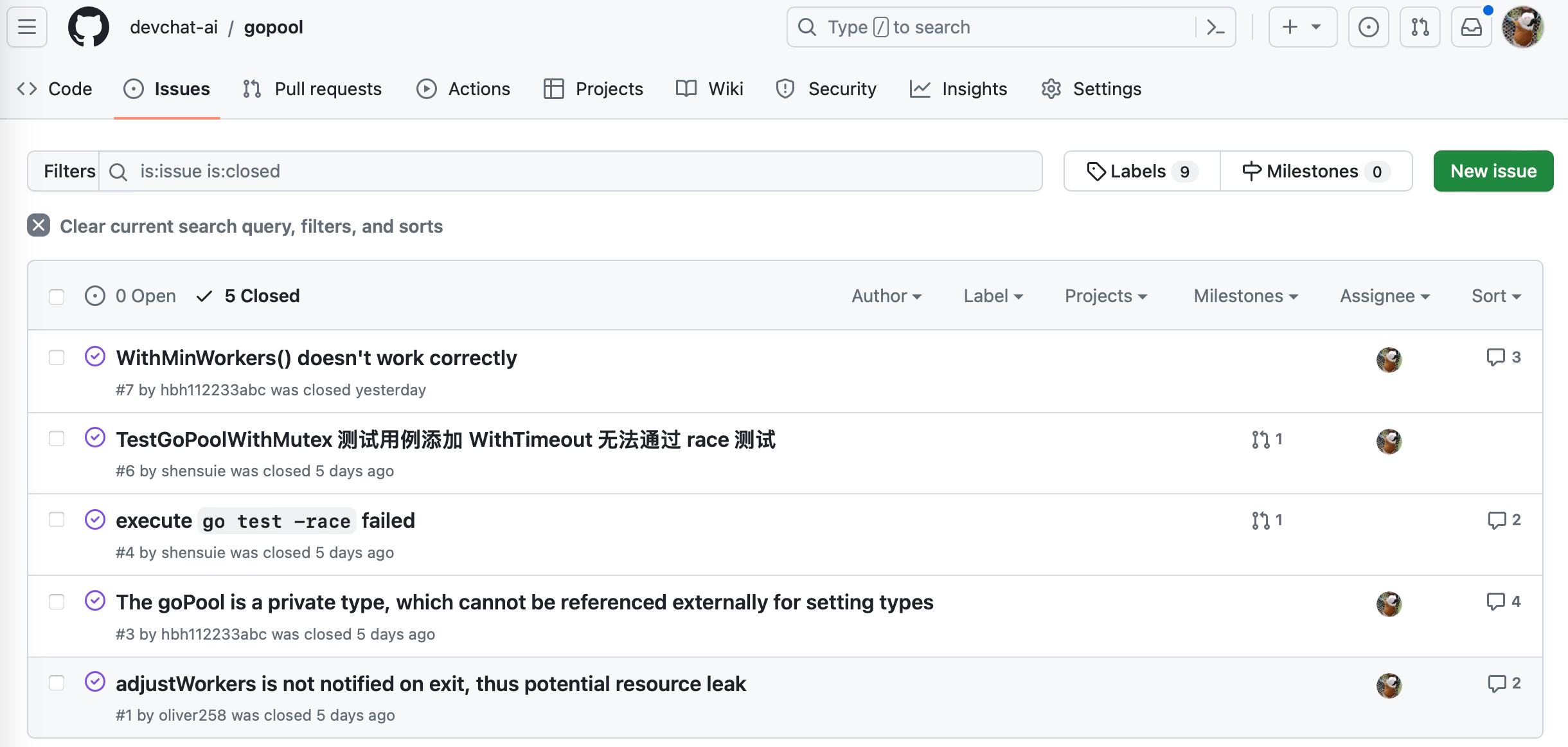
(容我辩解5秒钟)Bugs 有归有,不过平均一个 issue 的解决时间没有超过半天,至少我提供的售后服务还可以的,对吧?哈哈……
(5秒到了)不得不承认:一个足够健壮的 Worker Pool 还是需要花点时间来打磨。
那就再打磨一下吧:
2. 重构测试代码
当前所有测试用例都放在 gopool_test.go 中,这个文件已经接近200行了,维护起来开始吃力。所以我决定今天先让 GPT-4 来改造一下测试用例的组织方式。
下文使用 DevChat 和 GPT-4 交互。如果你对 DevChat 感兴趣,可以跳转阅读这篇文章:
- 《DevChat:将 GPT-4 无缝融入 VS Code,极致提升你的编程体验》
- 如果你想要注册 DevChat,点击这个链接可以免费注册,目前 DevChat 还在公测中,不收费。
2.1 引入 Ginkgo 测试框架
- 我对 DevChat 说:
当前我的测试代码全部在 gopool_test.go 中,我觉得可读性不够好。我希望你引入 Ginkgo 测试框架来帮我重新组织测试代码。首先我只需要你告诉我如何引入 Ginkgo,搭建测试骨架代码,而不用编写具体的测试用例。
DevChat 的回答如下:
要引入 Ginkgo 测试框架并搭建测试骨架代码,你需要按照以下步骤进行:
- 首先,你需要安装 Ginkgo 和 Gomega。Ginkgo 是一个 Go 测试框架,Gomega 是一个配套的断言库。你可以通过以下命令安装它们:
go get github.com/onsi/ginkgo/ginkgo
go get github.com/onsi/gomega/...
- 然后,你需要在你的测试目录下生成一个新的 Ginkgo 测试套件。你可以通过以下命令生成:
ginkgo bootstrap
这将会生成一个名为 suite_test.go 的文件,其中包含了一个基本的测试套件骨架。
- 接下来,你可以为你的
gopool包生成一个 Ginkgo 测试文件。你可以通过以下命令生成:
ginkgo generate gopool
这将会生成一个名为 gopool_test.go 的文件,其中包含了一个基本的测试文件骨架。
- 最后,你可以在
gopool_test.go文件中添加你的测试用例。以下是一个基本的测试用例骨架:
var _ = Describe("Gopool", func() {
    Context("when something happens", func() {
        It("should do something", func() {
            // Your test code goes here
        })
    })
})
在这个骨架中,Describe 用于描述你正在测试的对象,Context 用于描述你正在测试的场景,It 用于描述你的期望结果。
以上就是引入 Ginkgo 并搭建测试骨架代码的步骤。你可以根据你的需求修改和添加测试用例。
因为 gopool_test.go 文件已经存在,Ginkgo 也没有智能到能够直接“merge”,所以我先将当前代码备份到了 gopool_1_test.go 中:

2.2 尝试改造旧的测试用例
骨架有了,接下来我准备尝试让 GPT-4 来重写代码。
- 我对 DevChat 说:
我将原先的测试用例到备份到了 gopool_1_test.go 中,现在我需要你用 Ginkgo 的最佳实践重构测试代码,新的代码将会放到 gopool_test.go 中。
DevChat 的回答如下:
首先,我们需要将原先的测试用例转换为 Ginkgo 的格式。这包括将每个测试用例转换为一个 It 块,并使用 Gomega 断言库来替换原先的断言。以下是转换后的测试代码:
package gopool_test

import (
	. "github.com/onsi/ginkgo"
	. "github.com/onsi/gomega"

	"github.com/devchat-ai/gopool"
)

var _ = Describe("Gopool", func() {
	Describe("With Mutex", func() {
		It("should work correctly", func() {
			// Your test code goes here
		})
	})

	Describe("With SpinLock", func() {
		It("should work correctly", func() {
			// Your test code goes here
		})
	})

	Describe("With Error", func() {
		It("should work correctly", func() {
			// Your test code goes here
		})
	})

	Describe("With Result", func() {
		It("should work correctly", func() {
			// Your test code goes here
		})
	})

	Describe("With Retry", func() {
		It("should work correctly", func() {
			// Your test code goes here
		})
	})

	Describe("With Timeout", func() {
		It("should work correctly", func() {
			// Your test code goes here
		})
	})

	Describe("With MinWorkers", func() {
		It("should work correctly", func() {
			// Your test code goes here
		})
	})
})
这只是一个骨架代码,你需要将原先的测试代码复制到对应的 It 块中,并使用 Gomega 断言库来替换原先的断言。例如,你可以将 t.Errorf 替换为 Expect().To(Equal())。
对于基准测试,Ginkgo 并不直接支持,但你可以使用 Go 的原生 testing 包来进行基准测试。你可以将基准测试代码放在一个单独的文件中,例如 gopool_benchmark_test.go。
啥?我感觉 GPT-4 偷懒了,居然不直接给我把代码写好。另外我没记错的话,Ginkgo 是支持“基准测试”的,可能是 GPT-4 的训练数据太旧导致它不知道这件事。(没错,这时候是它不是她。)
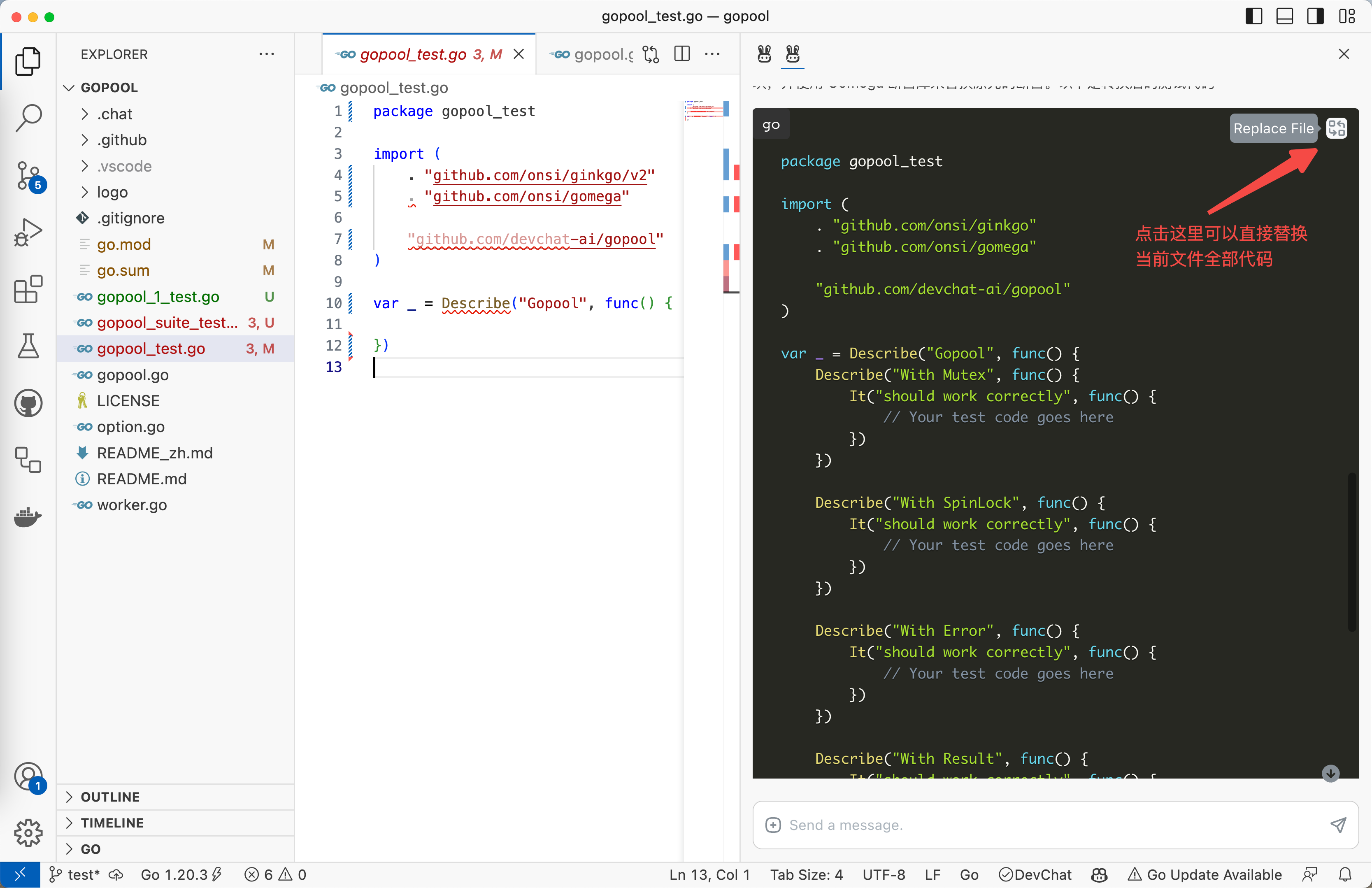
于是我先“笑纳”了这段代码,然后拆解问题,暂且将压测代码放到单独的文件,让 GPT-4 安心把功能测试代码重构好,然后我再和它算“基准测试”的账。
此刻我就有了一个新文件:
gopool_benchmark_test.go
里面内容如下:
package gopool

import (
	"sync"
	"testing"
	"time"

	"github.com/daniel-hutao/spinlock"
)


func BenchmarkGoPoolWithMutex(b *testing.B) {
	var wg sync.WaitGroup
	var taskNum = int(1e6)
	pool := NewGoPool(1e4, WithLock(new(sync.Mutex)))
	defer pool.Release()

	b.ResetTimer()
	for i := 0; i < b.N; i++ {
		wg.Add(taskNum)
		for num := 0; num < taskNum; num++ {
			pool.AddTask(func() (interface{}, error) {
				time.Sleep(10 * time.Millisecond)
				wg.Done()
				return nil, nil
			})
		}
		wg.Wait()
	}
	b.StopTimer()
}

func BenchmarkGoPoolWithSpinLock(b *testing.B) {
	var wg sync.WaitGroup
	var taskNum = int(1e6)
	pool := NewGoPool(1e4, WithLock(new(spinlock.SpinLock)))
	defer pool.Release()

	b.ResetTimer()
	for i := 0; i < b.N; i++ {
		wg.Add(taskNum)
		for num := 0; num < taskNum; num++ {
			pool.AddTask(func() (interface{}, error) {
				time.Sleep(10 * time.Millisecond)
				wg.Done()
				return nil, nil
			})
		}
		wg.Wait()
	}
	b.StopTimer()
}

func BenchmarkGoroutines(b *testing.B) {
	var wg sync.WaitGroup
	var taskNum = int(1e6)

	for i := 0; i < b.N; i++ {
		wg.Add(taskNum)
		for num := 0; num < taskNum; num++ {
			go func() (interface{}, error) {
				time.Sleep(10 * time.Millisecond)
				wg.Done()
				return nil, nil
			}()
		}
		wg.Wait()
	}
}
而 gopool_1_test.go 的内容我就不赘述了,就是原先的全量测试代码减去上面这些基准测试代码。那么接下来问题就拆分成了2个:
- 用 Ginkgo 的方式改造功能测试代码
- 用 Ginkgo 的方式改造基准测试代码
不过目测本文篇幅有点长了,所以我决定今天先完成功能测试代码的改造,基准测试下次再说。
2.3 重构功能测试代码
接下来该让 GPT-4 开始重构功能测试代码了。
- 我对 DevChat 说:
帮我将 gopool_1_test.go 中的用 testing 库编写的测试代码全部用 Ginkgo 的方式重构,更新到 gopool_test.go 中。
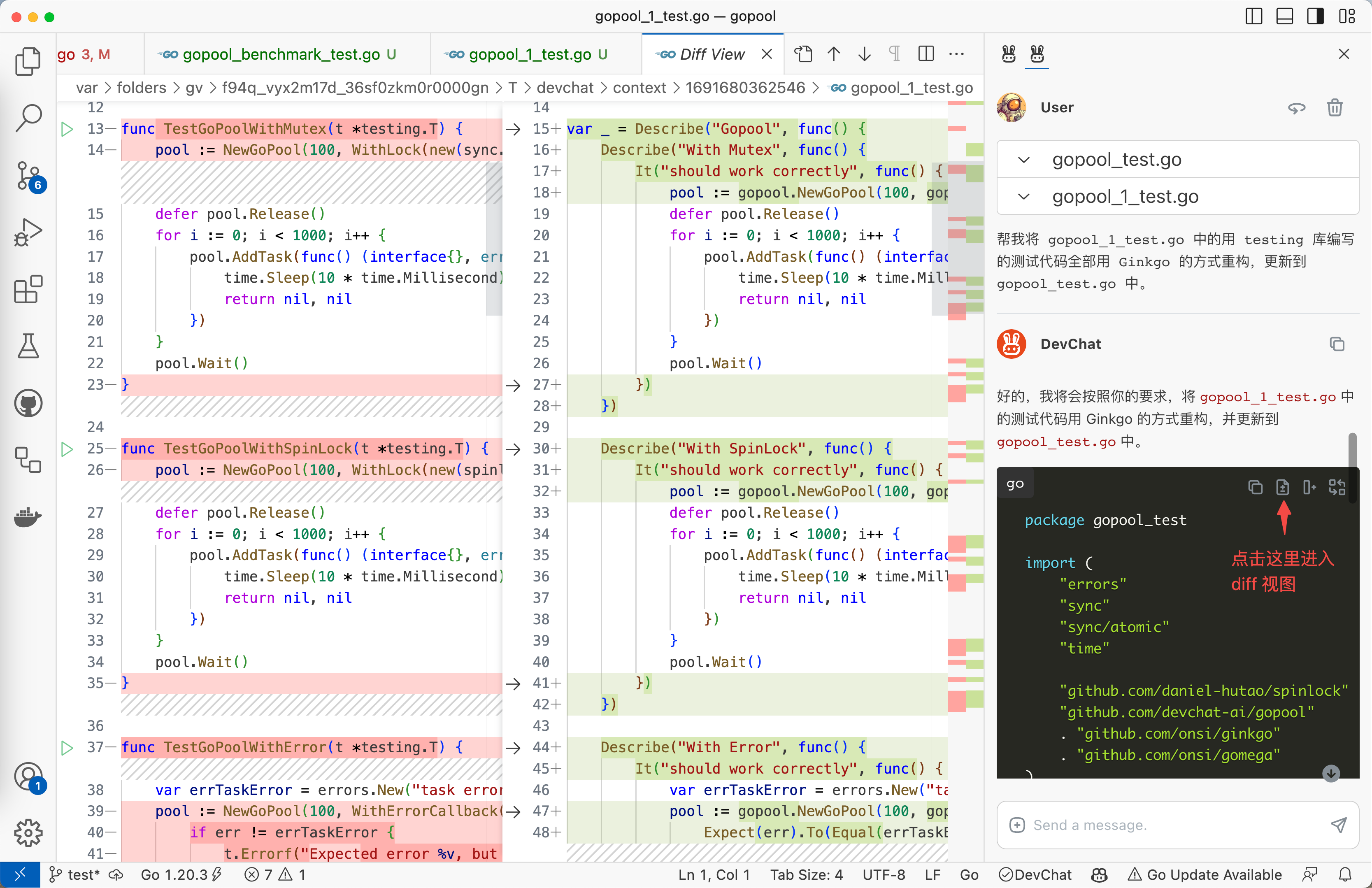
提示: DevChat 给出的代码库右上角有一个“diff”按钮,点一下可以进入“diff 视图”,这样就能看到当前打开文件中的代码和 GPT-4 给出的代码之间的 diff,然后你就能清晰地看到 GPT-4 给出的代码具体修改了什么了。
DevChat 的完整回答是:
好的,我将会按照你的要求,将 gopool_1_test.go 中的测试代码用 Ginkgo 的方式重构,并更新到 gopool_test.go 中。
package gopool_test

import (
	"errors"
	"sync"
	"sync/atomic"
	"time"

	"github.com/daniel-hutao/spinlock"
	"github.com/devchat-ai/gopool"
	. "github.com/onsi/ginkgo"
	. "github.com/onsi/gomega"
)

var _ = Describe("Gopool", func() {
	Describe("With Mutex", func() {
		It("should work correctly", func() {
			pool := gopool.NewGoPool(100, gopool.WithLock(new(sync.Mutex)))
			defer pool.Release()
			for i := 0; i < 1000; i++ {
				pool.AddTask(func() (interface{}, error) {
					time.Sleep(10 * time.Millisecond)
					return nil, nil
				})
			}
			pool.Wait()
		})
	})

	Describe("With SpinLock", func() {
		It("should work correctly", func() {
			pool := gopool.NewGoPool(100, gopool.WithLock(new(spinlock.SpinLock)))
			defer pool.Release()
			for i := 0; i < 1000; i++ {
				pool.AddTask(func() (interface{}, error) {
					time.Sleep(10 * time.Millisecond)
					return nil, nil
				})
			}
			pool.Wait()
		})
	})

	Describe("With Error", func() {
		It("should work correctly", func() {
			var errTaskError = errors.New("task error")
			pool := gopool.NewGoPool(100, gopool.WithErrorCallback(func(err error) {
				Expect(err).To(Equal(errTaskError))
			}))
			defer pool.Release()

			for i := 0; i < 1000; i++ {
				pool.AddTask(func() (interface{}, error) {
					return nil, errTaskError
				})
			}
			pool.Wait()
		})
	})

	Describe("With Result", func() {
		It("should work correctly", func() {
			var expectedResult = "task result"
			pool := gopool.NewGoPool(100, gopool.WithResultCallback(func(result interface{}) {
				Expect(result).To(Equal(expectedResult))
			}))
			defer pool.Release()

			for i := 0; i < 1000; i++ {
				pool.AddTask(func() (interface{}, error) {
					return expectedResult, nil
				})
			}
			pool.Wait()
		})
	})

	Describe("With Retry", func() {
		It("should work correctly", func() {
			var retryCount = int32(3)
			var taskError = errors.New("task error")
			var taskRunCount int32 = 0

			pool := gopool.NewGoPool(100, gopool.WithRetryCount(int(retryCount)))
			defer pool.Release()

			pool.AddTask(func() (interface{}, error) {
				atomic.AddInt32(&taskRunCount, 1)
				if taskRunCount <= retryCount {
					return nil, taskError
				}
				return nil, nil
			})

			pool.Wait()

			Expect(atomic.LoadInt32(&taskRunCount)).To(Equal(retryCount + 1))
		})
	})

	Describe("With Timeout", func() {
		It("should work correctly", func() {
			var taskRun int32

			pool := gopool.NewGoPool(100, gopool.WithTimeout(100*time.Millisecond), gopool.WithErrorCallback(func(err error) {
				Expect(err.Error()).To(Equal("task timed out"))
				atomic.StoreInt32(&taskRun, 1)
			}))
			defer pool.Release()

			pool.AddTask(func() (interface{}, error) {
				time.Sleep(200 * time.Millisecond)
				return nil, nil
			})

			pool.Wait()

			Expect(atomic.LoadInt32(&taskRun)).To(Equal(int32(1)))
		})
	})

	Describe("With MinWorkers", func() {
		It("should work correctly", func() {
			var minWorkers = 50

			pool := gopool.NewGoPool(100, gopool.WithMinWorkers(minWorkers))
			defer pool.Release()

			Expect(pool.GetWorkerCount()).To(Equal(minWorkers))
		})
	})
})
这段代码将 gopool_1_test.go 中的测试用例转换为 Ginkgo 的格式,并使用 Gomega 断言库来替换原先的断言。
这段代码基本是 ok 的,不过运行的时候会遇到这个错误:
go test ./...
/var/folders/gv/f94q_vyx2m17d_36sf0zkm0r0000gn/T/go-build3608449998/b001/gopool.test flag redefined: ginkgo.seed
panic: /var/folders/gv/f94q_vyx2m17d_36sf0zkm0r0000gn/T/go-build3608449998/b001/gopool.test flag redefined: ginkgo.seed

goroutine 1 [running]:
flag.(*FlagSet).Var(0x14000114120, {0x1049bd108, 0x104c0d4a0}, {0x1400011af70, 0xb}, {0x10486d229, 0x2a})
        /usr/local/go/src/flag/flag.go:982 +0x2a4
flag.(*FlagSet).Int64Var(...)
        /usr/local/go/src/flag/flag.go:769
github.com/onsi/ginkgo/config.Flags(0x14000191ba8?, {0x10485657a?, 0x989680?}, 0x1)
        /Users/danielhu/go/pkg/mod/github.com/onsi/ginkgo@v1.16.5/config/config.go:75 +0xe0
github.com/onsi/ginkgo.init.0()
        /Users/danielhu/go/pkg/mod/github.com/onsi/ginkgo@v1.16.5/ginkgo_dsl.go:53 +0x38
FAIL    github.com/devchat-ai/gopool    3.889s
FAIL
这时候 Google 一下,可以找到 Ginkgo issue 875。改起来也很容易,在 gopool_test.go 的开头应该将 . "github.com/onsi/ginkgo" 改成 . "github.com/onsi/ginkgo/v2"
所以目前 go.mod 就变成了这样:
module github.com/devchat-ai/gopool

go 1.20

require (
	github.com/daniel-hutao/spinlock v0.1.0
	github.com/onsi/ginkgo/v2 v2.11.0
	github.com/onsi/gomega v1.27.10
)

require (
	github.com/go-logr/logr v1.2.4 // indirect
	github.com/go-task/slim-sprig v0.0.0-20230315185526-52ccab3ef572 // indirect
	github.com/google/go-cmp v0.5.9 // indirect
	github.com/google/pprof v0.0.0-20210407192527-94a9f03dee38 // indirect
	golang.org/x/net v0.12.0 // indirect
	golang.org/x/sys v0.10.0 // indirect
	golang.org/x/text v0.11.0 // indirect
	golang.org/x/tools v0.9.3 // indirect
	gopkg.in/yaml.v3 v3.0.1 // indirect
)
再装一个 VS Code 的 ginkgo 插件,圆满了:

通过 ginkgo 插件运行一下:

也可以在命令行里自己敲 ginkgo -v 感受下更详细的结果输出:
$ ginkgo -v
Running Suite: Gopool Suite - /Users/danielhu/go/mycode/gopool
==============================================================
Random Seed: 1692081153

Will run 7 of 7 specs
------------------------------
Gopool With Mutex should work correctly
/Users/danielhu/go/mycode/gopool/gopool_test.go:17
• [0.203 seconds]
------------------------------
Gopool With SpinLock should work correctly
/Users/danielhu/go/mycode/gopool/gopool_test.go:31
• [0.201 seconds]
------------------------------
Gopool With Error should work correctly
/Users/danielhu/go/mycode/gopool/gopool_test.go:45
• [0.102 seconds]
------------------------------
Gopool With Result should work correctly
/Users/danielhu/go/mycode/gopool/gopool_test.go:62
• [0.102 seconds]
------------------------------
Gopool With Retry should work correctly
/Users/danielhu/go/mycode/gopool/gopool_test.go:79
• [0.101 seconds]
------------------------------
Gopool With Timeout should work correctly
/Users/danielhu/go/mycode/gopool/gopool_test.go:102
• [0.202 seconds]
------------------------------
Gopool With MinWorkers should work correctly
/Users/danielhu/go/mycode/gopool/gopool_test.go:123
• [0.001 seconds]
------------------------------

Ran 7 of 7 Specs in 0.916 seconds
SUCCESS! -- 7 Passed | 0 Failed | 0 Pending | 0 Skipped
PASS

Ginkgo ran 1 suite in 4.759009833s
Test Suite Passed
到现在,测试相关的文件就有了3个:
gopool_benchmark_test.gogopool_suite_test.gogopool_test.go
到此,提个 PR :Refactor tests using Ginkgo and Gomega
3. 总结
因为 GPT-4 的训练数据是大约2年前的,也就是最近2年这个世界发生了啥它是不知道的。所以对于一些变化大的库,对于一些版本敏感的问题,你要对 GPT 给出的代码保持警惕。有时候你需要的代码对版本不敏感,那无所谓;反之,及时 Google 一下。
总之,擅用 GPT,但别只用 GPT。偶尔还是想想你的老相好“Google Bing 和度娘”。