-
[读论文] Monocular 3D Object Reconstruction with GAN inversion (ECCV2022)
概述
- 项目主页:https://www.mmlab-ntu.com/project/meshinversion/
- 方法名称:MeshInversion
- 输入:单目图像 (in the wild,有背景的,没有抠图的)
- 输出:textured 3D mesh
- key challenge: 缺少3D或multiview supervision
- 方法核心:先预训练一个3D GAN (ConvMesh,其中mesh表达为deformation and texture maps),可以从latent code z生成textured mesh。然后在inference的时候,从输入的图片倒推最符合的z。(这是一个inferece optimization的方法!!)(将生成的mesh用预测的相机参数渲染出来,用输入图片的texture CD loss和mask CD loss来监督)
- 主要用到或参考的网络:ConvMesh,PatchGAN,mask 用现成的segmentation tool (PointRend)来获取。

Related Work
Single View 3D Reconstruction
image-3D object pairs [46,35,32,39]
multi-view images [33,28,51,47,34]
SMPL for humans and 3DMM for faces [8,40,18],CMR [19] reconstructs category-specific
textured meshtexture一般有两种方法,一个是direct regression of pixel values in the UV texture map – often blurry 但作者用的这个。
主流方法是learning the texture flow,对novel view的泛化能力不好。GAN inversion
GAN inversion 是指先训练好一个GAN,然后找到合适的z,使得z输入GAN以后得到的输出尽可能满足要求。
通常可以用
梯度下降(略)用一个encoder来学:
Bau, D., Strobelt, H., Peebles, W., Zhou, B., Zhu, J.Y., Torralba, A., et al.: Semantic photo manipulation with a generative image prior. In: SIGGRAPH (2019)或者二者的结合:
Zhu, J., Shen, Y., Zhao, D., Zhou, B.: In-domain GAN inversion for real image
editing. In: ECCV (2020)3D领域最新的工作,包括用GAN Inversion进行点云补全:
Zhang, J., Chen, X., Cai, Z., Pan, L., Zhao, H., Yi, S., Yeo, C.K., Dai, B., Loy, C.C.:
Unsupervised 3D shape completion through GAN inversion. In: CVPR (2021)textured mesh generation
6.Learning to predict 3D objects with an interpolation-based differentiable renderer.
In: NeurIPS (2019)
重建的mesh可微渲染之后,用渲染得到的multi view images做discriminaive 监督13.Leveraging 2D data to learn textured
3D mesh generation. In: CVPR (2020)
VAE 方法,face colors instead of texture maps38.Convolutional generation of textured 3D meshes
topology-aligned texture maps and deformation maps in the UV space. (本文就用了他的pretrained model)Method
看起来大体方法是用Generator从latent code生成geometry和texture,然后用chamfer mask loss和chamfer texture loss来监督。
Preliminaries
mesh表示为O = (V,F,T), 即点,面,texture map。
其中,由于An individual mesh is iso-morphic to a 2-pole sphere.
因此点的位置可用球体的deformation Δ V \Delta \mathbf{V} ΔV表示:
V = V s p h e r e + Δ V \mathbf{V} = \mathbf{V}_{sphere} + \Delta \mathbf{V} V=Vsphere+ΔV
以前的方法大多用MLP来regress delta V,本文使用CNN。渲染时,使用弱透视投影。(区别于透视投影和正交投影的一种投影方法),参数为π, 包含scale s, translation t和rotation r。
3.1 Reconstruction with Generative Prior
Pre-training Stage
- 这个阶段训练了一个3D GAN。
- Generator主要参考ConvMesh
- 发生在uv space
- 输出的是deformation map和texture map。
- Discriminator主要参考PatchGAN。
- Loss 包括
- generator loss
- Discrininator loss on UV space
- DIscrininator loss on image space (参考PatchGAN)
Inversion Stage
- 目的:find the z that best recovers the 3D object from the input image I i n \mathbf{I}_{in} Iin.
- 需要:原始的image,其对应的mask,还有将3Dshape进行渲染的相机参数。
- 其中mask 用现成的segmentation tool (PointRend)来获取。
- 理由在此:https://github.com/junzhezhang/mesh-inversion/issues/5 是为了fair comparison以及强调这是test time optimization
- 用ConvMesh 预测Mesh (shape)的latent code z,用CMR预测相机参数π。
- 如何预测相机参数π:如果直接regress camera pose from scratch,存在camera-shape ambiguity问题。[24] 所以我们用CMR来initialize the camera。
- 用预测的相机参数,将预测的mesh渲染为2D图片求loss(见下文)
- 其中mask 用现成的segmentation tool (PointRend)来获取。
由于这个相机位置是不断oprimize的,image不可能完美对齐,需要一个鲁棒的texture loss,见下文
3.2 chamfer texture loss (重点参考)
- 将image看做2D点云,每个点有2D坐标和3D的RGB颜色值。
- 两个图像的dissimilarity就用chamfer distance来表达。
- 其中distance D 被分解为 appearance term and spatial term, 都用的l2 distance。
- 重要:具体来说,考虑到我们只想让他tolerant on local misalignment, 因此在spatial term上增加了一个exp操作来惩罚空间距离过远的点,变成这样:

- 解释:首先是Da和Ds相乘。
- 增加epsilon是如果有一样位置的点(Ds为零),颜色相差极大(Da很大),那应该算作不同的点,免得给他弄成零了;
- 然后Ds这边加上指数,惩罚距离太远的,因为我只想要较小的misalignment
- 取个max
- 注意:Ds这一项是不可微的,他只是训练Da(texture)用的权重。
这个东西挺有用的,请看消融实验:
除了pixel level的CD loss,还有feature level的CD loss:
Specifically, we apply the Chamfer texture loss between the (foreground) feature maps extracted with a pre-trained VGG-19 network [42] from the rendered image and the input image.
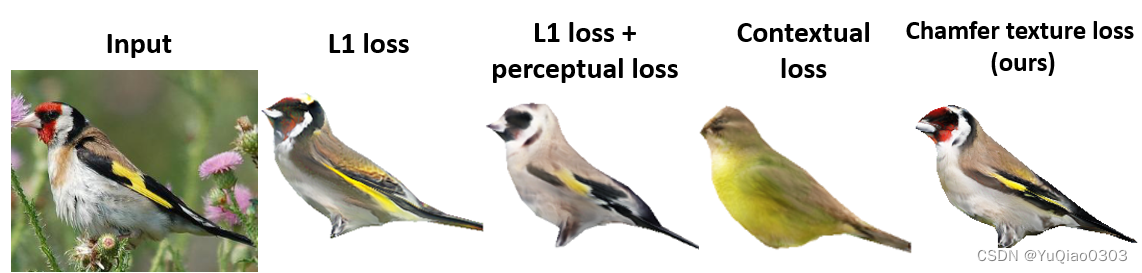
这一点有点像contextual loss (The contextual loss for image transformation with non-aligned data.),但有点区别。feature level Chamfer texture loss: 考虑location,但不要求完全对齐;
contextual loss:完全不考虑location。loss的消融实验

CT是指chamfer texture loss;
LpCT是pixel level的; LfCT是feature level的。看中间那三行,可以看到,
contextual是最差的,
其次是只有L1;
L1 + perceptual好一点;
最好的还是CT loss3.3 Chamfer Mask Loss
- 传统的mask loss,通常是把3Dshape量化到一个个grid of pixels(mask),然后和gt mask 求l1或IoU loss
- 从3D shape 得到mask需要rasterization that discretizes the mesh into a grid of pixels. 这一部会导致信息丢失,引入误差,对训练好的ConvMesh影响尤其大。
- 为此,作者提出Chamfer Mask Loss Lcm. (不求L1,而求CD,不再有量化误差)
- 不是将mesh渲染为binary mask,而是把mesh的点直接投影到image plane,得到Sv。
- 然后把用现成工具分割得到的前景点的坐标给normalize到-1到1之间,得到Sf。
- 然后计算Sv和Sf的chamfer distance
总loss
- pixel-level chamfer texture loss (appearance)
- feature-level chamfer texture loss (appearance)
- chamfer mask loss (geometry)
- smooth loss (neighboring faces to have similar normals i.e. low cosine)
- latent space loss (L2 norm of z to ensure Gaussian distribution)
等下仔细看看代码,尤其是这个latent space loss。
以及那个feature level是咋搞啊。Experiments
- datasets:
- CUB-200-2011 (鸟类)
- PASCAL3D: cars
- pretrain ConvMesh: pseudo ground truths ??? 感觉是指上文提到的那个segmentation和camera pose prediction网络得到的结果。
- inference 时GAN inversion: 似乎也是pseudo ground truths。
- evaluation: 用的GT了
- geometry accuracy: rendered masks 和 GT masks的2D mask IoU
- appearance quality: image synthesis metric FID (single view and multi view), 反映了GT images和generated images的分布的相似性。
- user study: 找了40个user来打分。
- (PASCAL3D 特有:有approximated 3D CAD shapes,可以用3D IoU)
Texture Flow vs. Texture Regression
Texture Flow 更常用,但在invisible的地方容易出错;因为容易copy foreground pixies including the obstacles.
实现(主要来自补充材料)
时间,显存,设备GPU
Pre-training:
600 epochs, with a batch size of 128,
15 hours on four Nvidia V100 GPUs.网络结构:和ConvMesh一样。
- convolutional generator G with 2 branches.
- 输入:latent code z (64)
- 输出:deformation map S 32*32; texture map T 512-512
- UV space discriminator
- deformation map
- texture map
- image space discriminator (PatchGAN)
chamfer texture loss实现笔记

- 解释:首先是Da和Ds相乘。
- 增加epsilon是如果有一样位置的点(Ds为零),颜色相差极大(Da很大),那应该算作不同的点,免得给他弄成零了;
- 然后Ds这边加上指数,惩罚距离太远的,因为我只想要较小的misalignment
- 取个max
- 注意:Ds这一项是不可微的,他只是训练Da(texture)用的权重。
texture CD loss 代码
mesh_inversion.py
https://github.com/junzhezhang/mesh-inversion/blob/d6614726344f5a56c068df2750fefc593c4ca43d/lib/mesh_inversion.py#L265if self.args.chamfer_texture_pixel_loss: # NOTE: batch size should be one pix_pos_pred = mask2proj(mask_pred) pix_pred = grid_sample_from_vtx(pix_pos_pred, image_pred) dist_map_c, idx_a, idx_b = distChamfer_downsample(pix_pred,color_target,resolution=self.args.chamfer_resolution) dist_map_p, _, _ = distChamfer_downsample(pix_pos_pred,vtx_target,resolution=self.args.chamfer_resolution, idx_a=idx_a, idx_b=idx_b) xy_threshold = self.args.xy_threshold k = self.args.xy_k alpha = self.args.xy_alpha eps = 1 - (2*k*xy_threshold)**2 rgb_eps = self.args.rgb_eps if eps == 1: xy_term = torch.pow(1+k*dist_map_p, alpha) else: xy_term = F.relu(torch.pow(eps+k*dist_map_p, alpha)-1) + 1 dist_map = xy_term * (dist_map_c + rgb_eps) dist_min_ab = dist_map.min(-1)[0] dist_mean_ab = dist_min_ab.mean(-1) loss += dist_mean_ab * self.args.chamfer_texture_pixel_loss_wt ### colect the matched points in the target for visualization indices = dist_map.argmin(dim=-1) self.matched_pos = torch.stack([vtx_target[i,indices[i]] for i in range(indices.shape[0])],0) self.matched_clr = torch.stack([color_target[i,indices[i]] for i in range(indices.shape[0])],0) # v2 from: grid sample self.matched_clr_v2 = grid_sample_from_vtx(self.matched_pos, target) # NOTE that back vertices color shown as well- 1
- 2
- 3
- 4
- 5
- 6
- 7
- 8
- 9
- 10
- 11
- 12
- 13
- 14
- 15
- 16
- 17
- 18
- 19
- 20
- 21
- 22
- 23
- 24
- 25
- 26
- 27
- 28
- 29
其中的参数:
https://github.com/junzhezhang/mesh-inversion/blob/d6614726344f5a56c068df2750fefc593c4ca43d/lib/arguments.py#L135# loss related self._parser.add_argument('--chamfer_mask_loss', action='store_true', default=True, help='if use Chamfer mask loss') self._parser.add_argument('--chamfer_mask_loss_wt', type=float, default=10.0) self._parser.add_argument('--chamfer_texture_pixel_loss', action='store_true', default=True, help='Chamfer texture loss - pixel level') self._parser.add_argument('--chamfer_texture_pixel_loss_wt', type=float, default=1.0) self._parser.add_argument('--chamfer_texture_feat_loss', action='store_true', default=True, help='Chamfer texture loss - feature level') self._parser.add_argument('--chamfer_texture_feat_loss_wt', type=float, default=0.04) self._parser.add_argument('--xy_threshold', type=float, default=0.16) self._parser.add_argument('--xy_k', type=float, default=1.0) self._parser.add_argument('--xy_alpha', type=float, default=1) self._parser.add_argument('--rgb_eps', type=float, default=1) self._parser.add_argument('--subpool_threshold', type=float, default=0.5) self._parser.add_argument('--chamfer_resolution', type=int, default=8192, help='resolution for computing chamfer texture losses') # other losses self._parser.add_argument('--mesh_regularization_loss', action='store_true', default=False, help='') self._parser.add_argument('--mesh_regularization_loss_wt', type=float, default=0.00005) self._parser.add_argument('--nll_loss', action='store_true', default=True, help='') self._parser.add_argument('--nll_loss_wt', type=float, default=0.05)- 1
- 2
- 3
- 4
- 5
- 6
- 7
- 8
- 9
- 10
- 11
- 12
- 13
- 14
- 15
- 16
- 17
- 18
-
相关阅读:
基于Python开发的飞机大战小游戏彩色版(源码+可执行程序exe文件+程序配置说明书+程序使用说明书)
小公司需要使用微服务架构吗?
系统安全分析与设计>网络攻击
计算机毕业设计ssm+vue基本微信小程序的疫情监控系统
Python生成随机数字/字符
0021Java程序设计-SSM框架图书管理系统
解决OpenCV在Cmake时,因网络问题无法下载部分所需文件
【Python3】【力扣题】202. 快乐数
sql数据类型,约束以及单表查询
【C++】泛型算法(五)泛型算法的使用与设计
- 原文地址:https://blog.csdn.net/qq_34342853/article/details/128187071
