-
MyBatis ---- 动态SQL
MyBatis 框架的动态 SQL 技术是一种根据特定条件动态拼接 SQL 语句的功能,它存在的意义是为了解决拼接 SQL 语句字符串时的痛点问题。
1. if
/** * 根据条件查询员工信息if * @param emp * @return */ List<Emp> getEmpListByMoreTJ(Emp emp);- 1
- 2
- 3
- 4
- 5
- 6
<select id="getEmpListByMoreTJ" resultType="emp"> select * from t_emp where <if test="empName != '' and empName != null"> emp_name = #{empName} if> <if test="age != '' and age != null"> and age = #{age} if> <if test="sex != '' and sex != null"> and sex = #{sex} if> <if test="email != '' and email != null"> and email = #{email} if> select>- 1
- 2
- 3
- 4
- 5
- 6
- 7
- 8
- 9
- 10
- 11
- 12
- 13
- 14
- 15
- 16

当 age、sex…等条件为空时,不会影响查询结果,但是若 empName 为空的话,查询语句就会变成 where 后面直接跟 and,这是不符合语法规则的,避免措施:
在查询语句中添加一个 1=1,恒成立条件,且不会影响查询效果<select id="getEmpListByMoreTJ" resultType="emp"> select * from t_emp where 1=1 <if test="empName != '' and empName != null"> and emp_name = #{empName} if> <if test="age != '' and age != null"> and age = #{age} if> <if test="sex != '' and sex != null"> and sex = #{sex} if> <if test="email != '' and email != null"> and email = #{email} if> select>- 1
- 2
- 3
- 4
- 5
- 6
- 7
- 8
- 9
- 10
- 11
- 12
- 13
- 14
- 15
- 16

2. where
/** * 根据条件查询员工信息where * @param emp * @return */ List<Emp> getEmpListByMoreTJ2(Emp emp);- 1
- 2
- 3
- 4
- 5
- 6
<select id="getEmpListByMoreTJ2" resultType="emp"> select * from t_emp <where> <if test="empName != '' and empName != null"> emp_name = #{empName} if> <if test="age != '' and age != null"> and age = #{age} if> <if test="sex != '' and sex != null"> and sex = #{sex} if> <if test="email != '' and email != null"> and email = #{email} if> where> select>- 1
- 2
- 3
- 4
- 5
- 6
- 7
- 8
- 9
- 10
- 11
- 12
- 13
- 14
- 15
- 16
- 17
- 18

where 和 if 一般结合使用:
a> 若 where 标签找那个的 if 条件都不满足,则 where 标签没有任何功能,即不会添加 where 关键字
b> 若 where 标签中的 if 条件满足,则 where 标签会自动添加 where 关键字,并将条件最前方多余的 and 去掉
注意:where 标签不能去掉条件最后多余的 and3. trim
/** * 根据条件查询员工信息trim * @param emp * @return */ List<Emp> getEmpListByMoreTJ3(Emp emp);- 1
- 2
- 3
- 4
- 5
- 6
<select id="getEmpListByMoreTJ3" resultType="emp"> select * from t_emp <trim prefix="where" suffixOverrides="and"> <if test="empName != '' and empName != null"> emp_name = #{empName} and if> <if test="age != '' and age != null"> age = #{age} and if> <if test="sex != '' and sex != null"> sex = #{sex} and if> <if test="email != '' and email != null"> email = #{email} and if> trim> select>- 1
- 2
- 3
- 4
- 5
- 6
- 7
- 8
- 9
- 10
- 11
- 12
- 13
- 14
- 15
- 16
- 17
- 18

4. choose、when、otherwise
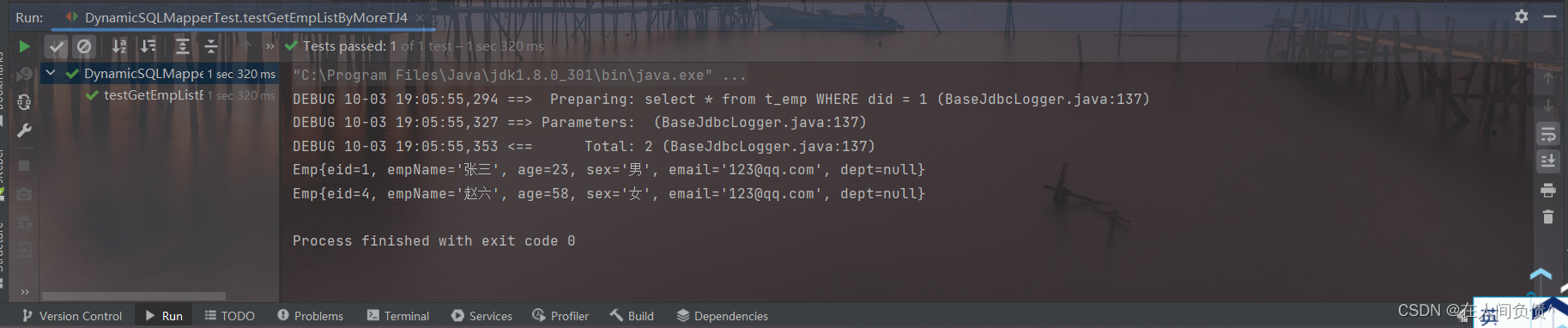
choose、when、otherwise相当于if…else if…else
/** * choose、when、otherwise * @param emp * @return */ List<Emp> getEmpListByMoreTJ4(Emp emp);- 1
- 2
- 3
- 4
- 5
- 6
<select id="getEmpListByMoreTJ4" resultType="emp"> select * from t_emp <where> <choose> <when test="empName != '' and empName != null"> emp_name = #{empName} when> <when test="age != '' and age != null"> age = #{age} when> <when test="sex != '' and sex != null"> sex = #{sex} when> <when test="email != '' and email != null"> email = #{email} when> <otherwise> did = 1 otherwise> choose> where> select>- 1
- 2
- 3
- 4
- 5
- 6
- 7
- 8
- 9
- 10
- 11
- 12
- 13
- 14
- 15
- 16
- 17
- 18
- 19
- 20
- 21
- 22
- 23
@Test public void testGetEmpListByMoreTJ4(){ SqlSession sqlSession = SqlSessionUtils.getSqlSession(); DynamicSQLMapper dynamicSQLMapper = sqlSession.getMapper(DynamicSQLMapper.class); List<Emp> empListByMoreTJ = dynamicSQLMapper.getEmpListByMoreTJ4(new Emp(null, null, null, null, null)); empListByMoreTJ.forEach(emp -> System.out.println(emp)); }- 1
- 2
- 3
- 4
- 5
- 6
- 7
- 8
- 9
5. foreach
/** * 通过数组批量删除 * @param eids * @return */ int deleteMoreByArray(@Param("eids") Integer[] eids);- 1
- 2
- 3
- 4
- 5
- 6
<delete id="deleteMoreByArray"> delete from t_emp where <foreach collection="eids" item="eid" separator="or"> eid = #{eid} foreach> delete>- 1
- 2
- 3
- 4
- 5
- 6
- 7
@Test public void testDeleteMoreByArray(){ SqlSession sqlSession = SqlSessionUtils.getSqlSession(); DynamicSQLMapper dynamicSQLMapper = sqlSession.getMapper(DynamicSQLMapper.class); int i = dynamicSQLMapper.deleteMoreByArray(new Integer[]{6, 7, 8}); System.out.println(i); }- 1
- 2
- 3
- 4
- 5
- 6
- 7
- 8
- 9
collection:设置要循环的数组或集合
item:表示集合或数组中的每一个数据
separator:设置循环体之间的分隔符
open:设置 foreach 标签中的内容的开始符
close:设置 foreach 标签中的内容的结束符
6. SQL片段
sql 片段,可以记录一段公共 sql 片段,在使用的地方通过 include 标签进行引入
<sql id="empColumns">eid, emp_name, age, sexsql> <select id="getEmpListByMoreTJ4" resultType="emp"> select <include refid="empColumns">include> from t_emp <where> <choose> <when test="empName != '' and empName != null"> emp_name = #{empName} when> <when test="age != '' and age != null"> age = #{age} when> <when test="sex != '' and sex != null"> sex = #{sex} when> <when test="email != '' and email != null"> email = #{email} when> <otherwise> did = 1 otherwise> choose> where> select>- 1
- 2
- 3
- 4
- 5
- 6
- 7
- 8
- 9
- 10
- 11
- 12
- 13
- 14
- 15
- 16
- 17
- 18
- 19
- 20
- 21
- 22
- 23
- 24
- 25

-
相关阅读:
使用聚氨酯密封件的好处?
09、全文检索 -- Solr -- SpringBoot 整合 Spring Data Solr (生成DAO组件 和 实现自定义查询方法)
SpringAOP是什么?为什么要有SpringAOP?
[2023年]-hadoop面试真题(二)
重仓比特币
利用python爬虫采集苹果公司各产品销售收入统计报告
分类算法——ROC曲线与AUC指标(九)
【算法】希尔 (Shell) 排序 详解
linux驱动-CCF-2 of_clk_provider
TiKV+SPDK,探索存储的性能极限
- 原文地址:https://blog.csdn.net/qq_52354698/article/details/127154355
