-
暴力算法 --- 莫队
莫队
什么是莫队?
答:优雅的暴力!!!
基础莫队
题目描述:给出一个长度为 N N N的序列,有若干查询,每次查询区间 [ l i , r i ] [l_i, r_i] [li,ri]出现 k i k_i ki次的数有多少个?
解题思路:最直观的做法就是拿到区间 [ l , r ] [l, r] [l,r]后,暴力计算,用 c n t [ x ] cnt[x] cnt[x]保存 x x x出现了几个, p o s [ t ] pos[t] pos[t]出现 t t t次的数有几个。此时,时间复杂度最坏为: O ( n 2 ) \mathcal O(n^2) O(n2)
可以尝试来优化一下这个操作:使用两个指针 L L L和 R R R(初始化: L = 1 , R = 0 L = 1, R = 0 L=1,R=0),对于每次查询,依次的把这两个指针移动到目标区间 [ l , r ] [l, r] [l,r]的同时,更新 c n t cnt cnt和 p o s pos pos数组。假设现在目标区间为: [ 1 , 5 ] [1, 5] [1,5], L = 2 , R = 5 L = 2, R = 5 L=2,R=5;移动 L L L指针左移L--,并更新 c n t cnt cnt和 p o s pos pos数组:L --; pos[cnt[a[L]]] --; cnt[a[L]] ++; pos[cnt[a[L]]] ++;- 1
- 2
- 3
- 4
移完以后,同理移动 R R R指针:
R ++; pos[cnt[a[R]]] --; cnt[a[R]] ++; pos[cnt[a[R]]] ++;- 1
- 2
- 3
- 4
可以发现上述都是把不在指针区间 [ L , R ] [L, R] [L,R]的数加进来了,因此可以封装成一个函数:
void add(int x) { // 把一个数x加入当指针区间内 pos[cnt[x]] --; cnt[x] ++; pos[cnt[x]] ++; }- 1
- 2
- 3
- 4
- 5
有增加就有删除,删除也是一样的:
void del(int x) { // 把一个数从指针区间删除 pos[cnt[x]] --; cnt[x] --; pos[cnt[x]] ++; }- 1
- 2
- 3
- 4
- 5
为了减少 [ L , R ] [L, R] [L,R]这两个指针的移动次数,可以先将序列分成 n \sqrt n n块,并从 1 ∼ n 1 \sim \sqrt n 1∼n编号,对于所有的查询按照块编号,从小到大排序,对于同一块,按照区间右端点升序排序。排完序后,我们再按照上述的操作去移动 L , R L, R L,R指针,这样的时间复杂度为: O ( n n ) \mathcal O(n\sqrt n) O(nn)
简单证明一下:
- 区间排序,
sort一遍, O ( n l o g n ) \mathcal O(n log n) O(nlogn) - L L L指针的移动:对于每块最坏跨越整个块 n \sqrt n n,最坏有 n n n块需要移动,总的: O ( n n ) \mathcal O(n\sqrt n) O(nn)
- R R R指针的移动,因为对于每块,区间是按照右端点升序排序,所以在块内最多也移动 n \sqrt n n,最坏有 n n n块需要移动,总的 O ( n n ) \mathcal O(n \sqrt n) O(nn)
综上述:莫队的总时间复杂度为: O ( n l o g n ) + O ( n n ) + O ( n n ) = O ( n n ) \mathcal O(nlogn) + \mathcal O (n \sqrt n) + \mathcal O(n \sqrt n) = \mathcal O(n \sqrt n) O(nlogn)+O(nn)+O(nn)=O(nn)
AC_Code:
#includeusing namespace std; constexpr int N = 1e5 + 10; int n, len, m, a[N], cnt[N], pos[N]; int bel(int x) { return x / len; } struct query { int l, r, k, id; bool operator < (const query &b){ return bel(l) == bel(b.l) ? r < b.r : bel(l) < bel(b.l); } }; void add(int x) { pos[cnt[x]] --; cnt[x] ++; pos[cnt[x]] ++; } void del(int x) { pos[cnt[x]] --; cnt[x] --; pos[cnt[x]] ++; } int main() { scanf("%d", &n); len = sqrt(n); for (int i = 1; i <= n; i ++) scanf("%d", &a[i]); scanf("%d", &m); vector<query> q(m); vector<int> ans(m); for (int i = 0; i < m; i ++) { q[i].id = i; cin >> q[i].l >> q[i].r >> q[i].k; } sort(q.begin(), q.end()); for (int i = 0, l = 1, r = 0; i < m; i ++) { int ql = q[i].l, qr = q[i].r; while (l > ql) add(a[-- l]); while (r < qr) add(a[++ r]); while (l < ql) del(a[l ++]); while (r > qr) del(a[r --]); ans[q[i].id] = pos[q[i].k]; } for (int i = 0; i < m; i ++) cout << ans[i] << "\n"; } - 1
- 2
- 3
- 4
- 5
- 6
- 7
- 8
- 9
- 10
- 11
- 12
- 13
- 14
- 15
- 16
- 17
- 18
- 19
- 20
- 21
- 22
- 23
- 24
- 25
- 26
- 27
- 28
- 29
- 30
- 31
- 32
- 33
- 34
- 35
- 36
- 37
- 38
- 39
- 40
- 41
- 42
- 43
- 44
- 45
- 46
- 47
带修改莫队
题目描述:有长度为 N N N的序列,现在有两个操作:
- Q L R Q \ L \ R Q L R 区间 [ L , R ] [L, R] [L,R]有多少个不同的数
- R P C R \ P \ C R P C 把 P P P位置的数改成 C C C
解题思路:查询操作可以用莫队轻松解决,可是这个修改要怎么办呢?我们可以加上一维时间,使之变为待修改莫队!具体操作如下:
增加一维时间t,在把区间移动到目标区间后,检查当前时间是不是目标时间,不是的话,跟修改 L , R L, R L,R指针一样去修改时间t。
这里要注意的是,比如你现在把某个位置的数 x x x改成了 c c c,此时的时间为 t 1 t_1 t1,在把 x x x修改为 c c c后,这个时候你要把原来的数 x x x记下来,如果以后询问小于 t 1 t_1 t1的时候,这个位置的数是 x x x而不是 c c c,这里有个简化操作,可以直接把 x x x和 c c c互换即可,下次操作直接更改就行(具体细节看代码
AC_Code:
#includeusing namespace std; constexpr int N = 1e6 + 10; int n, m, len, a[N], cnt[N]; int bel(int x) { return x / len; } struct query { int l, r, t, id; bool operator < (const query & b) { return (bel(l) ^ bel(b.l)) ? bel(l) < bel(b.l) : (bel(r) ^ bel(b.r)) ? bel(r) < bel(b.r) : t < b.t; } }; struct M { int pos, color; }; M modify[N]; int now; void add(int x) { if(!cnt[x]) ++ now; cnt[x] ++; } void del(int x) { cnt[x] --; if(!cnt[x]) -- now; } int main() { scanf("%d%d", &n, &m); //len = sqrt(n); 此时退化为了O(n^2) len = pow(n, 2.0 / 3); for (int i = 1; i <= n; i ++) scanf("%d", &a[i]); vector<query> q; int cntc = 0; for (int i = 0; i < m; i ++) { char opt[2]; int l, r; scanf("%s%d%d", opt, &l, &r); if(opt[0] == 'Q') { q.push_back({l, r, cntc, (int)q.size()}); } else { modify[++cntc] = {l, r}; } } sort(q.begin(), q.end()); vector<int> ans(q.size()); for (int i = 0, l = 1, r = 0, t = 0; i < (int)q.size(); i ++) { int ql = q[i].l, qr = q[i].r, qt = q[i].t; while (l > ql) add(a[-- l]); while (r < qr) add(a[++ r]); while (l < ql) del(a[l ++]); while (r > qr) del(a[r --]); while (t < qt) { ++ t; if(ql <= modify[t].pos && qr >= modify[t].pos) { del(a[modify[t].pos]); add(modify[t].color); } swap(a[modify[t].pos], modify[t].color); } while (t > qt) { if(ql <= modify[t].pos && qr >= modify[t].pos) { del(a[modify[t].pos]); add(modify[t].color); } swap(a[modify[t].pos], modify[t].color); -- t; } ans[q[i].id] = now; } for (int &x : ans) cout << x << "\n"; } - 1
- 2
- 3
- 4
- 5
- 6
- 7
- 8
- 9
- 10
- 11
- 12
- 13
- 14
- 15
- 16
- 17
- 18
- 19
- 20
- 21
- 22
- 23
- 24
- 25
- 26
- 27
- 28
- 29
- 30
- 31
- 32
- 33
- 34
- 35
- 36
- 37
- 38
- 39
- 40
- 41
- 42
- 43
- 44
- 45
- 46
- 47
- 48
- 49
- 50
- 51
- 52
- 53
- 54
- 55
- 56
- 57
- 58
- 59
- 60
- 61
- 62
- 63
- 64
- 65
- 66
- 67
- 68
- 69
- 70
- 71
- 72
- 73
- 74
树上莫队
题目描述:给定 N N N个节点的树,每个节点有一个颜色。现在有 m m m次询问,每次询问给出两个节点 u , v u,v u,v,输出 u , v u,v u,v路径上的节点颜色个数。颜色为 ≤ 2 × 1 0 9 \le 2 × 10^9 ≤2×10⁹的非负整数
解题思路:
先得到树的欧拉序。
欧拉序特点:
每个节点出现两次,且他们中间的节点为这个节点子树上的点
欧拉序的求法:
在dfs的时候,得到一个点加入序列,退出的时候也加入序列,这样就得到了欧拉序
得到欧拉序有什么用呢,可以尝试将两个节点映射成欧拉序上的一段区间,这样问题就可以转换为莫队求区间不同数了。
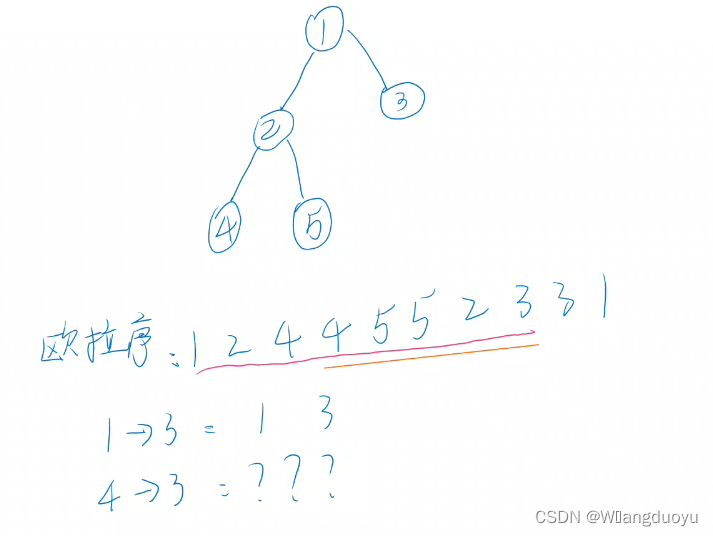
看上图,1->3很容易得到(就是图中红线)而且之间出现两次的数刚好不会算在其中。但是4->3怎么算?用第一个4指定不行,只能用第二个4,但是我们发现少了1,但是1是什么呢,是4和3的lca!所以,可以得到下面两个结论!(保证 f i r s t [ x ] < f i r s t [ y ] first[x] < first[y] first[x]<first[y],不满足就交换一下)
- 如果 L C A ( x , y ) = = x LCA(x, y) == x LCA(x,y)==x,区间为 [ f i r s t [ x ] , f i r s t [ y ] [first[x], first[y] [first[x],first[y] 对应上图1->3情况
- 如果 L C A ( x , y ) ! = x LCA(x, y) \ != x LCA(x,y) !=x,区间为 [ s e c o n d [ x ] , f i r s t [ y ] ] [second[x], first[y]] [second[x],first[y]],同时标记lca为 L C A ( x , y ) LCA(x, y) LCA(x,y),在计算的时候加上lca
AC_Code:
#includeusing namespace std; template < typename T> inline void read( T &x) { x = 0; bool f = 0; char ch = getchar(); while(!isdigit(ch)) { f ^= !(ch ^ 45), ch = getchar();} while(isdigit(ch)) x = (x << 1) + (x << 3) + (ch ^ 48), ch = getchar(); x = f ? -x : x; } template < typename T> inline void write(T x) { if(x < 0) putchar('-'), x = -x; if(x > 9) write(x / 10); putchar(x % 10 + 48); } template <typename T> inline void write(T x, char ch) { write(x); putchar(ch); } constexpr int N = 2e5 + 10; int n, m, len, a[N], cnt[N], ord[N], first[N], last[N], ncnt, depth[N], fa[N][30]; vector<int> G[N]; int bel(int x) { return x / len; } struct query { int l, r, lca, id; bool operator < (const query & b) { return (bel(l) ^ bel(b.l)) ? bel(l) < bel(b.l) : r < b.r; } }; void dfs(int u) { ord[++ ncnt] = u; first[u] = ncnt; for (int &x : G[u]) { if(x == fa[u][0]) continue; depth[x] = depth[u] + 1; fa[x][0] = u; for (int i = 1; (1 << i) <= depth[x]; i ++) fa[x][i] = fa[fa[x][i - 1]][i - 1]; dfs(x); } ord[++ ncnt] = u; last[u] = ncnt; } int LCA(int u, int v) { if(depth[u] < depth[v]) swap(u, v); for (int i = 20; i + 1;i --) if(depth[u] - (1 << i) >= depth[v]) u = fa[u][i]; if(u == v) return u; for (int i = 20; i + 1; i --) if(fa[u][i] != fa[v][i]) u = fa[u][i], v = fa[v][i]; return fa[u][0]; } int vis[N], now; vector<int> all; void solve(int pos) { if(vis[pos]) { cnt[a[pos]] --; if(!cnt[a[pos]]) now --; } else { if(!cnt[a[pos]]) now ++; cnt[a[pos]] ++; } vis[pos] ^= 1; } int main() { read(n); read(m); for (int i = 1; i <= n; i ++) read(a[i]), all.push_back(a[i]); sort(all.begin(), all.end()); all.erase(unique(all.begin(), all.end()), all.end()); for (int i = 1; i <= n; i ++) a[i] = lower_bound(all.begin(), all.end(), a[i]) - all.begin() + 1; for (int i = 1; i < n; i ++) { int u, v; read(u); read(v); G[u].push_back(v); G[v].push_back(u); } depth[1] = 1; dfs(1); len = sqrt(ncnt); vector<query> q(m); for (int i = 0; i < m; i ++) { int l, r; read(l); read(r); int lca = LCA(l, r); if(first[l] > first[r]) swap(l, r); if(l == lca) { q[i].l = first[l]; q[i].r = first[r]; } else { q[i].l = last[l]; q[i].r = first[r]; q[i].lca = lca; } q[i].id = i; } sort(q.begin(), q.end()); vector<int>ans(m); for (int i = 0, l = 1, r = 0; i < m; i ++) { int ql = q[i].l, qr = q[i].r, lca = q[i].lca; while (l > ql) solve(ord[-- l]); while (r < qr) solve(ord[++ r]); while (l < ql) solve(ord[l ++]); while (r > qr) solve(ord[r --]); if(lca) solve(lca); ans[q[i].id] = now; if(lca) solve(lca); } for (int &x : ans) write(x, '\n'); } - 1
- 2
- 3
- 4
- 5
- 6
- 7
- 8
- 9
- 10
- 11
- 12
- 13
- 14
- 15
- 16
- 17
- 18
- 19
- 20
- 21
- 22
- 23
- 24
- 25
- 26
- 27
- 28
- 29
- 30
- 31
- 32
- 33
- 34
- 35
- 36
- 37
- 38
- 39
- 40
- 41
- 42
- 43
- 44
- 45
- 46
- 47
- 48
- 49
- 50
- 51
- 52
- 53
- 54
- 55
- 56
- 57
- 58
- 59
- 60
- 61
- 62
- 63
- 64
- 65
- 66
- 67
- 68
- 69
- 70
- 71
- 72
- 73
- 74
- 75
- 76
- 77
- 78
- 79
- 80
- 81
- 82
- 83
- 84
- 85
- 86
- 87
- 88
- 89
- 90
- 91
- 92
- 93
- 94
- 95
- 96
- 97
- 98
- 99
- 100
- 101
- 102
- 103
- 104
- 105
- 106
- 107
- 108
- 109
- 110
- 111
- 112
- 113
- 114
- 115
- 116
- 117
- 118
- 119
- 120
- 121
- 122
- 123
- 124
回滚莫队
// TODO 待补- 1
例题:
ABC293_G
题目链接:点我
题意:有一个长度为 N N N的序列,现在有 m m m次询问,每次询问一段区间内 ( i < j < k ) (i \lt j\lt k) (i<j<k)并且 a i = a j = a k a_i = a_j = a_k ai=aj=ak的对数
sol:利用莫队,往区间加数 X X X的时候,对答案增加 c n t [ x ] ∗ ( c n t [ x ] − 1 ) / 2 cnt[x] * (cnt[x] - 1) / 2 cnt[x]∗(cnt[x]−1)/2,当前这一个和已有的匹配,删除同理Code:
#includeusing namespace std; typedef long long LL; typedef pair<int, int> pii; template < typename T> inline void Max(T &a, T b) { if(a < b) a = b; } template < typename T> inline void Min(T &a, T b) { if(a > b) a = b; } const int N = 2e5 + 10, B = 450; struct Q { int l, r, id; bool operator < (const Q &b) const { if(l / B == b.l / B) return r < b.r; return l < b.l; } }q[N]; int n, m; int a[N]; LL c, ans[N], cnt[N]; void add(int x) { c += (cnt[a[x]] * (cnt[a[x]] - 1)) / 2; cnt[a[x]] ++; } void del(int x) { cnt[a[x]] --; c -= (cnt[a[x]] * (cnt[a[x]] - 1)) / 2; } int main() { ios::sync_with_stdio(false); cin.tie(0);cout.tie(0); cin >> n >> m; for (int i = 1; i <= n;i ++) { cin >> a[i]; } for (int i = 1; i <= m; i ++) { cin >> q[i].l >> q[i].r; q[i].id = i; } sort(q + 1, q + 1 + m); for (int i = 1, l = 1, r = 0; i <= m; i ++) { while (l > q[i].l) add(-- l); while (r < q[i].r) add(++ r); while (l < q[i].l) del(l ++); while (r > q[i].r) del(r --); ans[q[i].id] = c; } for (int i = 1;i <= m; i ++) cout << ans[i] << "\n"; } - 1
- 2
- 3
- 4
- 5
- 6
- 7
- 8
- 9
- 10
- 11
- 12
- 13
- 14
- 15
- 16
- 17
- 18
- 19
- 20
- 21
- 22
- 23
- 24
- 25
- 26
- 27
- 28
- 29
- 30
- 31
- 32
- 33
- 34
- 35
- 36
- 37
- 38
- 39
- 40
- 41
- 42
- 43
- 44
- 45
- 46
- 47
- 48
- 49
- 50
- 51
- 52
- 53
- 54
- 55
- 56
- 57
- 58
- 59
- 60
- 61
-
相关阅读:
MATLAB 的 plot 绘图
JavaEE | 一文吃透Cookie
在学习编程的过程中,我会记录下以下内容:
模块目录结构说明
第三届VECCTF-2023 Web方向部分wp
鸿蒙OpenHarmony多线程能力场景化示例实践
这款信创国产化传输方案 安全又可靠!
网络安全(黑客)自学
(2023版)零基础入门网络安全_Web安全,收藏这一篇就够了
工程管理系统简介 工程管理系统源码 java工程管理系统 工程管理系统功能设计
- 原文地址:https://blog.csdn.net/ecjtu2020/article/details/128159647
