-
pytorch初学笔记(十四):损失函数
目录
一、损失函数
torch.nn — PyTorch 1.13 documentation
每一个样本经过模型后会得到一个预测值,然后得到的预测值和真实值的差值就成为损失(当然损失值越小证明模型越是成功),我们知道有许多不同种类的损失函数,这些函数本质上就是计算预测值和真实值的差距的一类型函数,然后经过库(如pytorch,tensorflow等)的封装形成了有具体名字的函数。
1.1 L1损失函数
1.1.1 简介
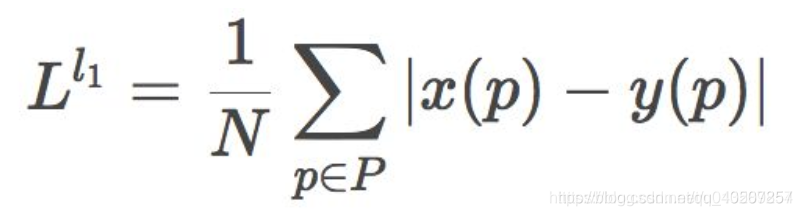
L1损失函数: 基于逐像素比较差异,然后取绝对值。
1.1.2 参数设定
L1Loss — PyTorch 1.13 documentation
CLASS torch.nn.L1Loss(size_average=None, reduce=None, reduction='mean')

我们一般设定reduction的值来显示平均值或者和。
参数设定:
reduction可取的值:
'none'|'mean'|'sum'.'none': no reduction will be applied-
'mean': the sum of the output will be divided by the number of elements in the output,求的是平均值,即各个差求和之后除以总数。 -
'sum': the output will be summed. Note:size_averageandreduceare in the process of being deprecated, and in the meantime, specifying either of those two args will overridereduction.只求和,不除总数。 -
Default:
'mean'
1.1.3 代码实现
设置reduction的值为默认值和sum,观察区别。
- import torch
- from torch.nn import L1Loss
- inputs = torch.tensor([1,2,3],dtype=torch.float32)
- targets = torch.tensor([1,2,5],dtype=torch.float32)
- inputs = torch.reshape(inputs,(1,1,1,3))
- targets = torch.reshape(targets,(1,1,1,3))
- loss1 = L1Loss()
- result1 = loss1(inputs,targets)
- print(result1)
- loss2 = L1Loss(reduction="sum")
- result2 = loss2(inputs,targets)
- print(result2)
- 当取值为默认值mean时,求的是平均值,sum=(1-1+2-2+5-3)=2, n=3, result = sum/n=0.6667
- 当取值为sum时,求的是和,即result=2

1.2 MSE损失函数(平方和)
1.2.1 简介
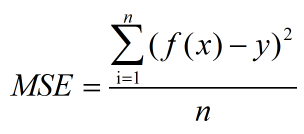
均方误差(Mean Square Error,MSE)是回归损失函数中最常用的误差,它是预测值f(x)与目标值y之间差值平方和的均值,其公式如下所示:
1.2.2 参数介绍
MSELoss — PyTorch 1.13 documentation

与上面的L1损失函数一样,我们可以改变reduction的值来进行对应数值的输出。
1.2.3 代码实现
- import torch
- from torch.nn import L1Loss, MSELoss
- inputs = torch.tensor([1,2,3],dtype=torch.float32)
- targets = torch.tensor([1,2,5],dtype=torch.float32)
- inputs = torch.reshape(inputs,(1,1,1,3))
- targets = torch.reshape(targets,(1,1,1,3))
- loss_mse1 = MSELoss()
- result1 = loss_mse1(inputs,targets)
- print(result1)
- loss_mse2 = MSELoss(reduction="sum")
- result2 = loss_mse2(inputs,targets)
- print(result2)
可以看到reduction设置不同的值对应的输出也不同。

1.3 损失函数的作用
- 计算实际输出和目标之间的差距
- 为更新输出(反向传播)提供一定的依据
二、在神经网络中使用loss function
2.1 使用交叉熵损失函数
使用上次定义的神经网络和CIFAR10数据集进行图像分类,分类问题使用交叉熵损失函数。
- import torch.nn
- from torch import nn
- import torchvision.datasets
- from torch.nn import Conv2d, MaxPool2d, Flatten, Linear, Sequential
- from torch.utils.data import DataLoader
- from torch.utils.tensorboard import SummaryWriter
- dataset = torchvision.datasets.CIFAR10(root="./CIFAR10",train=False,transform=torchvision.transforms.ToTensor(),download=True)
- dataloader = DataLoader(dataset,batch_size=1)
- class Maweiyi(torch.nn.Module):
- def __init__(self):
- super(Maweiyi, self).__init__()
- self.model1 = Sequential(
- Conv2d(in_channels=3, out_channels=32, kernel_size=5, padding=2),
- MaxPool2d(kernel_size=2),
- Conv2d(in_channels=32, out_channels=32, kernel_size=5, padding=2),
- MaxPool2d(kernel_size=2),
- Conv2d(in_channels=32, out_channels=64, kernel_size=5, padding=2),
- MaxPool2d(kernel_size=2),
- Flatten(),
- Linear(in_features=1024, out_features=64),
- Linear(in_features=64, out_features=10)
- )
- def forward(self, x):
- x = self.model1(x)
- return x
- maweiyi = Maweiyi()
- # 使用交叉熵损失函数
- loss_cross = nn.CrossEntropyLoss()
- for data in dataloader:
- imgs,labels = data
- outputs = maweiyi(imgs)
- results = loss_cross(outputs,labels)
- print(results)
可以看到使用loss function计算出了在神经网路中预测的output和真实值labels之间的差距大小。

2.2 反向传播
results_loss.backward()

-
相关阅读:
大数据从入门到精通(超详细版)之Hive案例,指标统计, Sql语句的编写
js中进行数字,超大金额(千位符)格式化处理
单片机C语言实例:3、数码管累加与累减动态显示
Taro中添加小程序 “lazyCodeLoading“: “requiredComponents“,
C语言最佳实践(B站学习)更新
使用Redis实现缓存及对应问题解决
剑指offer015 三数之和
EMD、EEMD、FEEMD、CEEMDAN分解的对比(其中CEEMDAN分解可以有效消除模态分解)
C#底层库--操作Excel帮助类(读取、导出表格)
ASP.NET Core 性能优化-缓存
- 原文地址:https://blog.csdn.net/weixin_45662399/article/details/128108725
