-
链表OJ题+牛客题
目录
206.反转链表
给你单链表的头节点head,请你反转链表,并返回反转后的链表。

实现如下结果:

思路:
取链表中的节点头插:

代码:
- /**
- * Definition for singly-linked list.
- * struct ListNode {
- * int val;
- * struct ListNode *next;
- * };
- */
- struct ListNode* reverseList(struct ListNode* head){
- struct ListNode *cur=head;
- struct ListNode *plist=NULL;
- while(cur)
- {
- struct ListNode *next=cur->next;
- cur->next=plist;//cur->next指向plist的地址
- plist=cur; //plist 指向cur的地址,刚上面的一行代码和这一行代码使得链表的空间相连
- cur =next;
- }
- return plist;
- }/**
- * Definition for singly-linked list.
- * struct ListNode {
- * int val;
- * struct ListNode *next;
- * };
- */
- struct ListNode* reverseList(struct ListNode* head){
- struct ListNode *cur=head;
- struct ListNode *plist=NULL; //作为新的头节点
- while(cur)
- {
- struct ListNode *next=cur->next; //记住cur的下一个节点
- cur->next=plist;// 头插
- plist=cur; //换头
- cur =next; //将原来cur->next节点的地址赋给cur
- }
- return plist;
- }
876.链表的中间节点
给定一个头节点为head的非空单链表,返回链表的中间节点。如果有两个中间节点,则返回第二个中间节点。要求只能遍历一遍
思路:用快慢指针找到中间节点,定义两个结构体变量指针slow,fast。
slow每次走一步,fast每次走两步。当fast->next为空的时候,则链表长度为奇数,那么slow就是中间节点;当fast为空时,链表的长度为偶数,那么中间节点有两个,则返回第二个中间节点。

代码:
- /**
- * Definition for singly-linked list.
- * struct ListNode {
- * int val;
- * struct ListNode *next;
- * };
- */
- struct ListNode* middleNode(struct ListNode* head){
- struct ListNode *fast,*slow;
- slow=fast=head;
- while(fast&&fast->next)
- {
- slow=slow->next;
- fast=fast->next->next;
- }
- return slow;
- }
链表中倒数第k个节点
输入一个链表,输出该链表中第k个节点
思路:定义结构体指针变量slow,fast,让fast先走k部,然后它们都各自每次向后走一步,当fast为空的时候,返回slow,此时slow就为链表中第k个节点。也可以让fast先走k-1步,当fast->next为空的时候,slow就是链表中第k个节点。
在这里需要注意的就是要注意k的值是否大于链表的长度,如果大于则返回NULL.

代码:
- struct ListNode*FindKthToTail(struct ListNode*pListHead,int k)
- {
- struct ListNode*fast,slow;
- fast=slow=pListHead;
- while(k--)//让fast先走k步
- {
- //链表可能没有k步长
- if(fast==NULL)
- {
- return NULL;
- }
- fast=fast->next;
- }
- while(fast)//当fast为空
- {
- fast=fast->next;
- slow=slow->next;
- }
- return slow;
- }
CM11链表分割
描述:
现有一链表头指针为LinstNode* pHead,给一定值x,编写一段代码将所有小于x的节点排在其余结点之前,且不能改变原来的数据顺序,返回重新排列后的链表头指针。
思路:
这道题用带哨兵位的链表求解,将所有小于x的节点尾插到第一个哨兵位节点后面;其余的尾插到第二个带哨兵位节点后面;最后将两个链表链接,返回第一个哨兵位节点后一个节点。

这里需要注意的是,在最后尾插结束时记得将第二个链表的尾节点的下一个节点置空(即上图的greaterTail的下一个节点置空),因为尾插结束,greaterTail->next还指向链表中的其他节点,如果不置空,会形成环。

代码:
- class Partition
- {
- public:
- ListNode *Partition(ListNode*pHead,int x)
- {
- struct ListNode*lessHead,*lessTail;
- struct ListNode*greaterHead,*greaterTail;
- lessHead=lessTail=(struct ListNode*)malloc(sizeof(structListNode));
- greaterHead=greaterTail=(struct ListNode*)malloc(sizeof(struct ListNode));
- lessTail->next=greaterTail->next=NULL;
- struct ListNode*cur=pHead;
- while(cur)
- {
- if(cur->val{lessTail->next=cur;lessTail=lessTail->next;}else{greaterTail->next=cur;greterTail=greaterTail->next;}cur=cur->next;}lessTail->next=greaterHead->next;greaterTail->next=NULL;pHead=lessHead->next;free(lessHead);free(greaterHead);return pHead;}}
OR36 链表的回文
描述:
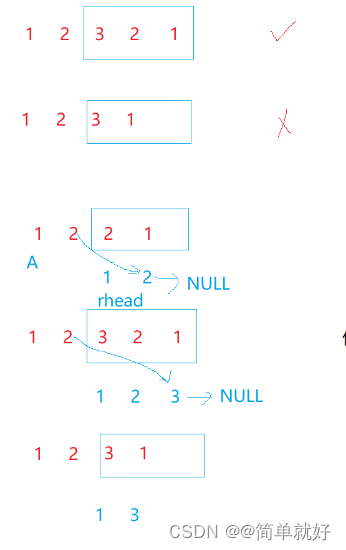
对于一个链表,请设计时间复杂度为O(n),空间复杂度为O(1)的算法,判断其是否为回文结构。
给定一个链表的头指针A,请返回一个bool值,代表其是否为回文结构。保证链表长度小于等于900.

思路:将链表的后半部分的节点逆置,再将前半部分的值和后半部分的值相比。因为额外的空间复杂度为O(1),所以不能整体逆置,整体逆置要重新开辟一个和原来一样长的链表空间。所以这里将后半部分的节点逆置之后就可以比较了。
代码:
- /*
- struct ListNode {
- int val;
- struct ListNode *next;
- ListNode(int x) : val(x), next(NULL) {}
- };*/
- class PalindromeList {
- public:
- struct ListNode* middle(struct ListNode* phead) //返回中间值
- {
- struct ListNode*fast,*slow;
- fast=slow=phead;
- while(fast&&fast->next)
- {
- slow=slow->next;
- fast=fast->next->next;
- }
- return slow;
- }
- struct ListNode*reverse(struct ListNode*phead)
- {
- struct ListNode*cur=phead;
- struct ListNode*rehead=NULL;
- while(cur)
- {
- struct ListNode*next=cur->next;
- //头插
- cur->next=rehead;
- rehead=cur;
- cur=next;
- }
- return rehead;
- }
- bool chkPalindrome(ListNode* A)
- {
- struct ListNode*mid=middle(A);
- struct ListNode*rehead=reverse(mid);
- while(A && rehead)
- {
- if(A->val!=rehead->val)
- return false;
- A=A->next;
- rehead=rehead->next;
- }
- return true;
- // write code here
- }
- };
- 相关阅读:
uniapp 手写 简易 时间轴 组件
【python】Conda强大的包/环境管理工具
CH455G驱动数码管
(项目)ZHUZHU新闻
2022年全球市场品牌保护和安全标签总体规模、主要生产商、主要地区、产品和应用细分研究报告
开关量8入4出,高速以太网通讯Socket自由协议远程IO模块 YJ94
ubuntu20环境搭建+Qt6安装
React插槽
矩阵置零00
【Android】内存泄露 使用 LeakCanary 应当如何应对?最全的解决
- 原文地址:https://blog.csdn.net/weixin_53269843/article/details/127963267
