-
【DropBlock】《DropBlock:A regularization method for convolutional networks》

NIPS-2018
1 Background and Motivation
Dropout 的缺点,as a regularization technique for fully connected layers, it is often less effective for convolutional layers
有此缺点的原因,activation units in convolutional layers are spatially correlated so information can still flow through convolutional networks despite dropout.
Thus a structured form of dropout is needed to regularize convolutional networks
作者提出了 DropBlock,a form of structured dropout, where units in a contiguous region of a feature map are dropped together

the networks must look elsewhere for evidence to fit the data2 Related Work
- DropConnect
- maxout
- StochasticDepth
- DropPath
- Scheduled-DropPath
- shake-shake regularization
- ShakeDrop regularization
The basic principle behind these methods is to inject noise into neural networks so that they do not overfit the training data.
Our method is inspired by Cutout(灵感来源去 cutout,可参考 【Cutout】《Improved Regularization of Convolutional Neural Networks with Cutout》)
DropBlock generalizes Cutout by applying Cutout at every feature map in a convolutional networks.
3 Advantages / Contributions
提出DropBlock 数据增广策略,works better than dropout in regularizing convolutional networks
4 DropBlock
linearly increase it over time during training
Its main difference from dropout is that it drops
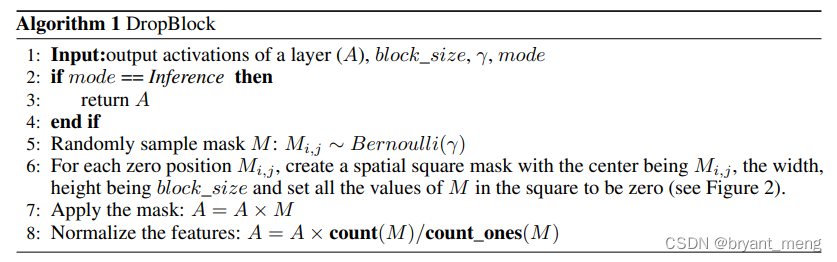
contiguous regions from a feature map of a layer instead of dropping out independent random units.算法流程
示意图

先找 mask M M M,图2a 绿色区域, M M M 中找 block 中心点,也即 zero entry M i , j M_{i,j} Mi,j(红X),服从 M i , j ∼ B e r n o u l l i ( γ ) M_{i,j} \sim Bernoulli(\gamma) Mi,j∼Bernoulli(γ) 二项分布,以 block 中心外扩形成边长为 block_size 的正方形 block 区域(黑X),黑X 和绿框重叠的区域被置为了0为了保证每一个 M i , j M_{i,j} Mi,j 点都能扩展成一个正方形,本文仅仅在绿色区域中采样,也即 feat_size - block_size + 1 区域。
两个要配置的参数
-
block_size,所有特征图上 block_size 大小固定
DropBlock resembles dropout when block_size = 1 and resembles SpatialDropout when block_size covers the full feature map.(通道被 mask 了) -
γ \gamma γ,

其中 keep_prob 的含义, keep every activation unit with the probability of keep_prob,实验中被设置为了 between 0.75 and 0.95下面看看 γ \gamma γ 的推导过程,来自DropBlock
- 特征删除总量为 ( 1 − k e e p _ p r o b ) ∗ ( f e a t _ s i z e ) 2 (1-keep\_prob)*(feat\_size)^2 (1−keep_prob)∗(feat_size)2
- 中心区域(绿框)大小为 ( f e a t _ s i z e − b l o c k _ s i z e + 1 ) 2 (feat\_size - block\_size + 1)^2 (feat_size−block_size+1)2
- 红叉数量为 ( f e a t _ s i z e − b l o c k _ s i z e + 1 ) 2 ∗ γ (feat\_size - block\_size + 1)^2 * \gamma (feat_size−block_size+1)2∗γ
- 总屏蔽(黑叉)大小为 ( f e a t _ s i z e − b l o c k _ s i z e + 1 ) 2 ∗ γ ∗ b l o c k _ s i z e 2 (feat\_size - block\_size + 1)^2 * \gamma * block\_size^2 (feat_size−block_size+1)2∗γ∗block_size2
由 ( 1 − k e e p _ p r o b ) ∗ ( f e a t _ s i z e ) 2 = ( f e a t _ s i z e − b l o c k _ s i z e + 1 ) 2 ∗ γ ∗ b l o c k _ s i z e 2 (1-keep\_prob)*(feat\_size)^2 = (feat\_size - block\_size + 1)^2 * \gamma * block\_size^2 (1−keep_prob)∗(feat_size)2=(feat_size−block_size+1)2∗γ∗block_size2,推导出 γ \gamma γ 的公式,当然,黑叉区域有重叠,上述只是个大概的估计(The main nuance of DropBlock is that there will be some overlapped in the dropped blocks, so the above equation is only an approximation. )
Scheduled DropBlock
gradually decreasing keep_prob over time from 1 to the target value is more robust
实验中用的是线性 decrease(use a linear scheme of decreasing the value of keep_prob)
5 Experiments
Datasets
- ILSVRC 2012 classification dataset
- COCO
- PASCAL VOC
5.1 ImageNet Classification
5.1.1 DropBlock in ResNet-50

1)Where to apply DropBlockonly after convolution layers or applying DropBlock after both convolution layers and skip connections.
applying DropBlock to Group 4 or to both Groups 3 and 4(对应的应该是 ResNet 的 stage4 和 stage5)
2)DropBlock vs. dropout

block_size 默认为 7
图 3a 可以看出,DropBlock 效果比较好
图 3b 可以看出,引入 scheduled keep_prob 后,acc 更高,而且应对不同的 keep_prob 设定,其鲁棒性更好(峰值维持的更持久)

图 4 可以看出,DropBlock 作用在 Group3&4 比单独作用在 Group3 上效果要好,引入 schedule keep_prob 后效果提升,DropBlock 作用在 skip connection 分支后,效果进一步提升。block_size 设置为7效果最好。作者 diss SpatialDropout,can be too harsh when applying to
high resolution feature map on group 3,也是,整块特征图都丢对比 Cutout,it does not improve the accuracy on the ImageNet dataset in our experiments.
5.1.2 DropBlock in AmoebaNet

5.2 Experimental Analysis
1)DropBlock drops more semantic information

validation accuracy reduced quickly with decreasing keep_prob during inference.说明 DropBlock removes semantic information and makes classification more difficult.
2)Model trained with DropBlock is more robust
图5看出 block_size = 7 is more robust and has the benefit of block_size = 1 but not vice versa.
3)DropBlock learns spatially distributed representations

实话说第三列我没有怎么看出来是个书店5.3 Object Detection in COCO

5.4 Semantic Segmentation in PASCAL VOC

6 Conclusion(own)
- dropblock 和 dropout 是兼容的
- 作用在 skip connection 可以进一步提升性能
代码,参考 DropBlock的原理和实现
from torch import nn import torch from torch import Tensor import torch.nn.functional as F import torchvision.transforms as T import PIL.Image as Image import matplotlib.pyplot as plt torch.set_printoptions(profile="full") import numpy as np class DropBlock(nn.Module): """ Implements DropBlock2d from `"DropBlock: A regularization method for convolutional networks"- 1
- 2
- 3
- 4
- 5
- 6
- 7
- 8
- 9
- 10
- 11
- 12
- 13
- 14
- 15
- 16
- 17
- 18
- 19
- 20
- 21
- 22
- 23
- 24
- 25
- 26
- 27
- 28
- 29
- 30
- 31
- 32
- 33
- 34
- 35
- 36
- 37
- 38
- 39
- 40
- 41
- 42
- 43
- 44
- 45
- 46
- 47
- 48
- 49
- 50
- 51
- 52
- 53
- 54
- 55
- 56
- 57
- 58
- 59
- 60
- 61
- 62
- 63
- 64
- 65
- 66
- 67
- 68
- 69
- 70
- 71
- 72
- 73
- 74
- 75
- 76
- 77
- 78
- 79
- 80

看代码的话,感觉 dropblock 每个通道丢弃的区域是独立的,不然和直接在原始图片空间维度上 drop 没有区别了实现的过程很巧妙,生成了 bernoulli 的 mask 后,用 size 为 block_size 步长为 1 的 max pooling 来生成黑×区域(类比腐蚀膨胀操作)


-
相关阅读:
电机控制算法
YAGEO(国巨)旧电脑风扇制作风力发电机步骤详解 - 电动机控制电路图
二、图像处理
linux ld 链接器学习笔记
nvm 解决不同项目需要使用的node版本不一致、nvm版本管理
基于Java的国内外重大新闻展示平台的设计与实现
办公小技巧:word打印怎么做?
Git: 仓库clone和用户配置
Spring文章汇总
03路由策略
- 原文地址:https://blog.csdn.net/bryant_meng/article/details/127851646
