-
逻辑回归预测瘀血阻络证||LogRegression 二分类 python3
要求
把数据集分为训练集和测试集使用逻辑回归训练、预测,得出相应的分类指标准确率accuracy,精确率precision,召回率recall,F1-score,并画出最终的ROC曲线,得出AUC值。
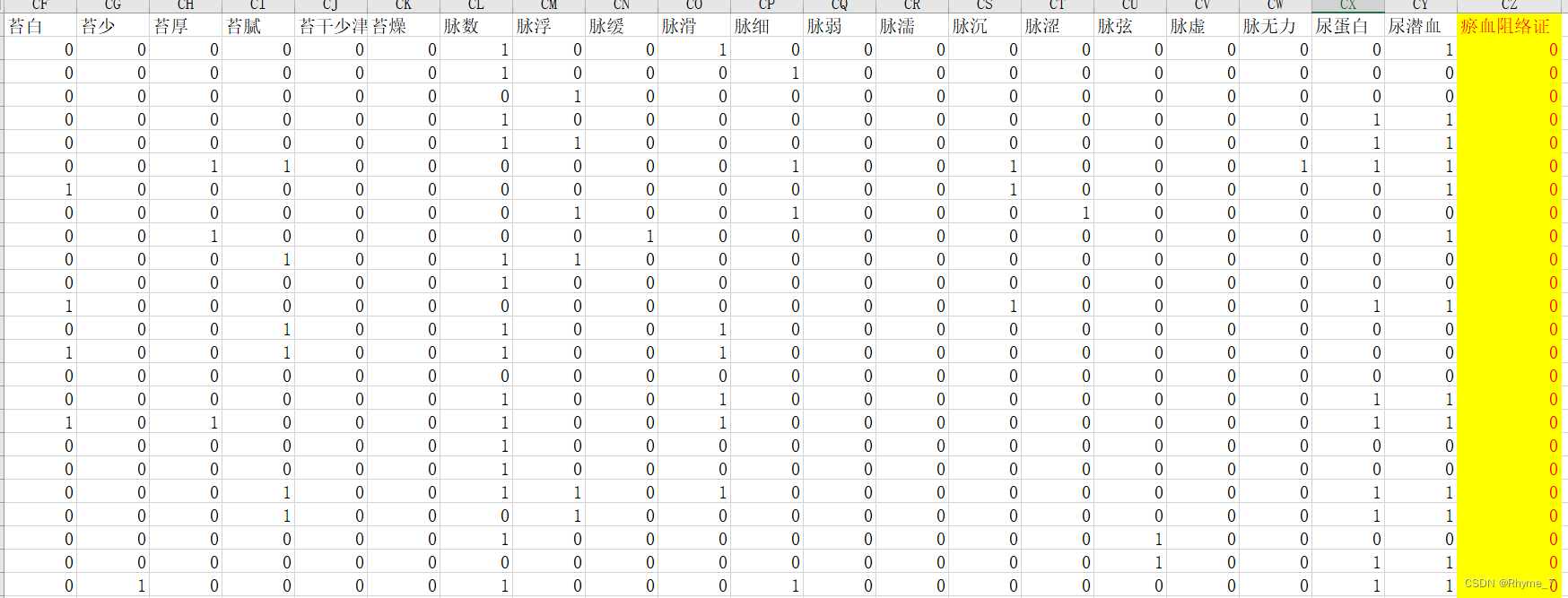
数据格式
664条样本 每条103个属性,最后一列为标签
结果


代码
- import pandas as pd
- from sklearn.linear_model import LogisticRegression
- from sklearn.model_selection import train_test_split
- from sklearn.preprocessing import StandardScaler
- from sklearn.metrics import classification_report, roc_curve, auc
- import matplotlib.pyplot as plt
- #根据标签和预测概率结果画出ROC图,并计算AUC值
- def acu_curve(y, prob):
- fpr, tpr, threshold = roc_curve(y, prob) ###计算真正率和假正率
- roc_auc = auc(fpr, tpr) ###计算auc的值
- plt.figure()
- lw = 2
- plt.figure(figsize=(6, 6))
- plt.plot(fpr, tpr, color='darkorange',
- lw=lw, label='ROC curve (area = %0.3f)' % roc_auc) ###假正率为横坐标,真正率为纵坐标做曲线
- plt.plot([0, 1], [0, 1], color='navy', lw=lw, linestyle='--')
- plt.xlim([0.0, 1.0])
- plt.ylim([0.0, 1.05])
- plt.xlabel('False Positive Rate')
- plt.ylabel('True Positive Rate')
- plt.title('Receiver operating characteristic')
- plt.legend(loc="lower right")
- plt.show()
- # 二分类,逻辑回归 瘀血阻络证预测
- # 读取数据 (如果不指定标签名,会默认把第一行数据当成标签名)
- data = pd.read_excel(
- "症状_瘀血阻络证_data.xlsx"
- )
- # print(data)
- # 缺失值进行处理 (原始数据中的?表示缺失值) 本样本无缺失值
- # data = data.replace(to_replace='?', value=np.nan)
- # data = data.dropna() # 删除有缺少值的行
- # 分割数据集 划分为训练集和测试集
- x_train, x_test, y_train, y_test = train_test_split(data.iloc[:, 0:103], data.iloc[:, 103:104],
- test_size=0.125) # 前103为属性;最后一列是目标值
- # 7:1划分;83条测试、581条训练
- # 进行标准化处理 因为目标结果经过sigmoid函数转换成了[0,1]之间的概率,所以目标值不需要进行标准化。
- std = StandardScaler()
- x_train = std.fit_transform(x_train)
- x_test = std.transform(x_test)
- # 逻辑回归预测
- lg = LogisticRegression(C=1.0) # 默认使用L2正则化避免过拟合,C=1.0表示正则力度(超参数,可以调参调优)
- lg.fit(x_train, y_train.values.ravel())
- # 回归系数
- # print(lg.coef_)
- # 进行预测
- y_predict_p = lg.predict_proba(x_test)#结果用类别概率表示 方便画ROC图
- #print(y_predict_p)
- y_predict = lg.predict(x_test)#结果用标签值表示 方便利用classification_report()函数 输出模型评估报告
- #print(y_predict)
- # 用classification_report()函数 输出模型评估报告
- # 原始数据中的目标值:0表示非瘀血阻络证,1表示瘀血阻络证
- print(classification_report(y_test,y_predict))
- #调用函数画出ROC图,并计算AUC值
- acu_curve(y_test,y_predict_p[:,1:2])
使用五折交叉验证
结果展示

更新一下
- import pandas as pd
- import warnings
- from sklearn.metrics import roc_curve
- from sklearn.preprocessing import StandardScaler
- from sklearn.model_selection import cross_val_predict
- from sklearn.linear_model import LogisticRegression
- from sklearn.model_selection import cross_val_score
- import matplotlib.pyplot as plt
- # 二分类 五折验证 逻辑回归 瘀血阻络证预测
- # 读取数据
- data = pd.read_excel(
- "症状_瘀血阻络证_data.xlsx"
- )
- # print(data)
- x_train = data.iloc[:, :-1] # 特征
- y_train = data.iloc[:, -1] # 标签
- # 进行标准化处理 因为目标结果经过sigmoid函数转换成了[0,1]之间的概率,所以目标值不需要进行标准化。
- std = StandardScaler()
- x_train = std.fit_transform(x_train)
- lr = LogisticRegression(random_state=填入你的随机数, tol=1e-6, C=0.01)
- lr_result = lr.fit(x_train, y_train.ravel())
- '''estimator:估计方法对象(分类器)
- X:数据特征(Features)
- y:数据标签(Labels)
- cv:几折交叉验证
- scoring='accuracy':准确率为结果的度量指标'''
- def muti_score(model):
- warnings.filterwarnings('ignore')
- accuracy = cross_val_score(model, x_train, y_train, scoring='accuracy', cv=5)
- precision = cross_val_score(model, x_train, y_train, scoring='precision', cv=5)
- recall = cross_val_score(model, x_train, y_train, scoring='recall', cv=5)
- f1_score = cross_val_score(model, x_train, y_train, scoring='f1', cv=5)
- auc = cross_val_score(model, x_train, y_train, scoring='roc_auc', cv=5)
- print("准确率:", accuracy.mean())
- print("精确率:", precision.mean())
- print("召回率:", recall.mean())
- print("F1_score:", f1_score.mean())
- print("AUC:", auc.mean())
- #画ROC
- y_scores = cross_val_predict(lr, x_train, y_train, cv=5, method='decision_function')
- fpr, tpr, thresholds = roc_curve(y_train, y_scores)
- plt.plot(fpr, tpr, linewidth=2, label='ROC(AUC=%0.3f)' % cross_val_score(lr, x_train, y_train, cv=5, scoring='roc_auc').mean(),
- color='darkorange')
- plt.xlabel('FPR') # False Positive Rate,假阳性率
- plt.ylabel('TPR') # True Positive Rate,真阳性率
- plt.plot([0, 1], [0, 1], color='navy', lw=2, linestyle='--')
- plt.ylim(0, 1.05)
- plt.xlim(0, 1.05)
- plt.legend(loc=4)
- plt.show()
- model = eval("lr")
- muti_score(model)
注意点
1、iloc函数使用方法(1条消息) iloc函数使用方法_阿狸狸_Nicole的博客-CSDN博客_.iloc
 https://blog.csdn.net/qq_39368111/article/details/110435536
2、 y_train.values.ravel()(1条消息) DataConversionWarning: A column-vector y was passed when a 1d array was expected. 问题解决_weixin_39223665的博客-CSDN博客
https://blog.csdn.net/weixin_39223665/article/details/812687413、classification_report()(1条消息) python机器学习classification_report()函数 输出模型评估报告_侯小啾的博客-CSDN博客_classification_report函数https://blog.csdn.net/weixin_48964486/article/details/122881350 -
相关阅读:
Flameshot源码编译方法
Python使用腾讯云SDK实现对象存储(上传文件、创建桶)
分享一个 asp.net core 多文件分块同时上传的组件
HBase与Hive集成
DBA 数据库管理 . 内连接.外链接
【MySQL】初识数据库
JUC并发编程——各种锁的理解(基于狂神说的学习笔记)
[AutoSar]工程中的cpuload陷阱(三)测试
【C++编程语言】之 加号 左移 递增 赋值 关系 函数调用 的 运算符重载
杠杆炒股中吸筹是什么?
- 原文地址:https://blog.csdn.net/qq_54499870/article/details/127871118