-
JAVA线程池 -clt设计与分析
1. 前言
- ctl 是线程池源码中常常用到的一个变量。
- 它的主要作用是记录线程池的生命周期状态和当前工作的线程数。
- 作者通过巧妙的设计,将一个整型变量按二进制位分成两部分,分别表示两个信息。
2. 源码解析
源码部分
/** * The main pool control state, ctl, is an atomic integer packing * two conceptual fields * workerCount, indicating the effective number of threads * runState, indicating whether running, shutting down etc * * In order to pack them into one int, we limit workerCount to * (2^29)-1 (about 500 million) threads rather than (2^31)-1 (2 * billion) otherwise representable. If this is ever an issue in * the future, the variable can be changed to be an AtomicLong, * and the shift/mask constants below adjusted. But until the need * arises, this code is a bit faster and simpler using an int. * * The workerCount is the number of workers that have been * permitted to start and not permitted to stop. The value may be * transiently different from the actual number of live threads, * for example when a ThreadFactory fails to create a thread when * asked, and when exiting threads are still performing * bookkeeping before terminating. The user-visible pool size is * reported as the current size of the workers set. * * The runState provides the main lifecycle control, taking on values: * * RUNNING: Accept new tasks and process queued tasks * SHUTDOWN: Don't accept new tasks, but process queued tasks * STOP: Don't accept new tasks, don't process queued tasks, * and interrupt in-progress tasks * TIDYING: All tasks have terminated, workerCount is zero, * the thread transitioning to state TIDYING * will run the terminated() hook method * TERMINATED: terminated() has completed * * The numerical order among these values matters, to allow * ordered comparisons. The runState monotonically increases over * time, but need not hit each state. The transitions are: * * RUNNING -> SHUTDOWN * On invocation of shutdown(), perhaps implicitly in finalize() * (RUNNING or SHUTDOWN) -> STOP * On invocation of shutdownNow() * SHUTDOWN -> TIDYING * When both queue and pool are empty * STOP -> TIDYING * When pool is empty * TIDYING -> TERMINATED * When the terminated() hook method has completed * * Threads waiting in awaitTermination() will return when the * state reaches TERMINATED. * * Detecting the transition from SHUTDOWN to TIDYING is less * straightforward than you'd like because the queue may become * empty after non-empty and vice versa during SHUTDOWN state, but * we can only terminate if, after seeing that it is empty, we see * that workerCount is 0 (which sometimes entails a recheck -- see * below). */ private final AtomicInteger ctl = new AtomicInteger(ctlOf(RUNNING, 0)); private static final int COUNT_BITS = Integer.SIZE - 3; private static final int CAPACITY = (1 << COUNT_BITS) - 1; // runState is stored in the high-order bits private static final int RUNNING = -1 << COUNT_BITS; private static final int SHUTDOWN = 0 << COUNT_BITS; private static final int STOP = 1 << COUNT_BITS; private static final int TIDYING = 2 << COUNT_BITS; private static final int TERMINATED = 3 << COUNT_BITS; // Packing and unpacking ctl private static int runStateOf(int c) { return c & ~CAPACITY; } private static int workerCountOf(int c) { return c & CAPACITY; } private static int ctlOf(int rs, int wc) { return rs | wc; }- 1
- 2
- 3
- 4
- 5
- 6
- 7
- 8
- 9
- 10
- 11
- 12
- 13
- 14
- 15
- 16
- 17
- 18
- 19
- 20
- 21
- 22
- 23
- 24
- 25
- 26
- 27
- 28
- 29
- 30
- 31
- 32
- 33
- 34
- 35
- 36
- 37
- 38
- 39
- 40
- 41
- 42
- 43
- 44
- 45
- 46
- 47
- 48
- 49
- 50
- 51
- 52
- 53
- 54
- 55
- 56
- 57
- 58
- 59
- 60
- 61
- 62
- 63
- 64
- 65
- 66
- 67
- 68
- 69
- 70
- 71
- 72
基础常量
线程池运行的状态,并不是用户显式设置的,而是伴随着线程池的运行,由内部来维护。
线程池内部使用一个原子整型变量ctl维护两个值:运行状态(runState)和线程数量 (workerCount) 其中高3位保存runState,低29位保存workerCount当前池线程数。如下代码所示:// 初始化ctl值为0,并设置状态为RUNNING private final AtomicInteger ctl = new AtomicInteger(ctlOf(RUNNING, 0)); // 结果:32-3=29,就用来表示分隔runState 和workerCount 的位数 // 之所以-3,因为线程池的生命周期有 5 个状态,为了表达这 5 个状态,我们需要 3 个二进制位。 private static final int COUNT_BITS = Integer.SIZE - 3; // 结果:000 1 1111 1111 1111 1111 1111 1111 1111 private static final int CAPACITY = (1 << COUNT_BITS) - 1;- 1
- 2
- 3
- 4
- 5
- 6
- 7
目前我们已经有了三个变量信息(如何使用这三个值,请看下文):
- clt:保存了运行状态(runState)和线程数量 (workerCount) 的值
- COUNT_BITS:29,分隔runState 和workerCount 的位数
- CAPACITY(2进制):000 1 1111 1111 1111 1111 1111 1111 1111,前三位为0,后29位为1
可能你对【CAPACITY】二进制的值有所疑惑,那么我们来看看推演过程
1. (1 << COUNT_BITS) - 1可平替为 (1 << 29) - 1 2. 首先看 1 的二进制代表 0000 0000 0000 0000 0000 0000 0000 0001。 3. 向左移 29 位得到 0010 0000 0000 0000 0000 0000 0000 0000。 4. 数据减 1 得到 0001 1111 1111 1111 1111 1111 1111 1111。- 1
- 2
- 3
- 4
- 5
我们都知道线程池有五个状态,它在线程池中分布是如下表示的:
- RUNNING:能接受新提交的任务,并且也能处理阻塞队列中的任务。
- SHUTDOWN:指调用了 shutdown() 方法,不再接受新提交的任务,但却可以继续处理阻塞队列中已保存的任务。
- STOP:指调用了 shutdownNow() 方法,不再接受新提交的任务,同时抛弃阻塞队列里的所有任务并中断所有正在执行任务。
- TIDYING: 所有任务都执行完毕,workerCount 有效线程数为 0。
- TERMINATED:终止状态,当执行 terminated() 后会更新为这个状态。

源码如下
// 结果29 private static final int COUNT_BITS = Integer.SIZE - 3; // runState is stored in the high-order bits private static final int RUNNING = -1 << COUNT_BITS; private static final int SHUTDOWN = 0 << COUNT_BITS; private static final int STOP = 1 << COUNT_BITS; private static final int TIDYING = 2 << COUNT_BITS; private static final int TERMINATED = 3 << COUNT_BITS;- 1
- 2
- 3
- 4
- 5
- 6
- 7
- 8
我们来推算下他们值(2进制表示)
/** * 各个值的二进制表示: * * 1111 1111 1111 1111 1111 1111 1111 1111 (-1) * 0000 0000 0000 0000 0000 0000 0000 0000 (0) * 0000 0000 0000 0000 0000 0000 0000 0001 (1) * 0000 0000 0000 0000 0000 0000 0000 0010 (2) * 0000 0000 0000 0000 0000 0000 0000 0011 (3) * * 【分析】: * 初始容量值,高三位全是0,低29位全是1;后续操作会以此为基础进行操作 * CAPACITY(29) 000 1 1111 1111 1111 1111 1111 1111 1111 * * ---------------3位-1位 -28位--- * 【前三位,表明状态位,后29位表明线程个数,即 2^29 - 1 基本够用了】 * * RUNNING(-536870912) 111 0 0000 0000 0000 0000 0000 0000 0000 * SHUTDOWN(0) 000 0 0000 0000 0000 0000 0000 0000 0000 * STOP(536870912) 001 0 0000 0000 0000 0000 0000 0000 0000 * TIDYING(1073741824) 010 0 0000 0000 0000 0000 0000 0000 0000 * TERMINATED(1610612736) 011 0 0000 0000 0000 0000 0000 0000 0000 * * /- 1
- 2
- 3
- 4
- 5
- 6
- 7
- 8
- 9
- 10
- 11
- 12
- 13
- 14
- 15
- 16
- 17
- 18
- 19
- 20
- 21
- 22
- 23
- 24
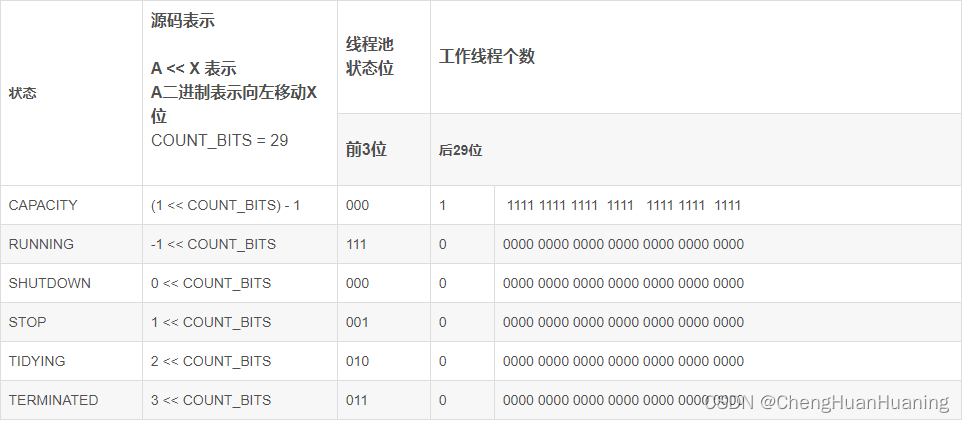
根据以上分析得,我们只需要重点关注高三位:- RUNNING:对应的高3位值是111
- SHUTDOWN:对应的高3位值是000。
- STOP: 对应的高3位值是001。
- TIDYING:对应的高3位值是010。
- TERMINATED:对应的高3位值是011。
打包函数与拆包函数
拆包函数
上面我们曾说过,线程池内部使用一个原子整型变量
ctl维护两个值:运行状态(runState)和线程数量 (workerCount) 其中高3位保存runState,低29位保存workerCount当前池线程数
这样我们就可以知道这两个方法的目的:获取当前参数的高3位和低29位// 获取当前运行状态 private static int runStateOf(int c) { return c & ~CAPACITY; } // 获取工作线程数 private static int workerCountOf(int c) { return c & CAPACITY; }- 1
- 2
- 3
- 4
- 5
- 6
- 7
- 8
让我们复习下&(与运算): 只要有0则为0
让我们复习下|(或运算): 只要有1则为1运行状态
c & ~CAPACITY :意为CAPACITY取反后与c进行&操作,得到当前入参二进制的前三位(运行状态)我们以c为【RUNNING】状态举例 CAPACITY结果 000 1 1111 1111 1111 1111 1111 1111 1111 ~CAPACITY取反结果 111 0 0000 0000 0000 0000 0000 0000 0000 (前三位全为1,后29位全为0) c的结果 111 X XXXX XXXX XXXX XXXX XXXX XXXX XXXX (由上诉可知RUNNING高3位值是111) c & ~CAPACITY的结果 111 0 0000 0000 0000 0000 0000 0000 0000 (与RUNNING对应的结果一致)- 1
- 2
- 3
- 4
- 5
获取线程数量
我们以2个线程数来举例
CAPACITY结果 000 1 1111 1111 1111 1111 1111 1111 1111 2的二进制表示 XXX 0 0000 0000 0000 0000 0000 0000 0010 c & CAPACITY的结果 000 0 0000 0000 0000 0000 0000 0000 0010- 1
- 2
- 3
打包函数
// rs 运行状态 // wc 工作线程个数 private static int ctlOf(int rs, int wc) { return rs | wc; }- 1
- 2
- 3
对 runState 和 workerCount 进行 | (按位或)操作来得到 ctl 变量
就是因为 runState 的高 3 位为有效信息,而 workerCount 的低 29 位为有效信息,合起来正好得到一个含 32 位有效信息的整型变量。为什么之前提到的生命周期常量要在 -1 ~ 3 的基础上再左移 29 位,因为不在常量初始化处左移的话就要在拆包/打包的时候右移来保证取到的是正确的数值。然而拆包/打包操作是要经常进行的,而常量的初始化只有一次。两下对比,明显在初始化时左移是效率更高的选择。
引用文章
-
相关阅读:
从四个角度全面认识 ChatGPT
词云的可视化设计教程
el-table的formatter属性的使用方法
矩形脉冲波形的占空比及脉冲和瞬态特征的测量
json文本的反序列化,转化为python对象
【java学习—七】对象的实例化过程(33)
【DRF自定义filter】
Java 多线程:并发编程的三大特性
30天黑客(网络安全)自学
MySQL MHA高可用配置及故障切换
- 原文地址:https://blog.csdn.net/ChengHuanHuaning/article/details/127738087
