-
C++多线程 join、detach、joinable
join()
- 进程是资源分配的最小单位
- 线程共享进程的栈空间,但是每个线程拥有独立的栈
- 主程序调用join目的是
等待子线程退出,回收他的资源
如果子线程已经推出,join、立即执行
如果没有退出,join阻塞,直到子线程退出
注意
不能同时对一个线程使用join和detach - 格式
thread my(show); my.join();- 1
- 2
detach()
- 主程序调用detach目的:
分离子线程,
子线程退出时系统才自动回收资源 - 注意
不能同时对一个线程使用join和detach - 另外可以通过延迟[sleep]主程序return
来查看detach执行情况
如果不sleep可能看不到结果,
但是不影响程序后台执行


joinable()
bool类型函数,它会表示当前的线程是否是可执行线程(能被join或者detach)
1 -> 表示可以join或者detach
0 ->表示已经可以join或者detach不可再重复回收资源


this_thread全局函数
this_thread::get_id()
获取线程ID
void fun(int ret, const string & str) { cout << "我是第" << ret << "个成员,我的线程ID是: "; cout << this_thread::get_id() << endl; } int main() { thread my(fun, 10, "哈啊哈哈"); my.join(); thread my1(fun, 11, "wssdasda哈"); cout << "我是主线程,我操作的my1的子线程ID是:" << my1.get_id() << endl; my1.join(); cout << "我是主线程,我操作的my1的子线程ID是:" << my1.get_id(); }- 1
- 2
- 3
- 4
- 5
- 6
- 7
- 8
- 9
- 10
- 11
- 12
第二次my1的线程id是0是因为他已经被回收

this_thread::sleep_for()
线程休眠
时间参数是休眠的具体时间//方法1 chrono::milliseconds dura(1000); this_thread::sleep_for(dura); //方法2 this_thread::sleep_for(chrono::milliseconds(100));- 1
- 2
- 3
- 4
- 5
- 6
this_thread::sleep_until()
时间参数是时间点【略】
this_thread::yield()
让线程放出自己抢到的时间片
swap(不属于this_thread命名空间下)
格式(二者选其一)
swap(a,b);
a.swap(b);
移动构造函数拷贝进程[不在this::thread]
thread类的拷贝函数被删除
所以用移动构造函数赋值
另外赋值的已经转移,原来的线程付给了新的
原来的废弃,新的接管
如下图my不可再用,my1接管my
使用move可以转为右值

创建线程
void test01();//函数作为卡调用对象传入
void test02();//类作为可调用对象传入
void test03();//lambda匿名函数普通函数创建线程
void fun(int ret, const string& str) { cout << "我是第" << ret << "个成员,我要说话:“" << str << "”" << endl; } int main() { thread my(fun, 10, "哈啊哈哈"); my.join(); }- 1
- 2
- 3
- 4
- 5
- 6
- 7
lambda匿名函数类创建线程
auto f = [](int ret, const string& str) { cout << "我是第" << ret << "个成员,我要说话:“" << str << "”" << endl; }; thread my(f, 10, "哈啊哈哈"); my.join(); //注意default和传入值 thread my1([](int ret = 10, const string &str = "啊啊啊啊啊") { cout << "我是第" << ret << "个成员,我要说话:“" << str << "”" << endl; },50,"aaaaaa"); my1.join();- 1
- 2
- 3
- 4
- 5
- 6
- 7
- 8
- 9
- 10

类创建线程
仿函数创建线程
切记仿函数无参不创建匿名类对象【原因不详】

#include#include using namespace std; class stu { public: void operator()(int ret, const string& str); }; void stu::operator()(int ret, const string& str) { cout << "我是第" << ret << "个成员,我要说话:“" << str << "”" << endl; } int main() { stu s1; thread name(s1, 20, "哈哈哈"); name.join(); //注意用仿函数类名对象,必须带参数,如果无参只能用上面的不能用stu() thread name1(stu(), 30, "aaa"); name1.join(); } - 1
- 2
- 3
- 4
- 5
- 6
- 7
- 8
- 9
- 10
- 11
- 12
- 13
- 14
- 15
- 16
- 17
- 18
- 19
- 20

类的静态成员函数创建线程
#include#include using namespace std; class stu { public: static void fun(int ret, const string& str); }; void stu::fun(int ret, const string& str)//类成员函数类外写 { cout << "我是第" << ret << "个成员,我要说话:“" << str << "”" << endl; } int main() { thread name(stu::fun, 3, "hello"); name.join(); } - 1
- 2
- 3
- 4
- 5
- 6
- 7
- 8
- 9
- 10
- 11
- 12
- 13
- 14
- 15
- 16
- 17

类的普通成员函数【注意】
①、必须先创建对象
②、对象的生命周期比子线程长
③、注意传进去的是指针
thread name(&stu::fun,&s1, 3, “hello”);#include#include using namespace std; class stu { public: void fun(int ret, const string& str); }; void stu::fun(int ret, const string& str)//类成员函数类外写 { cout << "我是第" << ret << "个成员,我要说话:“" << str << "”" << endl; } int main() { stu s1; thread name(&stu::fun,&s1, 3, "hello"); name.join(); } - 1
- 2
- 3
- 4
- 5
- 6
- 7
- 8
- 9
- 10
- 11
- 12
- 13
- 14
- 15
- 16
- 17

【创建线程总结之万变不离其宗】
普通函数、lambda、static类成员函数
thread thread_name(方法,参数1,参数2 , ... ,参数n)- 1
仿函数类
thread thread_name(类对象,参数1,参数2 , ... ,参数n)- 1
注意如果是匿名类对象(stu())则必须有参数,无参的可使用匿名类对象
普通成员函数
thread thread_name(方法,类对象(不可匿名),参数1,参数2 , ... ,参数n)- 1
相关代码
#includeusing namespace std; //thread是一个类 #include //线程头文件linux和win //show函数 void show(){ cout<<"我是show函数子线程1"<<endl; cout<<"我是show函数子线程2"<<endl; cout<<"我是show函数子线程3"<<endl; cout<<"我是show函数子线程4"<<endl; cout<<"我是show函数子线程5"<<endl; } //stu类 class stu { public: void operator()(){//方函数 cout<<"我是class类子线程1"<<endl; cout<<"我是class类子线程2"<<endl; cout<<"我是class类子线程3"<<endl; cout<<"我是class类子线程4"<<endl; cout<<"我是class类子线程5"<<endl; } }; void test01();//函数作为卡调用对象传入 void test02();//类作为可调用对象传入 void test03();//lambda匿名函数 int main(){ //test01(); //test02(); test03(); cout<<"我是主线程1"<<endl; cout<<"我是主线程2"<<endl; return 0; } void test03(){ //()无参数可以省略小括号 thread my_xc([](){ cout<<"我是lambda匿名函数子线程1"<<endl; cout<<"我是lambda匿名函数子线程2"<<endl; cout<<"我是lambda匿名函数子线程3"<<endl; cout<<"我是lambda匿名函数子线程4"<<endl; cout<<"我是lambda匿名函数子线程5"<<endl; }); my_xc.join(); } void test02(){ stu s1; thread my_xc(s1); //my_xc.join(); //detach个走个的,输出顺序会混乱 my_xc.detach();//注意join后不可以detach,二者只能有一个 } void test01(){ //子线程也从函数开始执行(初始函数)(初始函数结束则线程结束) thread my_xc(show);//show[函数是一个可调用对象 //join-->阻塞主线程,让主线程等待子线程执行完毕,会合后一起走 //注释掉join或放到return 0 后面 //报错terminate called without an active exception //my_xc.join();//主线程被堵住子线程依然可以走 //joinable可判断是否join、detach过 cout<<"是否可以join或detach:"<<my_xc.joinable()<<endl; //主线程从mian函数开始(一般主线程结束子线程就会被强行结束[detach例外]) //主线程和子线程没关系可以用detach【注意join之后不可再detach】 my_xc.detach();//【守护线程】(子线程在后台运行)【但是不建议用detach】 cout<<"是否可以join或detach:"<<my_xc.joinable()<<endl; } - 1
- 2
- 3
- 4
- 5
- 6
- 7
- 8
- 9
- 10
- 11
- 12
- 13
- 14
- 15
- 16
- 17
- 18
- 19
- 20
- 21
- 22
- 23
- 24
- 25
- 26
- 27
- 28
- 29
- 30
- 31
- 32
- 33
- 34
- 35
- 36
- 37
- 38
- 39
- 40
- 41
- 42
- 43
- 44
- 45
- 46
- 47
- 48
- 49
- 50
- 51
- 52
- 53
- 54
- 55
- 56
- 57
- 58
- 59
- 60
- 61
- 62
- 63
- 64
- 65
- 66
- 67
- 68
- 69
- 70
- 71
- 72
- 73
- 74
使用detach格外小心
传递int类型时不建议用引用(detach)
如果传递类对象要进行转换,不要让编译器进行隐式转换
【使用临时对象可以确保线程参数再mian函数结束之前就被构造出来】
thread my(show1,i,string(buff));
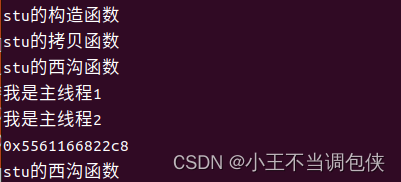
thread my(show1,i,mydelfclass(buff));#includeusing namespace std; //thread是一个类 #include //线程头文件linux和win //类 class stu{ public: int m; stu(int m):m(m){ cout<<"stu的构造函数id:"<<this_thread::get_id()<<endl; } stu(const stu &s){ cout<<"stu的拷贝函数"<<endl; } ~stu(){ cout<<"stu的西沟函数"<<endl; } }; //show函数 void show(const int &i ,const string &mybuff){ cout<<i<<endl; cout<<mybuff<<endl; } //class_show void show_class(const int &i ,const stu &my_stu){ cout<<&my_stu<<endl; } void test01(); void test02(); void test03(); int main(){ //test01(); test02(); cout<<"我是主线程1:"<<this_thread::get_id()<<endl; cout<<"我是主线程2:"<<this_thread::get_id()<<endl; return 0; } void test02(){ int i = 1; int arr = 12; thread my(show_class,i,stu(arr)); my.detach();//但是detach会存在问题【不推荐引用,但是指针一定不可以】 } void test01(){ int i = 1; int &arr = i; char buff[] = "我是子线程"; //string(buff)对这个对象进行转【临时的string对象】 thread my(show,i,string(buff)); //my.join();//show用的是i是thread的拷贝的新地质 my.detach();//但是detach会存在问题【不推荐引用,但是指针一定不可以】 } - 1
- 2
- 3
- 4
- 5
- 6
- 7
- 8
- 9
- 10
- 11
- 12
- 13
- 14
- 15
- 16
- 17
- 18
- 19
- 20
- 21
- 22
- 23
- 24
- 25
- 26
- 27
- 28
- 29
- 30
- 31
- 32
- 33
- 34
- 35
- 36
- 37
- 38
- 39
- 40
- 41
- 42
- 43
- 44
- 45
- 46
- 47
- 48
- 49
- 50
- 51
- 52
- 53
- 54
- 55
- 56
- 57
- 58
- 59
- 60
- 61
- 62
- 63
- 64
趣味练习 之 线程排序
sleep排序法
#include#include #include #include #include #include using namespace std; vector <double> res; mutex flag; void show(const double ret) { Sleep(ret*1000);//排序的数字越细,*的数字要越大 flag.lock(); res.push_back(ret); cout << "我是" << ret << "我排序完毕" << endl; //cout << "我的线程ID:" << this_thread::get_id() << endl; flag.unlock(); } int main() { vector <double>ret = { 10,8,20,11,21,21.001}; thread n1(show, ret[0]); thread n2(show, ret[1]); thread n3(show, ret[2]); thread n4(show, ret[3]); thread n5(show, ret[4]); thread n6(show, ret[5]); n1.join(); n2.join(); n3.join(); n4.join(); n5.join(); n6.join(); for (auto a : res) cout << a << endl; } - 1
- 2
- 3
- 4
- 5
- 6
- 7
- 8
- 9
- 10
- 11
- 12
- 13
- 14
- 15
- 16
- 17
- 18
- 19
- 20
- 21
- 22
- 23
- 24
- 25
- 26
- 27
- 28
- 29
- 30
- 31
- 32
- 33
- 34
- 35

猴子排序法
#include#include #include #include #include #include using namespace std; vector <double> res; mutex flag; void show(const double ret) { flag.lock(); res.push_back(ret); cout << "我是:" << ret << endl; flag.unlock(); } int main() { bool flag = 0; a: vector <double>ret = { 10,8,20,11,21,21.001}; thread n1(show, ret[0]); thread n2(show, ret[1]); thread n3(show, ret[2]); thread n4(show, ret[3]); thread n5(show, ret[4]); thread n6(show, ret[5]); n1.join(); n2.join(); n3.join(); n4.join(); n5.join(); n6.join(); for (int i = 0; i < res.size()-1; i++) { if (res[i] <= res[i + 1]) flag = 1; else { flag = 0; res.clear(); cout << "排序不对,再进行新一轮排序" << endl; goto a; } } // if (flag == 1) cout << "排序完毕"<<endl; for (auto a : res) cout << a << endl; } - 1
- 2
- 3
- 4
- 5
- 6
- 7
- 8
- 9
- 10
- 11
- 12
- 13
- 14
- 15
- 16
- 17
- 18
- 19
- 20
- 21
- 22
- 23
- 24
- 25
- 26
- 27
- 28
- 29
- 30
- 31
- 32
- 33
- 34
- 35
- 36
- 37
- 38
- 39
- 40
- 41
- 42
- 43
- 44
- 45
- 46
- 47
- 48
- 49

-
相关阅读:
NFTFi终极指南
LeetCode之二叉树
1. 梯度下降法
三、kotlin的类和对象(二)
线程与进程
【华为OD机试真题 python】 城市聚集度【2022 Q4 | 200分】
unity 渲染环境设置
【数据挖掘】滴滴公司数据挖掘工程师笔试题
基于rancher安装部署k8s
【大虾送书第十期】从不了解用户画像,到用画像数据赋能业务看这一本书就够了
- 原文地址:https://blog.csdn.net/weixin_45646601/article/details/127709058
