-
二、稀疏数组和队列
稀疏数组
1、基本介绍
当一个数组中大部分元素为0,或者为同一个值的数组时,可以用稀疏数组来保存该数组。
2、处理方式
- 记录数组一共有几行几列,有多少个不同的值
- 把具有不同值的元素的行列及值记录在一个小规模数组中,从而缩小程序的规模

3、思路分析
3.1 二维数组转稀疏数组的思路
- 遍历原始二维数组,得到有效数据的个数sum
- 根据sum创建稀疏数组 int sparseArray[][] = new int[sum + 1][3];(稀疏数组固定是3列)
- 将二维数组中的有效数据存放到稀疏数组中
3.2 稀疏数组转原始二维数组思路
- 读取稀疏数组第一行数据,根据第一行数据创建原始数组,如:int chessArr[][] = new int[11][11];
- 再读取稀疏数组后几行的数据,赋值给原始二维数组即可

4、代码实现
public class SparseArray { public static void main(String[] args) { //创建一个原始的二维数组 11*11 //0 表示没有棋子 1 表示黑子 2表示蓝子 int chessArr[][] = new int[11][11]; chessArr[1][2] = 1; chessArr[2][3] = 2; System.out.println("====原始的二维数组===="); printArray(chessArr); //将二维数组 转 稀疏数组 //1、先遍历二维数组,得到非零数据的个数 int sum = 0; for (int i = 0; i < chessArr.length; i++) { for (int j = 0; j < chessArr.length; j++) { if (chessArr[i][j] != 0) { sum++; } } } System.out.println("sum = " + sum); //2、创建对应的稀疏数组 (3列是固定的) int sparseArray[][] = new int[sum + 1][3]; //给稀疏数组赋值 sparseArray[0][0] = 11; sparseArray[0][1] = 11; sparseArray[0][2] = sum; //3、遍历数组,将非0的值放在sparseArray中 int count = 0;//用于记录是第几个非0数据 for (int i = 0; i < chessArr.length; i++) { for (int j = 0; j < chessArr.length; j++) { if (chessArr[i][j] != 0) { count++; sparseArray[count][0] = i; sparseArray[count][1] = j; sparseArray[count][2] = chessArr[i][j]; } } } System.out.println("====得到的稀疏数组===="); for (int i = 0; i < sparseArray.length; i++) { System.out.printf("%d\t%d\t%d\t\n", sparseArray[i][0],sparseArray[i][1],sparseArray[i][2]); } System.out.println(); //将稀疏数组 转 原始二维数组 // 1.先读取稀疏数组的第一行,根据第一行的数据,创建原始的二维数组 int[][] chessArr2 = new int[sparseArray[0][0]][sparseArray[0][1]]; // 2.读取稀疏数组的后几行数据(从第二行开始),并复制给原始的二维数组即可 for (int i = 1; i < sparseArray.length; i++) { chessArr2[sparseArray[i][0]][sparseArray[i][1]] = sparseArray[i][2]; } // 3.输出恢复后的二维数组 System.out.println("====恢复后的二维数组===="); printArray(chessArr2); } public static void printArray(int[][] array) { for (int[] row : array) { for (int data : row) { System.out.printf("%d\t",data); } System.out.println(); } } }- 1
- 2
- 3
- 4
- 5
- 6
- 7
- 8
- 9
- 10
- 11
- 12
- 13
- 14
- 15
- 16
- 17
- 18
- 19
- 20
- 21
- 22
- 23
- 24
- 25
- 26
- 27
- 28
- 29
- 30
- 31
- 32
- 33
- 34
- 35
- 36
- 37
- 38
- 39
- 40
- 41
- 42
- 43
- 44
- 45
- 46
- 47
- 48
- 49
- 50
- 51
- 52
- 53
- 54
- 55
- 56
- 57
- 58
- 59
- 60
- 61
- 62
- 63
- 64
- 65
- 66
- 67
- 68
- 69
- 70
输出结果如下:
原始的二维数组
0 0 0 0 0 0 0 0 0 0 0
0 0 1 0 0 0 0 0 0 0 0
0 0 0 2 0 0 0 0 0 0 0
0 0 0 0 0 0 0 0 0 0 0
0 0 0 0 0 0 0 0 0 0 0
0 0 0 0 0 0 0 0 0 0 0
0 0 0 0 0 0 0 0 0 0 0
0 0 0 0 0 0 0 0 0 0 0
0 0 0 0 0 0 0 0 0 0 0
0 0 0 0 0 0 0 0 0 0 0
0 0 0 0 0 0 0 0 0 0 0
sum = 2
得到的稀疏数组
11 11 2
1 2 1
2 3 2恢复后的二维数组
0 0 0 0 0 0 0 0 0 0 0
0 0 1 0 0 0 0 0 0 0 0
0 0 0 2 0 0 0 0 0 0 0
0 0 0 0 0 0 0 0 0 0 0
0 0 0 0 0 0 0 0 0 0 0
0 0 0 0 0 0 0 0 0 0 0
0 0 0 0 0 0 0 0 0 0 0
0 0 0 0 0 0 0 0 0 0 0
0 0 0 0 0 0 0 0 0 0 0
0 0 0 0 0 0 0 0 0 0 0
0 0 0 0 0 0 0 0 0 0 0练习
- 在代码实现的的基础上,将稀疏数组保存到磁盘上,比如map.data
- 恢复原来的数组,读取map.data进行恢复
/** * 存储稀疏数组,相邻数据使用\t划分 * @param path 文件的存放路径 * @param sparseArr 稀疏数组对象 */ public static void save(String path,int[][] sparseArr) { FileWriter fileWriter = null; try { fileWriter = new FileWriter(path); for (int[] row : sparseArr) { fileWriter.write(row[0]+"\t" + row[1] + "\t" + row[2]); fileWriter.write("\r\n"); } } catch (IOException e) { e.printStackTrace(); }finally { try { fileWriter.close(); } catch (IOException e) { e.printStackTrace(); } } } /** * 读取二维稀疏数组,相邻数据使用\t划分 * @param path 文件的存放路径 * @return 二维的稀疏数组 */ public static void read(String path) { int[][] sparseArr = null; BufferedReader bufferedReader = null; try { bufferedReader = new BufferedReader(new FileReader(path)); String lineStr = null; int lineCount = 0; while ((lineStr = bufferedReader.readLine()) != null ) { String[] tempStr = lineStr.split("\t"); if (lineCount == 0) { // 稀疏数组的[0,2]位置记录了非0数据个数,所以稀疏数组大小为[Integer.parseInt(tempStr[2]) + 1][3] sparseArr = new int[Integer.parseInt(tempStr[2] ) +1 ][3]; } sparseArr[lineCount][0] =Integer.parseInt(tempStr[0]); sparseArr[lineCount][1] =Integer.parseInt(tempStr[1]); sparseArr[lineCount][2] =Integer.parseInt(tempStr[2]); lineCount++; } } catch (Exception e) { e.printStackTrace(); }finally { try { bufferedReader.close(); } catch (IOException e) { e.printStackTrace(); } } }- 1
- 2
- 3
- 4
- 5
- 6
- 7
- 8
- 9
- 10
- 11
- 12
- 13
- 14
- 15
- 16
- 17
- 18
- 19
- 20
- 21
- 22
- 23
- 24
- 25
- 26
- 27
- 28
- 29
- 30
- 31
- 32
- 33
- 34
- 35
- 36
- 37
- 38
- 39
- 40
- 41
- 42
- 43
- 44
- 45
- 46
- 47
- 48
- 49
- 50
- 51
- 52
- 53
- 54
- 55
- 56
队列
- 队列是一个有序列表,可以用数组或链表实现
- 遵循先进先出的原则,即:先存入队列的数据,要先取出。后存入的要后取出。
1、数组模拟队列
- 队列本身也是有序列表,若使用数组的结构来存储队列的数据,则队列数组的声明如下图,其中MaxSize为队列的最大容量
- 因为队列的输出输入是分别从前后端来处理,因此需要两个变量front和rear分别记录前后端的下标,front会随着数据输出而改变,而rear会随着数据输入而改变
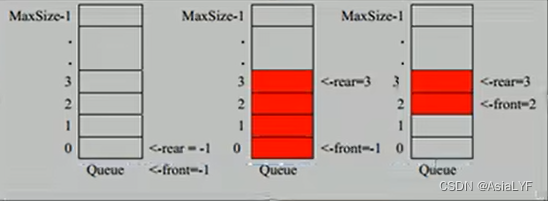 当我们将数据存入队列时称为”addQueue”,addQueue 的处理需要有两个步骤:思路分析
- 将尾指针往后移:rear + 1 , 当 rear==front 【空】
- 若尾指针 rear 小于队列的最大下标 MaxSize-1,则将数据存入 rear 所指的数组元素中,否则无法存入数据。 reatr==MaxSize - 1[队列满]
注:rear是队列最后(含), front是队列最前(不含)
2、代码实现
public class ArrayQueueDemo { public static void main(String[] args) { //创建一个队列 ArrayQueue arrayQueue = new ArrayQueue(3); char key = ' ';// 接受用户输入 Scanner scanner = new Scanner(System.in); boolean loop = true; System.out.println("s(show):显示队列"); System.out.println("e(exit):退出程序"); System.out.println("a(add):添加数据到队列"); System.out.println("g(get):从队列取数据"); System.out.println("h(head):查看队列头的数据"); while (loop) { key = scanner.next().charAt(0);// 接收第一个字符 switch (key) { case 's': arrayQueue.showQueue(); break; case 'a': System.out.println("输入一个数:"); int value = scanner.nextInt(); arrayQueue.addQueue(value); break; case 'g': try { int res = arrayQueue.getQueue(); System.out.printf("取出的数据是%d\n", res); continue; } catch (RuntimeException e){ System.out.println(e.getMessage()); } break; case 'h': try { int res = arrayQueue.headQueue(); System.out.printf("队列头的数据是%d\n", res); } catch (RuntimeException e){ System.out.println(e.getMessage()); } break; case 'e': scanner.close(); loop = false; break; default: break; } } System.out.println("程序退出"); } } class ArrayQueue{ private int maxSize;//表示数组的最大容量 private int front; //队列头 private int rear; //队列尾 private int[] arr; //该数组用于存放数据,模拟队列 public ArrayQueue(int maxSize) { this.maxSize = maxSize; arr = new int[maxSize]; front = -1;// 指向队列头部,指向队列头部的数据的前一个位置 rear = -1; // 指向队列尾,指向队列尾部的数据 } /** * 判断队列是否满 * @return */ public boolean isFull() { // 例如最大容量为5,rear是指向队列尾部数据,所以rear为4(maxSize - 1)的时候就为满了 return rear == maxSize -1; } /** * 判断队列是否为空 * @return */ public boolean isEmpty() { // 因为不是循环队列,头尾不相连,所以rear == front 时队列就为空 return rear == front; } /** * 添加数据到队列 * @param n */ public void addQueue(int n) { // 判断队列是否满 if (isFull()) { System.out.println("队列满,不能加入数据~~"); return; } rear++; arr[rear] = n; } /** * 数据出队列 * @return */ public int getQueue() { if (isEmpty()) { // 通过抛出异常 throw new RuntimeException("队列为空,不能取数据~~"); } front++; return arr[front]; } /** * 显示队列的所有数据 */ public void showQueue() { if (isEmpty()) { System.out.println("队列空的,没有数据~~"); return; } for (int i = 0; i < arr.length; i++) { System.out.printf("arr[%d] = %d\n", i, arr[i]); } } /** * 显示队列的头数据,不是取数据而仅仅是显示 * @return */ public int headQueue() { if (isEmpty()) { // 通过抛出异常 throw new RuntimeException("队列为空,不能取数据~~"); } return arr[front + 1]; } }- 1
- 2
- 3
- 4
- 5
- 6
- 7
- 8
- 9
- 10
- 11
- 12
- 13
- 14
- 15
- 16
- 17
- 18
- 19
- 20
- 21
- 22
- 23
- 24
- 25
- 26
- 27
- 28
- 29
- 30
- 31
- 32
- 33
- 34
- 35
- 36
- 37
- 38
- 39
- 40
- 41
- 42
- 43
- 44
- 45
- 46
- 47
- 48
- 49
- 50
- 51
- 52
- 53
- 54
- 55
- 56
- 57
- 58
- 59
- 60
- 61
- 62
- 63
- 64
- 65
- 66
- 67
- 68
- 69
- 70
- 71
- 72
- 73
- 74
- 75
- 76
- 77
- 78
- 79
- 80
- 81
- 82
- 83
- 84
- 85
- 86
- 87
- 88
- 89
- 90
- 91
- 92
- 93
- 94
- 95
- 96
- 97
- 98
- 99
- 100
- 101
- 102
- 103
- 104
- 105
- 106
- 107
- 108
- 109
- 110
- 111
- 112
- 113
- 114
- 115
- 116
- 117
- 118
- 119
- 120
- 121
- 122
- 123
- 124
- 125
- 126
- 127
- 128
- 129
- 130
- 131
- 132
- 133
- 134
- 135
- 136
- 137
4、此种实现方式存在缺陷和优化方案
- 数组使用一次就不能使用了,没有达到复用的效果
- 使用算法,改成一个环形的队列:取模%
环形队列
1、声明与结论
- front指向队列的头部元素,也就是说arr[front]就是队列的第一个元素,front的初始值为0
- rear指向队列的尾部元素的后一个位置,因为希望空出一个空间做为约定,rear的初始值为0
- 当队列满时,条件是 (rear +1) % maxSize= front 【满】
- 对队列为空的条件,rear == front 【空
- 队列中有效的数据的个数 (rear + maxSize - front) % maxSize 【rear=1 front=0,元素个数为1
2、结论分析
疑问:当空队列时,front等于rear,现在队列满时,也是front等于rear,那么如何判断此时的队列是空还是满呢?
办法1:设置一个标志变量flag。当front == rear,且flag = 0时队列为空,当front == rear,且flag = 1时队列为满。
办法2:当队列为空时,条件就是front == rear,当队列满时,我们保留一个元素空间,这样数组中还有一个空闲单元。如图1:
图1 
图2 
图3 我们重点来讨论一下第二种方法,由于rear可能比front大,也可能比front小,所以尽管它们只相差一个位置时就是满的情况,但也可能是相差整整一圈。所以若队列的最大尺寸为QueueSize,那么队列满的条件是(rear+1)%QueueSize == front(取模“%”的目的就是为了整合rear与front大小为一个问题)。比如图1,QueueSize = 5,front=0,而rear=4,(4+1)%5 = 0,所以此时队列满。再比如图2,front=2而rear=1,(1+1)%5 =2,所以此时队列也是满的。再比如图3,front=2,而rear=0,(0+1)%5 = 1,front ≠rear,所以此时队列并没有满。
另外,当rear>front时,即图1,此时队列的长度为rear-front。但当rear3、代码实现
public class CircleArrayQueueDemo { public static void main(String[] args) { // 创建一个队列 CircleArray circleArray = new CircleArray(4); // 其队列的有效数据最大是3 char key = ' '; // 接受用户输入 Scanner scanner = new Scanner(System.in); boolean loop = true; System.out.println("s(show):显示队列"); System.out.println("e(exit):退出程序"); System.out.println("a(add):添加数据到队列"); System.out.println("g(get):从队列取数据"); System.out.println("h(head):查看队列头的数据"); while (loop) { key = scanner.next().charAt(0); // 接收第一个字符 switch (key) { case 's': circleArray.showQueue(); break; case 'a': System.out.println("输入一个数:"); int value = scanner.nextInt(); circleArray.addQueue(value); break; case 'g': try { int res = circleArray.getQueue(); System.out.printf("取出的数据是%d\n", res); continue; } catch (RuntimeException e){ System.out.println(e.getMessage()); } break; case 'h': try { int res = circleArray.headQueue(); System.out.printf("队列头的数据是%d\n", res); } catch (RuntimeException e){ System.out.println(e.getMessage()); } break; case 'e': scanner.close(); loop = false; break; default: break; } } System.out.println("程序退出"); } } class CircleArray{ private int maxSize;//表示数组的最大容量 private int front; //队列头 private int rear; //队列尾 private int[] arr; //该数组用于存放数据,模拟队列 public CircleArray(int maxSize) { this.maxSize = maxSize; arr = new int[maxSize]; } // 判断队列是否满 public boolean isFull() { return (rear + 1) % maxSize == front; } //判断队列是否为空 public boolean isEmpty() { return front == rear; } // 添加数据到队列 public void addQueue(int n) { // 判断队列是否满 if (isFull()) { System.out.println("队列满,不能加入数据~~"); return; } // 直接将数据加入 arr[rear] = n; // 将 rear 后移 ,这里必须考虑取模 rear = (rear + 1) % maxSize; } // 数据出队列 public int getQueue() { if (isEmpty()) { // 通过抛出异常 throw new RuntimeException("队列为空,不能取数据~~"); } // front是指向队列的第一个元素 // 1.先把front对应的值保存到一个临时变量, int value = arr[front]; // 2.将front后移,考虑取模 front = (front + 1) % maxSize; return value; } // 显示队列的所有数据 public void showQueue() { if (isEmpty()) { System.out.println("队列空的,没有数据~~"); return; } // 从front开始遍历,遍历多少个元素 for (int i = front; i < front + size(); i++) { int index = i % maxSize; // 加上size之后可能会超过数组范围,需要进行取模 System.out.printf("arr[%d]=%d\n", index, arr[index]); } } // 求出当前队列的有效数据个数 public int size(){ // 这里 + maxSize保证分子是正数,也可以使用Math.abs(rear - front) return (rear + maxSize - front) % maxSize; } // 显示队列的头数据,不是取数据而仅仅是显示 public int headQueue() { // 判断队列是否为空 if (isEmpty()){ // 通过抛出异常 throw new RuntimeException("队列为空,没有数据~~"); } return arr[front]; } }- 1
- 2
- 3
- 4
- 5
- 6
- 7
- 8
- 9
- 10
- 11
- 12
- 13
- 14
- 15
- 16
- 17
- 18
- 19
- 20
- 21
- 22
- 23
- 24
- 25
- 26
- 27
- 28
- 29
- 30
- 31
- 32
- 33
- 34
- 35
- 36
- 37
- 38
- 39
- 40
- 41
- 42
- 43
- 44
- 45
- 46
- 47
- 48
- 49
- 50
- 51
- 52
- 53
- 54
- 55
- 56
- 57
- 58
- 59
- 60
- 61
- 62
- 63
- 64
- 65
- 66
- 67
- 68
- 69
- 70
- 71
- 72
- 73
- 74
- 75
- 76
- 77
- 78
- 79
- 80
- 81
- 82
- 83
- 84
- 85
- 86
- 87
- 88
- 89
- 90
- 91
- 92
- 93
- 94
- 95
- 96
- 97
- 98
- 99
- 100
- 101
- 102
- 103
- 104
- 105
- 106
- 107
- 108
- 109
- 110
- 111
- 112
- 113
- 114
- 115
- 116
- 117
- 118
- 119
- 120
- 121
- 122
- 123
- 124
- 125
- 126
- 127
- 128
- 129
- 130
- 131
-
相关阅读:
SpringMVC的整合完成CRUD(增删改查)
Java.lang.Class类 getCanonicalName方法有什么功能呢?
C语言扫雷游戏完整实现(上)
开放本人早年的Windows核心编程的代码库——供引擎设计参考
【电路基础1】电阻
轻量级网络IP扫描器WatchYourLAN
面试官:说说Netty对象池的实现原理?
DHCP协议从入门到部署DHCP服务器进行实验
MySQL常用命令02
数据结构与算法之链表-python实现(简单好用)
- 原文地址:https://blog.csdn.net/AsiaLYF/article/details/127682752
