-
你必须要知道CNN模型:ResNet残差网络
相关资料
- ResNet原始论文:https://arxiv.org/pdf/1512.03385.pdf
- 我的wps论文笔记:Deep Residual Learning for Image Recognition

- 李沐视频:残差网络 ResNet【动手学深度学习v2】
- 知乎:ResNet网络层分析
CNN模型ResNet的核心思想
ResNet解决了深度CNN模型难训练的问题。
ResNet-18,ResNet-34,ResNet-50都可以用做CV中的图片特征提取器。ResNet块
原始ResNet块(1x1卷积是通道数变化的作用)
果然是Conv->BN->ReLU的顺序。
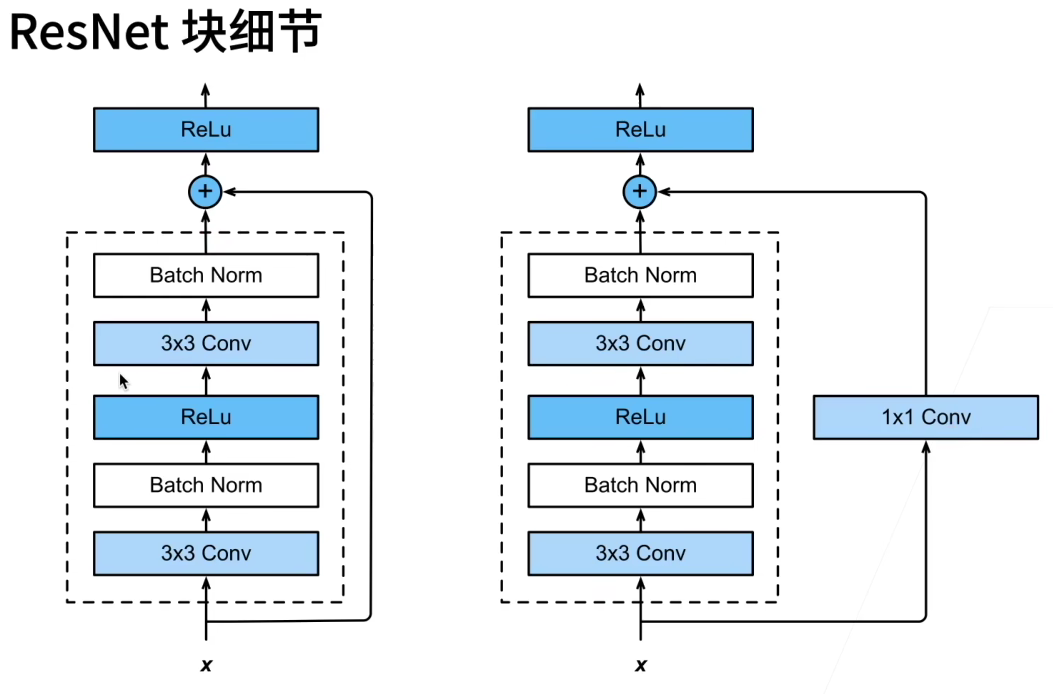
我们也可以尝试各种架构的残差块,具体看实验效果,也学效果可能都差不多

ResNet:ResNet18, ResNet34, ResNet50…
ResNet在PyTorch的官方代码中共有5种不同深度的结构,深度分别为18、34、50、101、152(各种网络的深度指的是“需要通过训练更新参数”的层数,如卷积层,全连接层等),和论文完全一致。

ResNet-18代码
Pytorch官方代码
class BasicBlock(nn.Module): expansion: int = 1 def __init__( self, inplanes: int, planes: int, stride: int = 1, downsample: Optional[nn.Module] = None, groups: int = 1, base_width: int = 64, dilation: int = 1, norm_layer: Optional[Callable[..., nn.Module]] = None, ) -> None: super().__init__() if norm_layer is None: norm_layer = nn.BatchNorm2d if groups != 1 or base_width != 64: raise ValueError("BasicBlock only supports groups=1 and base_width=64") if dilation > 1: raise NotImplementedError("Dilation > 1 not supported in BasicBlock") # Both self.conv1 and self.downsample layers downsample the input when stride != 1 self.conv1 = conv3x3(inplanes, planes, stride) self.bn1 = norm_layer(planes) self.relu = nn.ReLU(inplace=True) self.conv2 = conv3x3(planes, planes) self.bn2 = norm_layer(planes) self.downsample = downsample self.stride = stride def forward(self, x: Tensor) -> Tensor: identity = x out = self.conv1(x) out = self.bn1(out) out = self.relu(out) out = self.conv2(out) out = self.bn2(out) if self.downsample is not None: identity = self.downsample(x) out += identity out = self.relu(out) return- 1
- 2
- 3
- 4
- 5
- 6
- 7
- 8
- 9
- 10
- 11
- 12
- 13
- 14
- 15
- 16
- 17
- 18
- 19
- 20
- 21
- 22
- 23
- 24
- 25
- 26
- 27
- 28
- 29
- 30
- 31
- 32
- 33
- 34
- 35
- 36
- 37
- 38
- 39
- 40
- 41
- 42
- 43
- 44
- 45
- 46
- 47
相关问题
问题1:Transformer中用的是ResNet吗?
不是的,Transformer用的只是残差的思想,只是把输入加到输出。而ResNet是把多个ResNet块堆叠起来的CNN模型,是用在CV领域的图片特征提取器。
问题2:ResNet为什么能训练出1000层的模型
一句话:梯度反向传播时,加深网络时,改用乘法,而不是加法。
这样的好处:通常在靠近输入层的参数通常是比较难训练的,因为拿到的梯度比较小。引入ResNet后,因为加入了跳转或者说高速公路,所以在算梯度的时候,底层W的梯度可以直接让loss从高速公路反传过来,就不需要一定把中间很多卷积层走完。所以说在一开始的时候,我最下面的层也会拿到比较大的梯度,就是因为我加入了高速公路。。。同样地,倒数第二层也可以通过它上层的高速公路得到参数更新。 因此无论你模型有多深,我下面的层都能做参数的更新。

附:CNN模型ResNet-18网络架构图
Conv(浅蓝)-> BN(白色) -> ReLU(深蓝)


-
相关阅读:
ES6-04-模块化的暴露:export关键字
基于自适应自回归模型的高级人工智能概念及其实现
linux服务端c++开发工具介绍(vscode版)
Macos 远程登录 Ubuntu22.04 桌面
Android仿淘宝、京东Banner滑动查看图文详情
Python接口自动化 —— Json 数据处理实战(详解)
Redis配置优化
牛客NC314 体育课测验(一)【中等 图,BFS,拓扑排序 Java,Go、PHP】
全志R128驱动OLED屏幕步骤教程
第五篇、Callable接口实现多线程
- 原文地址:https://blog.csdn.net/qq_43827595/article/details/127224545
