-
Reactor的Publisher与Subscriber
Project Reactor介绍
在计算机中,响应式变成或者反应式编程(Reactive Programming)是一种面向数据流和变化传播的编程范式。这意味着可以在编程语言中很方便地变大静态或动态的数据流,而相关的计算模型会自动将变化的值通过数据流进行传播。
作用
Reactor希望用少量、有限个数的线程来满足高负载的需要。 IO阻塞浪费系统性能,只有纯异步处理才能发挥系统的全部性能。JDK的异步API较为难用,成为异步编程的瓶颈。
响应式编程特性
- Responsive(响应式)
- Resilient(弹性)
- Message Driven(消息驱动)
- asynchronous request(异步请求)
- non-blocking(非阻塞)
- Backpressure(背压)
数据处理流程
测试代码
Subscriber增强类:
public class LoggingSubscriber<T> implements Subscriber<T> { private static final Logger log = LoggerFactory.getLogger(LoggingSubscriber.class); private Subscription subscription; private long requested; private long received; private CountDownLatch finished = new CountDownLatch(1); @Override public void onComplete() { log.info("onComplete: sub={}", subscription.hashCode()); finished.countDown(); } @Override public void onError(Throwable t) { log.error("Error: sub={}, message={}", subscription.hashCode(), t.getMessage(),t); finished.countDown(); } @Override public void onNext(T value) { log.info("onNext: sub={}, value={}", subscription.hashCode(), value); this.received++; this.requested++; subscription.request(1); } @Override public void onSubscribe(Subscription sub) { log.info("onSubscribe: sub={}", sub.hashCode()); this.subscription = sub; this.received = 0; this.requested = 1; sub.request(1); } public long getRequested() { return requested; } public long getReceived() { return received; } /** * 阻塞调用者,直到发布者发出所有对象或产生错误 */ public void block() { try { finished.await(10, TimeUnit.SECONDS); } catch(InterruptedException iex) { throw new RuntimeException(iex); } } }- 1
- 2
- 3
- 4
- 5
- 6
- 7
- 8
- 9
- 10
- 11
- 12
- 13
- 14
- 15
- 16
- 17
- 18
- 19
- 20
- 21
- 22
- 23
- 24
- 25
- 26
- 27
- 28
- 29
- 30
- 31
- 32
- 33
- 34
- 35
- 36
- 37
- 38
- 39
- 40
- 41
- 42
- 43
- 44
- 45
- 46
- 47
- 48
- 49
- 50
- 51
- 52
- 53
- 54
- 55
- 56
- 57
- 58
- 59
使用Streams处理数据
public class SteamTest { private static Logger log = LoggerFactory.getLogger(SteamTest.class); public static void main(String[] args) { Publisher<String> pub = Streams.publish(Arrays.asList("hello", "hello again")); LoggingSubscriber<String> sub = new LoggingSubscriber<String>(); pub.subscribe(sub); sub.block(); } }- 1
- 2
- 3
- 4
- 5
- 6
- 7
- 8
- 9
- 10
- 11
限制请求数量
public class YieldTest { private static Logger log = LoggerFactory.getLogger(SteamTest.class); public static void main(String[] args) { /** * 限制对象创建数量 * 接收yieldRequest对象并返回下一个要发出的对象的Function参数 */ Publisher<String> pub = Streams.yield((t) -> { System.out.println(t.getRequestNum()); return t.getRequestNum() < 5 ? "hello" : null; }); LoggingSubscriber<String> sub = new LoggingSubscriber<String>(); pub.subscribe(sub); sub.block(); assertEquals(5, sub.getReceived()); } }- 1
- 2
- 3
- 4
- 5
- 6
- 7
- 8
- 9
- 10
- 11
- 12
- 13
- 14
- 15
- 16
- 17
- 18
- 19
周期性请求
public class PeriodicTest { private static Logger log = LoggerFactory.getLogger(SteamTest.class); public static void main(String[] args) { /** * 周期性做请求 */ ScheduledExecutorService executor = Executors.newScheduledThreadPool(1); Publisher<String> pub = Streams.periodically(executor, Duration.ofSeconds(1), (t) -> { return t < 5 ? String.format("hello %d", t) : null; }); LoggingSubscriber<String> sub = new LoggingSubscriber<String>(); pub.subscribe(sub); sub.block(); assertEquals(5, sub.getReceived()); } }- 1
- 2
- 3
- 4
- 5
- 6
- 7
- 8
- 9
- 10
- 11
- 12
- 13
- 14
- 15
- 16
- 17
- 18
一些核心概念
Operators-Publisher/Subscriber
-
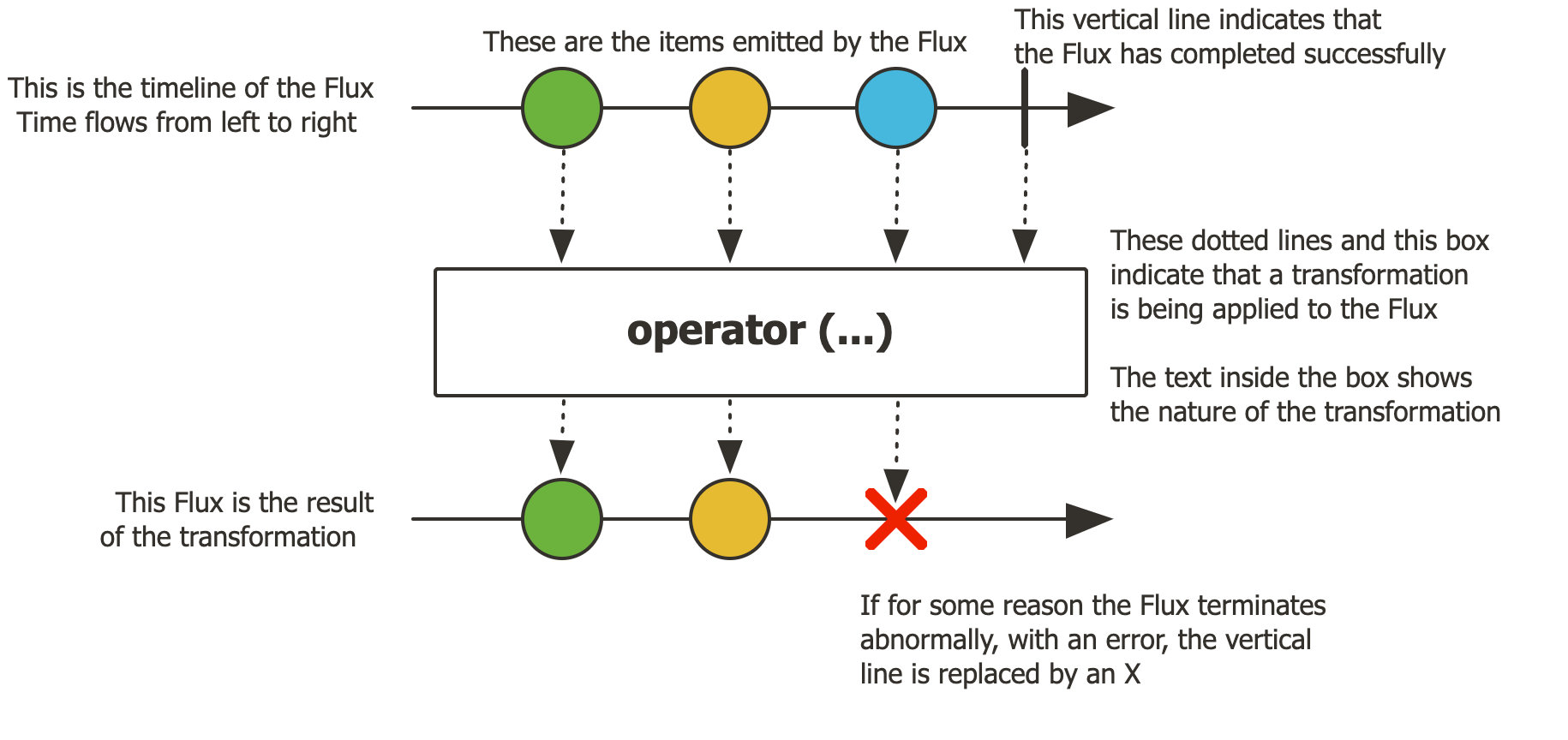
Flux是一个标准的Reactive Streams规范中的Publisher,它代表一个包含了[0…N]个元素的异步序列流。在Reactive Streams规范中,针对流中每个元素,订阅者将会监听这三个事件:onNext、onComplete、onError。 -
Mono是一个特殊的Flux,它代表一个仅包含1个元素的异步序列流。因为只有一个元素,所以订阅者只需要监听onComplete、onError。
Backpressure
- Subscription
- onRequest()、onCancel()、onDispose()
线程调度Schedulers
- immediate()/single()/newSingle()
- Elastic()/parallel()/newParallel()
错误处理
- onError/onErrorReturn/onErrorResume
- doOnError/doFinally
-
相关阅读:
第十五届蓝桥杯题解-数字接龙
【工具 & 技巧 & 笔试】PyCharm搜索快捷键大总结 | 【笔试题分享】2023美团算法策略方向题目 解析思路及实例代码(含时间复杂度分析)| 动态规划 求解:人在地图中行走 获得最大金币数量
城市排水管网监测方案(新型排水管网智能监测技术)
力扣刷题 day54:10-24
Livox SLAM(带LIO+闭环检测优化)
SSM整合之Mybatis笔记(MyBatis的分页插件(代码生成器))(P060—P062)
SparkSql批量插入或更新,保存数据到Mysql中
springboot 整合 dubbo 实现分组聚合
java基于微信小程序的驾校预约管理系统+ssm+uinapp+Mysql+计算机毕业设计
聊聊HttpClient的close
- 原文地址:https://blog.csdn.net/weixin_42313773/article/details/127595704
