-
4-11 Isomorphic (10分)
Two trees,
T1andT2, are isomorphic ifT1can be transformed intoT2by swapping left and right children of (some of the) nodes inT1. For instance, the two trees in Figure 1 are isomorphic because they are the same if the children of A, B, and G, but not the other nodes, are swapped. Give a polynomial time algorithm to decide if two trees are isomorphic.
Format of functions:
int Isomorphic( Tree T1, Tree T2 );where
Treeis defined as the following:- typedef struct TreeNode *Tree;
- struct TreeNode { ElementType Element; Tree Left; Tree Right; };
The function is supposed to return 1 if
T1andT2are indeed isomorphic, or 0 if not.Sample program of judge:
- #include
- #include
- typedef char ElementType;
- typedef struct TreeNode *Tree;
- struct TreeNode {
- ElementType Element;
- Tree Left;
- Tree Right;
- };
- Tree BuildTree(); /* details omitted */
- int Isomorphic( Tree T1, Tree T2 );
- int main()
- { Tree T1, T2;
- T1 = BuildTree();
- T2 = BuildTree();
- printf(“%d\n”, Isomorphic(T1, T2));
- return 0; }
- /* Your function will be put here */
Sample Output 1 (for the trees shown in Figure 1):
1Sample Output 2 (for the trees shown in Figure 2):
0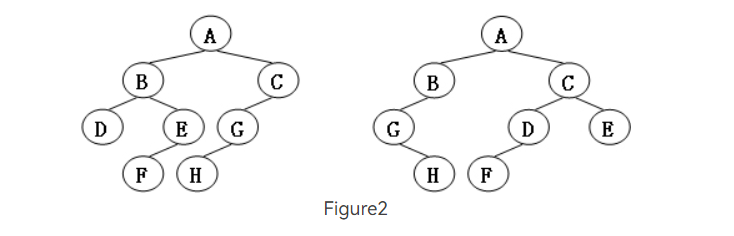
伪代码:
- int Isomorphic(Tree R1,Tree R2)
- {
- if(都是空树) return 1 ; //同构
- if(一个树为空树,一个不是空树) return 0 ; //不同构
- if(树根的值本身不相同) return 0 ;
- if(左子树都为空)/*不需要swap*/
- return Isomorphic(R1->Right,R2->Right);//只需要向下判断右子树
- /*能执行到这里说明左子树不同时为空*/
- if( 左子树同时不为空 && 左子树的值相同 )/*此时不需要swap*/
- return Isomorphic(R1->Right,R2->Right)&& Isomorphic(R1->Lift,R2->Lift);/*判断左左、右右子树是否同构*/
- /*执行到这里,有两种可能:左子树一个为空一个不为空 或 左子树同时不为空但是他们元素的值不同,这时就需要swap了*/
- return Isomorphic(R1->Lift,R2->Right)&&Isomorphic(R1->Right,R2->Lift);
代码:
- int Isomorphic( Tree T1, Tree T2 )
- {
- if(!T1&&!T2)return 1;//同时为空树
- if((T1&&!T2)||(!T1&&T2))return 0;//一个是空树,一个不是空树
- if(T1->Element!=T2->Element)return 0;//树根的值不一样
- if(!T1->Left&&!T2->Left)return Isomorphic(T1->Right,T2->Right);//左树同时为空,则判断右树
- else if(T1->Left&&!T2->Left)return Isomorphic(T2->Right,T1->Left);//左树一个为空一个不为空
- else if((!T1->Left&&T2->Left))return Isomorphic(T1->Right,T2->Left);
- //左树同时不为空
- if(T1->Left->Element==T1->Left->Element)
- return Isomorphic(T1->Left,T2->Left)&&Isomorphic(T1->Right,T2->Right);
- return Isomorphic(T1->Left,T2->Right)&&Isomorphic(T1->Right,T2->Left);
- }
评价:
问题看着挺难,但是把问题想清楚就容易很多了。
-
相关阅读:
Java文件操作
哈夫曼树构建、编码、译码C++实现
Git 常用设置|别名、邮箱、免密
Gradle笔记 七 publishing 项目发布
C# range
科技碰撞:元宇宙与虚幻引擎,被掩盖的底层逻辑何在?
基于SSM+Vue的校园共享单车管理系统
一行代码修复100vh bug | 京东云技术团队
什么是机器学习中的目标函数和优化算法,列举几种常见的优化算法
【概率论与数理统计(研究生课程)】知识点总结8(假设检验)
- 原文地址:https://blog.csdn.net/Zhonexixi/article/details/127595207
