写在前面:基于PaddleOCR代码库对其中所涉及到的算法进行代码简读,如果有必要可能会先研读一下原论文。
Abstract
- 论文链接:arxiv
- 应用场景:文本检测
- 代码配置文件:configs/det/det_r50_vd_east.yml
Train
PreProcess
class EASTProcessTrain(object):
    def __init__(self,
                 image_shape=[512, 512],
                 background_ratio=0.125,
                 min_crop_side_ratio=0.1,
                 min_text_size=10,
                 **kwargs):
        self.input_size = image_shape[1]
        self.random_scale = np.array([0.5, 1, 2.0, 3.0])
        self.background_ratio = background_ratio
        self.min_crop_side_ratio = min_crop_side_ratio
        self.min_text_size = min_text_size

   	...

    def __call__(self, data):
        im = data['image']
        text_polys = data['polys']
        text_tags = data['ignore_tags']
        if im is None:
            return None
        if text_polys.shape[0] == 0:
            return None

        #add rotate cases
        if np.random.rand() < 0.5:
            # 旋转图片和文本框(90,180,270)
            im, text_polys = self.rotate_im_poly(im, text_polys)
        h, w, _ = im.shape
        # 限制文本框坐标到有效范围内、检查文本框的有效性(基于文本框的面积)、以及点的顺序是否是顺时针
        text_polys, text_tags = self.check_and_validate_polys(text_polys,
                                                              text_tags, h, w)
        if text_polys.shape[0] == 0:
            return None

        # 随机缩放图片以及文本框
        rd_scale = np.random.choice(self.random_scale)
        im = cv2.resize(im, dsize=None, fx=rd_scale, fy=rd_scale)
        text_polys *= rd_scale

        if np.random.rand() < self.background_ratio:
            # 只切纯背景图,如果有文本框会返回None
            outs = self.crop_background_infor(im, text_polys, text_tags)
        else:
            """
            随机切图并以及crop图所包含的文本框,并基于缩小的文本框生成了几个label map:
                - score_map: shape=[h,w],得分图,有文本的地方是1,其余地方为0
                - geo_map: shape=[h,w,9]。前8个通道为缩小文本框内的像素到真实文本框的水平以及垂直距离,
                           最后一个通道用来做loss归一化,其值为每个框最短边长的倒数
                - training_mask: shape=[h,w],使无效文本框不参与训练,有效的地方为1,无效的地方为0
            """
            outs = self.crop_foreground_infor(im, text_polys, text_tags)

        if outs is None:
            return None
        im, score_map, geo_map, training_mask = outs
        # 产生最终降采样的score map,shape=[1,h//4,w//4]
        score_map = score_map[np.newaxis, ::4, ::4].astype(np.float32)
        # 产生最终降采样的gep map, shape=[9,h//4,w//4]
        geo_map = np.swapaxes(geo_map, 1, 2)
        geo_map = np.swapaxes(geo_map, 1, 0)
        geo_map = geo_map[:, ::4, ::4].astype(np.float32)
        # 产生最终降采样的training mask,shape=[1,h//4,w//4]
        training_mask = training_mask[np.newaxis, ::4, ::4]
        training_mask = training_mask.astype(np.float32)

        data['image'] = im[0]
        data['score_map'] = score_map
        data['geo_map'] = geo_map
        data['training_mask'] = training_mask
        return data
Architecture
Backbone
采用resnet50_vd,得到1/4、1/8、1/16以及1/32倍共计4张降采样特征图。
Neck
基于Unect decoder架构,完成自底向上的特征融合过程,从1/32特征图逐步融合到1/4的特征图,最终得到一张带有多尺度信息的1/4特征图。
def forward(self, x):
    # x是存储4张从backbone获取的特征图
    f = x[::-1]  # 此时特征图从小到大排列

    h = f[0]  # [b,512,h/32,w/32]
    g = self.g0_deconv(h)  # [b,128,h/16,w/16]
    h = paddle.concat([g, f[1]], axis=1)  # [b,128+256,h/16,w/16]
    h = self.h1_conv(h)  # [b,128,h/16,w/16]
    g = self.g1_deconv(h)  # [b,128,h/8,w/8]
    h = paddle.concat([g, f[2]], axis=1)  # [b,128+128,h/8,w/8]
    h = self.h2_conv(h)  # [b,128,h/8,w/8]
    g = self.g2_deconv(h)  # [b,128,h/4,w/4]
    h = paddle.concat([g, f[3]], axis=1)  # [b,128+64,h/4,w/4]
    h = self.h3_conv(h)  # [b,128,h/4,w/4]
    g = self.g3_conv(h)  # [b,128,h/4,w/4]

    return g
Head
输出分类头和回归头(quad),部分参数共享。
def forward(self, x, targets=None):
    # x是融合后的1/4特征图,det_conv1和det_conv2用于进一步加强特征抽取
    f_det = self.det_conv1(x)  # [b,128,h/4,w/4]
    f_det = self.det_conv2(f_det)  # [b,64,h/4,w/4]

    # # [b,1,h/4,w/4] 用于前、背景分类,注意kernel_size=1
    f_score = self.score_conv(f_det)
    f_score = F.sigmoid(f_score)  # 获取相应得分
    # # [b,8,h/4,w/4],8的意义:dx1,dy1,dx2,dy2,dx3,dy3,dx4,dy4
    f_geo = self.geo_conv(f_det)
    # 回归的range变为:[-800,800],那么最终获取的文本框的最大边长不会超过1600
    f_geo = (F.sigmoid(f_geo) - 0.5) * 2 * 800

    pred = {'f_score': f_score, 'f_geo': f_geo}
    return pred
Loss
分类采用dice_loss,回归采用smooth_l1_loss。
class EASTLoss(nn.Layer):
    def __init__(self,
                 eps=1e-6,
                 **kwargs):
        super(EASTLoss, self).__init__()
        self.dice_loss = DiceLoss(eps=eps)

    def forward(self, predicts, labels):
        """
        Params:
            predicts: {'f_score': 前景得分图,'f_geo': 回归图}
            labels: [imgs, l_score, l_geo, l_mask]
        """
        l_score, l_geo, l_mask = labels[1:]
        f_score = predicts['f_score']
        f_geo = predicts['f_geo']

        # 分类loss
        dice_loss = self.dice_loss(f_score, l_score, l_mask)

        channels = 8
        # channels+1的原因是最后一个图对应了短边的归一化系数(后面会讲),前8个代表相对偏移的label
        # [[b,1,h/4,w/4], ...]共9个
        l_geo_split = paddle.split(
            l_geo, num_or_sections=channels + 1, axis=1)
        # [[b,1,h/4,w/4], ...]共8个
        f_geo_split = paddle.split(f_geo, num_or_sections=channels, axis=1)
        smooth_l1 = 0
        for i in range(0, channels):
            geo_diff = l_geo_split[i] - f_geo_split[i]  # diff=label-pred
            abs_geo_diff = paddle.abs(geo_diff)  # abs_diff
            # 计算abs_diff中小于1的且有文本的部分
            smooth_l1_sign = paddle.less_than(abs_geo_diff, l_score)
            smooth_l1_sign = paddle.cast(smooth_l1_sign, dtype='float32')
            # smoothl1 loss,大于1和小于1的两个部分对应loss相加,只不过这里<1的部分没乘0.5,问题不大
            in_loss = abs_geo_diff * abs_geo_diff * smooth_l1_sign + \
                (abs_geo_diff - 0.5) * (1.0 - smooth_l1_sign)
            # 用短边*8做归一化
            out_loss = l_geo_split[-1] / channels * in_loss * l_score
            smooth_l1 += out_loss
        # paddle.mean(smooth_l1)就可以了,前面都乘过了l_score,这里再乘没卵用
        smooth_l1_loss = paddle.mean(smooth_l1 * l_score)

        # dice_loss权重为0.01,smooth_l1_loss权重为1
        dice_loss = dice_loss * 0.01
        total_loss = dice_loss + smooth_l1_loss
        losses = {"loss":total_loss, \
                  "dice_loss":dice_loss,\
                  "smooth_l1_loss":smooth_l1_loss}
        return losses
Dice Loss
公式:
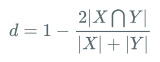
代码:
class DiceLoss(nn.Layer):
    def __init__(self, eps=1e-6):
        super(DiceLoss, self).__init__()
        self.eps = eps

    def forward(self, pred, gt, mask, weights=None):
        # mask代表了有效文本的mask,有文本的地方是1,否则为0
        assert pred.shape == gt.shape
        assert pred.shape == mask.shape
        if weights is not None:
            assert weights.shape == mask.shape
            mask = weights * mask

        intersection = paddle.sum(pred * gt * mask)  # 交集
        union = paddle.sum(pred * mask) + paddle.sum(gt * mask) + self.eps  # 并集
        loss = 1 - 2.0 * intersection / union

        assert loss <= 1
        return loss
SmoothL1 Loss
公式:

Infer
PostProcess
class EASTPostProcess(object):
    def __init__(self,
                 score_thresh=0.8,
                 cover_thresh=0.1,
                 nms_thresh=0.2,
                 **kwargs):

        self.score_thresh = score_thresh
        self.cover_thresh = cover_thresh
        self.nms_thresh = nms_thresh

    ...

    def __call__(self, outs_dict, shape_list):
        score_list = outs_dict['f_score']  # shape=[b,1,h//4,w//4]
        geo_list = outs_dict['f_geo']  # shape=[b,8,h//4,w//4]
        if isinstance(score_list, paddle.Tensor):
            score_list = score_list.numpy()
            geo_list = geo_list.numpy()
        img_num = len(shape_list)
        dt_boxes_list = []
        for ino in range(img_num):
            score = score_list[ino]
            geo = geo_list[ino]
            # 根据score、geo以及一些预设阈值和locality_nms操作拿到检测框
            boxes = self.detect(
                score_map=score,
                geo_map=geo,
                score_thresh=self.score_thresh,
                cover_thresh=self.cover_thresh,
                nms_thresh=self.nms_thresh)
            boxes_norm = []
            if len(boxes) > 0:
                h, w = score.shape[1:]
                src_h, src_w, ratio_h, ratio_w = shape_list[ino]
                boxes = boxes[:, :8].reshape((-1, 4, 2))
                # 文本框坐标根于缩放系数映射回输入图像上
                boxes[:, :, 0] /= ratio_w
                boxes[:, :, 1] /= ratio_h
                for i_box, box in enumerate(boxes):
                    # 根据宽度比高度大这一先验,将坐标调整为以“左上角”点为起始点的顺时针4点框
                    box = self.sort_poly(box.astype(np.int32))
                    # 边长小于5的再进行一次过滤,拿到最终的检测结果
                    if np.linalg.norm(box[0] - box[1]) < 5 \
                        or np.linalg.norm(box[3] - box[0]) < 5:
                        continue
                    boxes_norm.append(box)
            dt_boxes_list.append({'points': np.array(boxes_norm)})
        return dt_boxes_list

    def detect(self,
               score_map,
               geo_map,
               score_thresh=0.8,
               cover_thresh=0.1,
               nms_thresh=0.2):
        score_map = score_map[0] # shape=[h//4,w//4]
        geo_map = np.swapaxes(geo_map, 1, 0)
        geo_map = np.swapaxes(geo_map, 1, 2)  # shape=[h//4,w//4,8]
        # 获取score_map上得分大于阈值的点的坐标,shape=[n,2]
        xy_text = np.argwhere(score_map > score_thresh)
        if len(xy_text) == 0:
            return []
        # 按y轴从小到大的顺序对这些点进行排序
        xy_text = xy_text[np.argsort(xy_text[:, 0])]
        # 恢复成基于原图的文本框坐标
        text_box_restored = self.restore_rectangle_quad(
            xy_text[:, ::-1] * 4, geo_map[xy_text[:, 0], xy_text[:, 1], :])
        # shape=[n,9] 前8个通道代表x1,y1,x2,y2的坐标,最后一个通道代表每个框的得分
        boxes = np.zeros((text_box_restored.shape[0], 9), dtype=np.float32)
        boxes[:, :8] = text_box_restored.reshape((-1, 8))
        boxes[:, 8] = score_map[xy_text[:, 0], xy_text[:, 1]]

        try:
            import lanms
            boxes = lanms.merge_quadrangle_n9(boxes, nms_thresh)
        except:
            print(
                'you should install lanms by pip3 install lanms-nova to speed up nms_locality'
            )
            # locality nms,比传统nms要快,因为进入nms中的文本框的数量要比之前少很多。前面按y轴排序其实是在为该步骤做铺垫
            boxes = nms_locality(boxes.astype(np.float64), nms_thresh)
        if boxes.shape[0] == 0:
            return []
        # 最终还会根据框预测出的文本框内的像素在score_map上的得分再做一次过滤,感觉有一些不合理,因为score_map
        # 上预测的是shrink_mask,会导致框内有很多背景像素,拉低平均得分,可能会让一些原本有效的文本框变得无效
        # 当然这里的cover_thresh取的比较低,可能影响就比较小
        for i, box in enumerate(boxes):
            mask = np.zeros_like(score_map, dtype=np.uint8)
            cv2.fillPoly(mask, box[:8].reshape(
                (-1, 4, 2)).astype(np.int32) // 4, 1)
            boxes[i, 8] = cv2.mean(score_map, mask)[0]
        boxes = boxes[boxes[:, 8] > cover_thresh]
        return boxes


def nms_locality(polys, thres=0.3):
    def weighted_merge(g, p):
        """
        框间merge的逻辑:坐标变为coor1*score1+coor2*score2,得分变为score1+score2
        """
        g[:8] = (g[8] * g[:8] + p[8] * p[:8]) / (g[8] + p[8])
        g[8] = (g[8] + p[8])
        return g

    S = []
    p = None
    for g in polys:
        # 由于是按y轴排了序,所以循环遍历就可以了
        if p is not None and intersection(g, p) > thres:
            # 交集大于阈值那么就merge
            p = weighted_merge(g, p)
        else:
            # 不能再merge的时候该框临近区域已无其他框,那么其加入进S
            if p is not None:
                S.append(p)
            p = g
    if p is not None:
        S.append(p)

    if len(S) == 0:
        return np.array([])
    # 将S保留下的文本框进行标准nms,略
    return standard_nms(np.array(S), thres)