-
大厂SQL题5-同时在线人数、不同类别的第一
一、用户行为分析
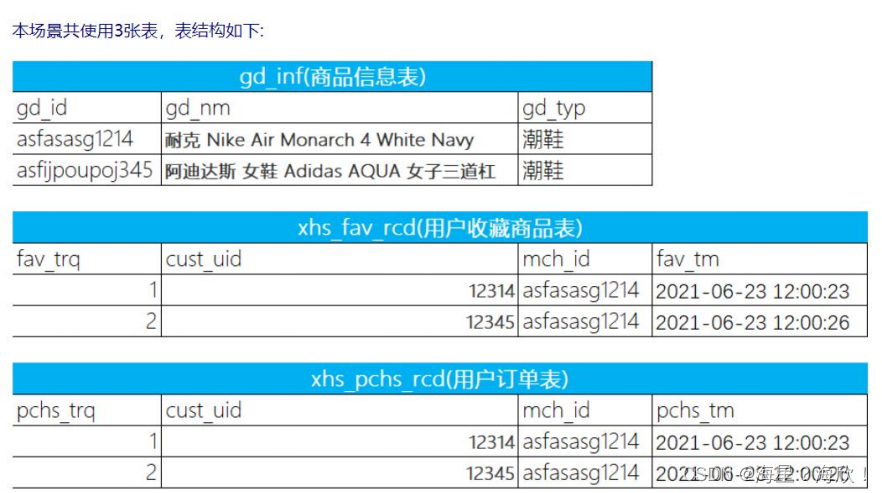
1、被收藏次数最多的商品为?-so easy
select mch_id,count(1) from xhs_fav_rcd group by mch_id- 1
- 2
- 3
想得到商品名称, 就再连接一下表一
2、购买人数最多的商品类目为? -平平无奇
select a.gd_typ,count(distinct c.cust_uid) as cnt from xhs_pchs_rcd c left join gd_inf a on a.gd_id=c.mch_id group by a.gd_typ order by 2 desc- 1
- 2
- 3
- 4
- 5
3、被收藏,却未被购买的商品?-轻松拿下
select distinct mch_id from xhs_fav_rcd b where mch_id not in (select distinct mch_id from xhs_pchs_rcd)- 1
- 2
- 3
- 4
4、哪个商品,既被同一个用户购买,又被同一个用户收藏,且购买人数最多?–不难
用内连接进行筛选
select b.mch_id,count(1) from xhs_fav_rcd b join xhs_pchs_rcd c on b.mch_id=c.mch_id and b.cust_uid=c.cust_uid group by b.mch_id order by 2 desc;- 1
- 2
- 3
- 4
- 5
二、直播观看人数

1、进入直播间的高峰期为?(以进入用户数衡量)-easy
高峰期问题:group by hour(时间)
select hour(enter_time),count(distinct usr_id) from ks_live_t1 t1 group by hour(enter_time) order by 2 desc- 1
- 2
- 3
- 4
2、晚上 11 点,哪个直播间的进入人数最多?-easy,读题:是11点进入,不是11点在直播间
select live_id,count(distinct usr_id) from ks_live_t1 t1 where hour(enter_time) = 23 group by live_id- 1
- 2
- 3
- 4
3、20:00-23:00,娱乐类、搞笑类,进入人数最多直播间分别是?
不同类别的第一输出
要是类别不多,求出次数cnt后,直接排个序看
要是一定要只输出第一:那就下面这样,嵌套用dense_rank()over(…)对次数分组排序rnk,再嵌套删选rnk=1的项select * from ( select *,dense_rank()over(partition by live_type order by cnt desc) rnk from ( select t2.live_type,t2.live_id,count(distinct usr_id) cnt from ks_live_t1 t1 left join ks_live_t2 t2 on t1.live_id = t2.live_id where hour(enter_time) between 20 and 22 and t2.live_type in ('购物','娱乐') group by t2.live_type,t2.live_id ) a ) where rnk=1- 1
- 2
- 3
- 4
- 5
- 6
- 7
- 8
- 9
- 10
- 11
- 12
- 13
- 14
4、娱乐类、搞笑类,人均在线时长(退出时间-进入时间)最长的直播间分别是?
和3一样套路,选择标准‘进入人数’–‘平均时长’
改一下cnt 即可,记得用avg()平均数select * from ( select *,dense_rank()over(partition by live_type order by cnt desc) rnk from ( select t2.live_type,t2.live_id,avg(timestampdiff(second,t1.enter_time,t1.leave_time) cnt from ks_live_t1 t1 left join ks_live_t2 t2 on t1.live_id = t2.live_id where hour(enter_time) between 20 and 22 and t2.live_type in ('购物','娱乐') group by t2.live_type,t2.live_id ) a ) where rnk=1- 1
- 2
- 3
- 4
- 5
- 6
- 7
- 8
- 9
- 10
- 11
- 12
- 13
- 14
4、各个直播间的同时在线人数的峰值?------重要!!!!!!!!
同时在线人数问题:
1,(id,进去时间,打标tag为1 )union all(id,出去时间,打标tag为-1 )
2,sum(tag) over (partition by live_id order by tms) as num
要是想得到直播间名字,就再连接一下表二
3,按id分组,输出最大人数max(tms)select live_id,max(num) as max_n from ( select live_id,tm,sum(tag)over(partition by live_id order by tms) as num from (select live_id,enter_time tm,1 as tag from ks_live_t1 union all select live_id,leave_time tm,-1 as tag from ks_live_t1 ) t ) a group by live_id- 1
- 2
- 3
- 4
- 5
- 6
- 7
- 8
- 9
- 10
语法:
sum(col1) over(partition by col2 order by col3 )
按col2 进行分组(partition ),每组以col3 进行排序(order),并进行连续加总(sum)
例子:
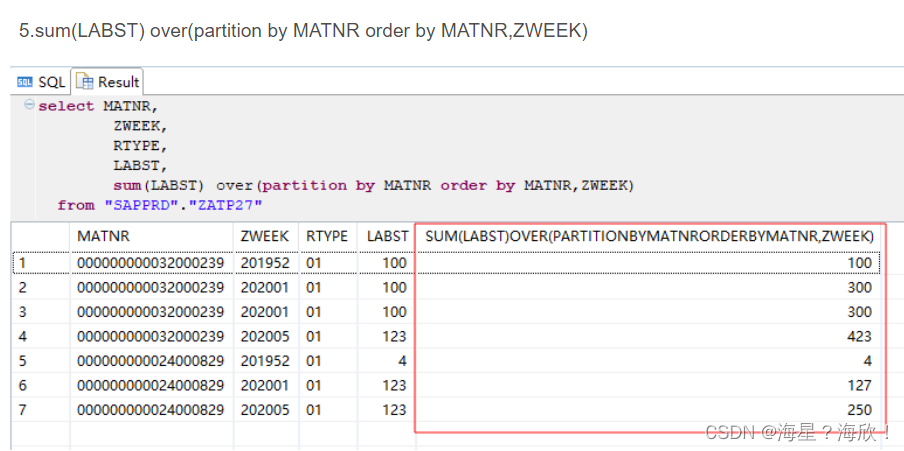
sum(tag)over(partition by live_id order by tms) as num
所以,按 live_id 分组后,按照时间tms累计求和 -
相关阅读:
java数据结构与算法——二叉树面试题
云原生爱好者周刊:Prometheus 推出 Agent 模式来适应新的使用场景
MVCC 底层实现原理
简单了解GaussDB
Golang 依赖注入设计哲学|12.6K 的依赖注入库 wire
个人网页设计成品DW静态网页 HTML网页设计结课作业 web课程设计网页规划与设计 Web大学生个人网页成品 web网页设计期末课程大作业
iOS-前半周【Zara】iOStableView And iOS无线轮播视图
理解 Redis 新特性:Stream
【QT】Qt 5 的程序:打印文档
K线形态识别_T字线和倒T字线
- 原文地址:https://blog.csdn.net/Sun123234/article/details/127398075