-
数据结构与算法(java版)第二季 - 7 图 BFS DFS 拓扑排序
图(Graph)
◼ 图由 顶点 (vertex)和 边 (edge)组成,通常表示为 G = (V, E) G表示一个图,V是顶点集,E是边集 顶点集V有穷且非空 任意两个顶点之间都可以用边来表示它们之间的关系,边集E可以是空的

有向图(Directed Graph)
有向图的边是有明确方向的

有向无环图(Directed Acyclic Graph,简称 DAG)
如果一个有向图,从任意顶点出发无法经过若干条边回到该顶点,那么它就是一个有向无环图
出度、入度
◼ 出度(Out-degree) 一个顶点的出度为 x,是指有 x 条边以该顶点为起点 顶点11的出度是3◼ 入度(In-degree) 一个顶点的入度为 x,是指有 x 条边以该顶点为终点顶点11的入度是2
无向图(Undirected Graph)


混合图(Mixed Graph)

简单图、多重图
◼ 平行边 在无向图中,关联一对顶点的无向边如果多于1条,则称这些边为平行边 在有向图中,关联一对顶点的有向边如果多于1条,并且它们的的方向相同,则称这些边为平行边◼ 多重图(Multigraph)有平行边或者有自环的图◼ 简单图(Simple Graph) 既没有平行边也不没有自环的图 课程中讨论的基本都是简单图

无向完全图
◼ 无向完全图的任意两个顶点之间都存在边 n 个顶点的无向完全图有 n(n − 1)/2 条边✓ n − 1 + n − 2 + n − 3 + ⋯ + 3 + 2 + 1
有向完全图(Directed Complete Graph)
◼ 有向完全图的任意两个顶点之间都存在方向相反的两条边 n 个顶点的有向完全图有 n(n − 1) 条边 ◼ 稠密图(Dense Graph):边数接近于或等于完全图◼ 稀疏图(Sparse Graph):边数远远少于完全图
如果顶点 x 和 y 之间存在可相互抵达的路径(直接或间接的路径),则称 x 和 y 是连通的

连通分量(Connected Component)
◼ 连通分量:无向图的极大连通子图 连通图只有一个连通分量,即其自身;非连通的无向图有多个连通分量◼ 下面的无向图有3个连通分量如果有向图 G 中任意2个顶点都是连通的,则称G为强连通图

强连通分量(Strongly Connected Component)
◼ 强连通分量:有向图的极大强连通子图 强连通图只有一个强连通分量,即其自身;非强连通的有向图有多个强连通分量
上面的图了解,过一遍就是可以的,去干饭干饭.
图的实现方案
◼ 图有2种常见的实现方案 邻接矩阵(Adjacency Matrix) 邻接表(Adjacency List)邻接矩阵(Adjacency Matrix)
◼ 邻接矩阵的存储方式 一维数组存放顶点信息 二维数组存放边信息◼ 邻接矩阵比较适合稠密图不然会比较浪费内存
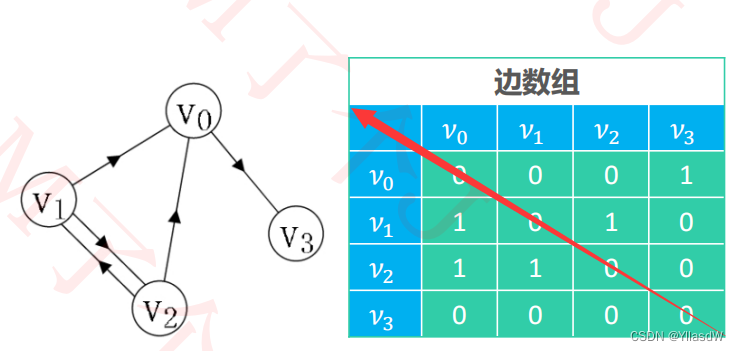 通过上面的图可以知道,它是关于对角线对称的.
邻接矩阵 – 有权图


邻接表(Adjacency List)

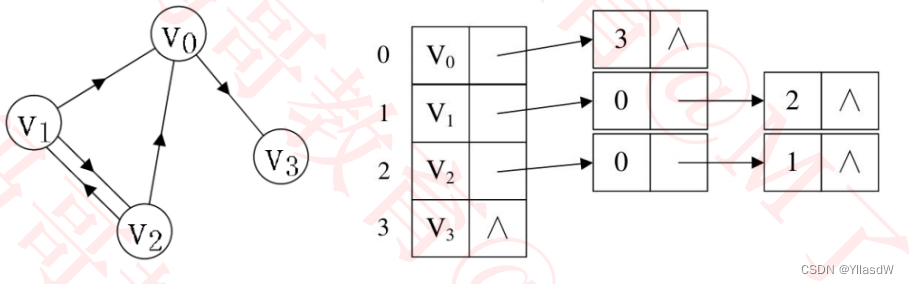

邻接表 – 有权图

上面的概念真是乱的很,下面开始写代码了.
抽象类:
- package com.mj.graph;
- import java.util.LinkedList;
- import java.util.List;
- import java.util.Map;
- import java.util.Set;
- public abstract class Graph
- protected WeightManager
weightManager; - public Graph() {}
- public Graph(WeightManager
weightManager) { - this.weightManager = weightManager;
- }
- public abstract int edgesSize();
- public abstract int verticesSize();
- public abstract void addVertex(V v);//顶点
- public abstract void addEdge(V from, V to);//边
- public abstract void addEdge(V from, V to, E weight);//权重
- public abstract void removeVertex(V v);
- public abstract void removeEdge(V from, V to);
- public abstract void bfs(V begin, VertexVisitor
visitor) ; - public abstract void dfs(V begin, VertexVisitor
visitor) ; - public abstract Set
- public abstract List
topologicalSort(); - // public abstract Map
- public abstract Map
- public abstract Map
- public interface WeightManager
{ - int compare(E w1, E w2);
- E add(E w1, E w2);
- E zero();
- }
- public interface VertexVisitor
{ - boolean visit(V v);
- }
- public static class PathInfo
- protected E weight;
- protected List
- public PathInfo() {}
- public PathInfo(E weight) {
- this.weight = weight;
- }
- public E getWeight() {
- return weight;
- }
- public void setWeight(E weight) {
- this.weight = weight;
- }
- public List
- return edgeInfos;
- }
- public void setEdgeInfos(List
- this.edgeInfos = edgeInfos;
- }
- @Override
- public String toString() {
- return "PathInfo [weight=" + weight + ", edgeInfos=" + edgeInfos + "]";
- }
- }
- //定义的边
- public static class EdgeInfo
- private V from;//起始
- private V to;//终止
- private E weight;//权值
- public EdgeInfo(V from, V to, E weight) {
- this.from = from;
- this.to = to;
- this.weight = weight;
- }
- public V getFrom() {
- return from;
- }
- public void setFrom(V from) {
- this.from = from;
- }
- public V getTo() {
- return to;
- }
- public void setTo(V to) {
- this.to = to;
- }
- public E getWeight() {
- return weight;
- }
- public void setWeight(E weight) {
- this.weight = weight;
- }
- @Override
- public String toString() {
- return "EdgeInfo [from=" + from + ", to=" + to + ", weight=" + weight + "]";
- }
- }
- }
实现类:
- package com.mj.graph;
- import java.util.ArrayList;
- import java.util.Comparator;
- import java.util.HashMap;
- import java.util.HashSet;
- import java.util.Iterator;
- import java.util.LinkedList;
- import java.util.List;
- import java.util.Map;
- import java.util.Map.Entry;
- import java.util.Objects;
- import java.util.Queue;
- import java.util.Set;
- import java.util.Stack;
- import com.mj.MinHeap;
- import com.mj.UnionFind;
- @SuppressWarnings("unchecked")
- public class ListGraph
- public ListGraph() {}
- public ListGraph(WeightManager
weightManager) { - super(weightManager);
- }
- private static class Vertex
- V value;
- Set
- Set
- Vertex(V value) {
- this.value = value;
- }
- @Override
- public boolean equals(Object obj) {
- return Objects.equals(value, ((Vertex
- }
- @Override
- public int hashCode() {
- return value == null ? 0 : value.hashCode();
- }
- @Override
- public String toString() {
- return value == null ? "null" : value.toString();
- }
- }
- private static class Edge
- Vertex
- Vertex
- E weight;
- Edge(Vertex
- this.from = from;
- this.to = to;
- }
- EdgeInfo
- return new EdgeInfo<>(from.value, to.value, weight);
- }
- @Override
- public boolean equals(Object obj) {
- Edge
- return Objects.equals(from, edge.from) && Objects.equals(to, edge.to);
- }
- @Override
- public int hashCode() {
- return from.hashCode() * 31 + to.hashCode();
- }
- @Override
- public String toString() {
- return "Edge [from=" + from + ", to=" + to + ", weight=" + weight + "]";
- }
- }
- private Map
- private Set
- private Comparator
- return weightManager.compare(e1.weight, e2.weight);
- };
- public void print() {
- System.out.println("[顶点]-------------------");
- vertices.forEach((V v, Vertex
- System.out.println(v);
- System.out.println("out-----------");
- System.out.println(vertex.outEdges);
- System.out.println("in-----------");
- System.out.println(vertex.inEdges);
- });
- System.out.println("[边]-------------------");
- edges.forEach((Edge
- System.out.println(edge);
- });
- }
- @Override
- public int edgesSize() {
- return edges.size();
- }
- @Override
- public int verticesSize() {
- return vertices.size();
- }
- @Override
- public void addVertex(V v) {
- if (vertices.containsKey(v)) return;
- vertices.put(v, new Vertex<>(v));
- }
- @Override
- public void addEdge(V from, V to) {
- addEdge(from, to, null);
- }
- @Override
- public void addEdge(V from, V to, E weight) {
- Vertex
- if (fromVertex == null) {
- fromVertex = new Vertex<>(from);
- vertices.put(from, fromVertex);
- }
- Vertex
- if (toVertex == null) {
- toVertex = new Vertex<>(to);
- vertices.put(to, toVertex);
- }
- Edge
- edge.weight = weight;
- if (fromVertex.outEdges.remove(edge)) {
- toVertex.inEdges.remove(edge);
- edges.remove(edge);
- }
- fromVertex.outEdges.add(edge);
- toVertex.inEdges.add(edge);
- edges.add(edge);
- }
- @Override
- public void removeEdge(V from, V to) {
- Vertex
- if (fromVertex == null) return;
- Vertex
- if (toVertex == null) return;
- Edge
- if (fromVertex.outEdges.remove(edge)) {
- toVertex.inEdges.remove(edge);
- edges.remove(edge);
- }
- }
- @Override
- public void removeVertex(V v) {
- Vertex
- if (vertex == null) return;
- for (Iterator
- Edge
- edge.to.inEdges.remove(edge);
- // 将当前遍历到的元素edge从集合vertex.outEdges中删掉
- iterator.remove();
- edges.remove(edge);
- }
- for (Iterator
- Edge
- edge.from.outEdges.remove(edge);
- // 将当前遍历到的元素edge从集合vertex.inEdges中删掉
- iterator.remove();
- edges.remove(edge);
- }
- }
- @Override
- public void bfs(V begin, VertexVisitor
visitor) { - if (visitor == null) return;
- Vertex
- if (beginVertex == null) return;
- Set
- Queue
- queue.offer(beginVertex);
- visitedVertices.add(beginVertex);
- while (!queue.isEmpty()) {
- Vertex
- if (visitor.visit(vertex.value)) return;
- for (Edge
- if (visitedVertices.contains(edge.to)) continue;
- queue.offer(edge.to);
- visitedVertices.add(edge.to);
- }
- }
- }
- @Override
- public void dfs(V begin, VertexVisitor
visitor) { - if (visitor == null) return;
- Vertex
- if (beginVertex == null) return;
- Set
- Stack
- // 先访问起点
- stack.push(beginVertex);
- visitedVertices.add(beginVertex);
- if (visitor.visit(begin)) return;
- while (!stack.isEmpty()) {
- Vertex
- for (Edge
- if (visitedVertices.contains(edge.to)) continue;
- stack.push(edge.from);
- stack.push(edge.to);
- visitedVertices.add(edge.to);
- if (visitor.visit(edge.to.value)) return;
- break;
- }
- }
- }
- @Override
- public List
topologicalSort() { - List
list = new ArrayList<>(); - Queue
- Map
- // 初始化(将度为0的节点都放入队列)
- vertices.forEach((V v, Vertex
- int in = vertex.inEdges.size();
- if (in == 0) {
- queue.offer(vertex);
- } else {
- ins.put(vertex, in);
- }
- });
- while (!queue.isEmpty()) {
- Vertex
- // 放入返回结果中
- list.add(vertex.value);
- for (Edge
- int toIn = ins.get(edge.to) - 1;
- if (toIn == 0) {
- queue.offer(edge.to);
- } else {
- ins.put(edge.to, toIn);
- }
- }
- }
- return list;
- }
- @Override
- public Set
- return Math.random() > 0.5 ? prim() : kruskal();
- }
- private Set
- Iterator
- if (!it.hasNext()) return null;
- Vertex
- Set
- Set
- addedVertices.add(vertex);
- MinHeap
- int verticesSize = vertices.size();
- while (!heap.isEmpty() && addedVertices.size() < verticesSize) {
- Edge
- if (addedVertices.contains(edge.to)) continue;
- edgeInfos.add(edge.info());
- addedVertices.add(edge.to);
- heap.addAll(edge.to.outEdges);
- }
- return edgeInfos;
- }
- private Set
- int edgeSize = vertices.size() - 1;
- if (edgeSize == -1) return null;
- Set
- MinHeap
- UnionFind
- vertices.forEach((V v, Vertex
- uf.makeSet(vertex);
- });
- while (!heap.isEmpty() && edgeInfos.size() < edgeSize) {
- Edge
- if (uf.isSame(edge.from, edge.to)) continue;
- edgeInfos.add(edge.info());
- uf.union(edge.from, edge.to);
- }
- return edgeInfos;
- }
- // public Map
- // Vertex
- // if (beginVertex == null) return null;
- //
- // Map
- // Map
- // // 初始化paths
- // for (Edge
- // paths.put(edge.to, edge.weight);
- // }
- //
- // while (!paths.isEmpty()) {
- // Entry
- // // minVertex离开桌面
- // Vertex
- // selectedPaths.put(minVertex.value, minEntry.getValue());
- // paths.remove(minVertex);
- // // 对它的minVertex的outEdges进行松弛操作
- // for (Edge
- // // 如果edge.to已经离开桌面,就没必要进行松弛操作
- // if (selectedPaths.containsKey(edge.to.value)) continue;
- // // 新的可选择的最短路径:beginVertex到edge.from的最短路径 + edge.weight
- // E newWeight = weightManager.add(minEntry.getValue(), edge.weight);
- // // 以前的最短路径:beginVertex到edge.to的最短路径
- // E oldWeight = paths.get(edge.to);
- // if (oldWeight == null || weightManager.compare(newWeight, oldWeight) < 0) {
- // paths.put(edge.to, newWeight);
- // }
- // }
- // }
- //
- // selectedPaths.remove(begin);
- // return selectedPaths;
- // }
- @Override
- public Map
- return dijkstra(begin);
- }
- @SuppressWarnings("unused")
- private Map
- Vertex
- if (beginVertex == null) return null;
- Map
- selectedPaths.put(begin, new PathInfo<>(weightManager.zero()));
- int count = vertices.size() - 1;
- for (int i = 0; i < count; i++) { // v - 1 次
- for (Edge
- PathInfo
- if (fromPath == null) continue;
- relax(edge, fromPath, selectedPaths);
- }
- }
- for (Edge
- PathInfo
- if (fromPath == null) continue;
- if (relax(edge, fromPath, selectedPaths)) {
- System.out.println("有负权环");
- return null;
- }
- }
- selectedPaths.remove(begin);
- return selectedPaths;
- }
- /**
- * 松弛
- * @param edge 需要进行松弛的边
- * @param fromPath edge的from的最短路径信息
- * @param paths 存放着其他点(对于dijkstra来说,就是还没有离开桌面的点)的最短路径信息
- */
- private boolean relax(Edge
- // 新的可选择的最短路径:beginVertex到edge.from的最短路径 + edge.weight
- E newWeight = weightManager.add(fromPath.weight, edge.weight);
- // 以前的最短路径:beginVertex到edge.to的最短路径
- PathInfo
- if (oldPath != null && weightManager.compare(newWeight, oldPath.weight) >= 0) return false;
- if (oldPath == null) {
- oldPath = new PathInfo<>();
- paths.put(edge.to.value, oldPath);
- } else {
- oldPath.edgeInfos.clear();
- }
- oldPath.weight = newWeight;
- oldPath.edgeInfos.addAll(fromPath.edgeInfos);
- oldPath.edgeInfos.add(edge.info());
- return true;
- }
- private Map
- Vertex
- if (beginVertex == null) return null;
- Map
- Map
- paths.put(beginVertex, new PathInfo<>(weightManager.zero()));
- // 初始化paths
- // for (Edge
- // PathInfo
- // path.weight = edge.weight;
- // path.edgeInfos.add(edge.info());
- // paths.put(edge.to, path);
- // }
- while (!paths.isEmpty()) {
- Entry
- // minVertex离开桌面
- Vertex
- PathInfo
- selectedPaths.put(minVertex.value, minPath);
- paths.remove(minVertex);
- // 对它的minVertex的outEdges进行松弛操作
- for (Edge
- // 如果edge.to已经离开桌面,就没必要进行松弛操作
- if (selectedPaths.containsKey(edge.to.value)) continue;
- relaxForDijkstra(edge, minPath, paths);
- }
- }
- selectedPaths.remove(begin);
- return selectedPaths;
- }
- /**
- * 松弛
- * @param edge 需要进行松弛的边
- * @param fromPath edge的from的最短路径信息
- * @param paths 存放着其他点(对于dijkstra来说,就是还没有离开桌面的点)的最短路径信息
- */
- private void relaxForDijkstra(Edge
- // 新的可选择的最短路径:beginVertex到edge.from的最短路径 + edge.weight
- E newWeight = weightManager.add(fromPath.weight, edge.weight);
- // 以前的最短路径:beginVertex到edge.to的最短路径
- PathInfo
- if (oldPath != null && weightManager.compare(newWeight, oldPath.weight) >= 0) return;
- if (oldPath == null) {
- oldPath = new PathInfo<>();
- paths.put(edge.to, oldPath);
- } else {
- oldPath.edgeInfos.clear();
- }
- oldPath.weight = newWeight;
- oldPath.edgeInfos.addAll(fromPath.edgeInfos);
- oldPath.edgeInfos.add(edge.info());
- }
- /**
- * 从paths中挑一个最小的路径出来
- * @param paths
- * @return
- */
- private Entry
- Iterator
- Entry
- while (it.hasNext()) {
- Entry
- if (weightManager.compare(entry.getValue().weight, minEntry.getValue().weight) < 0) {
- minEntry = entry;
- }
- }
- return minEntry;
- }
- @Override
- public Map
- Map
- // 初始化
- for (Edge
- Map
- if (map == null) {
- map = new HashMap<>();
- paths.put(edge.from.value, map);
- }
- PathInfo
- pathInfo.edgeInfos.add(edge.info());
- map.put(edge.to.value, pathInfo);
- }
- vertices.forEach((V v2, Vertex
- vertices.forEach((V v1, Vertex
- vertices.forEach((V v3, Vertex
- if (v1.equals(v2) || v2.equals(v3) || v1.equals(v3)) return;
- // v1 -> v2
- PathInfo
- if (path12 == null) return;
- // v2 -> v3
- PathInfo
- if (path23 == null) return;
- // v1 -> v3
- PathInfo
- E newWeight = weightManager.add(path12.weight, path23.weight);
- if (path13 != null && weightManager.compare(newWeight, path13.weight) >= 0) return;
- if (path13 == null) {
- path13 = new PathInfo
- paths.get(v1).put(v3, path13);
- } else {
- path13.edgeInfos.clear();
- }
- path13.weight = newWeight;
- path13.edgeInfos.addAll(path12.edgeInfos);
- path13.edgeInfos.addAll(path23.edgeInfos);
- });
- });
- });
- return paths;
- }
- private PathInfo
- Map
- return map == null ? null : map.get(to);
- }
- // @Override
- // public void bfs(V begin) {
- // Vertex
- // if (beginVertex == null) return;
- //
- // Set
- // Queue
- // queue.offer(beginVertex);
- // visitedVertices.add(beginVertex);
- //
- // while (!queue.isEmpty()) {
- // Vertex
- // System.out.println(vertex.value);
- //
- // for (Edge
- // if (visitedVertices.contains(edge.to)) continue;
- // queue.offer(edge.to);
- // visitedVertices.add(edge.to);
- // }
- // }
- // }
- //
- // @Override
- // public void dfs(V begin) {
- // Vertex
- // if (beginVertex == null) return;
- //
- // Set
- // Stack
- //
- // // 先访问起点
- // stack.push(beginVertex);
- // visitedVertices.add(beginVertex);
- // System.out.println(beginVertex.value);
- //
- // while (!stack.isEmpty()) {
- // Vertex
- //
- // for (Edge
- // if (visitedVertices.contains(edge.to)) continue;
- //
- // stack.push(edge.from);
- // stack.push(edge.to);
- // visitedVertices.add(edge.to);
- // System.out.println(edge.to.value);
- //
- // break;
- // }
- // }
- // }
- // public void dfs2(V begin) {
- // Vertex
- // if (beginVertex == null) return;
- // dfs2(beginVertex, new HashSet<>());
- // }
- //
- // private void dfs2(Vertex
- // System.out.println(vertex.value);
- // visitedVertices.add(vertex);
- //
- // for (Edge
- // if (visitedVertices.contains(edge.to)) continue;
- // dfs2(edge.to, visitedVertices);
- // }
- // }
- }
-
相关阅读:
poi+ResultSet+线程池导出数据库表结构
Apifox : 不仅是Api调试工具,更是开发团队的协作神器
sealos爆火后依然要开发sealer,背后原因有哪些?
Config
数说故事《汽车行业全场景数字化解决方案》之数字化营销平台搭建
【浅谈DBA 最重要的素质---读书笔记】
WPS中样式和编号的关系
1747. 应该被禁止的 Leetflex 账户
UE5 ChaosVehicles载具换皮 (连载二)
测试接触不到第一手需求,如何保证不漏测?
- 原文地址:https://blog.csdn.net/m0_47489229/article/details/127423605


